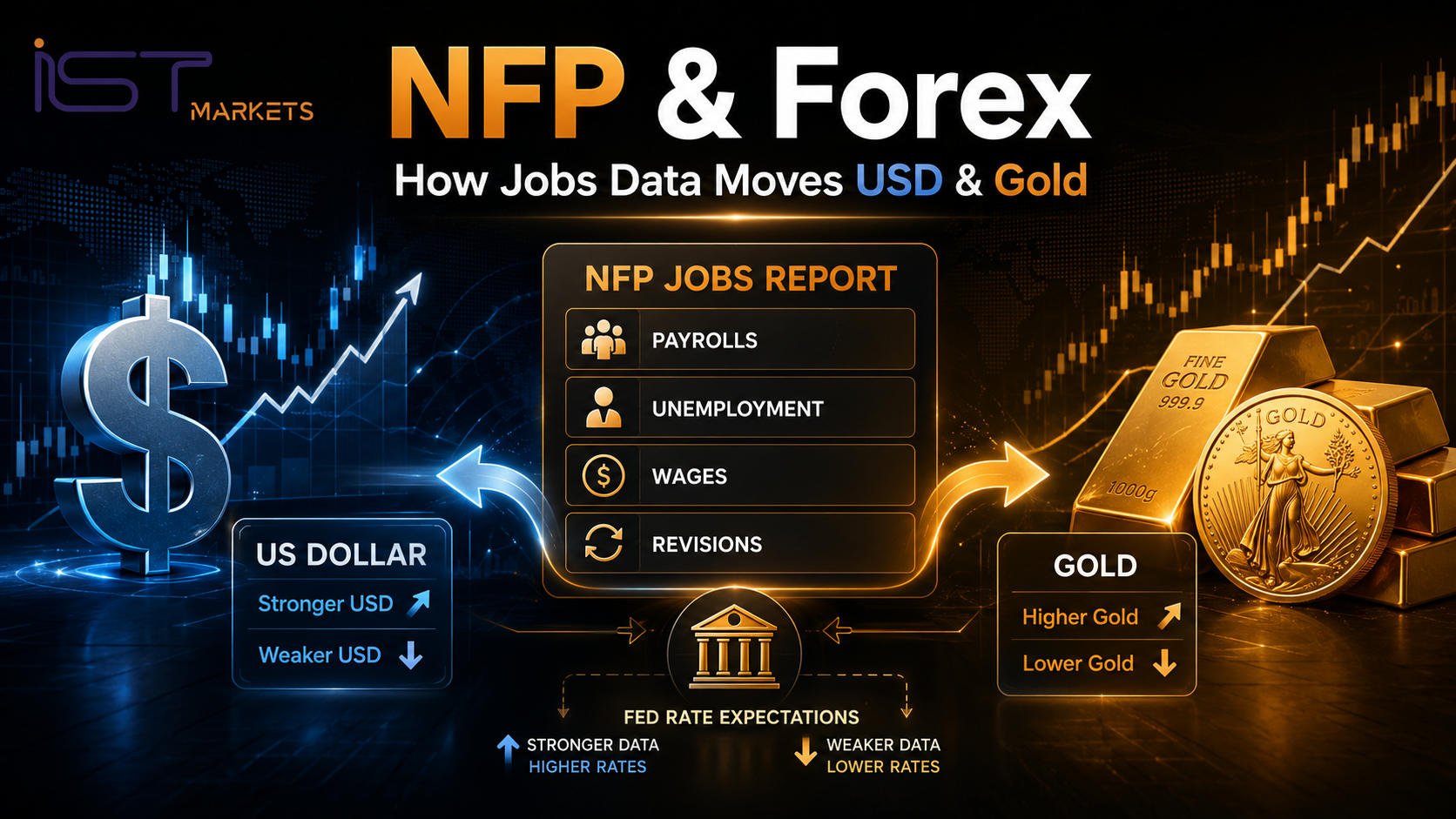
NFP and Forex: How Jobs Data Can Affect the US Dollar and Gold
A beginner-focused NFP forex guide to payrolls, unemployment, wage growth, revisions, Federal Reserve expectations, US dollar reactions and gold event risk.
Quick Answer: What should beginners know about NFP forex?
NFP forex analysis examines how the US jobs report changes expectations for economic growth, wage pressure, Federal Reserve policy, Treasury yields and the US dollar.
Nonfarm payrolls are only one part of the release. Traders should also check revisions, unemployment, labor-force participation, average hourly earnings and hours worked. Gold may respond through changes in yields, the dollar and risk demand. Because spreads, slippage and reversals can increase around the release, beginners should treat NFP as an event-risk decision—not an automatic signal to buy or sell.
What this guide covers
This article focuses specifically on the US Employment Situation, payroll revisions, the US dollar and gold. For a broader explanation of employment releases across different economies and currency markets, read the IST
jobs report forex trading guide.
Important risk reminder
NFP releases can create rapid movement, wider spreads, price gaps, slippage and sharp reversals in USD currency pairs and gold. A correct economic interpretation does not guarantee a profitable trade or an expected execution price. Leverage can magnify losses and reduce free margin quickly. This guide is educational only and does not provide personal financial advice, a buy or sell recommendation, or a signal to trade the release.
Source and editorial methodology
Definitions, survey coverage, release methodology and revision explanations in this guide are based on the U.S. Bureau of Labor Statistics. Federal Reserve sources support the discussion of maximum employment, price stability and policy expectations. Gold explanations use World Gold Council research. IST Markets’ Risk Disclosure, Order Execution Policy, Fees and Legal Documents support the account, cost and execution sections. Market pathways are presented as conditional frameworks—not fixed forecasts.
NFP forex at a glance
| Question | Decision-led answer |
|---|---|
| Main headline | Monthly change in US nonfarm payroll employment. |
| Other data to check | Revisions, unemployment, participation, wages, hours and industry breadth. |
| Main USD channel | Changes in Federal Reserve expectations and relative yields. |
| Main gold channel | Treasury yields, the US dollar, growth concern and defensive demand. |
| Main beginner risk | Reacting to payrolls before reading revisions, unemployment and wages. |
What is NFP in forex trading?
NFP stands for Nonfarm Payrolls. In market discussions, it normally refers to the monthly change in US nonfarm payroll employment published within the Bureau of Labor Statistics’ Employment Situation report.
The
Current Employment Statistics program
produces industry estimates of nonfarm employment, hours and earnings from payroll records supplied by businesses and government agencies.
Traders monitor the report because employment, unemployment and wages can influence expectations for economic growth, inflation pressure and Federal Reserve policy. But NFP forex analysis should never be reduced to the payroll headline alone.
Direct definition
NFP forex analysis means reading the US jobs report, comparing its components with market expectations and assessing whether the information changes the outlook for Federal Reserve policy, Treasury yields, the US dollar and gold.
When is NFP released?
The Employment Situation is commonly published early in the month at 8:30 a.m. Eastern Time, but the exact date can vary with the official publication calendar and holidays.
Do not assume every report will arrive on the first Friday. Confirm the date using the
official BLS Employment Situation schedule
and verify the event time with an
economic calendar before trading.
First preparation step
Use the economic calendar to check the event time, previous result, market forecast and affected instruments. The calendar prepares you for volatility; it does not predict the direction.
NFP is not one number: two surveys, one release
The Employment Situation combines data from two separate surveys. They use different samples, concepts and measurement methods, so payroll employment and the unemployment rate can sometimes send different messages.
| Survey | What it measures | Key outputs | Important distinction |
|---|---|---|---|
| Establishment Survey — CES | Payroll jobs, hours and earnings reported by businesses and government agencies. | Nonfarm payrolls, average hourly earnings, weekly hours and employment by industry. | Measures jobs. One person holding two payroll jobs may be counted twice. |
| Household Survey — CPS | Labor-force status among people in sampled households. | Unemployment, participation, employment-population ratio and demographic data. | Measures people and covers some work categories outside the CES scope. |
This explains why payroll employment can rise while unemployment also increases. The figures are not direct duplicates, and a disagreement does not automatically mean one result is wrong.
See the official
BLS Employment Situation Technical Note
and its
household and payroll employment comparison.
Why NFP numbers are estimates—not a live census
BLS currently describes the household survey as a sample of about 60,000 eligible households. The establishment survey covers about 119,000 businesses and government agencies representing approximately 622,000 worksites.
These are large statistical samples, but they are not an immediate count of every worker and employer in the United States. Sampling, incomplete initial responses, updated seasonal factors and later benchmark information are why revisions are a normal part of the process.
What does nonfarm payroll employment include?
The establishment survey includes paid civilian payroll jobs in private nonfarm businesses and federal, state and local government entities. The popular claim that NFP excludes all government workers is therefore inaccurate.
The CES nonfarm payroll series excludes categories including farm workers, private household workers, military personnel, unpaid family or volunteer workers, sole proprietors and unincorporated self-employed workers.
Coverage details are available in the official
CES Frequently Asked Questions.
NFP vs ADP, jobless claims and JOLTS
Several US labor-market releases appear on economic calendars, but they are not interchangeable with the official NFP figure.
| Release | What it broadly covers | Is it official NFP? |
|---|---|---|
| Employment Situation | Payrolls, unemployment, participation, wages, hours and related labor data. | Yes. It contains the official NFP estimate. |
| ADP Employment Report | A private-sector employment estimate using a separate data source and methodology. | No. |
| Weekly Jobless Claims | Initial and continuing unemployment-insurance claims. | No. |
| JOLTS | Job openings, hires, quits, layoffs and separations. | No. |
These releases can add context to labor demand and employment conditions, but none should be treated as a guaranteed preview of the official payroll result.
Markets trade the surprise, revisions and report quality
A large payroll gain is not automatically positive for the US dollar. Markets compare the result with the consensus forecast, the recent trend and what was already priced into yields and currencies.
The market reacts to what changed relative to expectations—not to whether the payroll number looks large in isolation.
The three stages of payroll revisions
| Stage | What happens? | Why traders should care |
|---|---|---|
| First preliminary estimate | The earliest estimate is published using responses available at release time. | It is timely but not final. |
| Two monthly revisions | Additional responses and updated seasonal calculations are incorporated. | Earlier labor strength or weakness may be reassessed. |
| Annual benchmark | CES estimates are aligned with broader employment records. | The longer-term payroll level and trend can change. |
Revision lens
A payroll beat can be weakened when downward revisions remove more jobs from previous months than the current month exceeded the forecast. Compare the current surprise with the net revision before judging the report.
BLS explains that first estimates are revised twice before being held constant until the annual benchmarking process. Review the official
nonfarm payroll revision data.
Advanced methodology note
CES also uses statistical adjustments to estimate employment associated with new businesses and business closures that cannot be captured immediately by the active survey sample. Beginners do not need to forecast this adjustment, but they should understand that the headline is an estimate produced through a defined statistical process.
Check special factors before treating the trend as permanent
Temporary influences can affect a particular report or industry. Before drawing a strong conclusion, check whether the official release mentions:
- Major strikes or workers returning from strikes.
- Severe weather and whether employees remained paid during the reference period.
- Government shutdown or temporary public-sector effects.
- Unusual seasonal patterns.
- Payroll growth concentrated in only a small number of industries.
These factors do not make the report irrelevant, but they can change how persistent or broad the labor signal appears.
NFP Report Quality Grid
| Payrolls | Unemployment | Wages | Revisions | Report-quality reading |
|---|---|---|---|---|
| Strong | Lower or stable | Firm | Positive | Labor strength appears broadly aligned. |
| Strong | Higher | Soft | Negative | Mixed; the headline may overstate strength. |
| Weak | Lower or stable | Firm | Positive | Headline weakness may be less severe. |
| Weak | Higher | Soft | Negative | Labor weakness appears broadly aligned. |
| In line | Stable | Clear surprise | Mixed | Wages may dominate the policy interpretation. |
| Strong but narrow | Stable | Mixed | Negative | Quality may be weaker than the headline suggests. |
Important limitation
The grid assesses whether the report is internally consistent. It does not guarantee a direction for the US dollar or gold. Prior pricing, yields, inflation conditions, liquidity and risk sentiment can still produce a different reaction.
The IST NFP Decision Stack
Stage A: Interpret the report
Stage B: Assess market and execution conditions
The Three-Gate NFP Test
The full Decision Stack is useful for detailed analysis. The Three-Gate Test gives beginners a simpler final filter.
Payrolls, revisions, unemployment, wages and special factors are clear.
Fed expectations, Treasury yields, the dollar and gold support the same interpretation.
Spread, slippage, position size, margin and correlated exposure are acceptable.
If any gate is unclear, observing, practising or skipping can be the more disciplined decision.
Why jobs data matters to the Federal Reserve
US monetary policy operates under goals that include maximum employment and stable prices. Maximum employment is not one fixed payroll or unemployment number, so policymakers assess a broad range of labor, inflation and economic indicators.
NFP matters to markets when payrolls, unemployment, wages and revisions change expectations about the future Federal Reserve policy path—not because one payroll result mechanically determines the next decision.
Review the official
Federal Reserve monetary-policy overview
and continue with the IST guide to
how Federal Reserve interest-rate decisions affect forex.
How NFP can affect the US dollar
NFP can affect the US dollar when labor-market information changes expectations for Federal Reserve policy and US interest-rate returns.
A broadly stronger report may support the dollar if markets price fewer rate cuts or a longer restrictive period. A broadly weaker report may pressure the dollar if markets price earlier or deeper easing.
The response remains relative. EUR/USD compares the US outlook with ECB expectations. GBP/USD also reflects Bank of England expectations, while USD/JPY can be influenced by Japanese policy, yield differences and global risk demand.
| Report pattern | Possible interpretation | Why USD may react differently |
|---|---|---|
| Strong payrolls, firm wages, stable unemployment | More restrictive expectations may emerge. | The result may already be priced in. |
| Strong payrolls, higher unemployment, softer wages | The signal is mixed. | The first dollar gain may fade. |
| Weak payrolls, higher unemployment, softer wages | Easier policy may be priced. | Severe risk aversion can still create defensive USD demand. |
| In-line payrolls with large revisions | Revisions may carry more information. | Direction depends on revisions and yields. |
How NFP can affect gold
NFP affects gold mainly through Federal Reserve expectations, Treasury yields, the US dollar and risk demand—not because job creation has one fixed effect on gold.
A strong report may pressure gold when it causes yields and the dollar to rise. A weak report may support gold when yields and the dollar fall. The response can change when growth fear, geopolitical risk, investment flows or positioning become more important.
| NFP pathway | Possible gold channel | What may alter it? |
|---|---|---|
| Strong jobs → higher yields → stronger USD | Possible pressure on gold. | Risk demand, positioning or separate buying flows. |
| Weak jobs → lower yields → weaker USD | Possible support for gold. | Weakness may already be priced in. |
| Weak jobs → severe growth concern | Defensive demand may support gold. | Safe-haven USD demand may compete. |
| Strong payrolls but weak wages and revisions | An initial decline may reverse. | Yields may reject the first interpretation. |
The World Gold Council’s
Gold Return Attribution Model
groups major gold drivers into economic expansion, risk and uncertainty, opportunity cost from currencies and interest rates, and momentum.
Continue with
gold trading for beginners
and
gold versus forex trading.
Why the first NFP market reaction can reverse
| Phase | What may drive it | Beginner caution |
|---|---|---|
| Headline | Payroll actual versus forecast, algorithms and stops. | The fastest move may not reflect the report. |
| Revisions | Changes to previous months. | A headline beat may lose credibility. |
| Cross-survey | Unemployment, participation and household employment. | The household message may differ. |
| Wages and policy | Earnings, hours and Fed expectations. | Wages may matter more than payrolls. |
| Cross-market confirmation | Yields, dollar breadth and gold. | Markets may reject the headline story. |
Direct answer
The first NFP move can reverse because automated trading may react to payrolls first, while traders later assess revisions, unemployment, participation, wages and the effect on Federal Reserve expectations.
Practical scenario: one headline, two positions, one risk
This example is hypothetical and does not recommend any position.
A beginner sees payrolls above forecast and immediately opens one position expecting US dollar strength and another expecting gold weakness.
The full report then shows negative payroll revisions, higher unemployment, lower participation and softer wage growth. Treasury yields rise briefly and reverse. The dollar gives back part of its gain, gold rebounds, and spreads were wider during the initial move.
| What went wrong? | Better process |
|---|---|
| Payrolls were read alone. | Read revisions, unemployment, participation and wages. |
| The first yield move was treated as confirmation. | Check whether yields sustain the interpretation. |
| USD and gold were treated as separate ideas. | Calculate risk across the shared thesis. |
| Spread and slippage were ignored. | Assess live execution conditions first. |
Central lesson
Long USD and short gold can be two instruments but one concentrated NFP thesis. Different instruments do not necessarily create different economic exposure.
Check live-trading readiness before event exposure
Understanding the report is only one part of readiness. Review account setup, spread, leverage, margin, order controls and position size using the IST
first live trade checklist.
Costs, execution risks and account limitations
| Risk | Examples | Preparation response |
|---|---|---|
| Interpretation | Ignoring revisions, wages or survey differences. | Use the Decision Stack. |
| Correlation | USD and gold depend on the same rate view. | Use one combined risk budget. |
| Execution | Wider spreads, gaps, slippage, rejection or requotes. | Accept that the requested price may not be available. |
| Leverage and margin | Fast movement can reduce free margin quickly. | Calculate exposure before the event. |
| Trading costs | Spread, commission, swap and conversion. | Check the relevant instrument and account terms. |
Review the IST Markets
Risk Disclosure,
Order Execution Policy,
Fees
and
Legal Documents.
Common NFP forex mistakes
| Mistake | Why it is weak | Better routine |
|---|---|---|
| Trading the headline without the forecast | The number may already be priced. | Compare actual, forecast and previous. |
| Ignoring revisions | Earlier weakness can offset the beat. | Check the net revision. |
| Treating payrolls and unemployment as one survey | They use different samples and concepts. | Read them separately, then compare. |
| Ignoring wages | Wages may influence policy expectations. | Check monthly and annual earnings. |
| Assuming strong NFP guarantees USD strength | Pricing, relative policy and risk demand matter. | Check yields and broad USD confirmation. |
| Assuming weak NFP guarantees a gold rise | Gold has multiple drivers. | Check yields, USD and risk demand. |
| Using an AI summary as a signal | It may omit revisions or survey conflict. | Verify the official release. |
NFP forex checklist
Before the release
After the release
When waiting or skipping may be more appropriate
- Payrolls and unemployment conflict.
- Wage growth contradicts the headline.
- Net revisions are larger than the current surprise.
- Special factors make the trend difficult to interpret.
- Treasury yields do not confirm the dollar move.
- Gold is responding to another dominant driver.
- Spread, slippage or liquidity exceed the risk plan.
- The account already contains correlated USD or gold exposure.
- Contract size or margin impact is unclear.
- CPI, an FOMC decision or another major event is close enough to change the interpretation.
Understanding the Employment Situation does not guarantee the expected market reaction. Orders may be filled at a different price during fast or gapping conditions, and related USD and gold positions can magnify the same loss. Review the Risk Disclosure and Order Execution Policy before trading leveraged products.
Practise the process before taking live NFP exposure
Start with the
economic calendar preparation guide
and practise reading payrolls, revisions, unemployment, wages and market confirmation without treating the release as a signal.
Supporting resources:
Demo vs Live Trading ·
Risk Disclosure ·
Order Execution Policy
Key NFP Terms
Frequently Asked Questions
What is NFP in forex trading?
NFP refers to US nonfarm payroll employment published within the monthly Employment Situation report. Forex traders monitor it because payrolls, unemployment and wages can affect Federal Reserve expectations, yields and the US dollar.
Does NFP include government workers?
The establishment survey includes civilian federal, state and local government payroll employment. It excludes categories including military personnel, farm workers, private household workers, sole proprietors and unpaid family workers.
Is NFP always released on the first Friday?
No. It is commonly released early in the month at 8:30 a.m. Eastern Time, but the exact date can vary. Check the official BLS schedule rather than relying on a fixed rule.
How does NFP affect the US dollar?
NFP can affect the dollar when payrolls, unemployment and wages change expectations for Federal Reserve policy and US yields. Prior pricing, the other currency and risk sentiment can change the response.
How does NFP affect gold?
NFP can affect gold through Federal Reserve expectations, Treasury yields, the US dollar and risk demand. Other drivers such as geopolitical risk, positioning and investment flows can alter the reaction.
Why can the first NFP reaction reverse?
The first move may focus on payrolls, while later movement reflects revisions, unemployment, participation, wages and the resulting change in Federal Reserve expectations.
Should beginners trade during NFP?
Beginners do not need to trade during NFP. Observing the release, reading the complete report, practising on demo or waiting for spreads and price behaviour to stabilise may be more appropriate than reacting immediately.
Official Sources and Further Reading
- BLS — Employment Situation
- BLS — Employment Situation Technical Note
- BLS — CES Frequently Asked Questions
- BLS — Household and Payroll Employment Comparison
- BLS — Nonfarm Payroll Revisions
- Federal Reserve — Monetary Policy
- World Gold Council — Gold Return Attribution Model
- IST Markets — Risk Disclosure
- IST Markets — Order Execution Policy
Review this guide when BLS definitions, survey methods, release schedules, revision practices, Federal Reserve frameworks, IST risk documents, costs or execution policies change materially. Current forecasts, rate expectations, yields and positioning should always be checked against the latest available information.