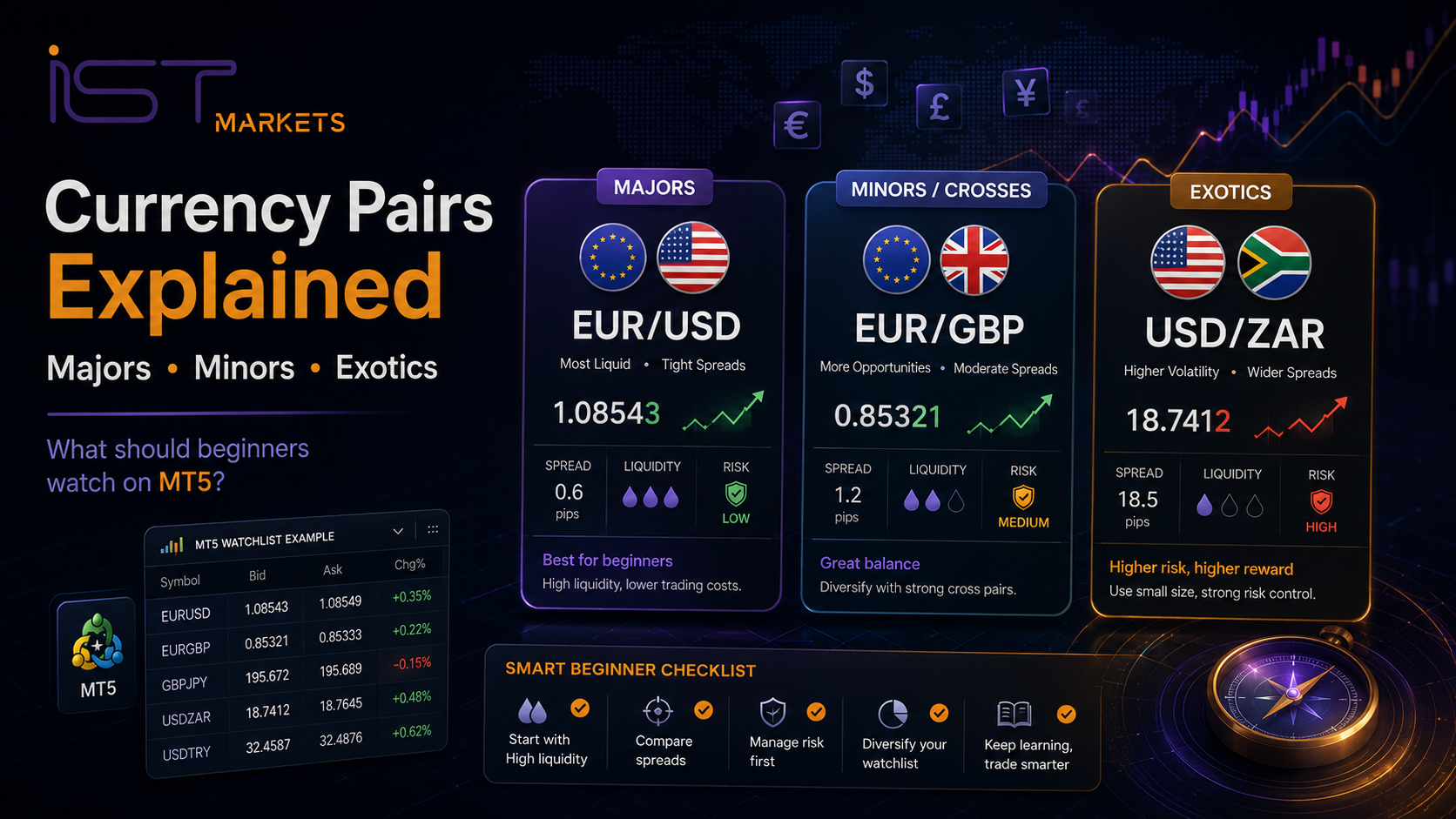
Currency Pairs Explained: Majors, Minors and Exotics for Beginner Traders
You do not need every pair on MT5. You need a watchlist you can explain.
Learn how to read base and quote currencies, compare major, minor and exotic pairs, inspect real trading conditions and reduce a crowded MT5 Market Watch into a smaller, more manageable study list.
Quick Answer: What should beginners know about currency pairs?
A currency pair expresses the value of one currency relative to another.
The first is the base currency and the second is the quote currency. Major, minor, cross and exotic are commonly used market labels, not guarantees about cost, liquidity, volatility or beginner suitability. Before adding a pair to an MT5 watchlist, identify both currencies, check the live spread, relevant economic events, contract specification, pip value, margin, overnight terms and repeated exposure to the same currency. A smaller watchlist that you understand is usually more useful than dozens of unexplained symbols.
What this guide helps you decide
By the end, you should be able to read a currency pair, understand the limits of pair categories, inspect an MT5 symbol, compare cost in account terms, identify repeated currency exposure and decide whether a pair belongs in your study watchlist, demo observations or exclusion list.
Important risk reminder
No pair category is automatically safe, predictable or suitable for beginners. Spreads, liquidity, volatility, slippage, leverage, margin, overnight costs, gaps and economic releases can materially affect a position. Stop orders support planning but may not execute at the requested price in fast or illiquid conditions. This article is educational and does not provide personal financial advice, a buy or sell recommendation or a promise of future performance.
Source and editorial methodology
Currency-code explanations are aligned with ISO 4217 and ECB exchange-rate methodology. Market-structure context uses final BIS analysis for April 2025. MT5 workflow guidance is based on MetaTrader’s official Market Watch documentation. Risk, cost and execution wording is supported by IST Markets’ Risk Disclosure, Order Execution Policy and Fees pages.
Reviewed by: IST Markets Research & Analysis Team · Last reviewed: July 2026 · Review triggers: material changes to BIS data, platform specifications, account costs or legal documents
A Currency Pair and a Trading Product Are Not the Same Thing
EUR/USD describes the exchange-rate relationship between the euro and the US dollar. If EUR/USD is 1.1000, one euro is priced at 1.10 US dollars.
The instrument available on a retail platform may be an off-exchange or derivative product with its own contract size, margin requirement, financing treatment, execution method and counterparty terms. Buying a platform instrument creates economic exposure to one currency relative to another; it does not necessarily mean receiving physical delivery of either currency.
| Layer | What it describes | What to check |
|---|---|---|
| Currency pair | The relative price of two currencies. | Base, quote and direction. |
| Platform symbol | The instrument name displayed by the provider. | Availability, naming and symbol properties. |
| Trading contract | The actual terms governing the position. | Contract size, volume limits, margin, swaps, hours and execution. |
Review the
IST Risk Disclosure
and
Legal Documents
for the terms and risks that apply to off-exchange instruments.
The Four-Part Anatomy of a Currency Pair
The first currency. EUR is the base in EUR/USD and represents one unit.
The second currency. USD shows how many dollars are required for one euro.
A rising EUR/USD price means EUR strengthened relative to USD; a falling price means it weakened relative to USD.
Pip value and profit or loss may need to be converted from the quote currency into the account currency.
Watchlist rule
If you cannot explain the base, quote, price direction and account-currency effect, the pair is not ready for your active watchlist.
What does buying or selling a pair mean?
Buying EUR/USD creates economic exposure broadly equivalent to being long EUR and short USD. Selling the pair creates the opposite exposure. The result depends on the relative movement between both currencies, not on either currency in isolation.
Readers who need the broader foundation can start with
how forex and currency pairs work.
This guide focuses on the next step: selecting and organising pairs.
Majors, Minors, Crosses and Exotics Explained
ISO 4217 standardises three-letter currency codes such as EUR, USD, GBP and JPY. It does not create official categories named major, minor or exotic. Those labels are widely used market conventions, and exact lists can differ between platforms and education providers.
Major pairs
Under the traditional retail-market convention, major pairs combine the US dollar with another widely traded currency. Common examples include EUR/USD, USD/JPY, GBP/USD, USD/CHF, AUD/USD, USD/CAD and NZD/USD.
They often receive broad economic coverage and may show competitive pricing in ordinary conditions. Treat them as widely followed learning references, then verify live costs, event risk, position size and execution before adding one to an active watchlist.
Minor and cross pairs
A cross pair does not include the US dollar. “Minor” is commonly used for crosses between other widely traded currencies, such as EUR/GBP, EUR/JPY, GBP/JPY or AUD/NZD.
Minor vs cross
Traditional minors are cross pairs, but not every non-USD cross must be classified as a minor by every provider. The symbol and its actual specification matter more than the label.
Exotic pairs
Exotic pairs commonly combine a widely traded currency with a currency that has lower global turnover or is associated with an emerging market. Educational examples include USD/ZAR, USD/TRY, USD/MXN and EUR/TRY.
These pairs may involve wider spreads, more concentrated liquidity, greater sensitivity to local policy, different overnight costs or less predictable execution during unstable periods. “Exotic” describes a market convention; it is not a judgement about the country or currency.
| Category | Common convention | Examples | Useful study value | Still verify |
|---|---|---|---|---|
| Major | USD with another widely traded currency. | EUR/USD, GBP/USD, USD/JPY. | Broad data coverage and commonly observed pricing. | Current spread, news, slippage, size and margin. |
| Minor / major cross | Two widely traded currencies without USD. | EUR/GBP, EUR/JPY, GBP/JPY. | Shows a direct relationship outside the dollar. | Pip conversion, two-region events and execution. |
| Exotic | A widely traded currency with a lower-turnover or emerging-market currency. | USD/ZAR, USD/TRY, USD/MXN. | Demonstrates how local policy, liquidity and cost can differ. | Availability, spread, financing, gaps and local events. |
Traditional majors and current turnover rankings are different
The traditional seven-major list remains useful for retail education, but it is not a permanent ranking of the seven most traded institutional pairs. Final BIS analysis reported average global OTC FX turnover of approximately $9.5 trillion per day in April 2025, covering spot and derivatives activity. It also reported that USD/CNY had become the third most traded pair globally, behind EUR/USD and USD/JPY.
This does not automatically make USD/CNY a simpler or lower-cost retail instrument. Institutional turnover, platform access, product structure and retail trading conditions are different questions.
Sources:
BIS final FX analysis
and
BIS analysis of emerging-market currency turnover.
Pair Category vs Actual Trading Conditions
A category helps organise symbols. It cannot tell you the exact cost, liquidity or monetary risk of a trade.
| Question | Can the category answer it? | What answers it? |
|---|---|---|
| Does the pair contain USD? | Usually. | The base and quote symbols. |
| What is the spread now? | No. | The live bid and ask prices. |
| Is liquidity favourable now? | No. | Current session, holiday, event and available prices. |
| How volatile is the pair? | No. | Current range, event risk and market conditions. |
| What is one pip worth? | No. | Pair, position size and account currency. |
| Does overnight financing apply? | No. | Symbol and account terms. |
| Is it suitable for a beginner? | No. | Understanding, cost, events, specifications, exposure and readiness. |
Pair category is a starting label.
Live conditions determine the practical decision.
What to Check When Currency-Pair Names Look Different on MT5
A provider may use additional characters in a symbol name to distinguish instruments, account configurations or pricing groups. You may therefore see names such as EURUSD, EURUSDm or another provider-specific version.
Do not assume that two similarly named symbols have identical terms. In MT5, use the official symbol properties instead of guessing from the suffix.
MT5 verification workflow
The Specification window can display provider-defined trading conditions. Check:
What one lot represents.
The smallest permitted trade size.
The allowed size increments.
How required margin is determined.
Potential overnight treatment.
When the instrument is available.
MetaTrader’s official documentation confirms that Market Watch provides access to symbol specifications and that the displayed parameters are set by the provider. Continue with the IST guide to
platform features beginners should check.
CNY and CNH are not interchangeable labels
CNY commonly refers to onshore renminbi activity, while CNH is used for offshore renminbi activity. The two markets can have different liquidity, access and pricing conditions. If a platform offers USDCNY, USDCNH or both, inspect the exact product rather than assuming they represent identical trading conditions.
Compare Currency-Pair Cost in Three Ways
Comparing raw spread numbers alone can mislead beginners. The practical cost must be translated into the trading account and the planned risk.
The distance between bid and ask measured using the pair’s pip convention.
The estimated monetary cost after applying position size and any required conversion.
The entry cost compared with the planned stop distance and total acceptable loss.
Simple cost-ratio example
If an estimated spread is 3 pips and the planned stop distance is 20 pips, the spread alone equals 15% of that distance before any commission, financing or slippage. This does not decide whether to trade; it shows why cost needs context.
Equal lot size does not mean equal monetary risk. A 0.10 lot position can produce different pip values and require different stop distances across currency pairs. Calculate the potential account loss rather than comparing volume alone.
Review
pips and spreads
and the
Fees and Trading Costs page
before treating the headline spread as the complete cost.
Every currency pair carries two economic calendars
You are not choosing one economy. You are choosing a relationship between two economies.
| Pair | Base-side events | Quote-side events | Shared or global drivers |
|---|---|---|---|
| EUR/USD | ECB decisions, euro-area inflation, growth and employment. | Federal Reserve decisions, US inflation, jobs and growth. | Yield expectations, risk sentiment and global dollar demand. |
| GBP/JPY | BoE policy, UK inflation, wages and growth. | BoJ policy, Japanese inflation and intervention expectations. | Global risk appetite and yield differences. |
| AUD/NZD | RBA decisions, Australian CPI, jobs and growth. | RBNZ decisions and New Zealand economic data. | China-sensitive sentiment and commodity conditions. |
Use the
economic calendar preparation guide
and confirm current
market hours and events
before deciding that a familiar pair will behave normally.
Familiarity is useful—but incomplete
Recognising a currency can help with economic context. Suitability still depends on liquidity, pricing, policy risk, contract terms and your ability to monitor both sides of the pair.
Count Currency Exposure, Not Only Pair Symbols
Several symbols do not automatically create diversification.
| Position | Exposure created | Possible concentration |
|---|---|---|
| Buy EUR/USD | Long EUR, short USD. | Exposure to USD weakness. |
| Buy GBP/USD | Long GBP, short USD. | Additional USD-weakness exposure. |
| Buy AUD/USD | Long AUD, short USD. | Further short-USD concentration. |
One US release can affect all three positions. The charts may look different while the account still carries one concentrated dollar view.
The same principle applies to repeated EUR exposure across EUR/USD, EUR/GBP and EUR/JPY. Before adding another pair, list every currency you are long and short and assess the combined account risk.
The IST Pair Fit Test: Green, Amber or Red
Evaluate each pair across seven lenses:
You understand the pair, found the specification, can identify its events and can translate risk into account currency.
The relationship is understood, but cost, pip value, swap, execution or event behaviour still requires observation.
The product is unclear, specifications cannot be verified, risk cannot be calculated or the pair repeats excessive exposure.
A Seven-Day Currency-Pair Observation Plan
Choose one pair and observe it before expanding the watchlist. The objective is to understand the product and workflow—not to prove profitability.
| Day | Task | Output |
|---|---|---|
| 1 | Identify base, quote, direction and account currency. | A one-paragraph pair explanation. |
| 2 | Record the spread during two different activity windows. | A simple cost comparison. |
| 3 | List the central banks and major events for both currencies. | A two-currency event map. |
| 4 | Open MT5 Specification and record contract terms. | Verified symbol details. |
| 5 | Estimate pip value and account impact using a demo volume. | Monetary-risk understanding. |
| 6 | Compare the pair with one alternative pair. | Cost, event and exposure differences. |
| 7 | Apply the Pair Fit Test. | Green, amber or red decision. |
Demo practice can support platform learning and order rehearsal, but it does not reproduce every live spread, slippage, liquidity or emotional condition. Review
demo versus live trading
before treating simulated results as future proof.
Practical Scenario: The Beginner Who Added Twelve Pairs to MT5
This scenario is educational and does not recommend any pair or position.
A beginner adds EUR/USD, GBP/USD, AUD/USD, EUR/GBP, GBP/JPY, USD/ZAR, EUR/TRY and several other symbols to Market Watch. The trader assumes that every additional symbol creates another opportunity and that a 0.10 lot position carries similar risk on every pair.
The trader has not checked the live spread, contract size, pip value, account conversion, margin, overnight terms, relevant sessions or repeated currency exposure.
Before a major US release, the trader buys EUR/USD, GBP/USD and AUD/USD. All three positions carry short-USD exposure. The same event moves all three, creating a larger combined account change than expected.
| Mistake | Better process |
|---|---|
| Adding pairs before understanding them. | Complete the seven-day observation plan first. |
| Comparing movement without total cost. | Compare pips, account-currency cost and planned risk. |
| Treating three symbols as diversification. | Map the long and short currencies across all positions. |
| Assuming equal lot size means equal risk. | Calculate risk using pip value and stop distance. |
| Using category labels as decisions. | Apply the Pair Fit Test and inspect Specification. |
Central lesson
Twelve symbols can create more calendars, costs and repeated exposure—not twelve independent opportunities.
Currency Pairs Explained Checklist
Keep the pair on amber or red when:
- You cannot explain what buying or selling it means.
- The exact symbol or product specification is unclear.
- The spread, pip value or account conversion cannot be estimated.
- The pair requires more events than you can monitor consistently.
- It duplicates existing exposure to the same currency or event.
- You selected it mainly because the candles look larger.
- Its active hours conflict with work, sleep or concentration.
Risk reminder before taking action
Orders may be affected by volatility, illiquidity, gaps, available prices, connectivity and slippage. Leverage and correlated positions can magnify one currency view across several trades. Review the
Risk Disclosure
and
Order Execution Policy
before considering live leveraged exposure.
Build one pair before building a watchlist
Choose one pair and complete the seven-day observation plan. Check its base and quote currencies, two economic calendars, live spread, account-currency pip value, MT5 Specification and related exposure. Add a second pair only when you can explain what new information or risk relationship it introduces.
Continue with:
Platform Features ·
Economic Calendar ·
Demo vs Live ·
First Live Trade Checklist.
Final takeaway
Major, minor and exotic labels help organise currency pairs, but they do not determine whether a symbol belongs in your watchlist. A stronger decision comes from understanding the pair relationship, verifying the actual product, measuring cost in account terms, following both currencies’ events and assessing the exposure added to the account.
Key Currency-Pair Terms
Frequently Asked Questions
What is a currency pair in forex?
A currency pair expresses the value of one currency relative to another. In EUR/USD, EUR is the base currency and USD is the quote currency. A price of 1.1000 means one euro is priced at 1.10 US dollars.
What is the difference between base and quote currency?
The base is the first currency and represents one unit. The quote is the second currency and shows how much is required to price one unit of the base.
Are major, minor and exotic official classifications?
No. They are commonly used market conventions. ISO 4217 standardises currency codes, but it does not create official major, minor or exotic pair categories.
Are minor pairs the same as cross pairs?
A cross is any pair that excludes USD. Minor commonly refers to a cross between other widely traded currencies. Every traditional minor is a cross, but providers may categorise some non-USD pairs differently.
How should a beginner choose a first currency pair?
Choose a learning reference that you can explain, research and cost correctly. Verify both economic calendars, the live spread, MT5 Specification, pip value, margin and how the position changes existing currency exposure.
Why does my MT5 currency-pair symbol have extra letters?
Providers may use additional characters to distinguish instruments or account configurations. Do not rely on the suffix alone. Open the exact symbol’s Specification and verify its contract size, volume limits, margin, swaps and trading sessions.
What is the difference between CNY and CNH pairs?
CNY commonly refers to onshore renminbi activity, while CNH refers to offshore renminbi activity. Access, liquidity and pricing can differ, so USDCNY and USDCNH should not be treated as identical products.
Official Sources and Further Reading
- ISO — ISO 4217 Currency Codes
- ECB — Exchange-Rate Methodology
- BIS — Global FX Markets in April 2025
- BIS — Renminbi and Emerging-Market Currency Turnover
- MetaTrader 5 — Market Watch and Symbol Specification
- CFTC — What to Know Before Trading OTC Forex
- IST Markets — Risk Disclosure
- IST Markets — Order Execution Policy
- IST Markets — Fees and Trading Costs
Review this article when BIS turnover data, ISO currency codes, MT5 symbol availability, contract specifications, account costs or IST legal documents change materially. Live spreads, swaps, margin and instrument availability should always be verified directly before use.