Tools Content Layer
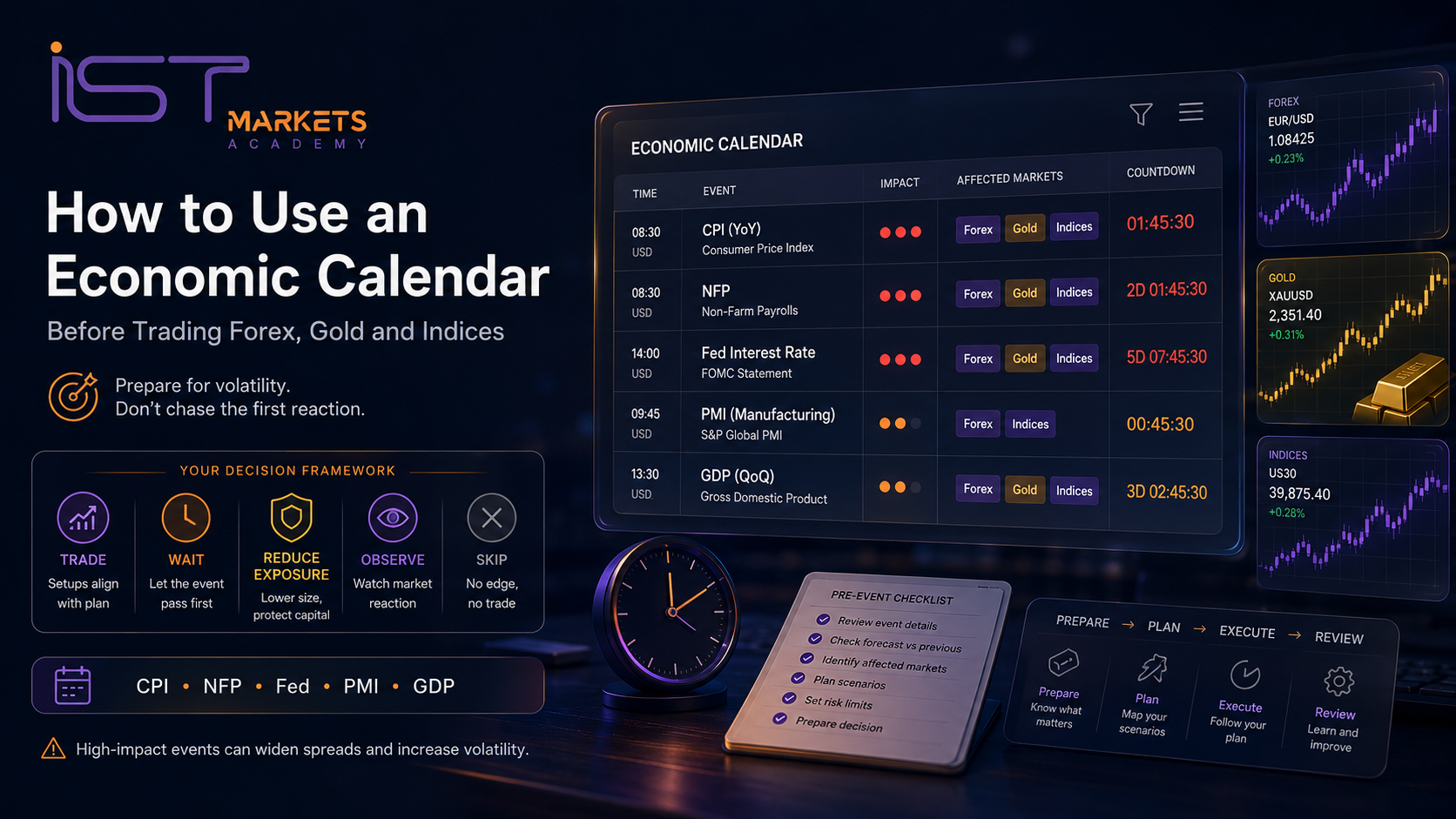
How to Use an Economic Calendar Before Trading Forex, Gold and Indices
A practical event-preparation playbook for traders following CPI, NFP, Fed decisions, PMI releases, gold, forex and index volatility.
Content Table
Use the calendar as preparation, not prediction.2Actual vs Forecast
Read the numbers, revisions and details.3High-Impact Events
CPI, NFP, Fed, PMI, GDP and more.4Event Decision Framework
Trade, wait, reduce exposure, observe or skip.5Reaction Matrix
Why price can reverse after the headline.6CPI Scenario
A realistic reversal example.7First 15 Minutes Rule
Avoid chasing unstable first reactions.8Checklist & Journal
Turn news into a repeatable process.9FAQ
Natural answers to trader questions.
Source Snapshot
- IST Markets Market Hours & Events: session timing, holidays and live economic calendar for planning around market events.
- IST Markets Risk Disclosure: leveraged products involve risk, including margin calls, stop-loss limitations, gaps, outages, OTC/counterparty risk and volatile execution conditions.
- U.S. Bureau of Labor Statistics: official source for CPI and employment data.
- Federal Reserve: official FOMC calendars, statements and minutes.
- ISM: official PMI reports for manufacturing and services.
- BEA: official GDP releases and revisions.
- World Gold Council: useful context for gold demand, rates, uncertainty and market drivers.
What an economic calendar shows
An economic calendar is a schedule of market-moving data releases, central-bank decisions, speeches, auctions and other events that traders may monitor before trading forex, gold and indices. A good economic calendar normally shows the event name, country or currency, release time, expected impact, previous reading, forecast and actual result after release.
For traders, the calendar answers four practical questions. First, what event could affect the market today? Second, when could volatility increase? Third, which currencies, commodities or indices may be sensitive to that event? Fourth, is the trade plan strong enough to handle wider spreads, fast price movement and a possible reversal?
The mistake beginners often make is treating the calendar like a direction machine. An event can explain why volatility may rise, but it does not tell a trader what to do. A strong report can still be followed by a reversal. A weak report can be ignored if the market already expected it. The calendar should therefore sit before the trade decision, not replace it.
Actual vs forecast vs previous: the key difference
The most important economic-calendar concept is not simply whether a number is “good” or “bad.” The important question is whether the result is different from what the market expected, and whether the details confirm that first impression.
For example, CPI measures inflation, but traders often look beyond the headline number. They may compare headline CPI with core CPI, monthly change, annual change and whether the result affects expectations for interest rates. Employment data can work the same way: headline payrolls may beat forecast, but unemployment, wage growth or prior-month revisions may weaken the interpretation.
| Calendar field | What it means | How traders should read it |
|---|---|---|
| Previous | The last reported figure, often from the prior month or quarter. | It gives a comparison point, but check whether it was revised. |
| Forecast | The market consensus estimate before the release. | The gap between actual and forecast often matters more than the absolute number. |
| Actual | The released figure once the data is published. | It can trigger volatility, but the first reaction is not always the final direction. |
| Revision | A change to a previously reported figure. | Revisions can change the market interpretation even when the headline actual looks simple. |
| Sub-components | Details inside the report, such as core CPI, wages or employment components. | Markets may focus on the detail that matters most for policy expectations. |
This is why a headline can look bullish or bearish at first and still fail to produce a clean trend. The calendar gives the release. The market decides how much of that release was expected, how important the details are, and whether price had already moved before the news.
High-impact events that can move forex, gold and indices
Not every calendar event deserves the same attention. A low-impact release may matter less than session liquidity, trend structure or the next major event. High-impact releases, however, can temporarily change spreads, volatility and execution conditions.
| Event | Why traders watch it | Markets often affected | What to verify before reacting |
|---|---|---|---|
| CPI / Inflation | Inflation can influence interest-rate expectations. | Forex, gold, indices, bonds | Headline vs core, forecast gap, yields, USD reaction. |
| NFP / Jobs data | Employment can shape growth and policy expectations. | USD pairs, gold, indices | Payrolls, unemployment, wages, revisions. |
| Fed decisions | Central-bank policy can change rate expectations and risk appetite. | USD, gold, US indices, global risk assets | Statement, press conference, projections, market pricing. |
| PMI reports | Business activity surveys can indicate expansion or slowdown. | Currency pairs, indices, commodities | Manufacturing vs services, new orders, prices, employment. |
| GDP | Broad growth measure, often revised. | Currency pairs, indices, rates | Advance/second/third estimate, components, revision risk. |
| Retail sales | Consumer demand signal. | Currency pairs, indices | Core/control group, revisions, inflation context. |
The same event can affect different markets in different ways. In forex, the first question is usually which currency is connected to the release and how the result may change rate expectations. In gold, traders often look at the U.S. dollar, yields, inflation expectations and risk sentiment. In indices, the focus may shift toward growth, future rates, corporate earnings expectations and investor risk appetite.
A useful habit is to mark high-impact events before the session starts. That prevents the common mistake of entering a trade two minutes before a major release without realising why spreads are widening or price is becoming unstable.
How to prepare before a market event
A strong economic-calendar workflow starts before the release, not during the spike. The goal is to decide what you will do under different conditions so that you are not reacting emotionally when the candle moves.
Start by checking the event time and timezone. Then identify the affected market. A U.S. CPI release may influence USD pairs, gold and U.S. index CFDs; an interest-rate decision may affect the domestic currency first, then risk sentiment more broadly. Next, check whether you already have open trades. A position that looks comfortable in normal conditions may become too large when volatility expands.
| Decision | When it may be sensible | Risk question to ask |
|---|---|---|
| Wait | The event is high impact and the market is already unstable. | Do I need to trade before the data, or can I wait for structure? |
| Observe | You are new to news volatility or unsure how the market behaves. | Can I learn more by watching than by forcing a trade? |
| Reduce exposure | You have open positions going into the event. | Is the position size appropriate for possible spread and slippage? |
| Trade later | The first reaction is violent but a clearer setup appears later. | Has volatility cooled enough to define entry, stop and invalidation? |
| Skip | The setup is unclear or risk is not measurable. | Is no trade the more disciplined decision? |
A practical pre-event routine can be simple: mark the event, check the expected impact, note forecast and previous readings, review open positions, check spreads, decide whether to reduce exposure, and define whether you will wait for the first reaction to settle. This process does not predict the outcome. It prevents the trader from making an unplanned decision during the most unstable part of the event.
Why markets sometimes move opposite to the headline
Markets do not move only because a headline is positive or negative. They move because traders compare the release with expectations, positioning, liquidity and what the data means for the next policy or growth narrative.
A CPI number above forecast might initially support the U.S. dollar and pressure gold if traders expect tighter policy. But the move can reverse if the market had already priced a hot number, if core inflation is less alarming than the headline, if yields fail to confirm the move, or if the first spike was mostly liquidity-driven.
| Calendar result | Possible market interpretation | What the trader should check |
|---|---|---|
| Actual far above forecast and price extends | Clear surprise, confirmed by market flow. | Is the move still tradable, or has risk become too wide? |
| Actual above forecast but price reverses | Priced in, mixed details, profit-taking or yield reaction mismatch. | Did sub-components confirm the headline? Did spreads normalise? |
| Actual close to forecast | Not enough surprise to change expectations. | Is volatility fading rather than expanding? |
| Headline strong, details weak | Market may focus on core details, wages, revisions or components. | Which detail matters most for rates or growth expectations? |
| First candle large, second candle rejects | Liquidity spike, stop run, overreaction or positioning unwind. | Is there a clean structure after 5-15 minutes? |
This is one of the most important lessons for beginners: the calendar explains the event, not the full trade. Price action, spreads, liquidity and positioning still matter. A trader who only reads “actual above forecast” can enter late, just as the market starts unwinding the first reaction.
Scenario: CPI beats forecast, then price reverses
Imagine CPI is scheduled during the U.S. session. Before the release, a trader marks USD pairs, gold and U.S. indices as sensitive markets. They check the forecast, previous reading and whether the calendar labels the event high impact. They also reduce unnecessary exposure because they know spreads may widen.
The CPI release comes above forecast. The first reaction is fast: the U.S. dollar strengthens, gold drops and indices wobble. A beginner who treats the headline as a signal may jump in immediately. But five minutes later, price reverses. Why? The market may have expected a strong number already. Core details may be less severe. Traders may take profit after the first move. Yields may not confirm the initial reaction. Liquidity may also be thin during the first spike.
The prepared trader does not need to predict all of that. They simply follow a process: wait for the first candle, check whether spreads have normalised, compare the move with chart levels, decide whether there is still a clean risk-reward structure, and skip the trade if the stop distance is too wide. In this scenario, preparation is the edge. Not prediction.
The first 15 minutes rule
For many beginners, the most dangerous part of high-impact news is the first few minutes after the release. That is when spreads can widen, liquidity can thin out, orders may be filled at different prices than expected, and the first candle can look more confident than the market really is.
A practical rule is to avoid treating the first 5-15 minutes as proof of direction. This does not mean traders must always wait exactly the same amount of time. It means the first reaction should be treated as information, not confirmation. Watch how price behaves after the spike. Does it hold above or below a key level? Does it reject the move? Does the spread return to normal? Is the stop-loss distance still reasonable?
This simple pause can protect beginners from chasing a move that has already expanded too far. It also gives time to compare the headline with details and with the chart instead of reacting only to speed.
Mini-playbooks for major calendar events
A calendar becomes more useful when each event has a small preparation playbook. The goal is not to memorise every macro relationship. The goal is to know what to verify before accepting the first market reaction.
| Event | Before the release | After the release |
|---|---|---|
| CPI | Check headline/core forecast, USD pairs, gold and indices exposure. | Compare actual vs forecast, check yields/USD/gold reaction, watch for reversal. |
| NFP | Review payroll forecast, unemployment, wages and prior revisions. | Do not rely on payrolls alone; check wages and unemployment context. |
| Fed decision | Mark statement time and press conference time separately. | Compare decision, statement tone, projections and market interpretation. |
| PMI | Check manufacturing/services, new orders, prices and employment components. | Ask whether the report changes growth or inflation expectations. |
| GDP | Check whether it is advance, second or third estimate. | Review components and revisions, not just the top-line growth number. |
Over time, traders can turn these playbooks into a personal event journal. That journal helps them understand whether they tend to enter too early, ignore spread changes, overreact to headlines or forget that revisions can change the story.
Mistakes to avoid during news volatility
News volatility attracts traders because movement can look like opportunity. But volatility without structure can also magnify mistakes. The most dangerous habit is trying to trade every calendar event simply because it is high impact.
| Mistake | Why it hurts traders | Better approach |
|---|---|---|
| Treating the calendar as a signal | A release does not automatically equal buy or sell. | Use it to prepare, then wait for chart and risk confirmation. |
| Ignoring timezone | You may enter right before a major event without knowing it. | Check platform/server time and local time. |
| Reading headline only | Details and revisions can change the meaning. | Check actual, forecast, previous, revisions and sub-components. |
| Chasing the first candle | The first reaction may reverse quickly. | Wait for spreads and structure to stabilise. |
| Forgetting open positions | Existing exposure may become too risky during news. | Review size, stop distance and margin before release. |
| Overtrading every event | Not all events are worth trading. | Focus on high-impact events connected to your market. |
The better approach is selective preparation. A trader following gold may care more about U.S. inflation, Fed policy and risk sentiment than a minor release from a country unrelated to their instrument. A trader watching EUR/USD should know which side of the pair the event affects. A trader watching indices should ask whether the event changes rate expectations, growth expectations or risk appetite.
Economic calendar trading checklist
A checklist makes the calendar practical. It turns a news event from a surprise into a planned risk decision.
| Step | Question to answer before trading |
|---|---|
| 1. Identify event | What is the release, currency and time? |
| 2. Check impact | Is it high impact for the market I trade? |
| 3. Read numbers | What are previous, forecast, actual and revisions? |
| 4. Check exposure | Do I already have open positions before the event? |
| 5. Review conditions | Are spreads, volatility and liquidity normal or unstable? |
| 6. Define risk | Where is invalidation and is the stop distance realistic? |
| 7. Decide action | Trade, wait, observe, reduce exposure or skip? |
| 8. Journal result | What happened in the first reaction and after 15 minutes? |
For traders who want to improve, an event journal is even more useful than a prediction journal. The goal is not to write “I thought CPI would be high.” The goal is to record how the market behaved and whether your process protected you from avoidable mistakes.
| Journal field | Example entry |
|---|---|
| Event | CPI release |
| Forecast | 3.2% year over year |
| Actual | 3.4% year over year |
| First reaction | USD up, gold down |
| 15-minute reaction | Gold recovered part of the drop |
| Spread condition | Wider than normal for several minutes |
| Decision | Waited, no immediate trade |
| Lesson | Headline was not enough; first move reversed near support. |
Risk reminder before the CTA
Economic-calendar tools can support preparation, but they cannot remove trading risk. High-impact events may create rapid price changes, spread widening, slippage, gaps and emotional decision-making. Leveraged trading can amplify losses, and margin calls can occur if exposure is too large for market conditions. Demo practice can help traders learn event workflows, but demo results do not prove future live performance.
Soft CTA: Use the Economic Calendar after launch
When the IST Markets Economic Calendar is available, use it as part of a preparation workflow: check the event, read the forecast and previous values, wait for the actual result, compare the market reaction with your chart and apply a risk plan before making any decision.
You can also review IST Markets market-event education, risk management resources and the Risk Disclosure before trading around high-impact news. The goal is not to trade every event. The goal is to make fewer rushed decisions when volatility increases.
FAQ
How do I read an economic calendar?
Start with the event time, currency, impact level, previous reading, forecast and actual result. Then check whether the event affects the market you trade and whether volatility conditions are suitable for your plan.
What does actual vs forecast mean?
Forecast is the market consensus before the release. Actual is the published result. Markets often react to the difference between actual and forecast, but details, revisions and positioning can also matter.
How should traders prepare before high-impact news?
Mark the event in advance, review open positions, check spreads and volatility, decide whether to wait or reduce exposure, and avoid entering only because the event looks exciting.
Why do markets sometimes move against the news headline?
The headline may already be priced in, sub-components may tell a different story, revisions may change the interpretation, or the first reaction may be driven by liquidity and positioning rather than lasting direction.
How does the economic calendar affect gold prices?
Gold can react to events that influence the U.S. dollar, yields, inflation expectations, central-bank policy and risk sentiment. CPI, Fed decisions, employment data and geopolitical uncertainty can all affect gold volatility.
Should beginners trade during NFP or CPI?
Beginners should be cautious. NFP and CPI can create fast movement, spread widening and reversals. Many beginners may learn more by observing first and practising on demo before trading live around major news.
Is an economic calendar a trading signal?
No. It is an information and preparation tool. It helps traders know when important events may occur, but it does not tell them to buy, sell or enter a trade.
References and Further Reading
- IST Markets Market Hours & Events
- IST Markets Risk Disclosure
- U.S. Bureau of Labor Statistics — CPI
- U.S. Bureau of Labor Statistics — Current Employment Statistics
- Federal Reserve — FOMC Calendars
- Institute for Supply Management — PMI Reports
- U.S. Bureau of Economic Analysis — GDP
- World Gold Council — Gold Outlook