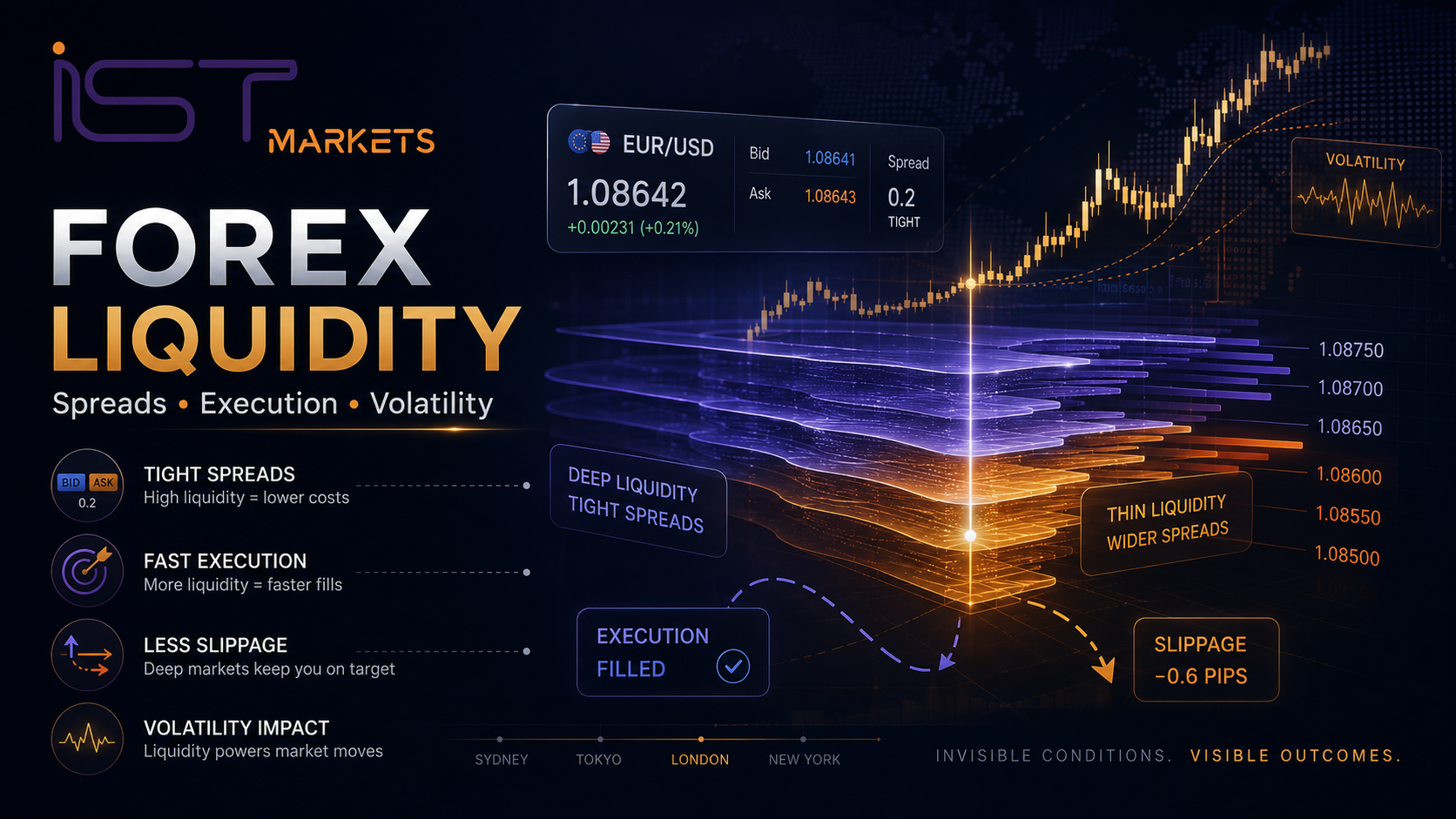
Liquidity in Forex: Why It Matters for Spreads, Execution and Volatility
You see the spread. You do not see all the liquidity behind it.
Learn how invisible market conditions become visible through changing spreads, unstable quotes, slippage, price gaps and volatility—and how to decide whether conditions are measurable, need rechecking or should be observed without live exposure.
Quick Answer: What Is Forex Liquidity?
Forex liquidity is the ability to buy or sell a currency product promptly, in meaningful size and with limited impact on price.
Liquid conditions may support more competitive spreads and steadier execution, but liquidity is not the same as trading volume, volatility or guaranteed fills. It can change by currency pair, product, session, economic event, holiday, order size and platform conditions. Before taking action, compare the current spread with an observed baseline, check the economic calendar, assess quote stability, verify the order type and position size, and remember that even a widely traded major pair can experience slippage during rapid repricing.
What this guide helps you decide
This guide connects market liquidity to the outcomes traders can actually observe: spread changes, quote speed, slippage, gaps and execution prices. It also explains what a retail platform cannot show completely, how liquidity differs from volume and volatility, and how to classify current conditions as measurable, uncertain or unsuitable for live exposure.
Important risk reminder
High liquidity does not make leveraged forex or CFD trading safe. Spreads, available prices, volatility, market gaps, slippage, leverage, margin and correlated positions can materially affect results. Stop orders support risk planning but do not guarantee the final execution price. This guide is educational and does not provide personal financial advice, a buy or sell recommendation, or a promise of future performance.
Editorial and source review
This article uses IMF and BIS research on liquidity measurement, market depth, price impact and FX market structure. The current market context uses final BIS analysis for April 2025. Event references use official Federal Reserve, ECB, Bank of England and US Bureau of Labor Statistics calendars. Platform explanations use official MetaTrader 5 documentation, while execution and risk wording is aligned with current IST Markets legal and educational pages.
Written by: Omar Mahmoud · Editorial review: IST Markets Research & Analysis Team · Last reviewed: July 2026
What Forex Liquidity Means in Real Trading Terms
Forex liquidity describes how easily a currency product can absorb buying and selling without requiring an unusually large or disorderly change in price.
“Many buyers and sellers” is a useful beginner definition, but it is incomplete. A market can have considerable activity and still provide unstable execution at a particular moment. A stronger liquidity assessment considers the transaction cost, the amount available near the quoted price, the speed of execution, the price impact of an order and how quickly conditions recover after pressure.
The definition to remember
Liquidity does not predict whether a currency pair will rise or fall. It helps describe how reliably the market may absorb an order under the current conditions.
The Five Dimensions of Forex Liquidity
| Dimension | Plain-English meaning | What a trader may observe |
|---|---|---|
| Tightness | How close the best available buying and selling prices are. | The bid–ask spread. |
| Depth | How much may be available close to the current price. | Whether a larger order receives the same or a different average fill. |
| Immediacy | How promptly a transaction can be completed. | A rapid fill, delay, updated price or rejection. |
| Price impact | How much trading pressure changes the available price. | A worse average fill as size or market pressure increases. |
| Resiliency | How quickly spreads and available prices return toward more normal conditions after a shock. | Whether disruption fades quickly or remains persistent. |
No single measurement captures every dimension. A spread may help assess tightness, while turnover, quote activity and price impact can reveal other parts of the liquidity picture.
Liquidity vs Trading Volume vs Volatility
| Concept | What it describes | What it does not prove |
|---|---|---|
| Liquidity | Cost, depth, execution capacity, price impact and recovery. | The future direction of the market. |
| Volume or turnover | How much trading activity took place. | That every visible quote has strong depth. |
| Volatility | How quickly and how far prices move. | Whether liquidity is strong or weak by itself. |
A liquid market can still be highly volatile. New information may attract substantial activity while prices adjust rapidly. A thin market can also appear quiet for a period, then jump sharply when a relatively small amount of trading reaches limited available depth.
The April 2025 market lesson
Final BIS analysis estimated average daily OTC FX turnover at approximately $9.5 trillion in April 2025. The period included elevated volatility and substantial activity, while spread-based liquidity measures remained relatively resilient across several FX segments. Volatility, turnover and liquidity can therefore rise or change together without becoming the same condition.
Quoted Liquidity vs Executable Liquidity
One of the most useful distinctions for a beginner is the difference between what appears available and what remains available when the order reaches execution.
Quoted Liquidity
The price—and any displayed volume—that appears available on the platform at a particular moment.
Executable Liquidity
The price and size that remain available when the order reaches the execution process.
Quoted liquidity is what appears available.
Executable liquidity is what remains available when the order arrives.
A displayed bid and ask do not reveal how long the prices will remain available, how much can be executed at each level or whether rapid market movement will replace those prices before the order is completed.
What a retail trader can—and cannot—see
| What you may observe | What you cannot see completely |
|---|---|
| Current bid, ask and displayed spread. | Every price available across all global FX venues. |
| How quickly the platform quotes change. | The complete risk capacity of banks, dealers and liquidity providers. |
| The final price received for your order. | All client flows being matched or internalised elsewhere. |
| Product-specific Depth of Market where available. | One complete global OTC forex order book. |
The global FX market is decentralised and fragmented across dealers, electronic venues and bilateral relationships. Some dealers also match client buying and selling within their own flow—a process commonly described as internalisation—instead of sending every trade to an external venue.
Practical interpretation
Your platform shows an execution window for the offered product—not the complete global forex market.
MetaTrader’s documentation explains that Depth of Market for exchange instruments can reflect an exchange order book, while OTC Depth of Market may be formed from prices provided by the broker. Review the exact product and execution terms rather than treating every DOM screen as universal market depth.
How Invisible Liquidity Conditions Create Visible Outcomes
| What you see | What it may indicate | What it does not prove | What to check next |
|---|---|---|---|
| Tight spread | Competitive pricing at the displayed quote. | Strong depth for every order size. | Quote stability, event timing and position size. |
| Widening spread | Greater uncertainty, fewer competing prices or lower risk appetite. | A known future direction. | Economic events, session changes, holidays and instrument hours. |
| Rapid quote changes | Fast repricing or reduced price certainty. | Automatic manipulation or misconduct. | News timing, connection quality and execution records. |
| Slippage | The requested or triggered price was unavailable at execution. | That liquidity was the only possible cause. | Order type, size, market movement, latency and execution policy. |
| Price gap | Few or no tradable prices between two levels. | That the next move is predictable. | Closures, news, holidays and stress conditions. |
A tight spread is useful—but incomplete
The bid–ask spread is one of the clearest liquidity signals visible to a retail trader. It describes the difference between the best displayed buying and selling prices. It does not show all quantity available behind those prices or guarantee that the prices will remain tradable.
Order size also matters. Liquidity may be sufficient for a smaller order but insufficient for a larger order at exactly the same price. If the available size at the best quote is consumed, the average execution can move through additional price levels.
Review
how pips and spreads translate trading cost
and
how position size changes account exposure.
Market risk, liquidity risk and execution risk are different
| Risk type | Core question | Example |
|---|---|---|
| Market risk | Did the market move against the position? | EUR/USD moves sharply after inflation data. |
| Liquidity risk | Were sufficient prices and depth available near the expected level? | Spread widens and nearby depth weakens. |
| Execution risk | Was the order completed at the expected price and in the expected way? | Slippage, a gap, a rejected order or delayed execution. |
A market view can be directionally correct and still produce a poor result if liquidity and execution risk were underestimated.
Why Liquidity Changes by Pair, Session and Event
Liquidity does not belong to “forex” as one permanent condition. It belongs to a particular product, currency pair, time, event and requested order size.
Currency pair and local market hours
Widely traded pairs normally attract broader participation than lower-turnover pairs, but conditions can still deteriorate around major news or market transitions. An emerging-market currency pair may also become thinner when its local financial centre is closed.
Session overlaps
The London–New York overlap may bring simultaneous European and North American participation. This can support competitive pricing in widely followed pairs, but the same window can contain US and Canadian data releases, interest-rate repricing and large institutional flows.
Participation is not permission
Treat an active overlap as a participation window. Then check whether a scheduled event is creating faster repricing or weaker price certainty.
Rollover, holidays and week-end transitions
Conditions may become less measurable around daily rollover, regional banking holidays, platform maintenance and the approach to the week-end close. Participation can decline, spreads can change and gaps between available prices may become more likely.
Check the current
market hours and events
rather than assuming that every instrument follows the same uninterrupted schedule.
Liquidity before, during and after economic news
Before the Release
Spreads may begin to change, displayed prices may remain available for less time and liquidity providers may reduce the size they are willing to quote.
At the Release
Quotes may update rapidly, the previous price can disappear, volatility and activity may rise, and orders may be filled at a different available price.
After the Release
The market may remain unstable while participants interpret details, revisions, policy implications and conflicting data.
News can increase trading activity while reducing price certainty.
The event is not necessarily finished because the headline number has been released. Check whether the spread has returned toward its baseline, whether quote updates have stabilised and whether the market is still repricing secondary details.
Use the
economic calendar preparation guide
as a volatility and timing tool—not as a prediction or trading signal.
Liquidity problem or technical problem?
| Possible factor | Clue | What to review |
|---|---|---|
| Market repricing | Fast quotes, widening spread, news or visible gaps. | Event timing and market conditions. |
| Connection latency | High ping, unstable internet or platform delay. | Connection and platform status. |
| Instrument status | Closed session, holiday, maintenance or restriction. | Market hours and symbol specification. |
| Order validation | Invalid size, insufficient margin or order-rule conflict. | Account and contract terms. |
The IST Liquidity Conditions Check
Use these six checks before a market order, stop order or short-term decision during changing conditions.
Which pair and exact product are you using? Are its contract and account terms understood?
Which session is active? Is the market near an opening, overlap, rollover, holiday or close?
Is a major release approaching, underway or still being interpreted?
Is the spread close to its observed baseline? Are quotes stable or jumping?
What order type, size and stop distance are being used? Would slippage materially change the planned loss?
Are pip value, margin, leverage, total exposure and execution terms understood?
Liquidity decision levels
Green: Conditions Are Measurable
Current spread and quote behaviour appear close to the observed baseline. Continue to the separate strategy, direction and risk checks.
Amber: Conditions Need Rechecking
One or more assumptions about spread, timing, events, order size or execution require further verification.
Red: Conditions Are Not Reliably Measurable
Costs or execution risk cannot be estimated with enough clarity. Observe without live exposure or skip.
A green assessment is not a trading signal. It only means the liquidity conditions are sufficiently measurable to continue the rest of the decision process.
Build a Liquidity Baseline Before Judging an Exception
A spread cannot be described as unusual unless it is compared with similar observations. Record the same symbol, account structure, approximate position size, session and event status over several days.
Compare like with like
Compare the same symbol, account structure, approximate order size, session and event status. A spread observed during an ordinary session should not be treated as the baseline for the seconds surrounding a major announcement.
Demo observation helps with platform and process learning, but it does not prove that live spreads, slippage, available depth, emotional pressure or results will be identical. Review
demo versus live trading.
Practical CPI Scenario: Two Traders, Two Processes
Hypothetical educational example
This comparison explains decision quality. It does not recommend trading or guarantee that either approach will produce a particular result.
Trader A: The Visible-Spread Decision
Trader A opens EUR/USD during the London–New York overlap and sees a competitive spread shortly before US CPI.
- Assumes the major pair guarantees reliable execution.
- Uses a market order seconds before the release.
- Places a close stop without allowing for slippage.
- Already holds other USD-sensitive positions.
Trader B: The Unknowns-First Decision
Trader B sees the same pair and spread but checks what the spread does not reveal.
- Checks the event countdown and quote stability.
- Does not treat the overlap as permission to trade.
- Reviews order type, size and total USD exposure.
- Waits when cost and execution cannot be measured clearly.
When CPI is released, the market reprices rapidly. The quote seen by Trader A is no longer available when the market order is completed. The entry receives slippage, and the nearby stop is triggered during the same movement at another available price.
Trader B is not guaranteed a profitable outcome. The difference is that Trader B has reduced the number of unknowns before deciding whether to expose capital.
A highly traded pair can still produce slippage when prices are changing faster than the displayed quote can remain available.
Common Forex Liquidity Mistakes
| Mistake | Why it is incomplete | Stronger process |
|---|---|---|
| Liquidity means volume. | Volume does not measure all aspects of cost, depth or price impact. | Use several liquidity indicators. |
| A tight spread guarantees the fill. | The quote may change or lack sufficient executable depth. | Check quote stability, timing and order size. |
| A major pair guarantees safe execution. | News, gaps, leverage and market speed still matter. | Assess the specific pair, event and order. |
| The overlap is always the best time. | Greater participation can arrive with concentrated event risk. | Combine session and calendar checks. |
| Slippage always proves misconduct. | Market movement, gaps, order size and connectivity may also affect execution. | Review the complete execution record and policy. |
| Demo results prove live execution. | Live conditions and trader behaviour can differ. | Use demo to practise process, not predict results. |
Forex Liquidity Checklist Before Taking Action
Risk reminder before taking action
Leveraged positions can lose value rapidly. Several related positions can multiply the same liquidity, currency and event risk. Orders may be affected by available prices, volatility, market gaps, connectivity and slippage. Review the
IST Risk Disclosure
and
Order Execution Policy
before considering live leveraged exposure.
Build a liquidity baseline before trading live
Choose one exact currency-pair symbol and record its spread, quote stability, session, event status and demo execution behaviour over several trading days. Use those observations to understand what normal looks like before judging an unusual market condition or considering live exposure.
Continue with:
Market Hours & Events ·
Economic Calendar Guide ·
Pips & Spreads ·
Stop Loss Guide ·
First Live Trade Checklist.
Final takeaway
Forex liquidity is an invisible market condition with visible consequences. Spreads, quote stability, slippage, gaps and recovery speed provide useful clues, but no single indicator gives the full answer. A disciplined assessment combines the product, time, event, price conditions, order risk and account exposure before capital is placed at risk.
Key Forex Liquidity Terms
Frequently Asked Questions
What is forex liquidity in simple terms?
Forex liquidity is the ability to buy or sell a currency product promptly, at competitive prices and without causing an unusually large price change. It includes spread, depth, execution speed, price impact and recovery after pressure.
Is forex liquidity the same as trading volume?
No. Volume measures trading activity. Liquidity also considers transaction cost, available depth, execution speed, price impact and how quickly conditions recover after pressure.
Can a highly liquid currency pair still be volatile?
Yes. Strong participation and competitive pricing can coexist with rapid price movement, especially when new economic information is being repriced. Liquidity and volatility should be evaluated separately.
Why do forex spreads widen around economic news?
Price uncertainty increases around important releases. Quotes may change rapidly, and price providers may reduce the size they are willing to offer or require wider spreads while the market is processing new information.
Why can slippage happen on EUR/USD or another major pair?
A major pair can still reprice faster than an order is completed. Slippage may also depend on the order type, order size, available executable liquidity, market gaps, connection quality and processing time.
Is market liquidity the same as a liquidity zone on a chart?
No. Market liquidity describes transaction cost, depth, execution capacity and price impact. A chart liquidity zone is an analytical hypothesis about where orders may be concentrated. It does not prove that those orders exist or predict the next direction.
Can MT5 show the full depth of the global forex market?
No single MT5 window represents every order and price across the decentralised global FX market. For OTC instruments, MetaTrader explains that Depth of Market may be formed using broker-provided quotes. Treat it as a product-specific view rather than a universal FX order book.
Official Sources and Further Reading
- IMF — Measuring Liquidity in Financial Markets
- BIS — Global FX Markets in April 2025
- BIS — Non-Visible Trading and FX Liquidity Conditions
- MetaTrader 5 — Depth of Market
- Federal Reserve — FOMC Calendar
- ECB — Monetary Policy Decisions
- Bank of England — MPC Dates
- US BLS — Official Release Calendar
- IST Markets — Risk Disclosure
- IST Markets — Order Execution Policy
Review and maintenance note
Review this article when BIS market data, MetaTrader documentation, instrument hours, execution terms or IST legal documents change materially. Live spreads, available prices, swaps, margin requirements and product availability should always be verified directly before use.