Online Forex Trading: What to Check Before Your First Live Trade
A practical live-readiness checklist for beginners moving from demo practice to real-money forex trading — focused on account setup, platform confidence, spreads, leverage, margin, market events, position size and risk control.
Quick Answer: What should you check before your first live forex trade?
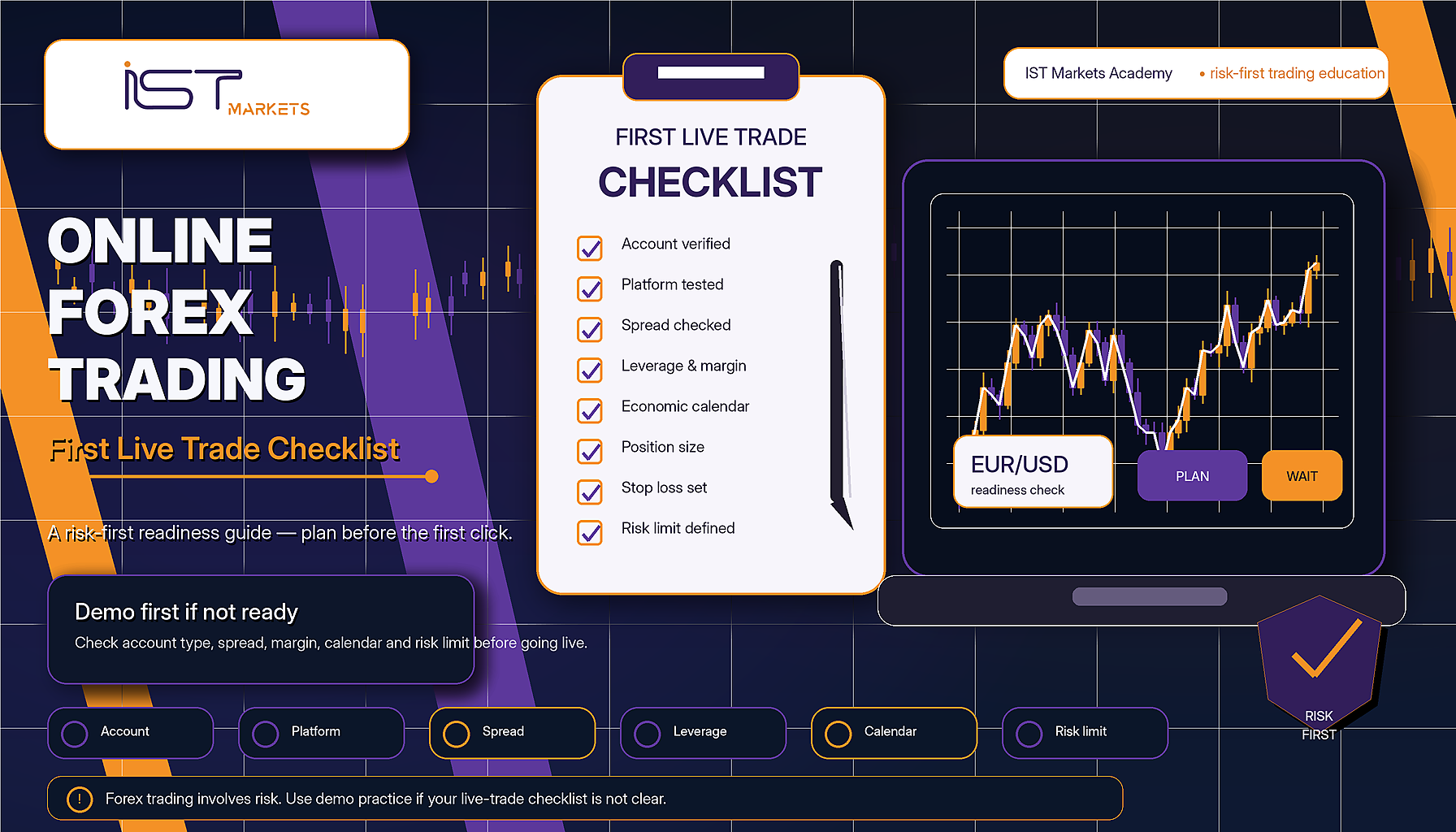
Before your first live forex trade, check that your trading account is verified, your platform works confidently, your spread is acceptable, your leverage and margin are understood, your position size matches a fixed risk limit, and no major economic event is about to distort market conditions. You should also know where your stop loss goes, what the trade could cost if it fails, and whether you have practised the same workflow on a demo account. Online forex trading should start with readiness, not excitement.
Risk reminder
Source Snapshot
This guide is designed to complement IST Markets’ forex basics, account types, demo account, leverage, spreads, economic calendar and risk resources. External reference areas include official market-risk and investor-protection materials from CFTC, FCA and ESMA.
Content Table
Why going live changes the decision.2Account and platform readiness
Verification, access and order control.3Spread, leverage and margin
Turn chart risk into money risk.4Market-event check
Avoid trading blind before news.5Risk limit and stop loss
Plan the loss before the entry.6EUR/USD scenario
A practical first-trade example.7Common mistakes
What beginners often miss.
The first live trade is not just a platform click
Online forex trading can feel simple from the outside. A beginner opens a platform, chooses a currency pair such as EUR/USD, selects buy or sell, enters a lot size and clicks a button. But the first live forex trade is not only a technical action. It is the point where platform practice becomes real capital risk.
That is why the first live trade should not be treated as a confidence test, a profit attempt or a way to “prove” that demo practice worked. It should be treated as a readiness test.
Can you place the trade correctly? Can you calculate the risk before entry? Can you accept the loss if the stop is reached? Can you avoid trading during unstable news conditions? Can you explain why this account type, lot size and stop distance make sense?
This is the difference between learning forex basics and preparing for live forex trading. The basics explain what currency pairs, pips, spreads and leverage mean. Live readiness asks a harder question: can you use those ideas responsibly when real money is involved?
A beginner who understands this distinction is already ahead of many first-time traders. The goal is not to rush into a first live order. The goal is to confirm that the account, platform, risk settings and decision process are ready for real execution.
Live-readiness principle
Account, platform and verification readiness
Before trading forex online with live funds, confirm the non-chart details first. Many beginners focus only on the chart and forget that account access, verification, funding, platform stability and order controls are part of the trade environment.
Start with the account. Is your trading account fully verified? Do you understand the account type, pricing model, available instruments, minimum trade size, currency conversion rules, margin requirements and withdrawal process? If the account is not fully understood, the first live trade may expose confusion at the worst possible moment.
Then check the platform. You should know how to open, modify and close an order; how to place stop loss and take profit; where to see margin, equity and free margin; how to read bid and ask prices; and how to review trade history.
A demo account is useful because it allows a beginner to repeat these actions before capital is at risk. Demo practice can reduce workflow mistakes, but it does not prove future live performance. The purpose of demo is preparation, not prediction.
| Readiness area | Ready | Not ready yet |
|---|---|---|
| Account verification | You know your account status, entity, account type and available markets. | You are unsure whether the account is fully verified or what conditions apply. |
| Platform control | You can place, modify and close orders without hesitation. | You still struggle with stop loss, take profit, order types or history review. |
| Demo workflow | You have practised the exact order workflow on demo repeatedly. | You want to learn order execution for the first time using live funds. |
| Account costs | You understand spread, commission, swaps or swap-free terms where applicable. | You only looked at the minimum deposit or headline spread. |
| Risk documents | You have reviewed the risk disclosure, account terms and legal documents. | You are relying only on the platform interface or marketing page. |
A simple rule is useful here: if you cannot explain your account type and platform workflow in one minute, you are not ready to test them with live funds.
Spread, leverage, margin and position size checks
The first live forex trade should be checked in money terms, not only chart terms. A setup may look clean, but if the spread is wide, the stop is too tight, the position size is too large or margin usage is uncomfortable, the trade is not ready.
Start with the spread. The spread is the difference between the bid and ask price. It is part of the trading cost and can change by instrument, account type, session and market conditions. A spread that looks acceptable during liquid hours may widen during rollover, low-liquidity periods or high-impact news.
Then check leverage and margin. Leverage allows a trader to control a larger position with less capital, but it also magnifies losses. Margin is the amount required to keep the position open. A beginner should not ask only, “How big can I trade?” The better question is, “How small can I trade while still learning responsibly?”
Position size is the bridge between your stop loss and your account risk. If your stop distance is wide, your position size may need to be smaller. If you cannot calculate how much you may lose if the stop is reached, the trade is not ready for live execution.
| Check | What it means | Why it matters before a first live trade |
|---|---|---|
| Spread | The difference between bid and ask price. | It affects entry cost and can widen during unstable conditions. |
| Leverage | The ability to control a larger position with less capital. | It can magnify both gains and losses. |
| Margin | Capital required to maintain the position. | Too much margin usage can increase pressure and reduce flexibility. |
| Stop distance | Distance between entry and invalidation. | Wider stops require smaller position sizes if risk is fixed. |
| Position size | Trade volume selected on the platform. | It determines how much the trade may affect the account. |
| Slippage | Execution at a different price than expected. | Fast or thin markets may affect fills, especially around news. |
Cost translation rule
Market-event check before entering
A first live trade should never be placed without checking the economic calendar. The calendar is not a buy or sell signal. It is a volatility-preparation tool. It helps you know when major releases may affect the currency pair you are trading.
For online forex trading, high-impact events such as inflation data, jobs reports, central-bank decisions, PMI releases and GDP updates can create fast price movement. They may also cause spreads to widen, liquidity to thin and orders to be filled at less favourable prices than expected.
Before entering, ask: Is there a major event in the next hour? Does the event affect one side of the currency pair? Is the spread normal? Is the pair already moving unusually? Would the stop distance still make sense if volatility expands?
| Calendar check | Why it matters | Beginner action |
|---|---|---|
| Event time | Volatility can increase before and after the release. | Avoid entering blindly minutes before major data. |
| Affected currency | EUR/USD reacts differently depending on whether EUR or USD is affected. | Know which side of the pair the event may influence. |
| Impact level | High-impact events may change conditions quickly. | Consider waiting, observing or reducing exposure. |
| Spread condition | Wider spreads increase trade cost and may distort stop placement. | Check the live bid/ask spread before placing the order. |
| First reaction risk | The first candle after news may reverse quickly. | Observe first if you cannot manage fast movement. |
The calendar should slow the trader down. It should not make the trader feel forced to trade. If the first live trade is about process, then skipping a trade before major news can be a strong decision.
Risk limit and stop-loss planning
A stop loss should not be added casually after entry. It should be part of the trade decision before the order is placed. For a beginner, the most important question is not “Where can this trade go?” It is “Where is the trade idea wrong, and how much would I lose if that happens?”
Your risk limit should be defined before the trade. Some traders use a small percentage of account equity per trade; others use a fixed currency amount. The exact number depends on personal circumstances, experience, account size and risk tolerance. The key point is consistency. If the risk changes emotionally from trade to trade, live trading becomes harder to evaluate.
A stop-loss order can help manage risk, but it is not a guarantee of perfect execution in all market conditions. Fast markets, gaps, slippage and low liquidity may affect the final exit price. That is why the first live trade should be sized conservatively enough that an imperfect exit does not create excessive account damage.
Before-entry risk question
Practical scenario: preparing a first live EUR/USD trade
Imagine a beginner is preparing for a first live EUR/USD trade. They have practised on demo, understand basic forex terms and feel ready to place a small live order. The chart shows a possible setup, but the trader does not click immediately.
First, they check the account. The account is verified, the platform is working, and the trader knows how to place and modify a stop loss. They also understand the account’s pricing model and know whether there may be spread, commission, swap or other applicable costs.
Second, they check the spread. If the EUR/USD spread is normal for their account and session, the trade remains possible. If the spread is unusually wide, they wait. A wider spread means the trade starts with a larger cost and may need a different stop or position size.
Third, they check leverage and margin. They do not use the maximum position size available. Instead, they work backwards from the risk limit. The trader asks: “If my stop is reached, how much will I lose?” Only after that do they decide whether the lot size is appropriate.
Fourth, they check the economic calendar. A U.S. inflation release is scheduled soon. Because USD is one side of EUR/USD, the trader understands that the pair may move sharply. Instead of forcing the trade before the release, they decide to observe the event first.
After the initial news reaction, the trader checks whether the spread has normalised and whether the chart still offers a clear invalidation level. They calculate the stop distance and reduce position size so that the possible loss fits their risk limit. If the position size becomes too small or the stop distance is still too wide, they skip the trade.
That decision is not failure. It is discipline.
Scenario lesson
The prepared beginner does not need to predict the news. They need to avoid an unplanned live trade during unstable conditions. The edge is not the first click. The edge is the checklist before the click.
Mistakes beginners make before going live
Most first-live-trade mistakes are not advanced technical problems. They are preparation problems. A beginner may know what EUR/USD is but still be unprepared for execution, spread movement, leverage pressure or the emotional difference between demo and live trading.
| Mistake | Why it hurts beginners | Better approach |
|---|---|---|
| Going live because demo felt easy | Demo does not create the same emotional pressure as real money. | Use demo to build workflow, not to guarantee live results. |
| Ignoring spread before entry | A wider spread increases cost and can distort stop placement. | Check the live bid/ask spread before placing the order. |
| Using too much leverage | Small price movements can create larger account impact. | Size the position from the risk limit, not from the maximum leverage available. |
| Trading before major news | News can trigger fast movement, slippage and reversals. | Check the calendar and consider waiting or observing. |
| No written risk amount | The trader may adjust risk emotionally after seeing the chart. | Define risk before entry and write it in a journal. |
| Choosing account type by headline | Low visible spread or account labels may hide other cost considerations. | Compare account types by total cost, trading style and eligibility. |
| Moving the stop loss emotionally | A planned loss can become a larger unplanned loss. | Define invalidation before entry and respect the plan. |
| Treating the first trade as a profit test | Pressure can lead to oversizing or revenge trading. | Treat the first live trade as a process test. |
The better approach is slower and more professional. Check the account. Check the platform. Check the spread. Check the calendar. Check the risk. Then decide whether the trade deserves live execution.
First live forex trade checklist
Use this checklist before your first live forex trade. If several answers are unclear, the better next step is usually more demo practice, account review or education — not a larger live trade.
| Check | Question before trading | If unclear |
|---|---|---|
| Account readiness | Is my account verified and do I understand its conditions? | Review account types, fees, legal documents and support materials. |
| Platform workflow | Can I place, modify and close orders confidently? | Practise on demo until the workflow is automatic. |
| Spread check | Is the live spread normal for this pair and session? | Wait or compare conditions before entering. |
| Leverage and margin | Do I know the margin impact and exposure size? | Reduce position size and study leverage again. |
| Calendar check | Is a major event about to affect this pair? | Observe or wait until conditions stabilise. |
| Stop loss | Where is the trade idea invalid? | Do not enter until the invalidation level is clear. |
| Position size | Does the position size match my risk limit? | Recalculate before entering. |
| Exit plan | Do I know what I will do if price moves against me? | Write the plan before the trade. |
| Emotional readiness | Can I accept a planned loss without revenge trading? | Stay on demo or reduce risk further. |
| Journal plan | Will I record the reason, risk, entry, exit and lesson? | Create a simple journal before going live. |
A first live trade does not need to be exciting. It needs to be controlled. If the checklist feels too slow, that is the point. Live trading rewards preparation more than speed.
Risk reminder before the CTA
Online forex trading involves leveraged products that can move quickly. Spreads may widen, slippage may occur, margin requirements may affect available equity and stop-loss orders may not always execute at the exact requested price in fast or illiquid conditions. A demo account can help you practise platform workflow, but it does not prove that live results will be profitable.
Before your first live trade, read the Risk Disclosure and any account, fee, execution and legal documents that apply to your jurisdiction and account type. If you cannot explain the risk, cost and margin impact of the trade before entering, you are not yet ready to place it live.
Soft CTA: Start with demo if you are not ready
If this checklist showed gaps in your platform workflow, risk calculation, spread awareness or calendar preparation, stay on demo first. Practise the same process until you can place, manage and review trades calmly.
Explore the IST Markets demo account to practise platform workflow before live funds. Then compare account types by total cost, trading style and eligibility before choosing a live structure.
FAQ
What should I check before my first live forex trade?
Check your account verification, platform workflow, spread, leverage, margin, position size, stop loss, economic calendar and risk limit. You should know the possible loss before entering and should have practised the same order process on demo.
How do beginners start online forex trading safely?
Beginners cannot remove trading risk, but they can start more responsibly by learning the basics, practising on demo, reading risk documents, choosing an account type they understand, using conservative position sizes and avoiding high-impact news until they understand event volatility.
What should I know before trading forex with real money?
You should understand spreads, leverage, margin, lot size, stop loss, slippage, swaps or swap-free terms, account conditions, platform execution and how economic events can affect the pair you trade. You should also know how much you are prepared to lose on a trade before entering.
What is a first live trade checklist?
A first live trade checklist is a pre-entry process that confirms account readiness, platform confidence, spread condition, leverage and margin impact, market-event risk, stop-loss level, position size and emotional readiness before placing a real-money trade.
What is the minimum capital for online forex trading?
Minimum capital depends on the broker, account type, jurisdiction and product conditions. The more important question is whether the account balance allows sensible position sizing. A very small balance can make normal market movement, spreads or slippage feel too large relative to the account.
How do I manage risk on my first live trade?
Define the maximum loss before entering, place a stop loss based on invalidation, size the position from the stop distance, avoid excessive leverage, check the economic calendar and accept that no trade is better than a trade with unclear risk.
When am I truly ready to go live?
You may be closer to live readiness when you can explain your account costs, use the platform confidently, calculate position size, check market events, follow a written risk plan and accept planned losses without emotional trading. Demo practice helps, but it is not proof of future live results.
References & Further Reading
- IST Markets Risk Disclosure
- IST Markets Demo Trading Account
- IST Markets: What is Forex Trading?
- IST Markets Leverage Guide
- IST Markets Pips & Spreads Guide
- IST Markets Economic Calendar
- IST Markets Forex Account Types
- CFTC: Foreign Currency Trading
- CFTC: Foreign Currency Forex Fraud Advisory
- FCA: Contracts for Differences
- ESMA: CFD Product Intervention Measures