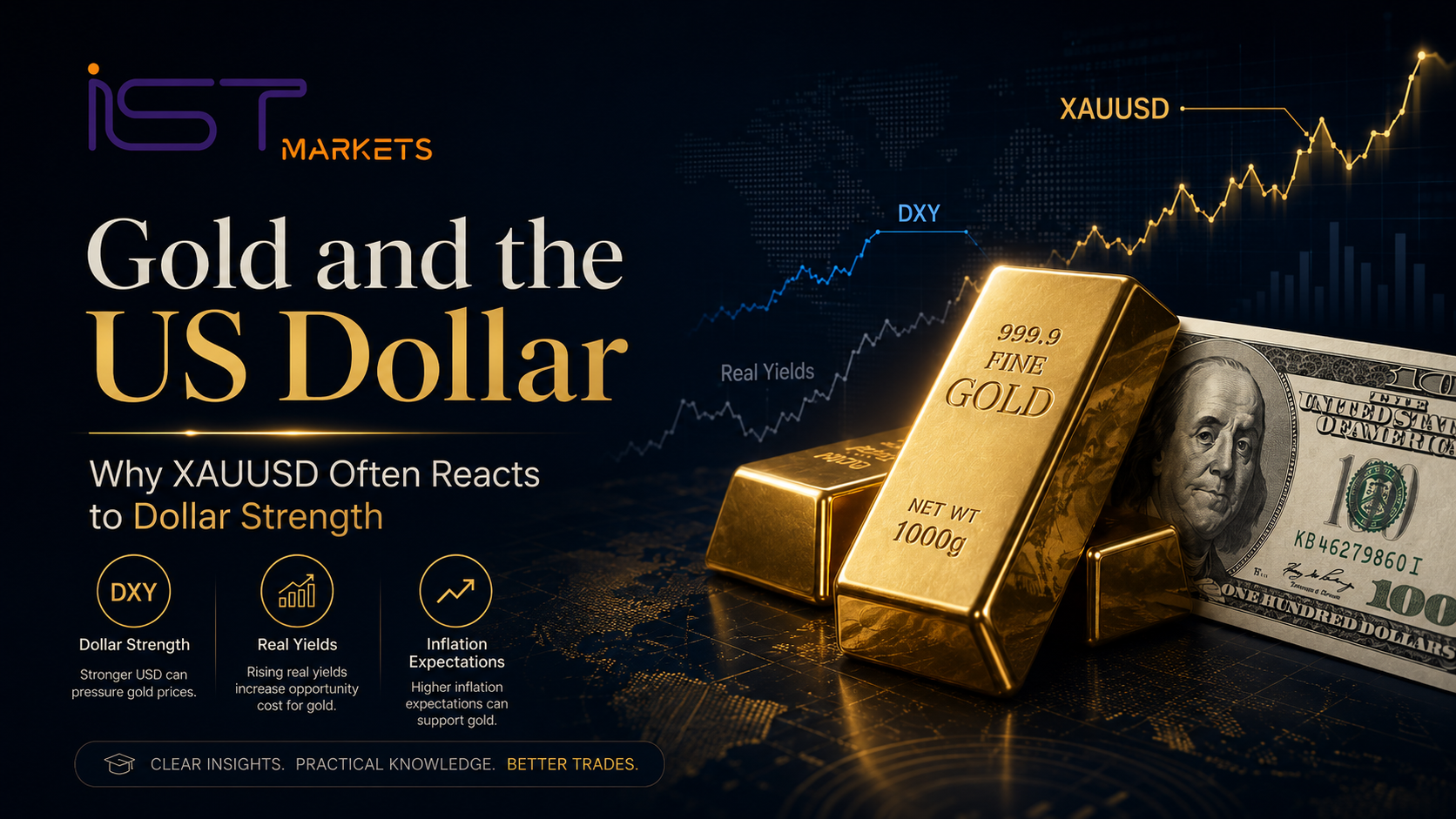
Gold and the US Dollar: Why XAUUSD Often Reacts to Dollar Strength
Gold and the dollar often move in opposite directions—but the relationship is a framework, not a trading signal.
Learn when dollar strength can help explain XAUUSD, when real yields or safe-haven demand matter more, and how to respond when the usual relationship stops working.
Quick Answer: Why Does Gold Often React to US Dollar Strength?
Gold often reacts inversely to the US dollar because XAUUSD expresses the price of gold in dollars, while gold also competes with interest-bearing US assets for investor demand.
A stronger dollar and rising real yields can create pressure on gold, while a weaker dollar and falling real yields can provide support. The relationship is not automatic, however. Safe-haven demand, central-bank purchases, investment flows, inflation expectations, market positioning and liquidity stress can cause gold and the dollar to rise together, fall together or temporarily move independently.
What this guide helps you decide
This guide helps you determine whether an XAUUSD move is mainly being driven by broad dollar strength, US yields, Federal Reserve expectations, safe-haven demand or a gold-specific factor. It also shows you what to verify on the platform before turning a macro explanation into a live trading decision.
Important risk reminder
XAUUSD can move sharply around inflation reports, employment data, Federal Reserve decisions and geopolitical events. Leveraged gold products can magnify relatively small price changes, while wider spreads, market gaps and slippage can cause the final loss to differ from the amount suggested by a planned stop level. This article is educational and does not provide personal financial advice, a buy or sell recommendation or a promise of future performance.
Source methodology
The market framework in this article uses World Gold Council research on opportunity cost, risk, economic expansion and momentum. Gold benchmark context is aligned with LBMA information, DXY composition with ICE documentation, real-yield data with the US Treasury, inflation-expectation methodology with the Federal Reserve Bank of St. Louis, and platform and execution guidance with official MetaTrader and IST Markets documentation.
Source review completed: July 2026
What Does XAUUSD Mean?
XAUUSD is a commonly used market symbol for gold priced in US dollars. XAU represents gold, while USD represents the US dollar. A quote of 2,500 broadly means that one troy ounce of gold is valued at 2,500 US dollars in the referenced market.
That does not mean every XAUUSD position involves buying physical bullion. A retail platform may offer a spot-metal or off-exchange derivative product with its own contract size, tick value, margin, financing and execution terms.
Price relationship vs trading product
XAUUSD describes the relationship between gold and the US dollar. Before trading it, verify the exact product specification rather than assuming that every broker symbol has identical contract, cost or execution conditions.
The LBMA Gold Price is an important global reference for unallocated gold delivered in London and is set through twice-daily auctions administered by ICE Benchmark Administration. A retail XAUUSD quote may reference the wider gold market, but it should not automatically be treated as identical to every benchmark, futures contract or physical-gold transaction.
For the broader foundation, read
the beginner guide to reading XAUUSD.
Why Dollar Strength Often Places Pressure on Gold
The relationship begins with pricing. Because internationally referenced gold prices are commonly expressed in US dollars, a stronger dollar can make the same dollar-denominated gold price more expensive when converted into other currencies.
That can affect international demand, investor positioning and the relative attractiveness of gold. A weaker dollar can have the opposite effect by reducing the translated price for buyers using other currencies.
The dollar effect is only one part of the explanation. Dollar strength often appears alongside higher US yields or tighter Federal Reserve expectations, creating an additional opportunity-cost pressure on a non-yielding asset such as gold.
Dollar strength affects the currency side of XAUUSD.
Real yields affect the opportunity cost of holding gold.
When Is the Gold–Dollar Relationship Most Useful?
The gold–dollar relationship is usually most informative when the dollar, real yields and the broader risk regime point in the same direction.
Regime 1: Several Gold Headwinds Align
DXY rises, real yields rise and risk appetite remains stable or improves. The usual pressure on gold may become clearer.
Regime 2: Several Gold Supports Align
DXY weakens, real yields fall and defensive demand increases. The supportive relationship may become clearer.
Regime 3: Drivers Conflict
DXY rises while real yields fall, or risk demand supports gold. The relationship is less reliable and requires further diagnosis.
The relationship can also weaken when gold-specific investment, central-bank demand, profit-taking or positioning becomes more important than the currency effect.
Practical rule
Treat the gold–dollar relationship as stronger when several independent drivers confirm it. Treat it as weaker when one indicator is moving alone.
DXY: What It Shows—and What It Misses
The US Dollar Index, often called DXY or USDX, tracks the dollar against a fixed basket containing the euro, Japanese yen, British pound, Canadian dollar, Swedish krona and Swiss franc.
It is useful because it gives traders a quick view of dollar direction against that basket. It is incomplete because it does not represent every global currency, every source of dollar demand or the reason the dollar is moving.
Before calling it a “dollar move,” check:
- Is USD strengthening against several major currencies?
- Are US Treasury yields confirming the move?
- Did US economic data or Federal Reserve expectations trigger it?
- Is DXY rising mainly because the euro or another heavily weighted component is weakening?
- Did XAUUSD move before DXY, after it or at the same time?
Use DXY as evidence, not a signal
DXY identifies broad direction within a fixed currency basket. Confirm the explanation with real yields, policy expectations, risk sentiment and gold-specific flows.
Nominal Yields, Real Yields and Inflation Expectations
Gold does not pay a regular bond coupon or cash interest. This makes the return available from interest-bearing assets an important part of gold’s opportunity cost.
| Measure | What it describes | Why it matters for gold |
|---|---|---|
| Nominal yield | The observable Treasury yield before adjusting for inflation. | Higher yields can improve the relative attraction of interest-bearing assets. |
| Real yield | A market yield derived from inflation-protected Treasury securities. | It provides a closer indication of the inflation-adjusted opportunity cost of holding gold. |
| Breakeven inflation | A market-based inflation expectation derived from nominal and inflation-protected Treasury yields. | It helps separate a yield move caused by real returns from one caused by changing inflation expectations. |
When real yields rise, interest-bearing US assets may become more attractive relative to gold. When real yields fall, the opportunity cost of holding gold may decline.
This is why “inflation rose” is not a complete gold explanation. A higher inflation result may support gold if investors focus on purchasing-power risk. It may pressure gold if the same result causes markets to expect tighter policy, a stronger dollar and higher real yields.
The better inflation question
Was inflation different from expectations, and how did that surprise change real yields, Federal Reserve pricing and the dollar?
Safe-Haven Competition: Gold, the Dollar or Both?
Gold and the US dollar can both attract defensive demand, but for different reasons. Gold may be used as a store of value or portfolio diversifier, while the dollar can benefit from global funding, reserve and liquidity demand.
During a moderate risk-off period, gold may rise while the dollar weakens if falling yields and expectations of easier US policy support XAUUSD.
During severe liquidity stress, demand for dollar cash may rise quickly. Gold can also rise as a defensive asset, or it can fall temporarily if investors sell liquid holdings to cover losses, reduce leverage or meet margin requirements.
Gold and the dollar can rise together because defensive demand is not one single trade.
When a Gold-Specific Driver May Be Dominant
Not every XAUUSD move is primarily a dollar move. Gold-specific demand or positioning can become dominant when:
- Gold moves strongly while DXY and real yields remain relatively stable.
- Investment-fund or ETF flows change materially.
- Central-bank demand becomes an important market narrative.
- Profit-taking or position liquidation follows an extended move.
- Gold breaks an important technical level while other macro indicators remain mixed.
- The move persists after the dollar and Treasury markets have stabilised.
Do not force a dollar explanation onto a move that is being driven mainly by gold-specific demand, supply or positioning.
The IST Gold–Dollar Driver Stack
Use this sequence to build an explanation before building a trade idea.
Is XAUUSD rising, falling or consolidating? Did the move begin before or after the event?
Is USD strengthening broadly, or is DXY being driven mainly by one component currency?
Is the inflation-adjusted opportunity cost of holding gold rising or falling?
Did markets price tighter policy, easier policy or no meaningful change?
Are investors seeking growth assets, gold protection, dollar liquidity or several defensive assets together?
Are fund flows, central-bank demand, positioning or technical momentum dominating?
Are spread, contract size, position risk and possible slippage understood?
Gold–Dollar Relationship Matrix
| Dollar | Real yields | Risk regime | Practical interpretation |
|---|---|---|---|
| Stronger | Rising | Stable / risk-on | Several potential headwinds for gold are aligned. |
| Weaker | Falling | Risk-off | Several potential supports for gold are aligned. |
| Stronger | Falling | Risk-off | Defensive demand may support both gold and USD. |
| Weaker | Rising | Risk-on | Dollar support for gold may be offset by higher opportunity cost. |
| Stable | Stable | Mixed | Gold-specific demand, positioning or momentum may dominate. |
The matrix is diagnostic—not predictive
Use it to identify aligned or conflicting forces. It does not predict the next XAUUSD price and does not replace strategy, position sizing or execution checks.
The Reaction Sequence Check
A common mistake is seeing gold fall and then assuming the dollar caused the move. Record the sequence before deciding what the dominant driver was.
- What moved first? DXY, Treasury yields, XAUUSD or another risk asset?
- Did nominal and real yields confirm the first move?
- Did DXY move broadly or mainly through one basket currency?
- Did gold respond immediately, with a delay or before the event?
- Did the first reaction persist or reverse?
- Was a gold-specific driver already active?
The first gold candle is a reaction.
The sustained move reflects how markets interpret the policy, yield and risk consequences.
Before, During and After CPI or FOMC
Before the Event
Check the forecast, previous figure, current DXY and yield trend, existing gold positioning, spread behaviour and whether the market has already moved.
During the Release
Compare the actual result with expectations, then observe DXY, nominal yields, real yields and XAUUSD together rather than reacting to the gold candle alone.
After the Release
Check revisions, underlying components, Federal Reserve implications, whether spreads normalise and whether the initial gold move persists or reverses.
Use the
economic calendar preparation guide
to identify event risk. The calendar supports preparation; it does not determine XAUUSD direction.
Practical Scenario: CPI Is High, So Should Gold Rise?
Hypothetical educational example
This scenario explains decision quality. It does not recommend a position or guarantee an outcome.
Trader A: The Inflation Shortcut
CPI is higher than expected. Trader A assumes that higher inflation must push gold higher.
- Does not check the real-yield response.
- Ignores the rise in DXY.
- Uses a market order during rapid repricing.
- Has not checked the contract size or tick value.
Trader B: The Interpretation Process
Trader B separates the inflation headline from the market’s reaction.
- Compares actual CPI with the forecast.
- Checks nominal yields, real yields and DXY.
- Reviews the change in Federal Reserve expectations.
- Waits when spread and execution risk are unclear.
Suppose the inflation surprise leads markets to price tighter monetary policy. Real yields and DXY rise, while XAUUSD falls after an unstable first reaction. The relevant explanation is not simply “inflation is high.” The market focused on higher opportunity cost and a stronger dollar.
Trader B is not guaranteed a profitable outcome. The improvement is that fewer assumptions remain untested before capital is exposed.
Before Trading XAUUSD on MT5
A strong macro explanation is incomplete until the exact platform product has been checked.
MT5 symbol-specification workflow
Market Watch → right-click the exact XAUUSD symbol → Specification
- Contract size.
- Tick size and tick value.
- Profit currency and margin currency.
- Minimum, maximum and volume step.
- Current or floating spread status.
- Stop level restrictions.
- Swap or overnight financing terms.
- Trading sessions and execution mode.
Do not assume that one lot, one dollar of gold movement or one symbol suffix has the same account effect across every provider or account.
Basic account-impact concept
The monetary effect of an XAUUSD movement depends on the price change, contract size, trading volume and the exact symbol specification. Use the verified platform values rather than a generic online example.
Review
position sizing before entry,
pips and spreads
and the
Order Execution Policy.
Market Risk, Relationship Risk and Execution Risk
| Risk | Core question | Example |
|---|---|---|
| Market risk | Did XAUUSD move against the position? | Gold falls after a data release. |
| Relationship risk | Was the assumed gold–dollar relationship incomplete or overridden? | Gold rises despite a stronger DXY because risk demand dominates. |
| Execution risk | Was the order completed at the expected price and cost? | Spread widening, slippage or a gap changes the result. |
Common Gold and US Dollar Mistakes
| Mistake | Why it fails | Better process |
|---|---|---|
| Dollar up means gold must fall. | Real yields, risk demand or gold-specific flows may dominate. | Require confirmation from several drivers. |
| DXY represents all dollar demand. | It tracks a fixed six-currency basket. | Check dollar breadth, yields and the reason for the move. |
| Higher inflation guarantees higher gold. | Inflation can also raise real yields and support USD. | Analyse the policy and yield reaction. |
| The first candle confirms the final direction. | Markets may reinterpret details or reverse after the headline. | Use the Reaction Sequence Check. |
| A correct macro explanation is a complete trade plan. | Contract size, spread, margin and slippage still affect the result. | Verify the symbol specification and monetary risk. |
| Demo execution proves future live results. | Live liquidity, spreads, slippage and emotions may differ. | Use demo for process rehearsal only. |
Gold and US Dollar Checklist Before Taking Action
Risk reminder before considering live exposure
Spot metals and other leveraged off-exchange products carry significant risk. Relatively small market movements can have a larger effect on deposited funds. Slippage can occur during news, volatility, low liquidity, market openings, closings or connection delays, and triggered stop orders are executed according to the method and liquidity available at the time. Review the
IST Risk Disclosure
and
Order Execution Policy.
Explain one XAUUSD move before building a trade
Select one historical or current gold move and record what moved first, what happened to DXY, nominal yields, real yields, Federal Reserve expectations and risk sentiment. Write a short explanation of the dominant driver, then verify the exact product specification before testing any setup on demo.
Continue with:
Gold Trading for Beginners ·
Economic Calendar Guide ·
Position Sizing ·
Demo vs Live.
Final takeaway
Gold often reacts inversely to the US dollar, but the relationship becomes most useful when dollar direction, real yields and the risk regime confirm one another. When they disagree, use the reaction sequence, check for gold-specific drivers and verify the exact XAUUSD product before interpreting the move or exposing capital.
Key Gold and US Dollar Terms
Frequently Asked Questions
Why does gold often move opposite the US dollar?
Gold is commonly priced in dollars, so a stronger dollar can make gold more expensive in other currencies. Dollar strength may also coincide with higher US real yields, increasing the relative attraction of interest-bearing assets.
What does XAUUSD mean?
XAUUSD is a commonly used symbol for gold priced in US dollars. The exact retail product may be a spot-metal or off-exchange derivative rather than physical gold.
Is DXY the same as the dollar used in XAUUSD?
No. DXY measures the dollar against a fixed basket of six currencies. It is useful for broad direction, but it does not represent every global dollar flow or explain every XAUUSD movement.
Why do real yields matter for gold?
Gold does not pay regular interest. When real yields rise, inflation-adjusted returns from interest-bearing US assets may become more attractive relative to gold. Falling real yields can reduce that opportunity cost.
Can gold and the US dollar rise at the same time?
Yes. During severe uncertainty, investors may seek both gold and dollar liquidity. They can attract defensive demand for different reasons.
Why can gold fall when inflation is high?
High inflation can cause markets to price tighter monetary policy, higher real yields and a stronger dollar. Those responses can place pressure on gold even when purchasing-power concerns are elevated.
What should beginners check before trading XAUUSD?
Check the exact symbol specification, contract size, tick value, spread, margin, DXY, real yields, policy expectations, economic events, risk sentiment, position size and possible slippage.
Official Sources and Further Reading
- World Gold Council — Gold Outlook 2026
- LBMA — Precious Metal Prices
- ICE — US Dollar Index
- US Treasury — Daily Real Yield Curve Rates
- Federal Reserve Bank of St. Louis — 10-Year Breakeven Inflation Rate
- MetaTrader 5 — Market Watch and Symbol Specification
- Federal Reserve — FOMC Calendar
- US Bureau of Labor Statistics — Release Calendar
- IST Markets — Risk Disclosure
- IST Markets — Order Execution Policy
Review and maintenance note
Review this article when World Gold Council research, DXY methodology, Treasury yield data, LBMA benchmark information, MetaTrader documentation, XAUUSD product terms or IST legal documents change materially. Live spreads, swaps, margin, contract specifications and trading hours should always be verified directly.