Quick Answer
What changes between demo and live trading?
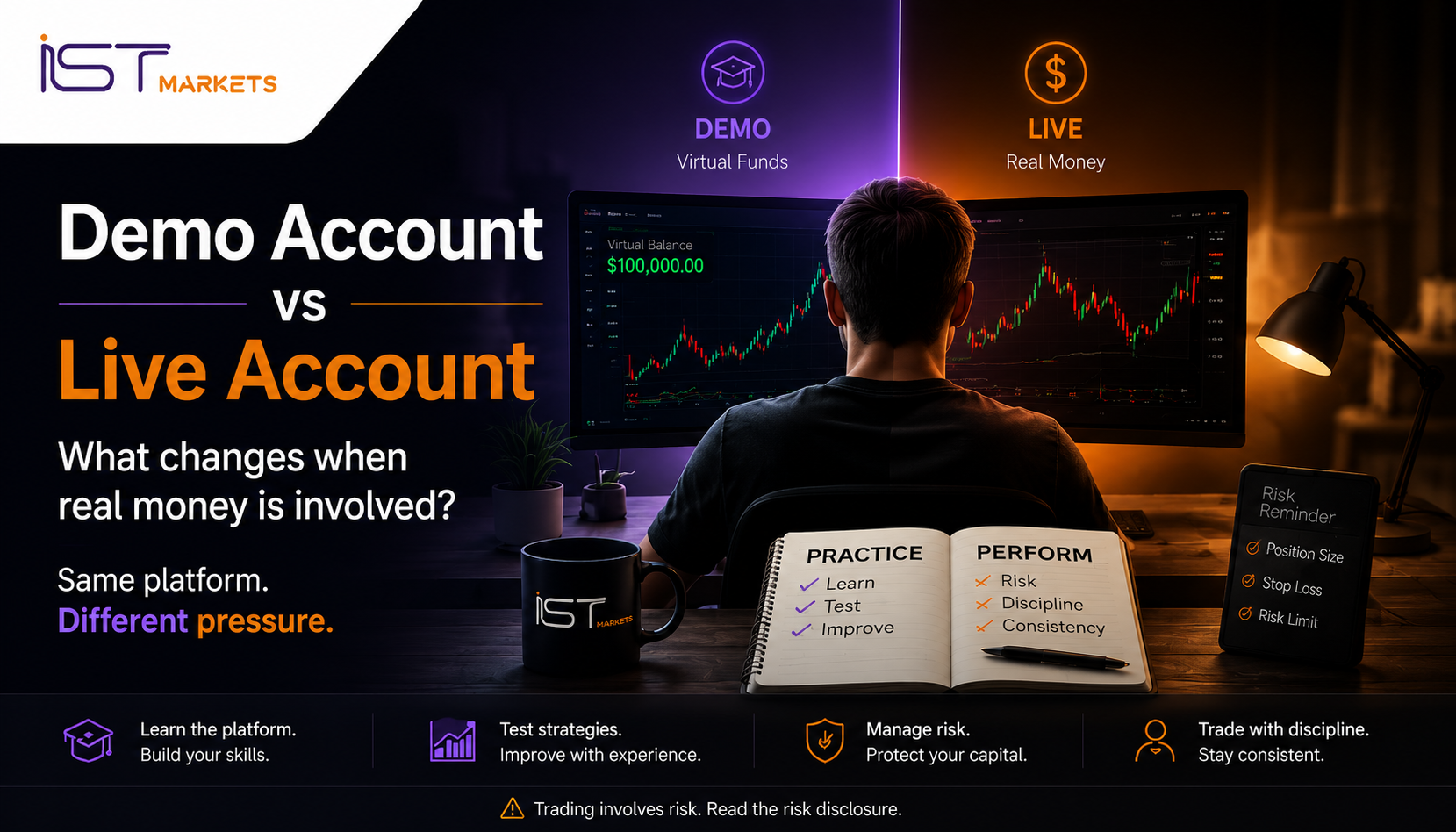
The biggest difference in demo account vs live account trading is not only the money. It is the pressure created by real risk. A demo account helps traders practise with virtual funds, learn the platform, test order types, and build a trading routine. A live trading account exposes the trader to real profit and loss, real emotional pressure, spread, slippage, changing market conditions, margin pressure, and the consequences of poor position sizing. Demo trading is useful, but it is not proof that the same results will continue when real money is involved. The safer goal is not to move from demo to live quickly. The goal is to move gradually, with discipline, realistic expectations, and a written risk plan.
Risk note: Trading forex and CFDs on margin involves significant risk and may not be suitable for all traders. Losses can occur quickly, especially when leverage, volatility, and emotional decision-making are involved. Always review the risk disclosure before trading live.
01 · Comparison
Demo Account vs Live Account: Comparison Table
A forex demo account is best understood as a training environment. A live account is a real-money trading environment. They may look similar on the screen, especially when both are accessed through the same trading platform, but they do not feel the same in practice.
| Area | Demo Trading Account | Live Trading Account |
|---|---|---|
| Money used | Virtual funds | Real deposited funds |
| Main purpose | Practice, platform learning, order testing, and routine building | Real trading with actual financial risk |
| Emotional pressure | Lower, because losses are simulated | Higher, because gains and losses affect real capital |
| Execution experience | Useful for practising platform workflow and market observation | May involve live-market factors such as spread, slippage, liquidity, gaps, and volatility |
| Position size behaviour | Traders may take larger trades because the money is not real | Position size must be controlled because losses are real |
| Risk discipline | Easy to ignore rules after a simulated loss | Rule-breaking can create direct financial damage |
| Confidence level | Can rise quickly, sometimes too quickly | Confidence is tested by fear, hesitation, and drawdown |
| Best use | Learning the platform and building repeatable habits | Applying a tested plan with smaller, controlled exposure |
| Main danger | False confidence | Emotional trading and capital loss |
This is why demo vs real trading should not be treated as a simple feature comparison. The main question is not: “Can I place trades on both?” The better question is: “Can I behave responsibly when the outcome matters?”
02 · Psychology
The Biggest Change Is Psychology
A trader can know what to do and still fail to do it under pressure.
That is the central difference between demo and live trading. In a demo account, a losing trade may feel annoying. In a live account, the same loss can feel personal. It can create fear, frustration, regret, or the urge to recover quickly. These emotions can push traders away from the plan they were able to follow easily during practice.
Fear of loss
The trader closes trades too early because they do not want to see a real-money loss increase.
Overconfidence
A strong demo period creates the belief that live trading will be just as easy.
Revenge trading
The trader opens another position quickly after a loss to “win it back”.
Rule fatigue
The trader follows the plan for a few trades, then abandons it after emotional stress.
This is why trading psychology matters as much as strategy. A demo account can help you practise technical steps. It can help you learn chart navigation, order placement, stop loss and take profit settings, watchlist setup, and basic platform workflow. But it cannot fully reproduce the emotional weight of a live forex account.
A professional transition from demo to live should therefore be gradual. The first live goal should not be to make large returns. A more sensible first goal is to prove that you can follow your process with real money at risk.
03 · Execution
Execution and Market Conditions: What May Differ
Many beginners assume that if the chart looks the same, the trading experience must be the same. That is not always true.
In live markets, order execution can be affected by conditions such as liquidity, spread changes, volatility, news events, price gaps, and slippage. Slippage means the final execution price may differ from the price expected or clicked. This can happen in fast-moving markets, around major economic releases, during low-liquidity periods, or when price moves sharply.
Live trading may involve:
- Variable spreads — the difference between bid and ask prices can widen in certain conditions.
- Slippage — an order may be executed at a different price than expected.
- Gaps — markets may open at a different level after weekends or major events.
- Order limitations — certain orders intended to limit risk may not always execute at the exact requested price.
- Margin pressure — if a position moves against you, margin requirements and liquidation risk become real.
This does not mean demo trading is useless. It means demo trading should be used for the right purpose. Use it to learn platform behaviour, order types, risk settings, trade journaling, and routine. Do not use it as proof that live performance will be identical.
Before moving live, traders should understand the basic cost and execution language connected to their account type, platform, and instruments. This includes spread, commission if applicable, swaps, margin, leverage, stop loss behaviour, and market volatility. Review the broker’s execution model, fees and costs, account conditions, and risk disclosure before trading live.
04 · Scenario
Why Demo Confidence Can Mislead Beginners
Demo confidence can be useful when it reflects skill. It can be dangerous when it reflects unrealistic behaviour.
Example: The oversized demo winner
Imagine a beginner trader opens a demo account with a large virtual balance. They start trading forex pairs with position sizes much larger than they would ever use with their own money. Over two weeks, they win several trades. The account grows quickly. The trader feels ready.
Then they open a live account and repeat the same behaviour. The first few trades move against them. Because the positions are too large, a normal market move now feels emotionally intense. The trader widens the stop loss, adds another position, or enters a new trade immediately after closing a loss. The problem was not the platform. The problem was that the demo period trained the wrong habit: oversized risk.
This is one of the most common traps in the move from a demo trading account to a live trading account. A trader may not realise that their demo results came from behaviour they would not be able to tolerate with real money.
Demo trading becomes more useful when it is made realistic. Use a virtual balance that reflects the capital you realistically plan to trade. Use position sizes similar to what you would use live. Record every trade in a journal. Include spread and possible slippage in your thinking. Treat missed rules as serious mistakes, even if the demo result was profitable. Focus on repeatable decisions, not just account growth.
A profitable demo period based on poor risk control is not readiness. A modest demo period with disciplined execution may be more valuable. This is also why independent trading education resources commonly warn that simulated trading may not reproduce the same emotions, slippage, or capital constraints found in live trading.
05 · Readiness
When a Trader May Be Ready to Move Live
There is no universal number of days or weeks that makes someone ready for live trading, and the right transition can also depend on the account type, trading conditions, and risk limits a trader chooses. Some traders spend months on demo and still do not follow a plan. Others become ready sooner because they practise with structure.
A trader may be closer to live readiness when they can answer “yes” to:
✓ Do I understand how my platform works?
✓ Can I place, modify, and close trades without confusion?
✓ Do I know my maximum risk per trade before entering?
✓ Do I use stop loss and take profit levels as part of a written plan?
✓ Have I tested my strategy across different market conditions?
✓ Do I keep a trading journal?
✓ Can I accept a loss without immediately trying to recover it?
✓ Do I understand spread, slippage, leverage, margin, and swaps?
✓ Have I reviewed the risk disclosure?
✓ Am I prepared to start small rather than trade aggressively?
Moving live should be a controlled step, not an emotional reward. The better mindset is: “I am ready to test my discipline with small real exposure,” not “I am ready to make money because demo went well.”
| Stage | Objective | Account Behaviour |
|---|---|---|
| Demo practice | Learn the platform and build routine | Use realistic position sizes and journal trades |
| Demo validation | Test a strategy and risk plan | Measure rule-following, not only profit |
| Small live start | Experience real-money pressure | Use reduced position size and strict risk limits |
| Review phase | Compare demo habits to live behaviour | Identify emotional changes and execution differences |
| Gradual scaling | Increase only if discipline remains stable | Avoid increasing size after one good week |
06 · Checklist
Demo-to-Live Readiness Checklist
Use this scorecard before switching from a demo account to a live account. It is not a guarantee of success. It is a practical filter to identify weak areas before they become expensive.
| Readiness Area | Question | Score Yourself |
|---|---|---|
| Platform skill | Can I open, modify, and close trades confidently? | 0 / 1 / 2 |
| Risk plan | Do I know my maximum risk per trade and per day? | 0 / 1 / 2 |
| Position sizing | Do I calculate trade size before entering? | 0 / 1 / 2 |
| Stop loss discipline | Do I use predefined invalidation levels? | 0 / 1 / 2 |
| Emotional control | Can I stop trading after a loss without revenge trading? | 0 / 1 / 2 |
| Journal habit | Do I record entries, exits, reason, result, and mistakes? | 0 / 1 / 2 |
| Market conditions | Do I know when spreads and volatility may increase? | 0 / 1 / 2 |
| Leverage awareness | Do I understand how leverage can magnify both gains and losses? | 0 / 1 / 2 |
| Risk disclosure | Have I reviewed the risk disclosure before trading live? | 0 / 1 / 2 |
| Live transition plan | Do I have a small-start plan for my first live trades? | 0 / 1 / 2 |
0–8
Stay on demo and rebuild your process.
9–14
You may understand the basics, but key risk habits need work.
15–18
You may be close to a small live test, with strict limits.
19–20
You appear better prepared, but live trading still involves real risk.
07 · Common Mistakes
Mistakes to Avoid When Switching to Live
The transition from demo to live is where many traders discover the gap between knowledge and behaviour. These are the mistakes to avoid.
| Mistake | Why It Matters | Better Approach |
|---|---|---|
| Starting too large | Real-money pressure becomes overwhelming | Start with smaller exposure and focus on process |
| Copying demo position sizes | Demo funds may not reflect real capital | Use live position sizing based on actual account size |
| Ignoring spread and slippage | Costs and execution differences affect results | Include costs and possible slippage in trade planning |
| Trading after major news without a plan | Volatility can increase execution and gap risk | Know event timing and avoid impulsive entries |
| Removing stop losses | A small planned loss can become a larger uncontrolled loss | Define risk before entry and respect invalidation |
| Chasing losses | Emotional recovery attempts can damage the account | Use daily loss limits and stop after rule breaks |
| Treating AI tools or calculators as signals | Tools can support thinking but cannot remove risk | Use tools for education, not as proof of trade quality |
| Moving live only because demo was profitable | Demo profit may reflect unrealistic sizing | Review risk discipline and consistency first |
A live account exposes the quality of your habits. If your demo process was careless, live trading will usually reveal it quickly.
Risk Reminder
Before Opening a Live Account
Before moving from a demo account to a live trading account, take a pause. Trading forex and CFDs on margin carries a high level of risk. Leverage can magnify losses as well as gains. Market conditions can change quickly. Spreads can widen. Slippage can occur. Stop-loss orders may not always limit losses exactly as expected in fast or illiquid conditions. Technical issues, platform interruptions, and weekend gaps can also affect trading. Independent investor-education sources such as Investor.gov and the FCA also highlight the risks of leveraged FX/CFD trading.
A demo account is a valuable practice tool, but it does not remove live-market risk. It also does not prove future performance. Only trade with capital you can afford to lose, and make sure you understand the product, account terms, execution model, margin requirements, legal documents, and risk disclosure before trading live.
FAQ
Frequently Asked Questions
Click any question below to expand the answer.
Sources & Further Reading
Helpful Resources for Further Reading
These links support the article’s risk framing, platform-readiness guidance, and demo-to-live transition discussion. Review the latest account-specific documents before opening or funding a live account.