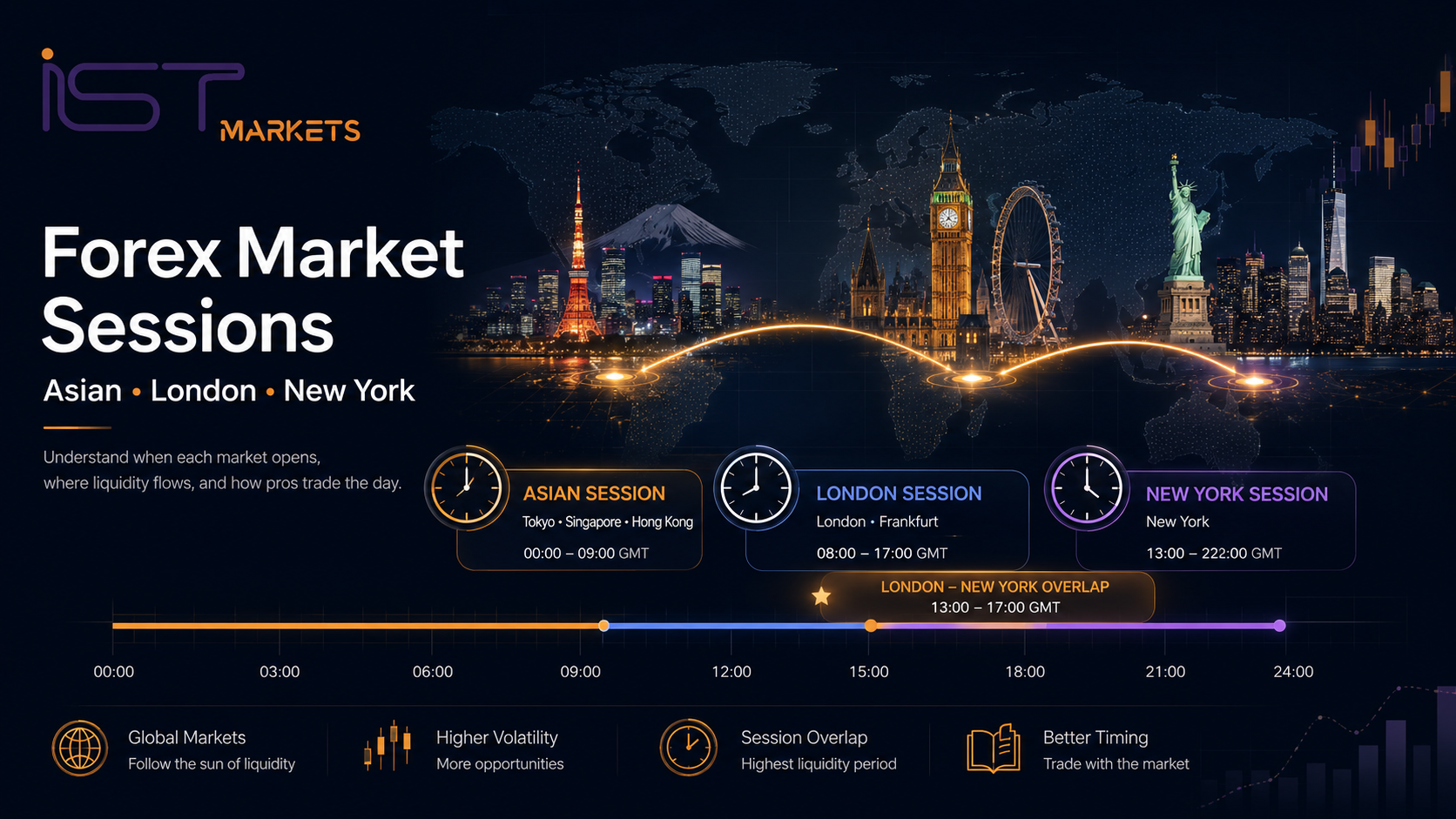
Forex Market Sessions Explained: Asian, London and New York Hours for Beginners
The market trades across time zones. Your routine should not.
Learn how to convert global forex activity into a practical local-time routine—without treating the busiest session, largest candle or session overlap as a trading signal.
Quick Answer: What should beginners know about forex market sessions?
Forex market sessions are practical activity windows associated with financial centres in Asia-Pacific, London and New York—not official openings of one central forex exchange.
Convert each window into your current local time, account for daylight-saving changes, check the selected currency pair and economic calendar, and verify platform time, spreads, margin and existing exposure. A busy session can bring more participation, but it can also produce faster repricing, wider execution differences and stronger emotional pressure. You do not need to watch every session, change your sleep schedule or trade the overlap.
What you should be able to do after reading
Identify the main activity windows, convert them into date-aware local time, understand why different websites show different hours, match a session with a currency pair and economic event, verify platform and execution conditions, and choose whether to trade, wait, observe, practise or skip.
Important risk reminder
A session label does not guarantee liquidity, tight spreads, favourable execution or a profitable opportunity. Economic releases, holidays, low liquidity, volatility, gaps, slippage, leverage and correlated positions can create rapid losses and margin pressure. This guide is educational and does not provide personal financial advice, a buy or sell recommendation, or a signal to trade during any session.
Source and editorial methodology
Market-size information is based on final Bank for International Settlements data for April 2025. Daylight-saving explanations use official UK Government and US NIST guidance. Session hours are presented as common planning references, not official exchange bells. IST Markets’ Market Hours, Economic Calendar, Fees, Risk Disclosure and Order Execution Policy support the platform, event, cost and execution sections.
Forex Sessions in Your Local Time
Select a date to calculate the reference windows using your browser’s current time zone.
What Are Forex Market Sessions?
Forex market sessions are reference windows used to describe periods when financial institutions, dealers and market participants in particular regions are more active.
Retail education commonly groups the day into an Asia-Pacific window, a London or European window and a New York or North American window. Sydney is also used to describe the transition into a new trading week.
These names are useful, but they can create a false impression that three separate forex exchanges open and close each day. Spot foreign exchange is an over-the-counter market operating through a network of banks, dealers, platforms, institutions and counterparties. It does not have one central global exchange or one official session bell.
The definition to remember
A forex session name describes where activity may be concentrated. It does not describe how the market must behave, whether an instrument is available or whether a trader should open a position.
Why does the forex market appear to operate around the clock?
As one financial region approaches the end of its business day, another becomes more active. Asia-Pacific activity passes into Europe, followed by North America, before the cycle begins again.
Retail access commonly continues across the working week, but actual instrument availability, maintenance periods, holidays and product breaks depend on the provider and contract. Check the
IST Market Hours and Events page
before assuming that every instrument follows the same schedule.
Three different clocks beginners often confuse
| Clock | Question it answers | What it does not prove |
|---|---|---|
| Global FX activity | Which regions and institutions may be more active? | That your retail instrument is available or suitable. |
| Platform availability | Can the selected product currently be traded? | That liquidity, spread or execution will be favourable. |
| Personal execution window | Do you have a plan, time, focus and acceptable risk? | That a trade is required simply because you are available. |
The Global FX Market in Context
Final BIS data show that average daily turnover in global OTC foreign exchange markets reached approximately $9.5 trillion in April 2025, 27% higher than in April 2022.
Average daily global OTC FX turnover in April 2025.
Increase from the April 2022 BIS survey.
Jurisdictions participating in the 2025 Triennial Survey.
What the $9.5 trillion figure actually includes
The figure covers global institutional OTC spot and derivatives activity, including forwards, FX swaps, currency swaps and options. It is not a measure of retail spot trading alone and does not describe the liquidity available to an individual account.
The 2025 BIS release identified the United Kingdom, United States, Singapore and Hong Kong as the four leading trading jurisdictions by sales-desk activity. This is why the “Asian session” should not be treated as Tokyo alone. Tokyo remains a useful time reference, but Singapore and Hong Kong are central parts of the wider Asia-Pacific market.
Official source:
BIS — Global FX Markets in April 2025.
Asian, London and New York Sessions Compared
| Activity window | Reference UTC hours | Currencies that may receive more attention | What can override the normal pattern? |
|---|---|---|---|
| Asia-Pacific / Tokyo reference | Approximately 00:00–09:00 UTC. | JPY, AUD, NZD and selected Asia-sensitive pairs. | Regional data, central-bank decisions, Chinese developments, holidays and geopolitical events. |
| London / European window | 08:00–17:00 UTC in UK winter; 07:00–16:00 UTC during BST. | EUR, GBP, CHF and European crosses. | UK or euro-area data, ECB or BoE events, holidays, opening flows and earlier Asian movement. |
| New York / North American window | 13:00–22:00 UTC in US winter; 12:00–21:00 UTC during US DST. | USD, CAD and instruments sensitive to US rates and data. | US and Canadian releases, FOMC communication, Treasury yields and previous European movement. |
Session conditions are conditional
A session name describes where activity may be concentrated. It does not describe how the market must behave that day.
| Type of day | How session behaviour may differ |
|---|---|
| Ordinary calendar day | Common regional participation patterns may appear more clearly. |
| High-impact data day | The release may dominate normal session characteristics. |
| Central-bank day | Participation and volatility may change before and after the decision. |
| Regional holiday | Participation may be lower even though the session is shown as active. |
| Geopolitical shock | Global risk repricing may override regional pair expectations. |
| Month or quarter end | Rebalancing and institutional flows may affect prices independently of retail narratives. |
Why Forex Session Times Change During the Year
Tokyo’s reference hours remain stable in UTC because Japan does not currently use seasonal clock changes. London and New York shift in UTC when the UK and United States enter or leave summer time.
The United Kingdom moves forward on the last Sunday in March and returns to GMT on the last Sunday in October. The United States begins daylight-saving time on the second Sunday in March and ends it on the first Sunday in November.
2026 transition timeline
US daylight-saving time begins. New York shifts one hour earlier in UTC.
British Summer Time begins. London shifts one hour earlier in UTC.
The UK returns to GMT. London shifts one hour later in UTC.
The US returns to standard time. New York shifts one hour later in UTC.
Transition-week warning
The UK and US do not change clocks on the same dates. During the gaps, a saved London–New York overlap table may be one hour wrong. Check the specific date rather than relying on a screenshot or permanent schedule.
Why different websites show different session times
Forex is decentralised, so publishers may define a session using local banking hours, dealer activity, a platform convention or a rounded educational window. Differences of about one hour do not necessarily mean one website is wrong.
Use one consistent reference system, check whether the publisher is using GMT, UTC, local time or server time, and confirm whether the table accounts for seasonal clock changes.
The Three Layers of Market Time
1. Market Availability
Is the instrument available, or is it affected by maintenance, a holiday or a product-specific break?
2. Regional Activity
Which currencies, institutions and economic releases may receive more attention?
3. Personal Execution Window
Do you have a prepared plan, enough time, acceptable costs and the focus to manage the position?
Market availability tells you when a price may be accessible.
Regional activity tells you when participation may change.
Your personal window determines whether you should act at all.
Liquidity, Volatility and Spread Are Not the Same
| Term | Practical meaning | What beginners should not assume |
|---|---|---|
| Liquidity | The availability of buyers, sellers and executable prices. | That every order will fill at the requested price. |
| Volatility | The speed and size of price movement. | That larger movement improves the probability of success. |
| Spread | The difference between the bid and ask prices. | That an active session always produces a tighter spread. |
| Slippage | The difference between the requested and executed price. | That a stop or market order must execute at the displayed level. |
Review the IST guide to
pips and spreads
before treating a busy period as automatically cheaper or safer.
The London–New York Overlap: Active Does Not Mean Safer
The overlap occurs when major European and North American participants are active at the same time. Participation in heavily traded pairs may increase, particularly in major USD and European currency pairs.
The same window can also concentrate US and Canadian releases, late-European positioning, changes in Treasury yields and rapid repricing. More participants can support liquidity, while more information arriving at once can increase interpretation and execution risk.
Best-fit is more useful than “best”
The busiest session is not automatically the best-fit session. The best-fit window is the one that aligns with your time, selected instrument, economic calendar, costs, exposure and ability to follow the plan.
Match the Session With the Pair and Economic Calendar
| Window | Pairs that may receive more regional attention | Checks before acting |
|---|---|---|
| Asia-Pacific | JPY, AUD, NZD and selected regional pairs. | Regional data, central banks, holidays and China-sensitive developments. |
| London | EUR, GBP, CHF and European crosses. | UK and euro-area releases, ECB/BoE events, spread and earlier movement. |
| New York | USD, CAD and USD-sensitive instruments. | US/Canadian data, FOMC risk, Treasury yields and European context. |
| London–New York overlap | Major USD pairs and European crosses. | News concentration, correlated exposure, price already travelled and execution conditions. |
Check the
economic calendar preparation guide
before every planned session. A session tells you when participation may change; the calendar tells you when new information may change the session itself.
Local Time, Server Time and Rollover Are Different
The time displayed on an MT5 chart may use the trading server’s time zone rather than the time on your phone or computer. This can change how session markers, daily candles and indicator resets appear.
- Compare platform time with current UTC.
- Record the server-to-local-time difference.
- Recheck the offset after seasonal clock changes.
- Do not copy session markings from another trader without converting them.
Session close, platform reset and rollover are not the same
“New York close” is often used as a charting or activity reference. It does not prove that every broker applies daily financing, maintenance or contract resets at exactly the same moment.
Overnight swaps depend on the instrument, market rates and account terms. A low-liquidity or maintenance window may also produce different conditions from the wider session. Verify the applicable specifications and the
IST Fees and Trading Costs page
rather than inferring rollover treatment from a generic session chart.
The IST Session Fit Test
Is the date-aware conversion correct, including current DST rules?
Is the selected pair logically connected to the currencies and regions active?
Have you checked inflation, employment, central-bank and other major events?
Are spread, liquidity, volatility and possible slippage acceptable?
Do other positions depend on the same currency, rate or event theme?
Do you have time, focus and emotional control to manage the position?
A session is suitable only when timing, instrument, event, cost, exposure and personal readiness align.
Beginner Routine Templates for Africa and MENA
Morning Learner
Review overnight movement, check the calendar, select one or two pairs and observe the European transition without assuming that the first move must continue.
After-Work Trader
Check what occurred before you arrived, identify whether major news has already been released and use a fixed 60–90 minute decision window instead of chasing the day’s movement.
Observer / Demo Routine
Follow one pair, record spread and volatility across different sessions, and practise platform workflow without treating simulated results as proof of live performance.
The IST
Demo Account vs Live Account guide
explains why demo practice cannot reproduce every live spread, slippage, liquidity and psychological condition.
Practical Scenario: The After-Work Overlap Trap
Hypothetical example
This scenario is educational and does not recommend any instrument or position.
A beginner in a UTC+3 location finishes work and opens MT5 during the London–New York overlap. EUR/USD and GBP/USD are moving quickly, gold is reacting to the dollar and US yields, and social media describes the overlap as the best time to trade.
The trader has not checked whether US inflation or employment data was released minutes earlier, whether spreads remain normal, whether London participation is beginning to fade or whether the movement has already travelled beyond the original plan.
Three positions are opened because three charts appear to provide diversification.
| What went wrong? | Better process |
|---|---|
| The trader arrived after the movement began. | Review what happened before opening the platform. |
| The overlap was treated as an entry signal. | Treat it as a window requiring further checks. |
| The economic event was ignored. | Check the release, timing and reaction before deciding. |
| Spread and execution were not reviewed. | Verify current bid, ask and volatility conditions. |
| Three USD-sensitive instruments were treated as diversification. | Calculate the combined currency and event exposure. |
Central lesson
Three charts can still represent one concentrated session-and-USD thesis. More positions do not automatically create more diversification.
The Final Session Decision Ladder
Common Mistakes and When to Skip
| Warning sign | Why it matters | Disciplined response |
|---|---|---|
| You saved one session schedule for the whole year. | London and New York shift seasonally. | Recalculate for the current date. |
| The platform time does not match your local markers. | Your candle and event timing may be wrong. | Confirm the server offset before acting. |
| A high-impact event is due or has just been released. | Normal session behaviour may no longer apply. | Observe until the event risk is understood. |
| The price moved before you became available. | Entering late can distort the original risk plan. | Do not chase the missed movement. |
| Several positions depend on the same currency theme. | Losses can become concentrated. | Calculate total exposure, not trade count. |
| You are tired, distracted or motivated by FOMO. | Decision quality and discipline may fall. | Skip the window and protect the routine. |
Build a Seven-Day Session Observation Routine
Before selecting a permanent trading window, observe one pair during one 60–90 minute window for seven trading days. The purpose is not to prove profitability. It is to understand your timing, platform, costs and behaviour.
| Journal field | What to record |
|---|---|
| Date | The exact observation date. |
| Local time and UTC | Your local window and corresponding UTC time. |
| Session | Asia-Pacific, London, New York or overlap. |
| Instrument | One selected currency pair or instrument. |
| Scheduled event | Any data release, speech or central-bank event. |
| Spread at start | The observed bid/ask difference. |
| Move before arrival | Whether the main movement had already begun. |
| Decision | Observe, practise, trade, wait or skip. |
| Lesson | The most important process insight. |
Risk reminder before taking action
Orders can be affected by volatility, illiquidity, market gaps, available prices, connection conditions and slippage. Leverage and several related positions can magnify the same loss. Review the
Risk Disclosure
and
Order Execution Policy
before using live leveraged exposure.
Build your seven-day session routine
Choose one currency pair and one 60–90 minute window. Record the local time, scheduled events, spread, movement before your arrival and whether you observed, practised, waited or skipped. Review the pattern before considering live exposure.
Supporting resources:
Market Hours & Events ·
Economic Calendar Guide ·
Demo vs Live Trading ·
First Live Trade Checklist
Final takeaway
The forex market can be available while your personal trading window should remain closed. A suitable session is not simply the busiest one. It is the window in which date, local time, instrument, economic events, costs, exposure and personal readiness fit a controlled process.
Frequently Asked Questions
Why do different websites show different forex session times?
Forex has no single central exchange or official global session bell. Websites may use banking hours, dealer activity, platform time or rounded educational windows. They may also show UTC, GMT, local time or times that do not adjust for daylight saving.
Is the Asian session the same as the Tokyo session?
Tokyo is a common time reference, but the wider Asia-Pacific market also includes major activity in Singapore, Hong Kong, Sydney and other regional centres.
Does daylight saving change forex session hours?
London and New York shift in UTC when the UK and US change clocks. Because they change on different dates, their overlap can temporarily move by one hour.
Is the London–New York overlap always the most liquid period?
It often brings simultaneous participation from major European and North American centres, but holidays, economic releases, instrument choice and available market liquidity can change conditions. Higher participation does not guarantee safer execution.
Why is my MT5 chart time different from my local time?
MT5 charts may display the broker’s server time rather than your device time. Record the server’s offset from UTC and convert it before marking sessions or comparing screenshots.
Can spreads widen during an active forex session?
Yes. Economic news, rapid repricing, holidays, low available liquidity and market transitions can widen spreads even during a normally active window.
Which session fits a full-time worker in Africa or MENA?
There is no universal answer. Choose a limited window that fits your current local time, work and sleep routine, selected instrument, economic calendar and ability to manage risk without rushing or fatigue.
Official Sources and Further Reading
- BIS — Global FX Markets When Hedging Takes Centre Stage
- BIS — 2025 OTC Foreign Exchange Turnover
- UK Government — Clock Changes
- NIST — US Daylight-Saving Rules
- IST Markets — Market Hours and Events
- IST Markets — Economic Calendar Preparation
- IST Markets — Risk Disclosure
- IST Markets — Order Execution Policy
- IST Markets — Fees and Trading Costs
Review and maintenance note
Review this article annually and whenever BIS data, daylight-saving laws, local time-zone rules, platform server settings, instrument hours, swap terms or IST execution documents change. Replace the 2026 transition timeline with the relevant year during each scheduled review.