Written by: IST Markets Education Team Reviewed by: IST Markets Research & Compliance Last updated: April 2026 This article is for educational purposes only and does not constitute investment advice.
Table of Contents
- What is a Pip?
- What is a Pipette?
- How to Calculate Pip Value
- Understanding Spreads
- Fixed vs Variable Spreads
- How the Spread Affects Your Trading Costs
- Minimising Trading Costs
- Frequently Asked Questions
📌 TL;DR — Key takeaways:
- A pip is the smallest standard unit of price movement in forex — usually the 4th decimal place
- Pip value depends on your lot size and which pair you’re trading
- The spread is the difference between the buy and sell price — it’s your cost to enter every trade
- Tighter spreads = lower trading costs
- Understanding both concepts is essential before placing your first live trade
Every forex price you see quoted has two numbers — and there’s a small gap between them. Every time a price moves, it moves in units so small they need their own name. Understanding these two mechanics — pips and spreads — is not optional knowledge. They are present in every single trade you will ever place.
Most beginners glance over them. The traders who understand them clearly have a measurable cost advantage over those who don’t.
This guide explains both concepts from scratch, with worked examples, a calculation walkthrough, and a clear breakdown of how spreads directly affect your trading costs.
What is a Pip?
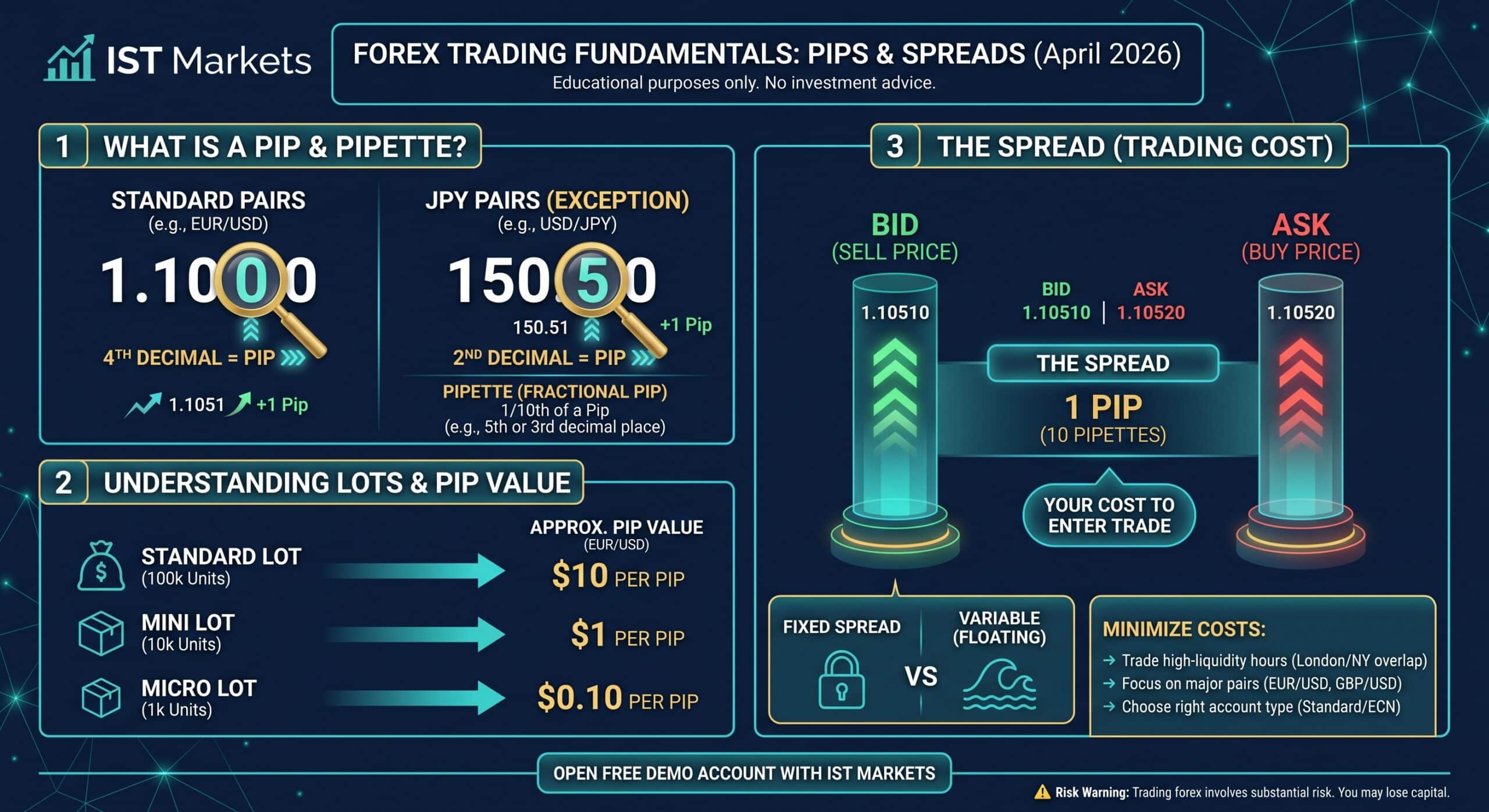
A pip (short for Percentage in Point, sometimes Price Interest Point) is the smallest standard unit of price change in a forex currency pair.
Simple definition: A pip is the “cent” of the forex world — the smallest measurable step a price normally moves.
For the vast majority of currency pairs, a pip is the fourth decimal place in the quoted price.
Example: If EUR/USD moves from 1.1050 to 1.1051, that is a movement of 1 pip. If it moves from 1.1050 to 1.1100, that is a movement of 50 pips.
| Movement | From | To | Pips |
|---|---|---|---|
| Small intraday move | 1.1050 | 1.1065 | 15 pips |
| Moderate daily move | 1.1050 | 1.1150 | 100 pips |
| Large news-driven move | 1.1050 | 1.1250 | 200 pips |
The Japanese Yen Exception
For currency pairs that include the Japanese Yen (JPY) — such as USD/JPY, EUR/JPY, or GBP/JPY — the pip is the second decimal place, not the fourth.
This is because the Yen is quoted differently: USD/JPY trades around 150.00, not 1.5000. So a move from 150.50 to 150.51 is 1 pip.
💡 Quick rule:
- Most pairs → pip = 4th decimal place (e.g., 1.1050 → 1.1051)
- JPY pairs → pip = 2nd decimal place (e.g., 150.50 → 150.51)
📌 In short: A pip is how forex measures distance. It tells you how far a price moved — but not yet what that movement is worth in money. That’s pip value (covered next).
What is a Pipette?
A pipette (also called a fractional pip) is one-tenth of a pip — the fifth decimal place for most pairs, or the third decimal place for JPY pairs.
Most modern forex platforms quote prices to five decimal places. The last digit is the pipette.
Example: EUR/USD quoted at 1.10504
- The 4 in the fifth decimal place is the pipette
- A move from 1.10504 to 1.10505 = 1 pipette = 0.1 pip
💡 Why does this matter? Spreads are often quoted in fractional pips — for example, “0.6 pips” — so understanding pipettes helps you read spread costs accurately. A spread of 0.6 pips = 6 pipettes.
How to Calculate Pip Value
Knowing that a price moved 20 pips tells you how far it moved — but not how much money that means for you. That depends on your lot size and the currency pair you’re trading.
Lot Sizes — The Foundation of Pip Value
In forex, position sizes are expressed in lots:
| Lot Type | Units | Approx. pip value on EUR/USD* |
|---|---|---|
| Standard lot | 100,000 | ~$10 per pip |
| Mini lot | 10,000 | ~$1 per pip |
| Micro lot | 1,000 | ~$0.10 per pip |
| Nano lot | 100 | ~$0.01 per pip |
Approximate values when account is denominated in USD. Actual values vary by pair and exchange rate.
Pip Value for USD-Denominated Accounts on USD Quote Pairs
For pairs where USD is the quote currency and your account is denominated in USD — such as EUR/USD, GBP/USD, AUD/USD — pip value is straightforward and fixed:
| Lot Type | Pip Value (USD account, USD quote pair) |
|---|---|
| Standard lot | $10.00 per pip |
| Mini lot | $1.00 per pip |
| Micro lot | $0.10 per pip |
| Nano lot | $0.01 per pip |
These values are stable and reliable for day-to-day use on major pairs like EUR/USD. Most beginners use these numbers as their working reference.
💡 Quick decision box:
- USD account + EUR/USD (or GBP/USD, AUD/USD) → use the shortcut values above
- Non-USD account, or trading a pair where USD is not the quote currency → use the IST Markets Pip Calculator for the exact value
For JPY Pairs
For USD/JPY and other JPY pairs, the pip is the second decimal place (not the fourth). This changes the calculation, and pip values are different. For USD/JPY at 150.50 with a standard lot, 1 pip ≈ $6.64 — not $10.
Rather than apply a formula manually, use the IST Markets Pip Calculator for JPY pairs, cross pairs (EUR/JPY, GBP/JPY), and any account not denominated in USD. Enter your pair, lot size, and account currency to get the exact value instantly.
📌 In short: A pip tells you how far the price moved. Pip value tells you how much money that movement means for you. The two together tell you your actual risk per trade.
Understanding Spreads
Every currency pair on a forex platform shows two prices, not one:
- Bid — the price at which you can sell the base currency
- Ask (also called Offer) — the price at which you can buy the base currency
The spread is the difference between these two prices, measured in pips.
Simple definition: The spread is the gap between what you can buy at and what you can sell at — right now, for a given currency pair. It is your cost to enter a trade.
Example:
| Price | |
|---|---|
| EUR/USD Ask (buy) | 1.10520 |
| EUR/USD Bid (sell) | 1.10510 |
| Spread | 1 pip (10 pipettes) |
When you open a long (buy) trade on EUR/USD at this moment, you immediately start at −1 pip. The market must move at least 1 pip in your favour just to reach break-even.
Why Does the Spread Exist?
The spread is one of the main ways many retail forex brokers price market access — though some account types also include a commission per trade, overnight swap charges, or other costs. Understanding the full cost structure of your specific account type is worth doing before you trade actively.
Some brokers — particularly those offering ECN or Raw Spread accounts — charge a small commission per trade instead and offer much tighter spreads. This can work out cheaper for active traders. For a breakdown of which structure suits which trading style, see our Account Types page.
Typical Spreads on Major Pairs
Spreads vary by broker, time of day, and market conditions. As a reference point, major pairs during normal London/New York session hours typically trade at:
| Pair | Typical Spread Range |
|---|---|
| EUR/USD | 0.5 – 1.5 pips |
| GBP/USD | 0.8 – 2.0 pips |
| USD/JPY | 0.5 – 1.5 pips |
| AUD/USD | 0.8 – 2.0 pips |
| USD/CHF | 1.0 – 2.5 pips |
| GBP/JPY | 1.5 – 3.5 pips |
These are indicative ranges only. Actual spreads depend on the broker, account type, and current market conditions.
⚠️ When spreads widen: During major news events, market open/close transitions, or periods of very low liquidity (late Friday, early Monday, public holidays), spreads on any pair can widen significantly — sometimes to 3–5× their normal level. Always be aware of upcoming economic releases before entering a trade.
📌 In short: The spread is the cost you pay to enter any trade. Every strategy, regardless of how it works, must account for the spread before it can be profitable.
Fixed vs Variable Spreads
Not all spreads work the same way. There are two main types — and choosing the right one depends on how and when you trade.
| Fixed Spread | Variable (Floating) Spread | |
|---|---|---|
| What it is | Stays the same regardless of market conditions | Moves with market conditions — tighter when liquid, wider when volatile |
| Pros | Predictable cost; no surprise widening during news | Often tighter during normal hours; very competitive on major pairs |
| Cons | Usually set higher than variable during calm markets | Can widen significantly during news, off-hours, or market open/close |
| Best for | Beginners wanting cost certainty; traders holding through news events | Traders active during peak liquidity hours (London/New York session) |
💡 Which is right for you? Most beginners start with variable spreads on major pairs during normal London/New York hours — costs are generally lower, and staying within peak hours naturally avoids the worst widening. As your strategy develops, you can compare structures in more detail on the IST Markets Account Types page.
📌 In short: Fixed spreads give you predictability. Variable spreads give you potentially lower costs — but only if you trade at the right times.
How the Spread Affects Your Trading Costs
The spread is not a one-off cost — it applies to every trade, every time. Understanding its cumulative impact is important for any trader who plans to trade with any frequency.
The Break-Even Calculation
Every trade you open starts at a loss equal to the spread. Here’s what that means in practice:
Scenario: You open a long trade on EUR/USD
- Spread: 1 pip
- Lot size: 1 mini lot ($1 per pip)
- Entry cost: $1 (the spread)
- For this trade to break even, EUR/USD must rise at least 1 pip
- For this trade to reach your 20-pip take profit target, EUR/USD must actually move 21 pips
This is why the spread is always factored into break-even calculations — not just as background knowledge, but as part of every trade plan.
The Compounding Cost of Spread Over Many Trades
| Trades per Month | Spread per Trade | Lot Size | Monthly Spread Cost |
|---|---|---|---|
| 20 trades | 1 pip | Mini lot ($1/pip) | $20 |
| 20 trades | 2 pips | Mini lot ($1/pip) | $40 |
| 50 trades | 1 pip | Mini lot ($1/pip) | $50 |
| 50 trades | 2 pips | Mini lot ($1/pip) | $100 |
| 50 trades | 1 pip | Standard lot ($10/pip) | $500 |
Reading this table: a trader placing 50 standard lot trades per month pays $500 in spread costs alone before a single pip of profit is realised — at a 1-pip spread. At 2 pips, that doubles to $1,000. Spread selection matters enormously at scale.
✅ Practical takeaway: For a beginner trading micro or mini lots, the absolute cost of the spread is small. But the habit of understanding spread cost before every trade is worth building now — because it scales directly with position size.
Minimising Trading Costs
You cannot eliminate the spread — but you can manage it intelligently.
1. Trade During High-Liquidity Hours
Spreads are tightest when the most participants are active. For major pairs, this is during the London session (8 AM – 5 PM GMT) and the London/New York overlap (1 PM – 5 PM GMT). Avoid trading in the first and last 30 minutes of a session, and avoid off-hours trading on pairs where spreads widen significantly.
2. Focus on Major Pairs
Major pairs (EUR/USD, GBP/USD, USD/JPY) carry the tightest spreads because they have the highest trading volume. Exotic pairs can carry spreads 10–20× wider than majors. For beginners, sticking to major pairs keeps costs predictable and low.
3. Choose the Right Account Type
For occasional traders: standard accounts with variable spreads typically offer competitive costs during normal hours.
For more active traders: ECN or Raw Spread accounts charge a small commission per trade but offer much tighter spreads. The total cost (spread + commission) can be lower than a standard account for traders who place many trades.
Visit the IST Markets Account Types page to compare the spread structures available.
4. Factor the Spread Into Every Trade Plan
Before entering a trade, answer this question: “How many pips does the market need to move in my favour just to break even?” That number is the spread. Your take profit target should be set with this cost already accounted for.
5. Compare Spreads Before Choosing a Broker
Not all brokers charge the same spreads on the same pairs. A broker offering 0.6 pips on EUR/USD costs roughly half as much per trade as one offering 1.2 pips — for every trade, indefinitely.
See our current spread rates on the IST Markets Spreads page — updated in real time.
Frequently Asked Questions
What is a pip in forex trading? A pip is the smallest standard unit of price movement in a forex pair. For most pairs, it is the fourth decimal place. For JPY pairs, it is the second decimal place. A move from 1.1050 to 1.1051 on EUR/USD is 1 pip.
How do you calculate pip value? Pip value depends on the currency pair, lot size, and account currency. For EUR/USD with a standard lot, 1 pip ≈ $10. With a mini lot, 1 pip ≈ $1. Use the Pip Calculator for exact values on any pair and lot size.
What is the spread in forex? The spread is the difference between the bid (sell) price and the ask (buy) price of a currency pair, measured in pips. It is the primary cost of entering a forex trade. A 1-pip spread on a mini lot trade costs approximately $1.
What is the difference between a fixed and variable spread? A fixed spread stays constant regardless of market conditions. A variable spread narrows during high-liquidity periods and widens during volatility or low-liquidity periods. Variable spreads on major pairs are often tighter during normal trading hours.
What is a pipette? A pipette is one-tenth of a pip — the fifth decimal place (or third for JPY pairs). It is used when brokers quote prices to five decimal places for greater precision.
How does the spread affect my profit? Every trade starts at a loss equal to the spread. The market must move in your favour by at least the spread amount before you break even. Lower spreads reduce the distance needed to reach break-even and lower your total trading costs over time.
When are spreads at their tightest? Spreads are typically tightest during the London session and the London/New York overlap (1 PM – 5 PM GMT) for major pairs. They widen during off-hours, major news releases, and early Monday or late Friday.
Getting Started with IST Markets
You now have a clear understanding of what pips and spreads are, how to calculate pip value, and how spreads affect the real cost of every trade you place.
The next step is to see these mechanics in action — in a live platform, on real prices, without financial risk.
→ Open Your Free Demo Account with IST Markets
Trade with virtual funds on real market prices. See pips and spreads in action before committing real capital.
Want to compare spread costs before opening an account? See IST Markets’ Current Spreads →
⚠️ Risk Warning Trading forex and leveraged products involves substantial risk and may not be suitable for all investors. You may lose some or all of your invested capital. Leverage can work against you as well as for you, and losses can exceed the margin deposited to maintain a position. These products are traded on an OTC (over-the-counter) basis and carry counterparty risk. Past performance is not indicative of future results. This content is for educational purposes only and does not constitute personal investment advice. Please consider your financial situation and risk tolerance carefully before trading. Service availability and regulatory protections may vary by jurisdiction and contracting entity.
Sources & Further Reading
- Bank for International Settlements (BIS) — Triennial Central Bank Survey of Foreign Exchange and OTC Derivatives Markets, 2025
- Commodity Futures Trading Commission (CFTC) — Trading in the Foreign Currency Markets: What Investors Need to Know
- Investopedia — Pip: What It Is in Forex Trading, Calculation, and Example
- Financial Conduct Authority (FCA) — CFDs, spread bets and binary options