Written by: IST Markets Education Team Reviewed by: IST Markets Research & Compliance Last updated: April 2026 This article is for educational purposes only and does not constitute investment advice.
Table of Contents
- What is Leverage in Forex?
- How Does Forex Leverage Work?
- Leverage Ratios Explained
- What is Margin — and How Does it Relate to Leverage?
- What is a Margin Call?
- Safe Leverage Best Practices
- The Psychological Side of Leverage
- Frequently Asked Questions
📌 TL;DR — Key takeaways from this guide:
- Leverage lets you control a larger position than your deposit — but losses scale up just as fast as gains
- Margin is the collateral your broker holds while your trade is open — it’s not a fee
- A margin call happens when your account equity falls too low to support your open positions
- Lower leverage (1:5 or 1:10) is generally more appropriate for beginners
- A stop loss on every trade is the most important safeguard when using leverage
- The biggest leverage risks are often psychological, not technical
Leverage is one of the most talked-about features of forex trading — and one of the least well understood. Beginners are often drawn to it because the numbers sound appealing: control $50,000 with just $500. What the headline rarely mentions is that the same ratio that multiplies your gains also multiplies your losses, at exactly the same speed.
This guide gives you a clear understanding of what forex leverage actually is, how margin requirements work, what the different leverage ratios mean in practice, and — most importantly — how to approach leverage in a way that protects your capital rather than destroying it.
This article is part of the IST Markets beginner education series. If you’re new to forex entirely, start with our guide on what forex trading is before continuing here.
What is Leverage in Forex?
Leverage in forex trading is a mechanism that allows you to open a trading position larger than the amount of money you have deposited. The broker provides the additional capital, and you control the full position — while your deposit acts as collateral.
Simple definition: Leverage is the ratio between your deposit and the total position you control. With 1:100 leverage, $1 of your money controls $100 in the market.
It’s expressed as a ratio: 1:10, 1:50, 1:100, 1:500. The first number is always 1 (your deposit unit). The second number is the total position size that 1 unit of your deposit controls.
A concrete example:
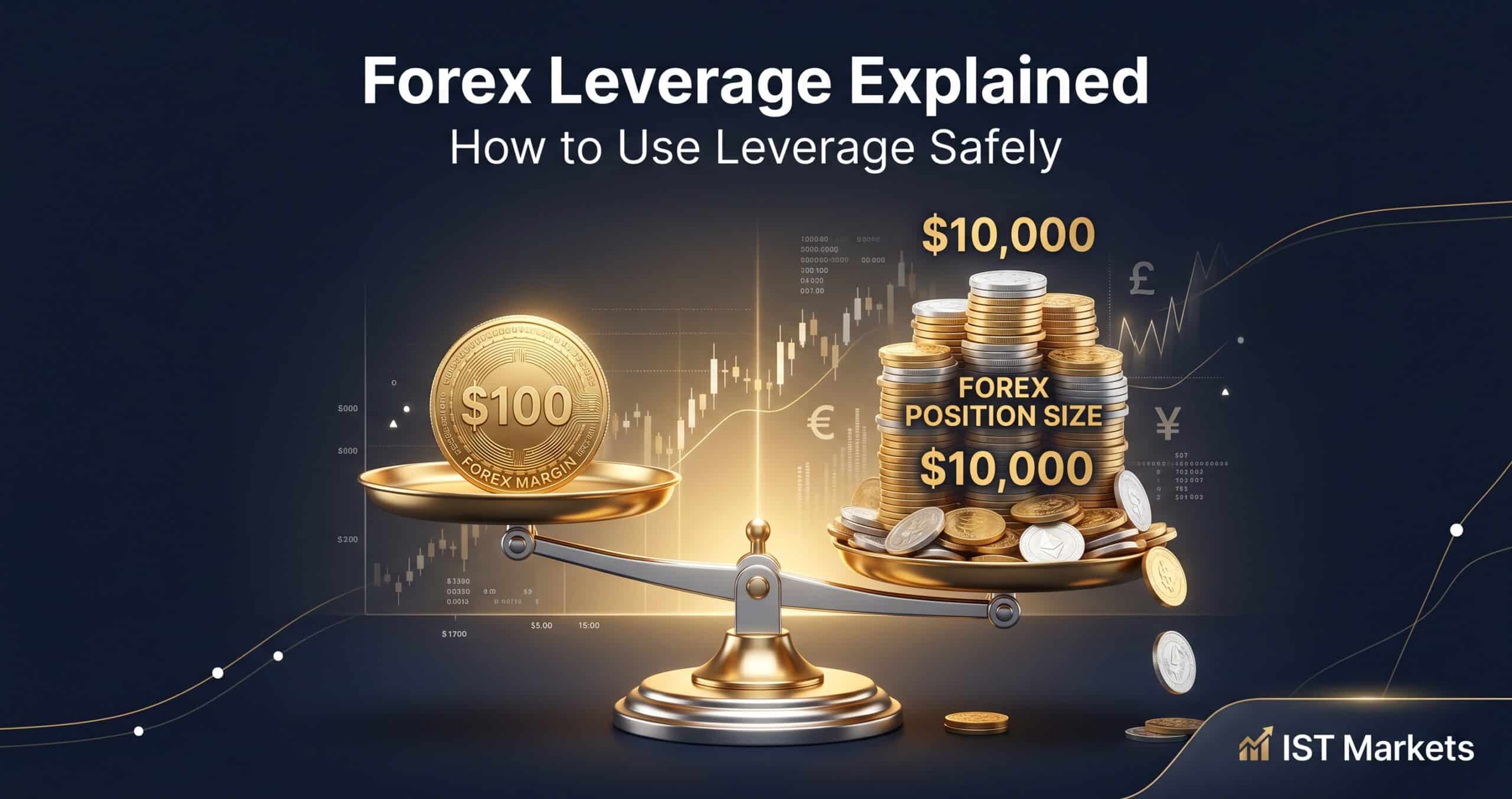
You want to trade EUR/USD. The full position size is $10,000. Without leverage, you’d need $10,000 in your account. With 1:100 leverage, you only need $100 — and you control the full $10,000 position.
If EUR/USD moves 1% in your favour, your $10,000 position gains $100 — which is a 100% return on your $100 deposit. But if EUR/USD moves 1% against you, your $10,000 position loses $100 — wiping out your deposit entirely.
This is the double-edged nature of leverage. It doesn’t change the market. It changes what market movements mean for your specific capital.
Why Does Leverage Exist?
Forex currency pairs move in small increments — often fractions of a percent per day. Without leverage, the profit potential on a small deposit would be negligible, and the market would be effectively inaccessible to retail traders with modest capital.
Leverage was introduced to make the forex market accessible to individual traders. The problem is that accessibility without understanding creates risk — which is why this guide exists.
How Does Forex Leverage Work?
Understanding how leverage works mechanically is the foundation of using it responsibly.
Your Deposit Is Collateral, Not the Full Cost
When you open a leveraged trade, you are not “buying” $10,000 worth of currency with $100. You are putting up $100 as a security deposit — called margin — to hold open a $10,000 position. The broker funds the difference.
Your profit or loss is calculated on the full $10,000 position, not just your $100 margin. This is the critical point that many beginners misunderstand.
A Step-by-Step Example
Let’s walk through a complete leveraged trade:
Setup:
- Account balance: $1,000
- Leverage: 1:50
- Currency pair: EUR/USD
- Position size: $10,000 (a mini lot)
- Margin required: $200 (2% of $10,000)
Scenario A — Trade moves in your favour: EUR/USD rises 50 pips. On a $10,000 mini lot, 1 pip ≈ $1. So 50 pips = $50 profit. Your $200 margin earned $50 — a 25% return on your deposited margin.
Scenario B — Trade moves against you: EUR/USD falls 50 pips. Loss = $50. Your margin position is now worth $150.
Scenario C — Market moves sharply against you: EUR/USD falls 200 pips. Loss = $200. Your margin has been entirely consumed. Without a stop loss in place, the broker may trigger a margin call (explained below).
⚠️ Key point: The leverage ratio determines how sensitive your account is to price movement. Higher leverage = larger position relative to deposit = faster losses (and gains) per pip. This is not inherently bad — but it must be understood before it’s used.
Leverage Ratios Explained
Different brokers offer different maximum leverage levels. The ratio available to you will also depend on the regulatory environment of the jurisdiction you’re in, the asset you’re trading, and whether you’re classified as a retail or professional client.
📌 Before the numbers: If the table below feels like a lot at once, focus on one row — the 1:10 row. Understand that one fully, then read the rest. The pattern is the same throughout.
Here is how the main ratios compare in practice, using a $1,000 deposit as the base:
| Leverage Ratio | Deposit | Position Controlled | 1% Market Move = | Risk Level |
|---|---|---|---|---|
| 1:5 | $1,000 | $5,000 | $50 profit or loss | Low |
| 1:10 | $1,000 | $10,000 | $100 profit or loss | Low–Medium |
| 1:50 | $1,000 | $50,000 | $500 profit or loss | High |
| 1:100 | $1,000 | $100,000 | $1,000 profit or loss (full account) | Very High |
| 1:500 | $1,000 | $500,000 | $5,000 profit or loss (5× account) | Extreme |
The key insight from this table: At 1:100, a single 1% move against you wipes out your entire $1,000 account. EUR/USD routinely moves 1% within a single trading session.
💡 Regulatory context: Many regulators have placed limits on the maximum leverage available to retail clients precisely because of these risks. In the European Union and UK, for example, retail clients are limited to 1:30 on major forex pairs under ESMA/FCA rules. Other jurisdictions allow higher ratios. The leverage available to you will depend on where you are and which IST Markets entity your account is registered under. Check your account documentation for the limits that apply to you.
How to Read a Leverage Ratio
When you see 1:100, read it as: “For every $1 I deposit, I can control $100 in the market.”
The inverse — which is how margin requirement is expressed — is simply the percentage version of the same thing:
- 1:100 leverage = 1% margin requirement
- 1:50 leverage = 2% margin requirement
- 1:10 leverage = 10% margin requirement
- 1:5 leverage = 20% margin requirement
Higher leverage = lower margin requirement = smaller deposit needed = higher risk per pip.
What is Margin — and How Does it Relate to Leverage?
Margin is the amount of money your broker requires you to hold in your account as collateral to keep a leveraged position open. It is not a fee — it’s a security deposit that is returned to you when the position closes (minus or plus your profit or loss).
There are three margin terms you’ll see in your trading platform. Each one means something slightly different:
| Term | What It Means | Why It Matters |
|---|---|---|
| Required margin | The deposit needed to open this specific position | Determines if you can open the trade |
| Used margin | Total collateral tied up across all open trades | Shows your total commitment right now |
| Free margin | Account equity minus used margin | Shows your remaining cushion |
💡 The one to watch: Free margin is your most important number day-to-day. It tells you how much room you have before a margin call becomes possible.
A worked example:
- Account balance: $2,000
- Open position: $50,000 (1:50 leverage → 2% margin requirement)
- Required margin: $1,000
- Used margin: $1,000
- Free margin: $2,000 − $1,000 = $1,000
If the market moves against you and your account equity drops to $1,100, your free margin shrinks to just $100. At a certain equity level — typically 50% of required margin, though this varies by broker — a margin call may be triggered.
💡 Beginner tip: Always monitor your free margin, not just your account balance. A healthy free margin is a sign of responsible position sizing. If free margin is close to zero, you are over-exposed.
What is a Margin Call?
In plain English: A margin call means your account no longer has enough cushion to support your open trades.
A margin call is one of the most important concepts in leveraged trading — and one worth understanding clearly before it ever happens to you.
What Triggers a Margin Call?
A margin call is triggered when your account equity falls to a certain percentage of your required margin — typically between 50% and 100%, depending on the broker’s policy. At this point, the broker notifies you that your account is at risk.
There are two common outcomes:
- Margin call notification — the broker alerts you to deposit more funds or close positions to bring your margin back to a safe level.
- Stop out — if your equity continues to fall to the broker’s stop-out level (often 20–50% of required margin), the broker automatically closes your open positions to prevent your balance from going negative.
A Margin Call Example
- Account balance: $500
- Open position: $25,000 (1:50 leverage, $500 margin required — your entire balance)
- The market moves 2% against you: loss = $500
- Account equity: $0
- Result: Margin call and forced close before equity reaches zero
This is an extreme example — but it illustrates why trading with your entire account as margin (100% utilisation) leaves zero room for normal market fluctuation.
✅ How to avoid a margin call:
- Never use more than 1–2% of your account as risk on a single trade
- Keep free margin well above zero at all times
- Use a stop loss on every position — this closes your trade automatically before losses consume your margin
- Avoid over-leveraging: opening multiple large positions simultaneously multiplies your margin exposure
Safe Leverage Best Practices
Leverage is not inherently dangerous — the way it is used can be. These practices are considered standard among traders who approach leverage with discipline.
📋 Quick summary — the 6 rules:
- Start with the lowest leverage available
- Risk no more than 1% of your account per trade
- Always set a stop loss before entering
- Calculate margin impact before every trade
- Reduce exposure during major news events
- Keep a leverage journal
Each rule is explained in full below.
1. Start With the Lowest Leverage Available
When you’re learning, the goal is to understand how the market moves — not to maximise every pip. Low leverage (1:5 or 1:10) keeps losses small while the learning process happens. You can always increase leverage later, once you have a documented track record of consistent execution.
2. Apply the 1% Rule
Risk no more than 1% of your account on any single trade. This is a widely used risk management principle — not a guarantee of profit, but a structural safeguard that prevents any single loss from significantly damaging your account.
How it works in practice:
- Account balance: $1,000
- Maximum risk per trade: $10 (1% of $1,000)
- Stop loss distance: 20 pips
- Maximum lot size: 0.05 (micro lots) so that 20 pips = $10
Your position sizing calculator can help you calculate the correct lot size for any trade based on your account balance, stop loss distance, and risk percentage.
3. Set a Stop Loss Before Every Trade
A stop loss is an automatic order that closes your trade if the price moves against you by a defined amount. It is your primary defence against leverage working against you.
Without a stop loss, a leveraged position is theoretically unlimited in its loss potential — the market can move far against you before you react, and losses compound faster than intuition suggests.
For a detailed guide on setting effective stop losses at the right levels, see our stop loss strategy guide.
4. Understand the Relationship Between Leverage and Margin Before You Trade
Before opening any leveraged position, calculate:
- How much margin will be required?
- How much free margin will remain after opening?
- At what price level will your stop loss close the trade?
- What is the maximum loss in dollar terms if the stop loss is hit?
If the answer to the last question makes you uncomfortable, reduce your position size — not your stop loss distance.
5. Avoid High Leverage During Major News Events
Economic news releases — such as US Non-Farm Payroll (NFP), central bank interest rate decisions, or inflation data — can cause currency prices to move rapidly and unpredictably within seconds. During these periods, even a well-placed stop loss can experience slippage (the trade closing at a worse price than your stop loss level because the market moved past it too quickly).
For beginners, the safest approach is to reduce position size or avoid open trades during major scheduled news events until you have experience managing volatility.
6. Keep a Leverage Journal
After every trade, record not just the outcome but the leverage and position size you used. Over 20–30 trades, patterns become visible: do you consistently over-leverage when the market is moving quickly? Do your losses come from positions that were too large? The journal is how you find out.
For a structured approach to risk management across all your trades, our risk management guide covers the full framework.
The Psychological Side of Leverage
This is the section most leverage guides skip — and the one that arguably matters most.
Why Leverage Changes How Traders Think
When you trade without leverage, a 1% market move is a 1% gain or loss on your capital. You feel it, but it’s manageable.
When you trade with 1:100 leverage, a 1% market move is a 100% gain or loss on your margin. That same number now feels existential.
This psychological shift happens to almost every beginner when they first use leverage in a live account — even those who understood the mechanics perfectly on paper. The reality of watching a position move $50 in seconds when your account is $500 activates emotional responses that override rational thinking.
The Three Leverage-Specific Psychological Traps
🔴 Trap 1: “I’ll just move my stop loss”
What it looks like: Your trade is at −30 pips. Your stop loss is at −40 pips. You’re almost certain the market will recover. So you move the stop loss to −60 pips to give it “more room.”
Why it happens: Accepting a loss feels like admitting you were wrong. Moving the stop loss delays that feeling — but it doesn’t change the outcome. It just makes the eventual loss larger.
What to do instead: Set your stop loss before entering the trade, at a level that reflects your actual risk tolerance — then leave it. If the trade hits your stop loss, that’s the system working correctly, not failing.
🔴 Trap 2: “I can recover it”
What it looks like: You lose $100. You feel compelled to make it back immediately. You open a larger position — using higher leverage — to recover faster. The trade goes against you again, this time for $200.
Why it happens: Leveraged losses feel disproportionately large because they are. The emotional pain creates urgency, and urgency overrides strategy.
What to do instead: After a loss, stop trading for the session. Review what happened without emotion. The market will be there tomorrow. Your account, if you revenge-trade aggressively, may not be.
🔴 Trap 3: “It worked last time”
What it looks like: You made a 200-pip gain using 1:100 leverage. Your account doubled. You feel confident. You increase your position size on the next trade.
Why it happens: One successful leveraged trade feels like confirmation that the approach is sound — when it may have been partly favourable market conditions that won’t repeat.
What to do instead: Judge your approach across 30–50 trades, not one or two. A single win with high leverage is not a track record.
How to Approach Leverage With the Right Mindset
The traders who use leverage sustainably share a common trait: they think about it in terms of risk per trade in absolute dollar terms, not in terms of the potential upside.
Before every trade, ask: “If this trade hits my stop loss, how much do I lose in dollars?” If that number is acceptable, the leverage and position size are appropriate. If it isn’t, reduce the position — regardless of how confident you feel about the trade.
Confidence does not change what the market will do. Position sizing is the only variable entirely within your control.
Frequently Asked Questions
What is leverage in forex trading? Leverage allows you to control a position larger than your actual deposit. With 1:100 leverage, a $500 deposit can control a $50,000 position. Profits and losses are both calculated on the full position size.
What is margin in forex trading? Margin is the deposit required to open and maintain a leveraged position. It acts as collateral — not a fee. When your position closes, the margin is released back to your account balance (adjusted for profit or loss).
What is a margin call? A margin call occurs when your account equity falls below the broker’s required margin level. The broker will ask you to deposit more funds or close positions. If the equity continues falling to the stop-out level, the broker may close your positions automatically.
What leverage ratio is appropriate for beginners? Lower ratios — such as 1:5 or 1:10 — are generally considered more appropriate for beginners because they limit how quickly losses can accumulate. Many experienced traders recommend starting with the lowest available leverage until you have a clear, documented understanding of your own risk management.
Can you lose more than your deposit with leverage? Yes. If the market moves significantly against your position before your stop loss is triggered — particularly during fast-moving market conditions — losses can exceed your initial deposit. This is one of the primary reasons stop losses and conservative position sizing are emphasised for all leveraged trading.
What is the difference between leverage and margin? They are two expressions of the same concept. Leverage (e.g., 1:100) is the ratio expressing how much larger your position is than your deposit. Margin (e.g., 1%) is the percentage of the total position size required as collateral. Higher leverage = lower margin requirement.
Getting Started Safely With Leverage at IST Markets
Leverage is a tool — and like any tool, its outcome depends on how it is used.
The path to using leverage responsibly starts with understanding it clearly (which you now do), continues with practising it in a no-risk environment, and only moves to live capital once you have a documented, consistent approach to position sizing and risk management.
The recommended sequence:
- Open a demo account with IST Markets — practise placing leveraged trades with virtual funds, applying stop losses, and monitoring margin levels in real market conditions with no risk to real money
- Apply the 1% rule across all demo trades — build the habit before it costs you anything
- Review your risk management fundamentals — leverage is one component of a broader framework
- Use the position sizing calculator to calculate your correct lot size before every trade
- Read the stop loss strategy guide — learn how to place stop losses at technically sound levels, not arbitrary ones
📌 Before trading with real leverage, review these pages:
- What is Forex Trading? — market fundamentals
- Forex Trading for Beginners — step-by-step first trade guide
- Risk Management Rules — the complete framework
- Stop Loss Strategy — how to protect every position
- Risk Disclosure — understand the risks specific to your account entity
Service availability and leverage limits may vary by jurisdiction and contracting entity. Review IST Markets’ legal documentation for the entity applicable to you.
⚠️ Risk Warning Trading forex and leveraged products involves substantial risk and may not be suitable for all investors. You may lose some or all of your invested capital. Leverage can work against you as well as for you, and losses can exceed the margin deposited to maintain a position. These products are traded on an OTC (over-the-counter) basis and carry counterparty risk. Past performance is not indicative of future results. This content is for educational purposes only and does not constitute personal investment advice. Please consider your financial situation and risk tolerance carefully before trading. Service availability and regulatory protections may vary by jurisdiction and contracting entity.
→ Open Your Free Demo Account with IST Markets
Practise leveraged trading with virtual funds. Real market conditions. No risk to real funds while using virtual money.
Ready to explore live account options when you are? Compare Account Types →
Sources & Further Reading
- Bank for International Settlements (BIS) — Triennial Central Bank Survey, 2025. bis.org
- Commodity Futures Trading Commission (CFTC) — Trading in the Foreign Currency Markets: What Investors Need to Know. cftc.gov
- Financial Conduct Authority (FCA) — CFDs and Spread Bets: High-Risk Investments. fca.org.uk
- European Securities and Markets Authority (ESMA) — ESMA Measures on CFDs and Binary Options. esma.europa.eu