Written by: IST Markets Education Team Reviewed by: IST Markets Research & Compliance Last updated: April 2026 This article is for educational purposes only and does not constitute investment advice.
Table of Contents
- Before You Start: The Mindset That Protects Beginners
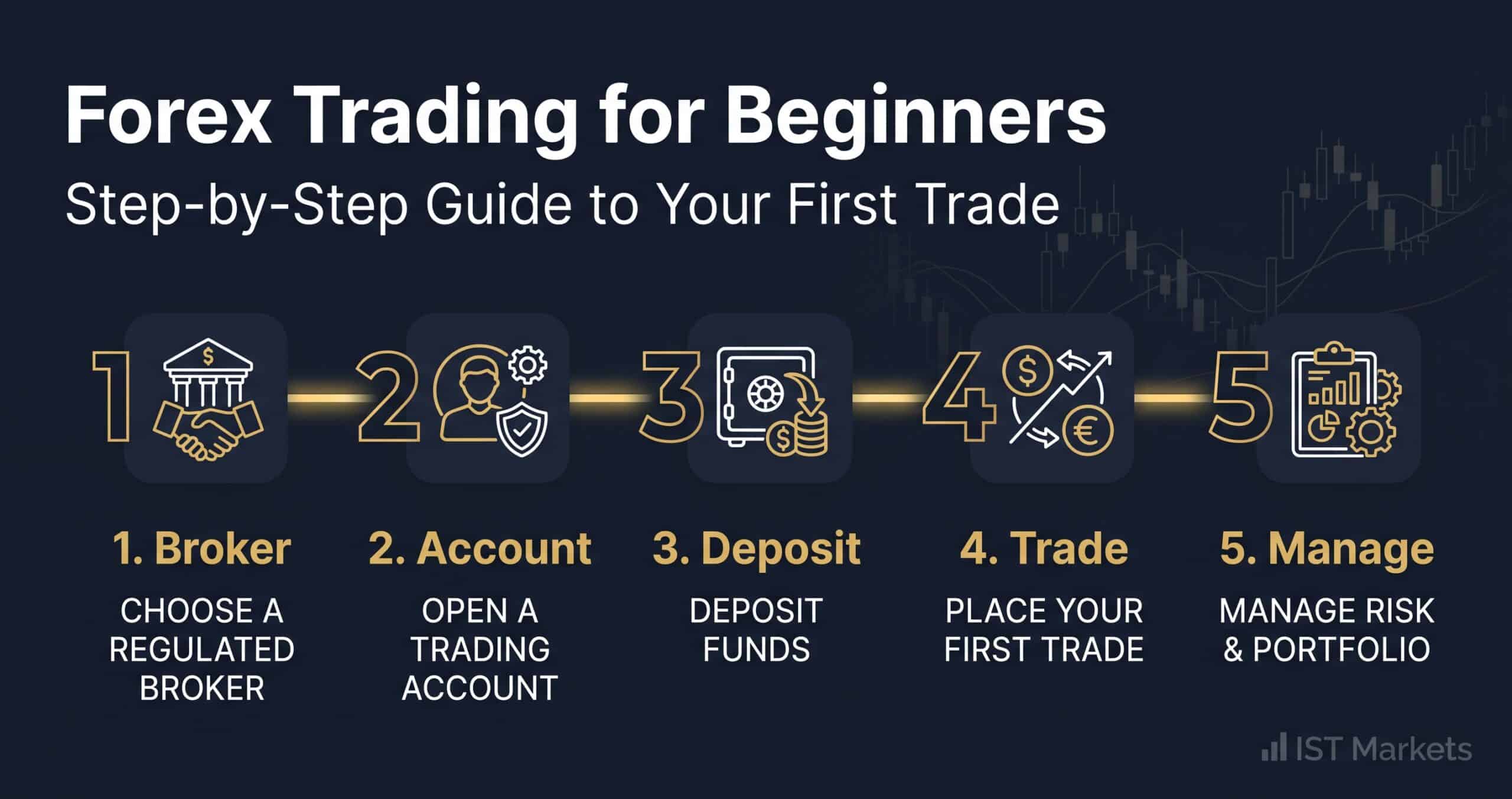
- Step 1: Choose a Forex Broker
- Step 2: Open Your Trading Account
- Step 3: Fund Your Account
- Step 4: Place Your First Trade
- Step 5: Manage Your Open Position
- Your First 30-Day Trading Checklist
- Frequently Asked Questions
- Getting Started with IST Markets
Most forex beginners read three articles, feel ready, open a live account, and lose money in the first week. Not because forex is impossible — but because there’s a big gap between understanding the concept and actually knowing what to click, what to set, and what to watch.
This guide closes that gap. You’ll find a clear understanding of every step involved in placing your first forex trade — from choosing a broker to managing an open position — explained in plain language, with no assumed knowledge.
If you haven’t read our introduction to what forex trading is yet, that’s worth a quick look first. This guide picks up where that one ends.
Before You Start: The Mindset That Protects Beginners
Before the steps, one thing is worth saying clearly.
Your first trades are not about making money. They are about learning to execute correctly — entering with a plan, managing risk, and observing how the market behaves in real time.
The beginners who last are those who treat their first 30–60 trades as paid education. The ones who don’t last are those who treat every trade as a chance to get rich quickly.
Keep that frame in mind throughout this guide. Every step below is designed to build a foundation — not to generate a shortcut.
Step 1: Choose a Forex Broker
Your broker is the platform through which every trade you place will be executed. Choosing the right one as a beginner is more important than most guides acknowledge — because the wrong environment makes learning harder, not easier.
What to Look for in a Forex Broker
Regulation is the most important factor. A regulated broker operates under the oversight of a recognised financial authority — such as the FCA (UK), ASIC (Australia), or CySEC (Europe). Regulation can provide important protections, but the exact safeguards, complaint routes, and client protections depend on the regulator and the contracting entity shown in your account documentation. Always review which entity you are contracting with and what protections apply to you specifically. Never trade with an unregulated broker.
💡 IST Markets note: IST Markets Ltd is regulated by the FSC Mauritius (Licence No. GB22200573 / SEC-2.1B). Regulatory protections, product availability, and complaint routes may differ depending on the contracting entity. Review IST Markets’ legal documents for the entity and jurisdiction that applies to you.
Spreads and fees directly affect your trading costs. Every trade you place costs you the spread (the gap between the buy and sell price — explained in our what is forex trading guide). Tighter spreads mean lower costs per trade, which matters a great deal when you’re trading frequently as a learner.
Platform quality affects your day-to-day experience. MetaTrader 4 (MT4) and MetaTrader 5 (MT5) are the most widely used platforms in retail forex — they’re worth learning on because the skills transfer regardless of which broker you eventually use.
Educational resources are particularly valuable at this stage. A broker that provides tutorials, market analysis, and clear documentation makes the learning curve shorter and less frustrating.
Customer support matters more than beginners expect. When you’re learning and something looks wrong on your screen, being able to speak to someone quickly is worth more than a marginal difference in spreads.
💡 Beginner tip: Don’t spend weeks comparing brokers. Choose a regulated broker with a clean reputation, a platform you can navigate, and educational support. You can always move later — but paralysis by comparison is itself a mistake.
When you’re ready to compare what sets IST Markets apart from other retail brokers, our Why Choose IST Markets page covers the specifics in detail.
Step 2: Open Your Trading Account
Once you’ve chosen a broker, the next step is opening an account. The process is straightforward but involves a few decisions worth understanding.
The Verification Process (KYC)
All regulated brokers are required to verify your identity before allowing you to trade. This is called KYC — Know Your Customer — and it’s a legal requirement, not bureaucracy for its own sake. It protects both you and the integrity of the financial system.
You’ll typically need to provide:
- A government-issued photo ID (passport or national ID)
- Proof of address (a utility bill or bank statement dated within the last 3 months)
Verification times vary depending on the broker, region, and the documents provided. Have your documents ready in clear, readable format to avoid unnecessary delays.
Choosing the Right Account Type
Most brokers offer more than one account type, each with slightly different conditions. Understanding the difference helps you choose what’s appropriate for your level.
| Account Type | Typical Features | Best For |
|---|---|---|
| Demo Account | Virtual funds, real market prices, no financial risk to real money | Learning the platform, testing strategy |
| Standard Account | Real funds, standard spreads, full market access | Beginners moving to live trading |
| ECN / Raw Spread Account | Tighter spreads + small commission per trade | More active or experienced traders |
| Islamic Account | Swap-free (no overnight interest charges) | Traders who require Sharia-compliant conditions |
✅ For complete beginners: Start with a demo account. Practise until you can execute a trade confidently, understand what your stop loss and take profit levels do, and complete 20+ trades without making execution errors. Then move to a standard live account.
To compare the specific account options available at IST Markets, visit our Account Types page.
Start on Demo — Here’s Why It Matters
A demo account is not a step you skip to get to the “real” part. It is the real part — for beginners.
A demo account gives you:
- Real-time or near-real-time market conditions (IST Markets’ demo environment provides real-time conditions — verify with your broker if using a different platform)
- Full platform functionality — charts, orders, indicators
- No risk to real funds while using virtual money
- The ability to make every possible mistake without financial consequence
Starting with a demo account is a common way for new traders to build genuine familiarity with the platform and market mechanics before live trading. Use it seriously, not as a throwaway exercise.
Step 3: Fund Your Account
When you’re ready to move from demo to live trading, the next step is making your first deposit.
How Much Should You Deposit?
There is no universally correct answer to this question, and any guide that gives you a specific number without knowing your financial situation should be treated with caution.
What we can say clearly:
- Only deposit what you can afford to lose entirely. Forex trading carries real risk. Your first deposit should be an amount whose complete loss would not affect your financial stability.
- A smaller deposit with good discipline is better than a large deposit with poor risk management. The size of your account does not determine the quality of your learning.
- Do not deposit under pressure. If a broker is pushing you to deposit a specific amount quickly, that is a warning sign.
Deposit Methods
Most regulated brokers accept a range of payment methods:
- Bank transfer (wire transfer)
- Credit or debit card
- E-wallets (PayPal, Skrill, Neteller, and others depending on your region)
Processing times vary — card and e-wallet deposits are typically instant, while bank transfers may take 1–3 business days.
A Note on Deposit Bonuses
Some brokers offer promotional incentives for new deposits. If IST Markets has a current offer running, you can check the details on our Promotions page. Always read the terms and conditions of any bonus carefully before accepting — particularly the trading volume requirements needed to withdraw bonus funds.
⚠️ Important: Never deposit funds to access a bonus. Deposit because you are ready to trade. The bonus, if available, is a secondary consideration — not the reason to fund your account.
Step 4: Place Your First Trade
This is the step most beginners are most nervous about — and the one most guides handle too quickly. Let’s walk through it in full detail.
Choose Your Currency Pair
For your first trade, EUR/USD is often considered a good starting point. It is one of the more beginner-friendly major pairs because of its liquidity and tight spreads, and there is a large volume of analysis and educational content available for it.
On your trading platform, find EUR/USD in the Market Watch window (MT4/MT5) or equivalent. You’ll see two prices displayed:
- Bid — the price at which you can sell
- Ask — the price at which you can buy
The difference between them is the spread — your cost to enter the trade.
Decide Your Direction
In forex, you have two options on every trade:
- Buy (go long) — you believe the base currency (EUR) will strengthen against the quote currency (USD). You profit if the price rises.
- Sell (go short) — you believe the base currency (EUR) will weaken against the USD. You profit if the price falls.
💡 Beginner tip: The ability to profit whether a market goes up or down is one of the things that makes forex different from simply buying shares. But it also means you can lose in either direction if your timing is wrong. This is why a stop loss (covered next) is non-negotiable.
Set Your Position Size
Position size (also called lot size) determines how much money is at stake per pip of movement.
In forex, the standard units are:
| Unit | Size | Pip value (approx. on EUR/USD) |
|---|---|---|
| Standard lot | 100,000 units | ~$10 per pip |
| Mini lot | 10,000 units | ~$1 per pip |
| Micro lot | 1,000 units | ~$0.10 per pip |
For beginners, micro lots are the appropriate starting point. A micro lot means a 10-pip move against you costs $1 — meaningful enough to feel real, small enough that mistakes are not catastrophic.
💡 How to think about position size: Before entering any trade, ask: “If the market moves X pips against me and hits my stop loss, how much will I lose?” That number should be an amount you are entirely comfortable losing. If it isn’t, reduce your lot size.
Set Your Stop Loss and Take Profit
These two levels are set before you enter the trade — and they are what separates disciplined trading from gambling.
Stop loss (SL) — an automatic order that closes your trade if the price moves against you by a defined amount. It is your maximum loss on this trade. If you set a stop loss 20 pips below your entry, and the price falls 20 pips, your trade closes automatically and you lose no more than that defined amount.
Take profit (TP) — an automatic order that closes your trade when the price reaches your target. If you set a take profit 40 pips above your entry, the trade closes automatically when that level is reached and your profit is secured.
✅ The ratio that matters: Aim for a take profit that is at least twice the distance of your stop loss. A 1:2 risk-to-reward ratio means even if you’re right on only half your trades, you can still be profitable overall before trading costs and assuming consistent execution. For example: stop loss = 20 pips, take profit = 40 pips.
Never trade without a stop loss. This is not a suggestion — it is the single most important rule for any beginner in any leveraged market.
Execute the Trade
Once you’ve defined:
- ✅ Currency pair (EUR/USD)
- ✅ Direction (buy or sell)
- ✅ Position size (lot size)
- ✅ Stop loss level
- ✅ Take profit level
Click Buy or Sell to open the trade. Your position is now live.
You’ll see it appear in your “Open Positions” or “Terminal” window (MT4/MT5), showing your entry price, current price, pip movement, and current profit or loss in real time.
Step 5: Manage Your Open Position
Opening the trade is not the end of the process — it’s the beginning of a different kind of discipline.
What to Do After Entering
The most common mistake beginners make after entering a trade is watching it constantly and making emotional decisions based on short-term price fluctuations.
The price will move against you at some point during nearly every trade — even trades that eventually reach your take profit. This is normal. It is not a signal to panic-close early.
If you’ve set your stop loss and take profit correctly before entering, the appropriate action for most trades is: do nothing.
Let the trade run. Let your pre-defined levels do their job. Interfering with a trade based on emotion — moving your stop loss further away because you don’t want to accept a loss, or closing your take profit early because you’re afraid of giving back gains — is how small losses become large ones and small gains become nothing.
When It’s Reasonable to Intervene
There are legitimate reasons to manage a trade after it’s open:
- Moving your stop loss to break even once the trade has moved a meaningful distance in your favour — this locks in a no-loss outcome even if the market reverses.
- Partial close — closing half your position at a target level and letting the rest run further with a protected stop loss. This is an intermediate technique, not recommended for your first few trades.
- Responding to a major news event that changes the fundamental picture of the trade — though for beginners, the cleaner approach is to simply avoid holding trades through major scheduled news events until you understand how to manage that risk.
Closing Your Trade Manually
If your stop loss or take profit hasn’t been triggered and you decide to close manually:
- Go to your Open Positions window
- Right-click the trade (MT4/MT5) or tap the close button
- Confirm the close
The profit or loss will be calculated automatically and reflected in your account balance immediately.
Your First 30-Day Trading Checklist
Use this as a practical reference for your first month. Print it, save it, or bookmark this page.
Before Your First Live Trade
- Chosen a regulated broker
- Completed identity verification (KYC)
- Opened and explored the trading platform on demo
- Placed at least 20 demo trades without execution errors
- Understood what a pip, spread, stop loss, and take profit mean
- Defined how much per trade you are comfortable losing
For Every Trade You Place
- Identified the currency pair and direction
- Set position size based on risk tolerance (not emotion)
- Set stop loss level before entering
- Set take profit level before entering
- Checked risk-to-reward ratio (minimum 1:2 recommended)
- Recorded the trade in your journal: pair, direction, entry, SL, TP, reasoning
After Each Trade
- Recorded the outcome in your journal
- Noted what you did well and what you’d change
- Did not increase position size after a win out of overconfidence
- Did not revenge-trade after a loss
After 20 Trades
- Reviewed journal for patterns in behaviour and outcomes
- Assessed whether your strategy is working across a sample (not a single trade)
- Decided whether to continue on demo or move to a live account
Frequently Asked Questions
How do I start forex trading as a complete beginner? Choose a regulated broker, open a demo account, practise placing trades with virtual funds until you can execute confidently, then follow the steps above for your first live trade. Never skip the demo stage.
How much money do I need to start forex trading? The right amount is whatever you can afford to lose without it affecting your financial stability. Most brokers accept small initial deposits. Focus on learning first — account size becomes more relevant as your skills develop.
What is a stop loss and why does it matter? A stop loss is an automatic instruction that closes your trade if the price moves against you by a set amount. It defines your maximum loss before you enter the trade — which is what makes it non-negotiable for beginners in any leveraged market.
What is the best currency pair for a first trade? EUR/USD is often considered a good starting point for beginners because of its liquidity, tight spreads, and the volume of available analysis and educational content. That said, the best pair is the one you understand best.
Should I use a demo account before trading live? Yes. A demo account gives you real market conditions with no risk to real funds. Starting with a demo account is a common way for new traders to build confidence and familiarity with the platform before committing real capital.
What is leverage and should beginners use it? Leverage allows you to control a larger position than your deposit. It amplifies both profits and losses. Beginners should use the lowest available leverage until they have a clear understanding of how it affects their risk per trade. For a full explanation, read our guide on leverage basics.
Getting Started with IST Markets
You now have a clear understanding of every step involved in placing your first forex trade. The next move is to put it into practice.
The most straightforward path from here:
- Open a demo account with IST Markets — practise the full process from account setup to trade execution, with no risk to real funds
- Complete your first 20 demo trades using the checklist above
- Review your journal — understand your patterns before committing real money
- Open your live account when you’re confident in your execution process
IST Markets provides a regulated trading environment, transparent pricing on major pairs (see our spreads and pricing page for current rates), and the educational support to help you move from beginner to confident trader at a pace that suits you.
📌 Before you fund a live account, review these pages:
- What is Forex Trading? — fundamentals and key concepts
- Account Types — choose the right account for your level
- Why Choose IST Markets — regulation, platform, and support
- Risk Disclosure — understand the risks before committing real funds
- Leverage Basics — how leverage affects your risk
Service availability may vary by jurisdiction. Please review IST Markets’ legal documentation for the entity and region that applies to you.
⚠️ Risk Warning Trading forex and leveraged products involves substantial risk and may not be suitable for all investors. You may lose some or all of your invested capital. Leverage can work against you as well as for you, and losses can exceed the margin deposited to maintain a position. These products are traded on an OTC (over-the-counter) basis and carry counterparty risk. Past performance is not indicative of future results. This content is for educational purposes only and does not constitute personal investment advice. Please consider your financial situation and risk tolerance carefully before trading. Service availability and regulatory protections may vary by jurisdiction and contracting entity.
→ Open Your Free Demo Account with IST Markets
Practise with virtual funds in real market conditions. No risk to real funds while using virtual money.
Ready to explore live account options? Compare Live Account Types →
Sources & Further Reading
- Bank for International Settlements (BIS) — Triennial Central Bank Survey, 2025. bis.org
- Commodity Futures Trading Commission (CFTC) — Trading in the Foreign Currency Markets. cftc.gov
- Financial Conduct Authority (FCA) — Retail CFD and Forex Products: Consumer Guidance. fca.org.uk
- CFA Institute — Introduction to Foreign Exchange Markets. cfainstitute.org