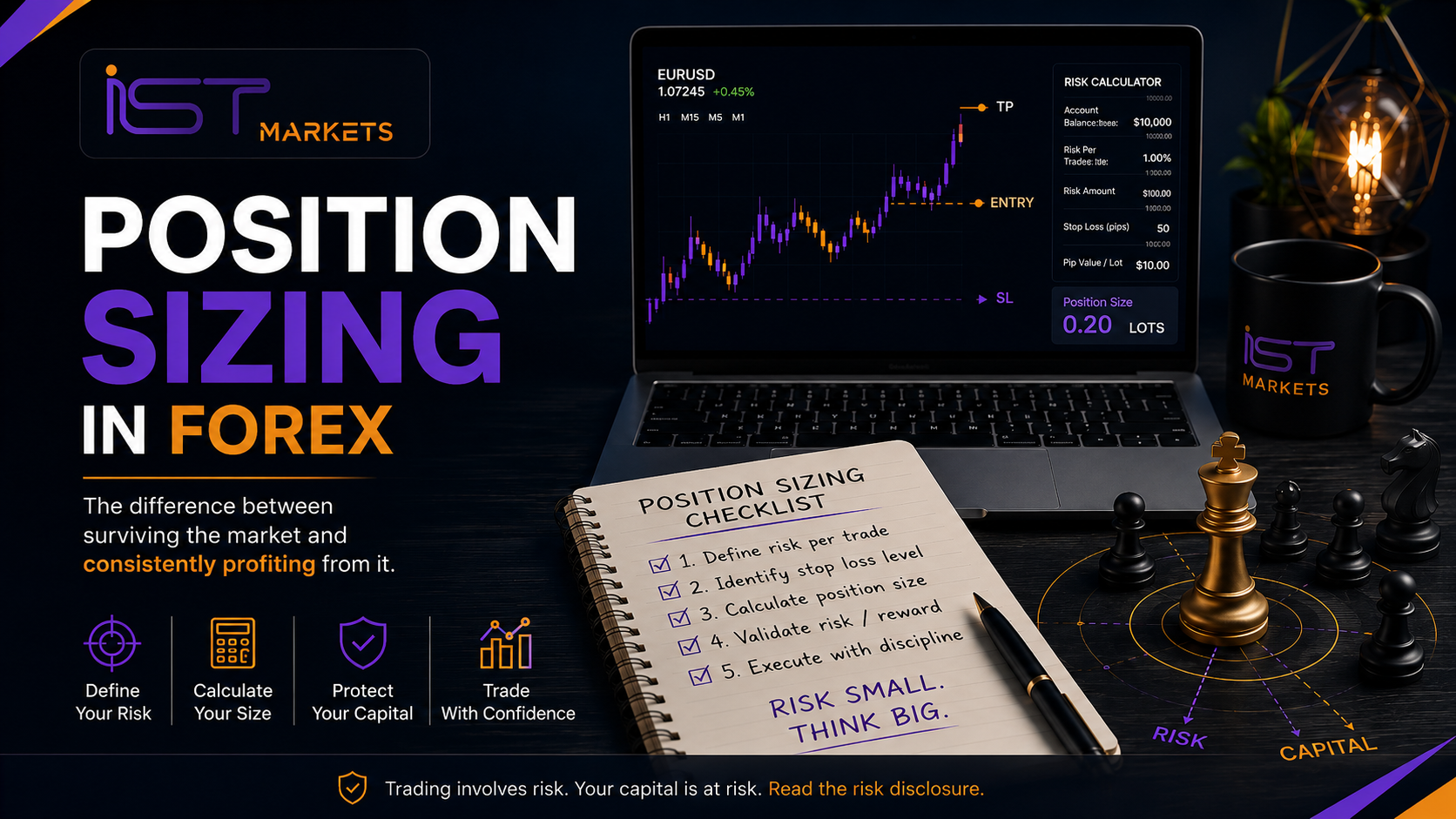
Position Sizing in Forex: How to Decide Trade Size Before Entry
A practical pre-entry risk guide for beginner-to-intermediate traders who understand entries, but need a repeatable process for deciding trade size before real money is exposed.
Quick Answer: What is position sizing forex?
Position sizing in forex is the pre-entry process of deciding how large a trade should be based on account equity, planned trade risk, stop-loss distance and pip value. It helps a trader estimate what could be lost if the trade is wrong before clicking buy or sell. A trade idea is not complete until the position size is known. Beginners should also check spread, slippage, swaps, commissions, margin impact and account terms because live outcomes can differ from simplified calculations.
Risk reminder before reading
Editorial Review Note
This guide treats position sizing as a pre-entry risk routine, not a prediction tool. The goal is to help traders define account risk before a position becomes live, instead of discovering the account impact after the order is already open.
Source Snapshot
This guide uses IST Markets Risk Disclosure, IST pip value and fees education, official retail-forex risk disclosure context, ESMA investor-protection context for CFDs, and established educational references for position-size formula validation. Examples are simplified for learning and should be checked against live platform specifications, account terms and product conditions before trading.
No-pressure education promise
What this guide will not do
Content Table
1What position sizing meansRisk before entry.
2Why entry is not enoughPrediction is not risk control.
3Official risk contextWhy sizing must stay conservative.
46 sizing brakesA pre-entry framework.
5Key inputsEquity, risk, stop, pip value.
6Formula frameworkSimplified, not guaranteed.
7Practical examplesSame risk, different size.
8Calculator blind spotsWhat tools cannot know.
What position sizing forex means in real trading terms
Position sizing forex means deciding the size of a forex trade before entry by connecting the account, the planned loss, the stop-loss distance and the pip value. It is the step that turns a trade idea into an account-level decision.
Many traders spend time choosing an entry and only a few seconds choosing trade size. In leveraged forex, that order can create problems. The trade size affects how much money is exposed if the trade moves against the account. That decision should be clear before the order becomes active.
Core idea
A position size can be expressed as units, lots or platform volume. But the important question is not only “What volume should I enter?” The better question is: “If this trade is wrong, what could happen to my account?”
Why entry alone is not enough
A trader can identify a strong-looking setup and still make a poor trade-size decision. The entry may be reasonable, but if the position size is too large for the account, a normal market movement can create account pressure, emotional decisions or margin stress.
This is the entry bias problem: when a setup looks convincing, traders may feel more comfortable increasing size. But a stronger opinion about direction does not remove the need to define risk before entry.
| What traders often focus on | What position sizing adds |
|---|---|
| Where to enter. | How much the account may lose if the entry is wrong. |
| Where price might go. | Whether the trade size fits account equity and stop distance. |
| How good the setup looks. | Whether the position remains proportionate if the setup fails. |
Official risk context: why sizing must stay conservative
Position sizing matters because leveraged trading can magnify account outcomes. IST Markets’ Risk Disclosure explains risks including leveraged losses, margin calls, stop-loss limitations, slippage, gaps and market disruption. A position-size formula can estimate planned risk, but live execution may still differ from the plan.
Official investor-risk sources also treat retail forex and CFD-style products carefully. U.S. retail forex rules include formal risk disclosure language, while ESMA’s CFD product intervention framework includes investor-protection concepts such as leverage limits, margin close-out and negative balance protection. These references are used as risk-education context, not as personal legal guidance or a claim that the same rules apply to every reader.
| Risk source | Relevant point | How beginners should use it |
|---|---|---|
| IST Markets Risk Disclosure | Leverage, margin calls, stop-loss limits, slippage, gaps and losses. | Treat position size as a risk control, not just an order input. |
| CFTC / eCFR context | Retail forex is treated as an area requiring formal risk disclosure. | Read risk documents before using live funds. |
| ESMA context | Leverage limits, margin close-out and mandatory risk warnings are investor-protection topics for CFDs. | Understand why leverage and margin are more than platform features. |
The 6 Position Sizing Brakes before entry
Before opening a forex trade, use these six brakes as a practical pre-entry framework. If one brake is unclear, the position size may need more review before real money is exposed.
| Brake | Question before entry | Why it matters |
|---|---|---|
| Account brake | Does this planned risk fit my account equity? | The same trade risk can be small for one account and serious for another. |
| Stop-distance brake | Is my stop-loss distance defined before entry? | Trade size cannot be estimated properly if the stop distance is unknown. |
| Pip-value brake | Do I know the money impact per pip? | Pips are price distance; pip value translates distance into account impact. |
| Cost brake | Have I considered spread, slippage, swaps and commission? | The live result can differ from a simple pre-cost estimate. |
| Margin brake | Will this size pressure free margin if price moves? | Available margin is not the same as risk tolerance. |
| Exposure brake | Do I already have related trades open? | Several similar trades can behave like one larger exposure. |
Key inputs for position sizing forex
A position-size decision usually starts with five inputs: account equity, planned risk amount, stop-loss distance, pip value and trading costs. Missing any of these can make the estimate weaker.
| Input | Meaning | Beginner warning |
|---|---|---|
| Account equity | The current account value used to judge whether planned risk is proportionate. | Do not copy trade size from someone with a different account. |
| Planned trade risk | The amount the trader is prepared to lose if the trade is wrong. | Do not choose this emotionally after entry. |
| Stop-loss distance | The number of pips between entry and the planned exit level. | A wider stop usually requires smaller size if planned risk stays the same. |
| Pip value | The money impact of one pip movement for the selected pair and size. | It can vary by pair, account currency and product specification. |
| Costs and execution | Spread, slippage, swaps, commission, conversion and gap risk. | A clean formula does not guarantee a clean live result. |
A simplified position sizing formula framework
Some traders use a fixed risk framework where they decide a planned risk amount before entry. This is an educational framework, not a universal recommendation. The important principle is that risk is defined before the trade becomes live.
Risk amount = Account equity × selected planning limit
The selected planning limit is an educational input, not a recommendation. Each trader’s financial situation and risk tolerance are different.
Estimated position size = Risk amount ÷ Stop-loss distance ÷ Pip value
This is simplified for education. It does not include spread, slippage, swaps, commissions, currency conversion, gaps or platform/product-specific rules.
Helpful internal learning path
Practical examples: same risk, different stop distance
The following examples are simplified. They show the logic of position sizing, not a recommendation for any account or trade.
| Scenario | Stop-loss distance | Same planned risk | Required pip value before costs |
|---|---|---|---|
| Tight stop | 20 pips | $20 | $1.00 per pip |
| Medium stop | 50 pips | $20 | $0.40 per pip |
| Wide stop | 100 pips | $20 | $0.20 per pip |
The lesson is simple: if the stop-loss distance gets wider and the planned risk amount stays the same, the position size usually needs to get smaller. This is one of the main reasons fixed lot sizes can create inconsistent account risk.
Same trade idea, different account impact
A position size cannot be judged properly without the account context. The same dollar risk can feel very different on two accounts.
| Same planned risk | Account A | Account B | Lesson |
|---|---|---|---|
| Estimated trade loss before costs | $30 | $30 | The planned loss looks identical in dollars. |
| Account equity | $300 | $3,000 | The account context changes the pressure. |
| Account impact | 10% | 1% | The same risk amount can be much heavier for a smaller account. |
What a position size calculator cannot know
Position size calculators can be useful planning tools, but they cannot know everything that may happen after entry. A calculator can estimate. It cannot guarantee live execution.
| Calculator can estimate | Calculator cannot guarantee |
|---|---|
| Approximate trade size. | Exact stop-loss fill. |
| Estimated risk before costs. | Actual live execution during volatility. |
| Pip value based on inputs. | Future spread widening or gaps. |
| Margin estimate. | Emotional behaviour after the order is open. |
Costs, slippage, spreads, swaps and margin limits
A position-size estimate can look clean in a spreadsheet, but live trading includes costs and execution conditions. Spread, slippage, swaps, commissions and currency conversion can affect the final account result.
Margin also matters. The platform may allow a larger position because leverage reduces required margin. That does not mean the account can comfortably withstand the exposure. Available margin is not the same as acceptable risk.
Cost-readiness rule
Position sizing vs lot size vs leverage
Position sizing overlaps with lot size and leverage, but they are not the same concept. Understanding the difference helps beginners avoid using one number as a substitute for full risk planning.
| Concept | Main question | Why it matters |
|---|---|---|
| Lot size | What does 0.01, 0.10 or 1.00 mean? | It defines platform volume and pip-value impact. |
| Pip value | How much is one pip worth? | It translates price distance into money impact. |
| Position sizing | How large should this trade be before entry? | It connects account equity, stop distance, pip value and planned risk. |
| Leverage | How much exposure can margin allow? | It can make larger exposure easier to open, but does not remove risk. |
Aggregate exposure check: one small trade may not stay small
Position sizing should not only look at one isolated trade. If several open trades are connected to the same theme, they may behave like one larger exposure.
| Trade | Theme | Planned risk |
|---|---|---|
| Trade 1 | USD weakness | $20 |
| Trade 2 | USD weakness | $20 |
| Trade 3 | USD weakness | $20 |
| Total | Related exposure | $60 before costs |
A trader may think each position is small, but the combined exposure can still create account pressure. This is why position sizing should include open exposure, not only the next trade.
Beginner scenario: sizing after entry vs sizing before entry
Imagine a trader finds a setup and enters quickly with a familiar lot size. After entry, the market moves against the position. Now the trader checks the account and realises the stop-loss distance is wider than expected, the pip value is larger than assumed, and free margin is under pressure.
The problem was not only the market direction. The problem was that risk was discovered after the trade became live. A pre-entry sizing routine reverses that process. The trader checks account equity, stop distance, pip value, costs, margin and related exposure before opening the order.
Common position sizing mistakes beginners should avoid
| Mistake | Why it is risky | Better approach |
|---|---|---|
| Sizing after entry | Risk is already live before it is understood. | Define size before clicking buy or sell. |
| Using the same lot size every time | Stop distance, pair volatility and pip value change. | Recalculate when the setup or instrument changes. |
| Copying a signal provider’s size | Their account, leverage and risk tolerance may be different. | Translate any idea into your own account-risk framework. |
| Treating stop-loss as guaranteed | Slippage, gaps and volatility can affect execution. | Use stops for planning, but allow for execution risk. |
| Confusing margin with risk tolerance | The platform may allow a trade that the account cannot comfortably absorb. | Base size on planned risk and account equity, not only available margin. |
| Increasing size after a loss | Revenge sizing can increase account damage. | Pause and rebuild the pre-entry plan. |
| Ignoring correlated trades | Several trades may move against the account together. | Check total open exposure before adding a trade. |
Position sizing forex checklist before taking action
Use this checklist before opening a live position. If two or more answers are unclear, the position-size decision may need more review before live execution.
| Readiness question | Ready? | Why it matters |
|---|---|---|
| I know my account equity. | Yes / No | Risk needs account context. |
| I know my planned trade risk. | Yes / No | The trade should not define risk after entry. |
| I know the stop-loss distance. | Yes / No | Stop distance affects required size. |
| I know the pip value. | Yes / No | Pip value translates price distance into money impact. |
| I checked spread, slippage, swaps and commission. | Yes / No | Costs can change the final result. |
| I checked margin and free margin impact. | Yes / No | Margin pressure can develop if the position moves against the account. |
| I checked related open trades. | Yes / No | Several related trades can create larger combined exposure. |
Where this guide fits in your learning path
Position sizing sits between analysis and execution. First, learn what lot size means. Then learn pip value. Then connect stop distance, planned risk and account equity before entry. After that, review margin, leverage and the risk of margin calls.
Smart learning path
Risk reminder before the CTA
Before using live funds, review the risk disclosure, account terms, fees, platform conditions and product specifications. Position sizing can help estimate planned risk, but it cannot guarantee execution, remove slippage, prevent gaps or make leveraged trading suitable for every person.
A responsible trader does not wait until the trade is live to discover the account impact. The trade size should be part of the plan before entry.
Soft CTA: Build your pre-entry sizing routine before using live funds
Before placing live trades, review the IST Markets risk disclosure, check the legal documents, practise through a demo account, compare account types, and review trading fees and costs.
Practise first. Verify first. Treat position sizing as a risk routine, not a prediction tool.
Final Takeaway
A strong trade idea is still incomplete without a clear position-size decision. The goal is not to predict every move correctly; it is to know the account impact before risk becomes live.
FAQ
What is position sizing forex in simple terms?
Position sizing forex is the process of deciding trade size before entry based on account equity, planned risk, stop-loss distance and pip value.
How does position sizing forex work for beginners?
A beginner starts by defining the planned risk amount, then checks stop-loss distance and pip value to estimate a trade size. The estimate should also consider costs, margin and execution risk.
What inputs do I need to calculate position size?
The core inputs are account equity, planned trade risk, stop-loss distance and pip value. Traders should also check spread, slippage, swaps, commission, currency conversion, margin and account terms.
Is position sizing the same as lot size?
No. Lot size is the platform volume, such as 0.01, 0.10 or 1.00. Position sizing is the process of deciding what volume fits the account, stop-loss distance, pip value and planned risk.
Does stop-loss distance affect position size?
Yes. If the planned risk amount stays the same, a wider stop-loss distance usually requires a smaller position size. A tighter stop may allow a larger size, but tight stops can also be affected by normal volatility.
Can a position size calculator guarantee my risk?
No. A calculator can estimate planned risk based on inputs, but it cannot guarantee live execution, stop-loss fill, spread behaviour, slippage, gaps or emotional decisions after entry.
Should I use the same position size on every trade?
Using the same size on every trade can create inconsistent risk because stop-loss distance, pip value, volatility, account equity and open exposure can change from one setup to another.
References & Further Reading
- IST Markets Risk Disclosure
- IST Markets Legal Documents
- IST Markets Demo Trading Account
- IST Markets Trading Account Types
- IST Markets Trading Fees and Costs
- IST Markets Pip Value Calculator Explained
- CFTC — Foreign Currency Trading
- eCFR — 17 CFR § 5.5 Risk Disclosure Statement
- ESMA — CFD Product Intervention Obligations
- BabyPips — Position Size Calculator