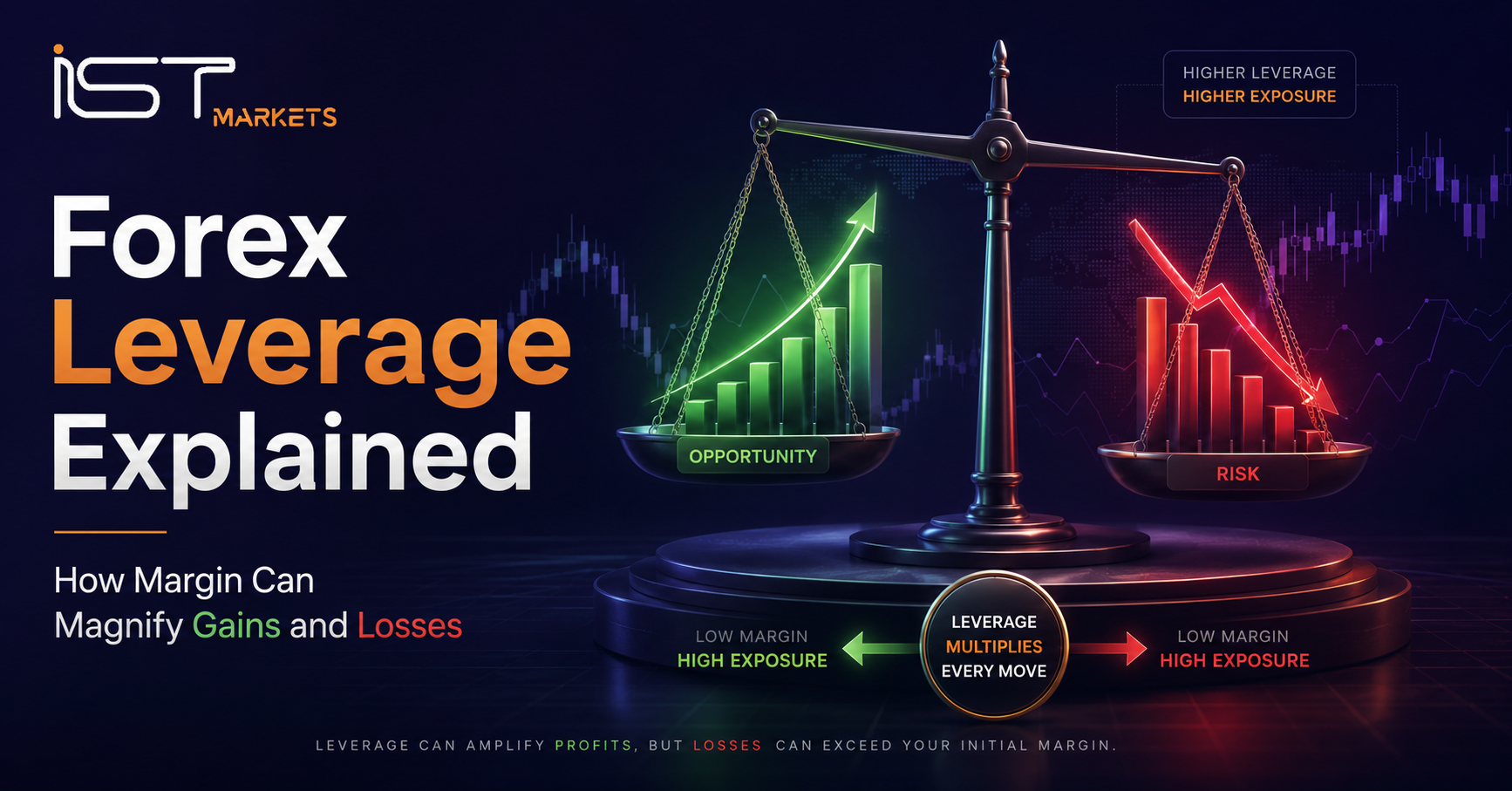
Forex Leverage Explained: How Margin Can Magnify Gains and Losses
A risk-first guide for beginners who see leverage as buying power, but need to understand exposure, margin, equity, position size and loss magnification before trading live.
Quick Answer: What should beginners know about forex leverage?
Forex leverage lets a trader control a larger market position with a smaller margin amount, but it does not reduce risk. The market movement is measured against the full position size, not only the margin used. This means leverage can magnify gains and losses. A beginner should understand exposure, required margin, account equity, free margin, margin pressure, spreads, slippage and stop-out risk before using live funds. Leverage is not extra money; it is larger exposure. If the position is too large for the account, a small adverse move can cause a large loss.
Risk reminder before reading
Editorial Review Note
This guide explains forex leverage as a risk-management concept, not as a promotional feature. The goal is to help beginners understand margin, exposure, account equity and loss magnification before using leverage in a live account.
Source Snapshot
This guide uses investor-risk education from CFTC, NFA, FCA and ESMA, plus IST Markets Risk Disclosure and legal-document references. Formula examples are simplified for education and should be checked against live platform specifications, account terms and product conditions before trading.
No-pressure leverage education promise
Content Table
1What leverage meansExposure, not free money.
2Why it matters before live tradingSmall moves can become big account events.
3Core formulasMargin, leverage and exposure.
4Simple exampleHow exposure changes the result.
5Margin pressureBalance, equity and free margin.
6Costs and leverageSpread, slippage and swaps matter more.
7Beginner scenarioThe trader attracted by high leverage.
8Common mistakesWhat beginners often misunderstand.
What forex leverage explained means in real trading terms
Forex leverage explained simply means understanding how a smaller margin amount can control a larger market position. If a trader uses 1:50 leverage, every $1 of margin can control up to $50 of market exposure, subject to the account terms and product conditions. That sounds powerful, but it is where many beginners misunderstand the risk.
Leverage does not make the trade safer. It does not make the market more predictable. It does not reduce the size of a price move. It only changes the amount of margin needed to open the position. Once the trade is open, gains and losses are based on the full position exposure.
Core idea
This is why leverage should be taught as a risk-management concept, not as a shortcut. Beginners often see leverage as extra buying power, but a better way to think about it is: leverage makes it easier to open a larger position than your account would otherwise allow. That larger position can move for or against you.
Why leverage matters before funding or trading live
Leverage matters before live trading because it changes how quickly a trading account can be affected. A beginner may think a currency pair moved only 0.5% or 1%, but if the position size is large relative to account equity, that move can become a major account event.
The CFTC warns that retail forex trading is risky and that forex fraud often uses “too good to be true” return promises. It also states that many retail foreign exchange traders end each quarter in the red. That warning matters for leverage because high leverage is sometimes presented as an opportunity while the loss side is explained only in small print.
Regulators have also treated leverage as a key investor-protection issue in CFD markets. ESMA’s CFD product intervention measures included leverage limits, a margin close-out rule, negative balance protection, restrictions on incentives and standardised risk warnings. This does not create a universal rule for every trader or jurisdiction, but it shows why leverage should be explained with caution rather than hype.
A beginner should understand leverage before funding because live emotions are different from demo emotions. When real equity moves, decisions can become reactive. A trader may widen a stop-loss, add to a losing position, or open a bigger trade to recover losses. Leverage makes those emotional mistakes more dangerous.
Beginner trap
The core formulas: leverage, margin and exposure
Leverage becomes easier to understand when the formulas are simple. These formulas are educational approximations. Actual margin calculations can depend on instrument, account currency, platform, broker terms, market conditions and product specifications.
| Concept | Simple formula | Beginner meaning |
|---|---|---|
| Exposure | Exposure = Margin Used × Leverage | How large the market position is compared with the margin used. |
| Required Margin | Required Margin = Position Size ÷ Leverage | How much margin is needed to open the position. |
| Margin Requirement | Margin Requirement = 1 ÷ Leverage Ratio | The fraction of the position value required as margin. |
For example, with 1:100 leverage, the simplified margin requirement is 1%, because 1 ÷ 100 = 0.01. With 1:50 leverage, the simplified margin requirement is 2%. This does not mean 1:100 is safer. It only means less margin may be required to open the same position.
Better interpretation
Simple example: how a small market move can affect equity
The easiest way to understand leverage is to compare the same account equity with different exposure levels. The table below is simplified for education. It ignores spread, commission, swap, slippage and platform-specific stop-out rules.
| Account Equity | Leverage Used | Controlled Exposure | 1% Adverse Move | Impact on Equity |
|---|---|---|---|---|
| $1,000 | 1:10 | $10,000 | -$100 | About 10% of equity |
| $1,000 | 1:50 | $50,000 | -$500 | About 50% of equity |
| $1,000 | 1:100 | $100,000 | -$1,000 | About 100% of equity before costs |
The market move in the example is the same: 1%. What changes is the exposure. Higher leverage makes it easier to open a larger position, but the loss is measured against the larger position size. That is the part many beginners miss.
Loss magnification rule
Margin pressure: balance, equity, used margin and free margin
Many beginners look only at account balance. In leveraged trading, balance is not enough. A live platform may show balance, equity, used margin, free margin and margin level. These numbers help show whether the account has enough room to keep positions open.
| Term | Simple meaning | Why beginners should care |
|---|---|---|
| Balance | Account value before unrealised open profit or loss. | It can look stable while open positions are losing money. |
| Equity | Balance plus or minus unrealised open profit or loss. | This is the number that shows live account pressure. |
| Used Margin | Margin currently tied to open positions. | High used margin can leave less room for market movement. |
| Free Margin | Equity not currently used as margin. | Low free margin can create pressure or restrict new trades. |
| Margin Level | A platform ratio comparing equity to used margin. | Falling margin level can lead to warnings, margin calls or stop-out depending on account terms. |
A beginner should know where these figures appear on the trading platform before opening a live position. If a trader cannot explain balance, equity and free margin, they are not ready to use larger leveraged positions.
Costs make leverage more sensitive
Leverage does not exist in isolation. Trading costs can feel more important when exposure is large. Spread, commission, swap and slippage affect the trade before strategy quality is even tested.
Spread
The spread is the difference between the buy and sell price. A larger position means the spread cost can represent a larger account impact. Beginners should not evaluate leverage without understanding spread behaviour, especially around news, market open or low-liquidity periods.
Slippage
Slippage happens when the trade executes at a different price than expected. On a larger leveraged position, the same slippage can have a bigger financial effect. Stop-loss orders can help manage risk, but they may not always fill at the exact requested price during fast-moving markets.
Swap or overnight charges
If a leveraged position is held overnight, financing adjustments may apply depending on the product and account terms. A beginner holding trades for more than one session should understand overnight costs before entering.
Cost-readiness rule
Beginner scenario: attracted by high leverage
Imagine a beginner with a $1,000 account. They see high leverage and think: “Now I can trade like a larger account.” The platform allows a much larger position than the beginner expected. The trader opens a large position because the required margin looks small.
At first, the trade looks manageable. Then the market moves against the position. The account balance may still look familiar, but equity falls because the open trade is losing. Free margin becomes smaller. The trader feels pressure. They may close emotionally, widen the stop, add another position, or hope the market reverses.
This scenario is common because the trader focused on how much the account could open, not how much the account could safely absorb. A more professional approach would begin with risk per trade, position size, margin impact and stop-loss planning before entry.
| Rushed leverage path | Risk-first leverage path |
|---|---|
| Looks at maximum leverage first. | Defines maximum risk per trade first. |
| Opens a large position because margin required is small. | Chooses position size based on account equity and stop distance. |
| Ignores spread and slippage. | Checks total cost before entry. |
| Watches balance only. | Monitors equity, used margin, free margin and margin level. |
| Uses demo profit as confidence. | Uses demo to practise process, not to prove live performance. |
Common mistakes beginners make with leverage
Most leverage mistakes come from misunderstanding the relationship between margin, exposure and equity. The table below turns common beginner errors into practical checks.
| Mistake | Why it is risky | Better approach |
|---|---|---|
| Thinking leverage is extra money | It increases exposure, not certainty or account strength. | Think in terms of position size and risk per trade. |
| Choosing the highest leverage available | It can make large positions easy to open and hard to manage. | Use the smallest exposure that fits the plan. |
| Ignoring equity | Balance may look stable while open losses reduce equity. | Monitor equity, free margin and margin level. |
| Using demo success as proof | Demo does not fully recreate live emotion or execution conditions. | Use demo for platform practice and process building. |
| Forgetting trading costs | Spread, slippage and swaps can matter more when exposure is large. | Review fees and product specifications before trading. |
| Adding to losing trades | It increases exposure when the account is already under pressure. | Follow a written risk rule and avoid revenge trading. |
Forex leverage explained checklist before taking action
Use this checklist before using leverage in a live account. The goal is not to remove risk. The goal is to make the risk visible before money is exposed.
| Readiness area | What to confirm | Decision signal |
|---|---|---|
| Formula readiness | You can explain exposure, required margin and margin requirement. | Do not trade live if you cannot explain the position size. |
| Account readiness | You understand balance, equity, used margin, free margin and margin level. | Practise on demo until these platform numbers are familiar. |
| Cost readiness | You understand spread, commission, swap and slippage. | Review fees and product terms before entering a live trade. |
| Risk readiness | You know the maximum loss you accept before opening the trade. | If the trade can seriously damage the account, reduce exposure or do not trade. |
| Document readiness | You have reviewed risk disclosure, account terms and execution conditions. | Do not rely on platform access alone. |
Where this guide fits in your learning path
Leverage is only one part of account readiness. Before funding a live account, beginners should also review the account entity, legal documents, trading costs, platform workflow and risk disclosure. That broader readiness check comes before choosing position size or using margin.
Smart learning path
Risk reminder before the CTA
Before using leverage in a live account, read the risk disclosure, understand margin requirements, review account terms and practise position sizing on demo. Leverage can magnify both gains and losses. A stop-loss can support risk management, but it may not always fill at the exact requested price in fast markets, gaps or low-liquidity conditions.
A responsible beginner does not need to use the maximum leverage available. A smaller position that the trader understands is often more professional than a large exposure the trader cannot explain.
Soft CTA: Practise leverage before using it live
Before trading live, review the IST Markets risk disclosure, check the legal documents, practise through a demo trading account, and compare account types before deciding whether live leveraged trading is appropriate for you.
Practise first. Verify first. Use leverage only when you understand exposure, margin and risk.
FAQ
What is forex leverage explained in simple terms?
Forex leverage means controlling a larger market position with a smaller margin amount. It can magnify gains and losses because profit and loss are based on the full position exposure, not only the margin used.
What is the difference between leverage and margin?
Leverage is the ratio that allows larger exposure, such as 1:50 or 1:100. Margin is the amount required to open or maintain the position. Leverage describes the relationship; margin is the collateral used for the trade.
Does leverage increase losses?
Leverage can increase losses when it leads to a larger position size. The market movement is applied to the full exposure, so a small adverse move can create a larger account impact if the position is too large.
What should I check before using leverage?
Check required margin, position size, account equity, free margin, margin level, spread, slippage, swaps, stop-loss plan, account terms and risk disclosure before using leverage in a live trade.
Is high leverage dangerous for beginners?
High leverage can be dangerous when beginners use it to open positions that are too large for their account. The danger comes from excessive exposure, weak risk planning and not understanding margin pressure.
Is demo trading enough to practise leverage?
A demo account can help beginners practise order placement, margin monitoring and position sizing. However, demo results do not prove future live performance because live trading adds real financial pressure, execution differences and emotional decisions.
What is the safest way to start learning leverage?
The safest first step is education and demo practice. Learn the formulas, practise position sizing, review the risk disclosure and use small simulated positions until you can explain exposure, margin and potential loss clearly.
References & Further Reading
- CFTC — Forex Frauds Investor Education
- NFA — Forex Transactions Regulatory Guide
- ESMA — CFD Product Intervention Measures
- FCA — Restricting CFD Products Sold to Retail Clients
- IST Markets Risk Disclosure
- IST Markets Legal Documents
- IST Markets Demo Trading Account
- IST Markets Trading Account Types
- IST Markets Trading Fees and Costs