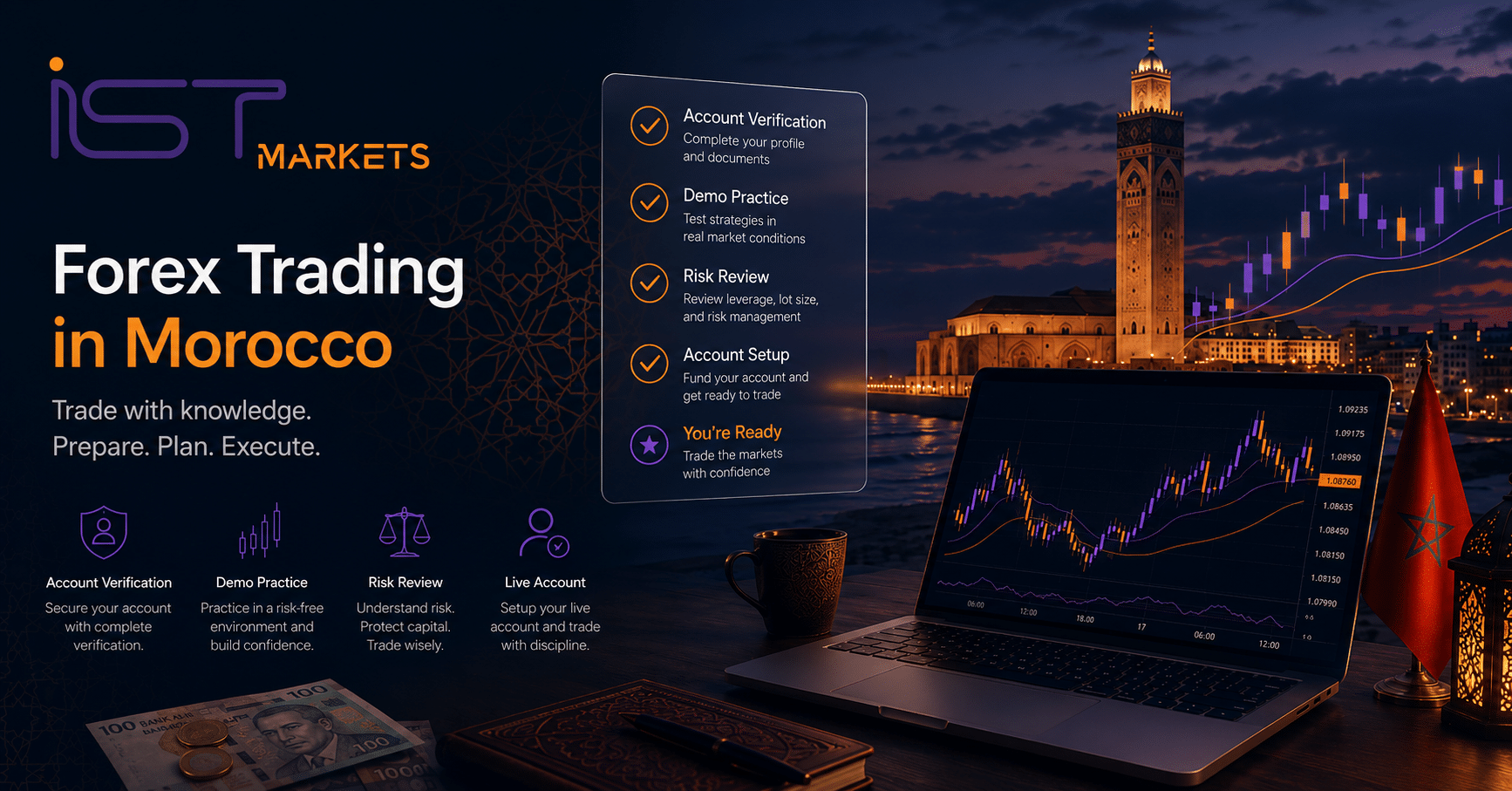
Quick Answer: What should beginners know about forex trading in Morocco?
Forex trading in Morocco means accessing global currency markets through an online broker account and a trading platform, often using margin and leverage. Before opening or funding a live account, Moroccan beginners should verify the broker’s legal entity, read account documents, understand whether the account currency differs from MAD, check both the deposit and withdrawal path, practise on demo, and review the risk disclosure. This article is educational only and does not provide legal, tax, investment or personal financial advice.
Risk reminder before reading
Who this guide is for — and who it is not for
This guide is for
- Moroccan beginners researching forex trading before live funding.
- Readers comparing online forex accounts, demo practice and account terms.
- Traders thinking in MAD but seeing accounts priced in USD, EUR or another currency.
- Beginners who want to understand the money path before using live funds.
- MT5 users who need to separate platform access from broker verification.
This guide is not for
- Ranking the “best forex brokers in Morocco.”
- Providing legal, tax, foreign-exchange or personal investment advice.
- Confirming that a specific overseas funding route is permitted.
- Promising safer trading, profits, income or guaranteed execution.
- Introducing brokers, referral partners or promoters planning activity from Morocco.
Source Snapshot
This article uses official Moroccan sources for trust and verification context, including AMMC for capital-market investor-protection awareness, Office des Changes for foreign-exchange awareness, and Bank Al-Maghrib for banking, payment-system and foreign-exchange-market context.
World Bank Morocco data may be used for macro and digital context only. It is not used to suggest that forex trading is suitable for everyone. IST Markets product, account, cost or funding claims should only be added if confirmed on live IST pages or by internal compliance-approved sources.
What this guide does not claim
- It does not say forex trading is suitable for every Morocco-based beginner.
- It does not say forex trading is legal for every person, broker, platform, product or funding route in Morocco.
- It does not state that every online forex broker promoted to Moroccan residents is locally authorised.
- It does not confirm Morocco-specific deposit or withdrawal methods for IST Markets.
- It does not treat MT5, demo results, social-media screenshots or fast deposits as proof of trust.
- It does not recommend funding a live account.
Content Table
1Why Morocco needs this guide
Verification, MAD awareness and money path.
2Morocco reality check
The account is only one layer.
3Forex trading in real terms
Account, platform, currency and risk.
4The Morocco money path
From MAD budget to account currency.
5Deposit vs withdrawal
The real account-readiness test.
6Account verification
Brand, legal entity and documents.
7Demo-to-live practice
What to practise before live trading.
Why Morocco needs an account-verification guide, not another broker list
Many Moroccan beginners are not only asking whether they can open a forex account. They are asking something more practical: “If my money is in MAD, how will it move, what currency will my account use, and will withdrawal be as clear as deposit?”
That is why forex trading in Morocco should not be explained only as charts, platforms and currency pairs. For a Morocco-based beginner, the account relationship matters. The legal entity matters. The difference between a broker brand and the company behind the account matters. The platform login matters. The account currency matters. The deposit and withdrawal route matters. Risk disclosure matters.
The better first step is not “open a live account quickly.” The better first step is: verify the account, understand the MAD-to-account-currency path, practise on demo, review risk, and pause if anything is unclear.
Micro CTA: Verify before funding
Morocco Reality Check: the account is only one part of the decision
For Morocco-based beginners, opening a trading account may look like a simple online step. But the real decision has several layers: the legal entity behind the account, the account currency, the MAD-to-account-currency path, the withdrawal route, the documents required, and the risks of leveraged trading.
Because Morocco has an official foreign-exchange framework, beginners should not rely only on social-media claims, Telegram messages, deposit screenshots or platform access. Office des Changes states that its missions include regulating and controlling foreign exchange transactions, setting the terms and conditions of foreign exchange transactions that may be performed by residents and non-residents, and ensuring compliance with applicable exchange regulations.
Legal-awareness note
Morocco Pre-Live Framework
Before opening or funding a live forex account from Morocco, a beginner should be able to explain five things:
- The legal entity behind the account.
- The account currency and how it relates to MAD.
- The deposit and withdrawal route.
- The demo-to-live differences on the platform.
- The main trading risks: leverage, margin, slippage and possible loss.
What forex trading in Morocco means in real trading terms
Forex trading in Morocco usually means that a Morocco-based trader accesses global currency markets through an online trading account and a platform such as MT5. The trader may speculate on currency pairs such as EUR/USD, GBP/USD or USD/JPY. This is different from exchanging Moroccan dirhams for travel, import payments or personal foreign-currency needs.
In real trading terms, the setup has several layers: broker brand, legal entity, account documents, account currency, platform login, demo or live server, pricing conditions, spread, commission, swaps, leverage, margin, slippage, withdrawal terms and risk disclosure. A beginner who only checks the chart may miss the real account environment behind the chart.
| Layer | What it means | Moroccan beginner check |
|---|---|---|
| Broker brand | The name, logo or ad you see online. | Do not stop at the logo. Identify the legal entity and account documents. |
| Trading account | The account relationship that holds balance, margin and trading conditions. | Check account type, currency, fees, leverage and terms before live funding. |
| Platform login | The login used to access charts and place orders. | Confirm whether the login is demo or live and which server it uses. |
| Money path | How funds move from a MAD budget to account currency and back. | Do not assume funding and withdrawal are equally simple. Verify both. |
| Risk exposure | Leverage, margin, volatility, slippage and possible loss. | Read the risk disclosure before any live decision. |
The Morocco money path: from MAD budget to account currency
For Moroccan beginners, the money path is one of the most important parts of forex account readiness. Many traders think about their available budget in Moroccan dirhams. But the trading account may show balance, equity, margin and profit/loss in another currency such as USD or EUR. That difference can affect how a beginner understands risk.
If your real-life budget is in MAD, do not judge risk only by the account balance shown in USD or EUR. The number on the platform is only part of the story. You also need to understand conversion, possible fees, withdrawal value and how losses would feel when translated back into your real budget.
| Money-path stage | Question to ask | Why it matters |
|---|---|---|
| MAD budget | How much am I thinking of in Moroccan dirhams? | Your real-life budget may not match the account currency displayed on the platform. |
| Account currency | Will my trading account show balance in USD, EUR or another currency? | Balance, margin and profit/loss may feel smaller or larger if you mentally convert back to MAD. |
| Conversion | What exchange rate or conversion process applies? | Conversion can affect the credited amount and later withdrawal value. |
| Deposit route | Which route is confirmed, and what documents may be required? | Easy deposit messaging is not enough; the route and terms should be clear. |
| Withdrawal route | Will withdrawals follow the same path, currency and timing? | A beginner should understand withdrawal terms before funding, not after trading. |
| Official-source awareness | Do I need to verify foreign-exchange requirements with official sources or qualified advice? | Morocco has an official foreign-exchange framework; do not rely only on social-media claims. |
Money-path rule
Deposit is not the test — withdrawal clarity is
Many beginners focus on whether they can deposit. That is not enough. A smooth deposit screen is not the same as a clear withdrawal process. The real account-readiness test is whether you understand how withdrawal may work before you deposit.
For Moroccan beginners, this matters because the account may involve MAD thinking, another account currency, a payment provider, possible conversion, verification documents and timing differences. Do not wait until after trading to understand the withdrawal process.
| Before deposit, ask… | Why it matters | Safe beginner action |
|---|---|---|
| Is withdrawal available through the same route? | Some payment paths may differ between deposit and withdrawal. | Read withdrawal terms before funding. |
| Will withdrawal be in the same currency? | Currency changes can affect the final value received. | Understand account currency and conversion first. |
| What documents may be required? | Verification, source-of-funds or account checks may apply. | Complete and understand verification before relying on withdrawal. |
| Are fees or timing stated clearly? | Unclear fees or delays can create avoidable stress. | Do not rely only on chat messages or ads. |
Account verification: brand, legal entity, platform and documents
One of the most common beginner mistakes is trusting what is easy to see: a logo, a platform screenshot, a social post, a WhatsApp message, or a “fast deposit” claim. Those are not enough. A trading account is a legal and financial relationship. You need to know which entity you are dealing with and what documents govern the account.
Use official-source discipline as a mindset: documents before promises, written terms before screenshots, and risk disclosure before live funding. AMMC’s investor-protection and financial-education role is a reminder that transparency and reliable information matter when financial decisions are involved.
| What you see | What you must verify | Why it matters |
|---|---|---|
| Broker logo or brand name | Legal entity name and account documents. | A brand may be marketed globally, but your account is governed by specific documents. |
| MT5 login | Demo/live status, server name and account environment. | A platform login does not prove broker trust or account readiness. |
| Account-opening page | Client agreement, risk disclosure, account terms and fees. | The legal and cost details are usually in documents, not headlines. |
| “Fast deposits” claim | Withdrawal rules, processing conditions, documents and currency path. | Deposit ease does not guarantee withdrawal clarity. |
| Social-media result screenshot | Risk, position size, account terms and whether the result is verifiable. | Screenshots can hide losses, leverage, timing and risk. |
Before going live, review the relevant legal documents, account terms and risk disclosure. If a page, document or claim is not available or not clear, do not fill the gap with assumptions.
MT5 is access, not verification
MT5 can show you a chart, but it cannot tell you whether the account relationship, funding route, withdrawal terms or regulatory claim is clear. It is a platform for viewing prices, placing orders, managing positions and practising workflow. It is not a broker verification badge.
A Moroccan beginner should separate platform access from account trust. The useful question is not only “Can I log in to MT5?” The useful question is: “Do I know which entity holds my account, which documents apply, what currency my account uses, how funding and withdrawal may work, and what risks I am accepting?”
Platform rule
Demo trading: what Moroccan beginners should practise before live
A demo account is useful, but only if you use it correctly. Demo trading is not proof that live trading will work. It is a rehearsal for platform workflow, order management, account reading and risk discipline.
For Moroccan beginners, demo practice should include more than “open a trade and see if it wins.” It should include checking how balance, equity, margin, lot size, stop-loss, take-profit and account history appear on the platform. The goal is to understand what you are doing before real funds are involved.
| Demo task | What to practise | Live-account lesson |
|---|---|---|
| Login check | Confirm demo server, account number and platform environment. | Avoid confusing demo and live accounts later. |
| Order placement | Place a small practice order, then close it manually. | Do not learn basic platform controls with real funds. |
| Stop-loss and take-profit | Add, modify and remove protective levels. | Understand controls, while remembering stops may not guarantee exact execution. |
| Margin display | Watch balance, equity, margin and free margin. | Learn account pressure, not only profit/loss numbers. |
| Trade journal | Record reason, size, entry, exit, mistake and emotion. | Live trading requires process, not impulse. |
Micro CTA: Practise before account pressure
Costs and conditions: spread, commission, swaps, conversion and withdrawals
A Moroccan beginner should not judge a trading account only by minimum deposit or platform access. Real trading conditions may include spreads, commissions, swaps or overnight charges, margin requirements, conversion effects, withdrawal conditions and possible document checks.
The most dangerous cost is often the one the beginner did not understand. A small spread difference, a larger position size, leverage, or a currency-conversion assumption can change the real account result. Review the fees and account types before live trading.
Spread and commission
Spread is the difference between buy and sell prices. Commission may also apply depending on the account type. Beginners should understand whether trading costs are built into the spread, charged separately, or both.
Swaps and overnight costs
Positions held overnight may be affected by swap or financing charges depending on the product, account type and conditions. If a trader does not understand these costs, they should not hold positions overnight on live funds.
Leverage and margin
Leverage can make a position look easy to open, but it can also make losses move faster. A beginner should calculate position size, margin use and possible loss before placing a live trade.
Slippage and stop-loss limitations
Slippage can occur when the execution price differs from the expected price. Stop-loss orders can help manage risk, but they may not execute at the exact expected price in fast, illiquid or disrupted markets.
OTC and off-exchange risk
Many forex and CFD products are traded over the counter or off-exchange. These products may not offer the same protections as exchange-traded instruments. Traders should read the risk disclosure and understand the account relationship before using live funds.
Live-risk rule
If you cannot explain spread, leverage, margin, slippage, stop-loss limitations, account currency and withdrawal terms, you are not ready to fund a live account.
Moroccan beginner scenario: from curiosity to responsible pause
Imagine a beginner in Casablanca, Rabat or Marrakesh sees an online forex account advertised with MT5 access and fast setup. They are interested, but their real budget is in MAD. The account may show USD or EUR. The platform looks simple. A demo trade makes a profit. The beginner now thinks about going live.
A weak process would be to fund quickly because the platform looks professional. A stronger process starts with questions. Which legal entity governs the account? Which documents apply? What is the account currency? What conversion may happen? Is the deposit route clear? Is the withdrawal route equally clear? What documents may be required? What fees may apply? Has the trader read the risk disclosure?
The beginner then practises on demo again, not to chase profit, but to rehearse workflow: placing an order, setting a stop-loss, monitoring margin, closing the position and reviewing account history. If any part still feels unclear, the responsible decision is to pause.
Pausing is not weakness. For a beginner, pausing can be the most important risk decision before live trading.
Common mistakes Moroccan beginners should avoid
Many beginner mistakes happen before the first live trade. They are not always chart mistakes. They are account-readiness mistakes, money-path mistakes and verification mistakes.
| Mistake | Why it matters | Better approach |
|---|---|---|
| Starting with “which broker?” only | A broker list may not explain account entity, money path or risk. | Start with verification, documents, currency and withdrawal clarity. |
| Ignoring MAD/account-currency difference | Profit, loss, margin and withdrawal value may be understood incorrectly. | Know the account currency and how you mentally convert risk back to MAD. |
| Assuming deposits and withdrawals are equally simple | Withdrawal rules, documents, currency and timing may differ. | Check withdrawal terms before funding. |
| Treating MT5 as proof of trust | MT5 is a platform, not a legal or regulatory verification badge. | Verify the entity, documents and risk disclosure separately. |
| Demo profit equals live readiness | Live trading adds real money pressure, slippage and execution differences. | Use demo as workflow practice, not proof of future results. |
| Skipping the risk disclosure | Leverage, margin, OTC and stop-loss limitations may be misunderstood. | Read the risk disclosure before live funding. |
Before-live decision checklist
Use this decision checklist before opening or funding a live forex account. The goal is not to push you into action. The goal is to show when you should pause.
| If you cannot answer… | Decision | Next step |
|---|---|---|
| Which legal entity governs my account? | Do not fund yet. | Read account documents and verify the entity. |
| What currency will my account use? | Pause. | Understand balance, margin and P/L currency before live trading. |
| How could funds move from MAD to account currency? | Do not assume. | Verify the money path and official requirements where relevant. |
| How would withdrawal work? | Do not fund yet. | Review withdrawal terms, documents, timing and currency. |
| Is my platform login demo or live? | Do not trade yet. | Confirm account type, server and environment. |
| What leverage does to margin and possible loss? | Stay on demo. | Practise position size and margin calculations. |
| Have I read the risk disclosure? | Do not go live. | Review the risk disclosure carefully before any live decision. |
Personal trading research vs introducing others
Researching forex trading for your own possible account is different from introducing, referring, promoting or influencing other people’s trading decisions. This article is for personal trading-readiness research. It is not an introducing broker, referral partner or promoter guide.
If your activity involves referral links, running trading groups, promoting a broker, receiving compensation, teaching people to open accounts or influencing financial decisions, you should not rely on a beginner article. That type of activity may require separate legal, contractual and compliance review.
For promoters, educators or referral partners
Risk reminder before the CTA
A clear account page does not remove market risk. A demo profit does not prove live results. A platform login does not prove broker verification. A stop-loss does not guarantee an exact exit price. A deposit route does not automatically make withdrawal terms clear.
Before considering live funding, verify the legal entity, read the account documents, understand account currency, check the money path, practise platform workflow on demo, calculate margin exposure and review the risk disclosure. If any part is unclear, waiting is a responsible decision.
Soft CTA: Practise, verify, then decide
Before using live funds, review the IST Markets Legal Documents and Risk Disclosure so you understand the account relationship, trading risks and responsibilities.
If you are still learning platform workflow, practise first using a demo trading account. Demo practice helps you learn platform controls, but it does not prove future live results.
When comparing live conditions, review the relevant account types and fees carefully before making any funding decision.
FAQ
What is forex trading in Morocco?
Forex trading in Morocco means accessing global currency markets from Morocco through an online broker account and trading platform, often using margin and leverage. Beginners should verify account terms, legal entity, account currency, money path and risk before live funding.
Is forex trading in Morocco legal?
This article does not provide a blanket legal answer. Moroccan residents should verify the exact activity, account entity, product, money path and official requirements where relevant. For legal, tax or foreign-exchange questions, consult qualified advice or official sources.
How does forex trading in Morocco work for beginners?
A beginner usually opens or tests a demo account, logs in to a platform such as MT5, practises order workflow, checks the broker entity and account documents, reviews account currency and costs, and studies risk disclosure before considering a live account.
Why does MAD/account currency matter for Moroccan traders?
A Moroccan beginner may think in MAD, while the trading account may display balance, equity, margin and profit/loss in USD, EUR or another currency. This can affect how the trader understands risk, conversion, funding and withdrawal value.
Can I fund a trading account from Morocco?
This guide does not confirm whether a specific funding route is available or permitted. Before moving money, verify the account currency, provider terms, deposit and withdrawal process, documentation requirements and official foreign-exchange requirements where relevant.
Is MT5 enough to trust a broker?
No. MT5 is a trading platform, not a broker verification badge. It can help with charts and order workflow, but it does not prove the legal entity, account suitability, withdrawal clarity or risk level.
Is demo trading enough before live forex trading?
No. Demo trading can help with platform workflow and risk practice, but it does not prove future live performance. Live trading adds real money pressure, market execution differences, slippage, leverage risk and possible loss.
What should I check before opening a live forex account in Morocco?
Check the broker’s legal entity, account documents, risk disclosure, account type, account currency, deposit route, withdrawal route, fees, leverage, margin requirements, platform login type and whether you fully understand the money path.
What are the main risks of forex trading in Morocco?
The main risks include leverage, margin calls, spread changes, slippage, stop-loss limitations, market volatility, OTC/off-exchange risk, counterparty risk, account-currency misunderstanding, withdrawal uncertainty and demo-to-live overconfidence.