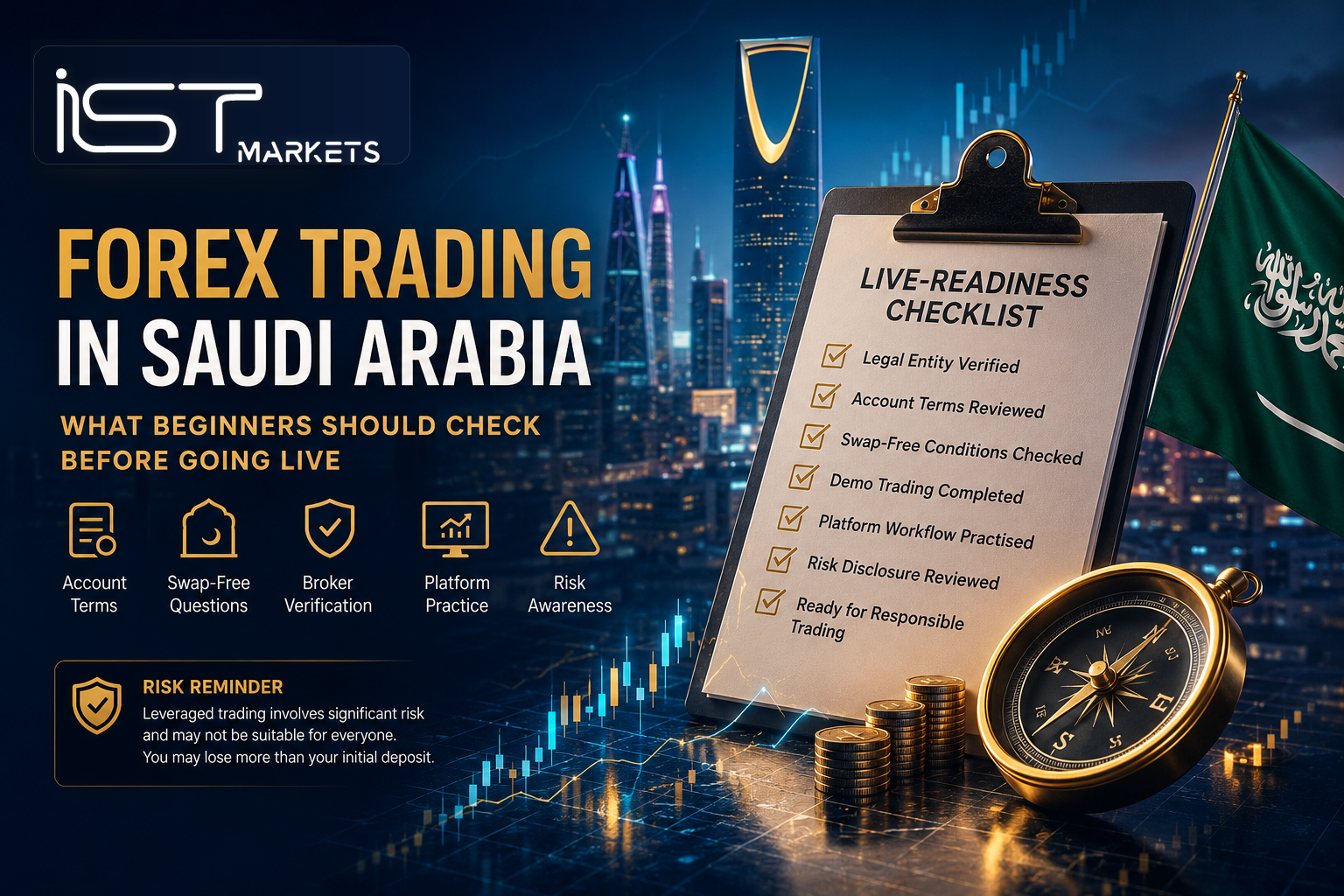
Quick Answer: What should Saudi-based traders check before going live?
Forex trading in Saudi Arabia means accessing currency markets through a broker account and trading platform, often with margin and leverage. Before going live, Saudi-based traders should verify the broker’s legal entity, read the written account terms, understand whether any swap-free conditions apply, practise the platform workflow on demo, check costs such as spread and possible overnight/admin fees, and review the risk disclosure. A swap-free or Islamic account label should never be treated as proof that trading is cost-free, risk-free or automatically suitable.
Risk reminder before reading
This is not a legal opinion or a Sharia ruling
Who this guide is for — and who it is not for
This guide is for
- Saudi-based beginners researching forex trading before live funding.
- First-time live traders who have used demo but are not sure they are ready.
- Early-stage retail traders checking account terms, platform workflow and trading risk.
- Readers asking swap-free or Islamic-account questions before holding positions overnight.
This guide is not for
- Ranking “best forex brokers in Saudi Arabia.”
- Providing a legal opinion about forex trading in Saudi Arabia.
- Providing religious rulings or declaring an account suitable for every trader.
- Introducing brokers, referral partners or promoters planning activity from Saudi Arabia.
Source Snapshot
This article uses World Bank Saudi Arabia data for macro and digital context. It also uses Saudi Capital Market Authority public information to support official-source verification habits, including checking official government domains and secure website protocols.
Trading-risk language is aligned with IST Markets’ Risk Disclosure, including leverage, margin, stop-loss limitations, electronic trading risk, OTC/off-exchange products and counterparty risk. This article avoids unsupported claims about local licensing, account availability, payment methods or funding routes.
What this guide does not claim
- It does not say forex trading is suitable for every Saudi-based trader.
- It does not confirm Saudi-specific funding or withdrawal methods.
- It does not state that every online forex broker is locally authorised.
- It does not provide a religious ruling on trading or account structures.
- It does not say swap-free means cost-free or risk-free.
- It does not say demo results predict live performance.
- It does not recommend opening or funding a live account.
Content Table
1Why Saudi Arabia needs this guide
Live-readiness and account terms.
2Forex trading in real terms
Account, platform, terms and risk.
3Official-source mindset
Broker claims and entity checks.
4Swap-free questions
What to check in writing.
5Not cost-free or risk-free
The label does not remove risk.
6Platform readiness
Demo, live login and order workflow.
7Risk mechanics
Spread, leverage, margin and slippage.
8Before-going-live decision tree
Clear checks before live funding.
Why Saudi Arabia needs a live-readiness and account-terms guide
Many pages about forex trading in Saudi Arabia focus on broad beginner questions or broker comparisons. That may help with basic awareness, but it often misses the practical decision that matters before live trading: are the account terms, swap-free conditions, platform workflow and trading risks clear enough before real money is used?
Saudi Arabia has a highly connected digital audience. World Bank data shows Saudi Arabia’s 2024 population at 35,300,280, GDP at approximately US$1.24 trillion, GDP per capita at US$35,121.7, inflation at 1.7%, and internet use at 100% of the population. These figures do not mean forex trading is suitable for every resident. They explain why high-quality, source-backed digital financial education matters.
For Saudi-based traders, the most useful guide is not a page that says “start now.” It is a page that slows the decision down. It should help the reader ask better questions: Who is the legal entity? What account terms apply? What does swap-free mean in writing? Does the platform workflow make sense on demo? What happens when leverage, margin and slippage enter the trade?
Micro CTA: Write down your account-terms questions
What forex trading in Saudi Arabia means in real trading terms
Forex trading in Saudi Arabia usually means that a Saudi-based trader accesses global currency markets through an online broker account and trading platform. The trader may speculate on movements in currency pairs such as EUR/USD, GBP/USD or USD/JPY. In many retail trading environments, this is done using margin and leverage, which can magnify both gains and losses.
In real trading terms, the process has several layers. The trader is not only choosing a currency pair. They are interacting with a broker brand, legal entity, account type, platform login, pricing conditions, risk disclosure and possible overnight cost structure. If the account is promoted as Islamic or swap-free, the trader must also understand what that means in the written terms.
This is why the first live trade is not just a platform click. A platform may show a buy or sell button, but the account terms define the environment behind that button. The trader should know the account type, the instrument, the margin requirement, whether overnight fees may apply, and what risks remain even if the account is swap-free.
| Layer | What it means | Saudi-based trader check |
|---|---|---|
| Broker brand | The public name seen in ads, search or social media. | Do not stop at the brand name; identify the legal entity. |
| Legal entity | The company that may govern the account relationship. | Read the legal documents and account terms before funding. |
| Account type | The pricing, commission, spread and conditions linked to the account. | Compare terms, not only labels. |
| Swap-free terms | Rules for overnight holding where swaps may be removed or replaced. | Check written terms, possible fees, limits and instrument coverage. |
| Trading platform | The software used to view charts, place orders and manage positions. | Practise on demo before using live funds. |
Official-source mindset: broker brand, legal entity and regulatory claims
A Saudi-based trader may see broker claims in search results, Telegram groups, social ads, WhatsApp screenshots or influencer content. None of these should replace source verification. A serious trading decision should start by asking: what is the exact legal entity, which documents apply, and where is the claim written officially?
Saudi official-source habits are especially useful here. The Capital Market Authority website states that links to official Saudi government websites end with gov.sa, and that government websites use HTTPS for encryption and security. This does not mean every forex broker must be found on a Saudi government website. It means a trader should learn to separate official sources from screenshots, copied logos and social media claims.
The Capital Market Authority also states that it oversees the organization and development of the capital market and issues rules to implement the Capital Market Law. However, this article does not make a broad claim that the CMA regulates every online forex or CFD broker a Saudi resident may find online. The safer approach is to verify the exact entity, activity, claim and account documents rather than relying on a generic “regulated” label.
Important verification principle
Regulatory approval is not a trading recommendation
| What you see | What it does not prove | Better check |
|---|---|---|
| Broker logo | It does not prove the contracting entity. | Find the legal company name in the account documents. |
| Platform login | It does not prove suitability or regulation. | Confirm server, account type and legal entity. |
| “Licensed” or “regulated” claim | It does not explain which entity or activity is covered. | Check the entity, jurisdiction and official source where relevant. |
| Social media recommendation | It does not prove account terms or risk suitability. | Use documents, official pages and risk disclosure. |
| Swap-free label | It does not prove no cost, no restriction or no risk. | Read swap-free conditions in writing. |
Micro CTA: Verify the source, not the screenshot
Swap-free questions: what to check before assuming the account fits your needs
For many Saudi-based traders, swap-free or Islamic account questions are central. But the term “swap-free” should not be treated as a slogan. It is an account-terms question. A trader should know what is removed, what may replace it, which instruments are covered, whether approval is required, and where the conditions are written.
IST Markets’ Islamic Trading Account page explains its model as removing interest-based rollover swaps and using a fixed administrative service fee where an overnight cost exists. That page also makes an important clarification: swap-free does not mean free of all costs. For this article, the broader lesson is not limited to IST Markets. Any trader comparing accounts should ask for written terms rather than relying on the account label.
Do not compare accounts by the word “Islamic” alone. Compare the written cost model, fee schedule, instrument coverage, eligibility, holding rules and the way charges appear in the platform or account statement. If those details are unclear, the account terms are not clear enough for a live decision.
| Question | Why it matters | What to look for |
|---|---|---|
| Is the account swap-free under the current written terms? | The label alone is not enough. | A clear page, schedule or agreement explaining the model. |
| Does swap-free apply to all instruments? | Conditions may differ by Forex, metals, indices or CFDs. | Instrument coverage and exclusions. |
| Are there admin, service or holding fees? | Swap-free does not automatically mean cost-free. | Fee schedule, calculation method and statement visibility. |
| Is there a time limit? | Some account conditions may change after a holding period. | Holding period rules and overnight conditions. |
| Is approval or activation required? | The feature may not apply automatically to every account. | Eligibility, activation process and account-type coverage. |
| Where is it written? | Verbal promises and ads are not enough. | Published terms, account documents or a fee schedule. |
Micro CTA: Do not assume from the label
Swap-free does not mean cost-free or risk-free
This is one of the most important points in the whole guide. A swap-free structure may change or remove interest-based rollover mechanics, but it does not remove market risk. It does not remove spread, margin, leverage, slippage, liquidity constraints, platform risk or the possibility of financial loss.
A trader should also avoid treating “Islamic account” as a substitute for their own review. This article does not provide a religious ruling. It focuses on practical account-readiness questions: what does the account charge, what does it remove, where is that written, and what risk remains if the trader opens a position?
Even when overnight swap mechanics are removed or replaced, the trade can still lose money because of price movement. A stop-loss can help manage risk, but it does not guarantee a perfect exit price in every market condition. Leverage can amplify loss. OTC and off-exchange trading may not provide the same protections as exchange-traded products.
A swap-free account can change overnight-cost treatment, but it does not change the fact that leveraged OTC products can create rapid losses, stop-loss limitations, electronic trading interruptions and counterparty risk. The account label affects one part of the cost structure; it does not remove the need for a full risk plan.
Account-terms rule
Swap-free is an account-terms question, not a trust shortcut. The correct question is not only “Is it swap-free?” It is “What exactly happens overnight, where is it written, and what risk still remains?”
Platform readiness: demo, live login, order workflow and account server
A trading platform is not the same as trading readiness. A platform lets the trader view charts, place orders, set stop-loss levels, modify positions and review account history. But knowing where the buttons are is not enough. The trader should understand which account server they are connected to, whether the account is demo or live, and how orders behave during normal and fast market conditions.
A demo trading account can help with workflow practice. It can teach how to log in, place a market order, set a stop-loss, close a position, read margin level and understand platform navigation. But demo should not be treated as proof that live trading will be profitable or emotionally easy.
Live trading adds real money pressure, possible execution differences, spread changes, slippage, margin stress and emotional decision-making. A trader who cannot place, modify and close orders confidently on demo should not learn those mechanics for the first time on a live account.
| Platform check | Ready sign | Not ready sign |
|---|---|---|
| Demo vs live account | You know which account environment you are using. | You may confuse demo and live credentials. |
| Order placement | You can place and close a demo order without hesitation. | You are still unsure where order controls are. |
| Stop-loss modification | You can set and adjust stop levels on demo. | You plan to figure it out after going live. |
| Margin display | You understand balance, equity, margin and free margin. | You focus only on profit or loss without margin awareness. |
Micro CTA: Practise workflow before funding
Costs and risk mechanics: spread, leverage, margin, admin fees, slippage and OTC risk
Before going live, a Saudi-based trader should understand the costs and risks that can affect real money. These include spread, commissions, leverage, margin requirements, possible overnight/admin fees, slippage, stop-loss limitations, electronic trading interruptions and OTC/off-exchange risk.
Spread and commission
The spread is the difference between the buy and sell price. Some account types or instruments may also involve commissions. Traders should review fees and trading conditions, but should also understand that live spreads may change during volatile or illiquid conditions.
Leverage and margin
Leverage lets a trader control a larger market exposure with a smaller margin amount. This can make a position look easier to open, but it can also increase the speed and size of losses. If the market moves against the position, the account may face margin stress or liquidation.
Overnight/admin fees
If an account is swap-free, the trader still needs to check whether any administrative service fee, holding fee or time-based condition applies. The question should be answered before a position is held overnight. It should not be discovered after charges appear in the account history.
Slippage and stop-loss limitations
A stop-loss can be useful, but it is not a guarantee of a perfect exit price. In fast markets, gaps, illiquidity or technical interruptions, the actual execution price may differ from the expected level. Position size should therefore be managed before the trade is placed.
OTC and off-exchange risk
Many forex and CFD products are traded over the counter or off-exchange. This can mean different protections compared with regulated exchange-traded markets. Traders should understand the counterparty relationship, execution model, account terms and risk disclosure before using live funds.
Live-risk rule
Before thinking about entry timing, calculate position size, margin impact, stop-loss distance and worst-case account stress. The entry price is not the risk plan.
Saudi beginner scenario: from demo confidence to live-readiness decision
Imagine a Saudi-based trader has practised on demo for several weeks. They have seen an online ad about a swap-free account and feel ready to go live. They know how to open a chart, place an order and close a trade. The easy mistake is to assume that platform confidence equals live readiness.
A stronger process starts before funding. The trader checks the legal entity behind the account and reads the client documents. They confirm whether swap-free conditions are written clearly, whether any admin or holding fees may apply, whether swap-free applies to the instruments they want to trade, and whether approval or activation is required.
Next, they test the platform workflow again on demo with live-style discipline. They place a small demo order, set a stop-loss, modify it, close the trade, review margin and read the account history. They do not treat demo profit as proof. They treat demo as a platform rehearsal.
Before considering live funding, they review the risk disclosure and calculate position size. If they cannot explain the legal entity, account terms, swap-free rules, margin impact and stop-loss limitations, they do not go live yet. That is a responsible live-readiness decision.
Common mistakes Saudi-based traders should avoid
The most common mistakes are not only trade-analysis mistakes. They often happen before the trade: trusting a label, ignoring account terms, misunderstanding swap-free conditions, using leverage too early or treating demo performance as live readiness.
| Mistake | Why it matters | Better approach |
|---|---|---|
| Assuming swap-free means no cost | Fees or conditions may still apply. | Read the written terms and fee schedule. |
| Confusing Islamic account with no risk | Market, leverage and execution risk still exist. | Review the full risk disclosure before live trading. |
| Trusting a social ad without verification | Ads may omit legal entity, terms or risks. | Use official sources and account documents where relevant. |
| Going live after demo profit | Demo profit does not prove future live performance. | Use demo for workflow practice only. |
| Ignoring margin impact | A small price move can create account stress with leverage. | Calculate position size and free margin first. |
| Not checking legal entity | The trader may not know which company governs the account. | Read legal documents before funding. |
Ready vs not ready: live-trading readiness table
A trader does not become live-ready because they opened a demo trade successfully. Live readiness means the account terms, swap-free conditions, platform workflow and risk exposure are clear enough to make a responsible decision.
| Ready to continue researching | Not ready to go live |
|---|---|
| You know the legal entity and applicable account documents. | You rely mainly on an ad, screenshot or referral message. |
| You have read the account terms. | You have not reviewed written terms before funding. |
| You understand swap-free conditions and possible fees. | You assume swap-free means no cost. |
| You have practised platform workflow on demo. | Your first full workflow test would be on live funds. |
| You understand leverage, margin and stop-loss limitations. | You focus only on potential profit. |
| You have read the risk disclosure. | You have not reviewed the risks before live funding. |
Before-going-live decision tree
A checklist tells a trader what to review. A decision tree tells the trader what to do if the answer is unclear. Use this before considering live funding.
| If you cannot answer… | Decision | Next step |
|---|---|---|
| Which legal entity governs my account? | Do not go live yet. | Read the legal documents and account terms. |
| What are the swap-free conditions? | Do not go live yet. | Ask for written terms and fee schedule where relevant. |
| Are there admin, service or holding fees? | Pause. | Review the account conditions before holding overnight. |
| Can I place, modify and close orders confidently? | Stay on demo. | Practise order workflow until it is clear. |
| How does leverage affect margin and possible loss? | Stay on demo. | Review margin, position size and risk disclosure. |
| Have I read the risk disclosure? | Do not fund yet. | Read the Risk Disclosure before any live decision. |
Personal trading research vs introducing others
Researching forex trading for your own possible account is different from introducing, referring, promoting or influencing other people’s trading decisions. This article is for personal trading-readiness research. It is not an introducing broker, referral partner or promoter guide.
If your activity involves referring others, sharing compensation-linked links, running trading groups, promoting a broker, teaching people to open accounts or influencing account decisions, you should not rely on a retail trading article. That type of activity may require separate legal, contractual and compliance review.
For promoters, educators or referral partners
Risk reminder before the CTA
Accessibility is not readiness. A platform button does not prove that the account, terms, swap-free rules, risk level or position size are suitable. A broker label does not replace legal documents. A demo profit does not prove live performance. A stop-loss does not guarantee a perfect exit price.
Before considering live funding, verify the legal entity, read account terms, understand swap-free conditions, practise the platform workflow on demo, calculate margin impact and review the risk disclosure. If any part is unclear, waiting is a responsible decision.
Soft CTA: Verify terms, practise workflow, read risk
Before using live funds, review the IST Markets Legal Documents and Risk Disclosure so you understand the entity, account terms, trading risks and responsibilities.
If swap-free conditions matter to your account decision, review the Islamic Trading Account details and check the written terms before holding positions overnight.
If you are still learning the platform workflow, practise first using a demo trading account. When comparing live conditions, review the relevant account types carefully before making any decision.
FAQ
What is forex trading in Saudi Arabia?
Forex trading in Saudi Arabia means accessing currency markets from Saudi Arabia through a broker account and trading platform. It often involves margin and leverage. Saudi-based traders should check the legal entity, account terms, swap-free conditions, platform workflow and risk disclosure before considering live funding.
Is forex trading in Saudi Arabia legal?
This article does not provide a blanket legal answer. The safer approach is to verify the exact broker entity, activity, jurisdiction, account documents and any regulatory claim through official sources where relevant. For legal questions, consult official Saudi sources and qualified legal advice.
What should I check before going live?
Check the broker’s legal entity, account terms, swap-free rules, possible fees, platform login, demo/live status, leverage, margin, stop-loss limitations and risk disclosure before live funding.
What does swap-free mean in forex?
Swap-free usually means that standard overnight rollover swaps are removed or treated differently. It does not automatically mean the account is free of all costs. Traders should check whether any administrative service fee, holding fee, time limit or instrument restriction applies.
Does swap-free mean halal?
This article does not provide a religious ruling. Swap-free means standard overnight swap mechanics may be removed or replaced under written account terms. Whether an account meets a trader’s religious requirements is a separate question that should be reviewed with qualified guidance and written product terms.
Is a swap-free or Islamic account risk-free?
No. Swap-free or Islamic account conditions do not remove market risk, leverage risk, margin risk, slippage, spread changes, platform risk or possible financial loss. The account terms may affect overnight cost treatment, but trading risk remains.
How do I check if a forex broker claim is real in Saudi Arabia?
Start with the legal entity name, account documents, official source where relevant, secure website checks and the broker’s risk disclosure. Do not rely only on screenshots, social ads, copied logos or referral messages.
Is demo trading enough before live forex trading?
No. Demo trading can help with platform workflow and order practice, but it does not prove future live performance. Live trading adds real money pressure, spread changes, slippage, margin risk and possible loss.
What are the main risks of forex trading in Saudi Arabia?
The main risks include leverage, margin calls, fast market movement, spread changes, slippage, swap or admin-fee misunderstanding, stop-loss limitations, electronic trading risk, OTC/off-exchange risk and counterparty risk.
Can I act as an introducing broker or promoter from Saudi Arabia?
This article is not an introducing broker or promoter guide. Introducing, referring, educating or promoting trading services may require separate legal, contractual and compliance review. Do not treat personal trading research as permission to promote or refer others.