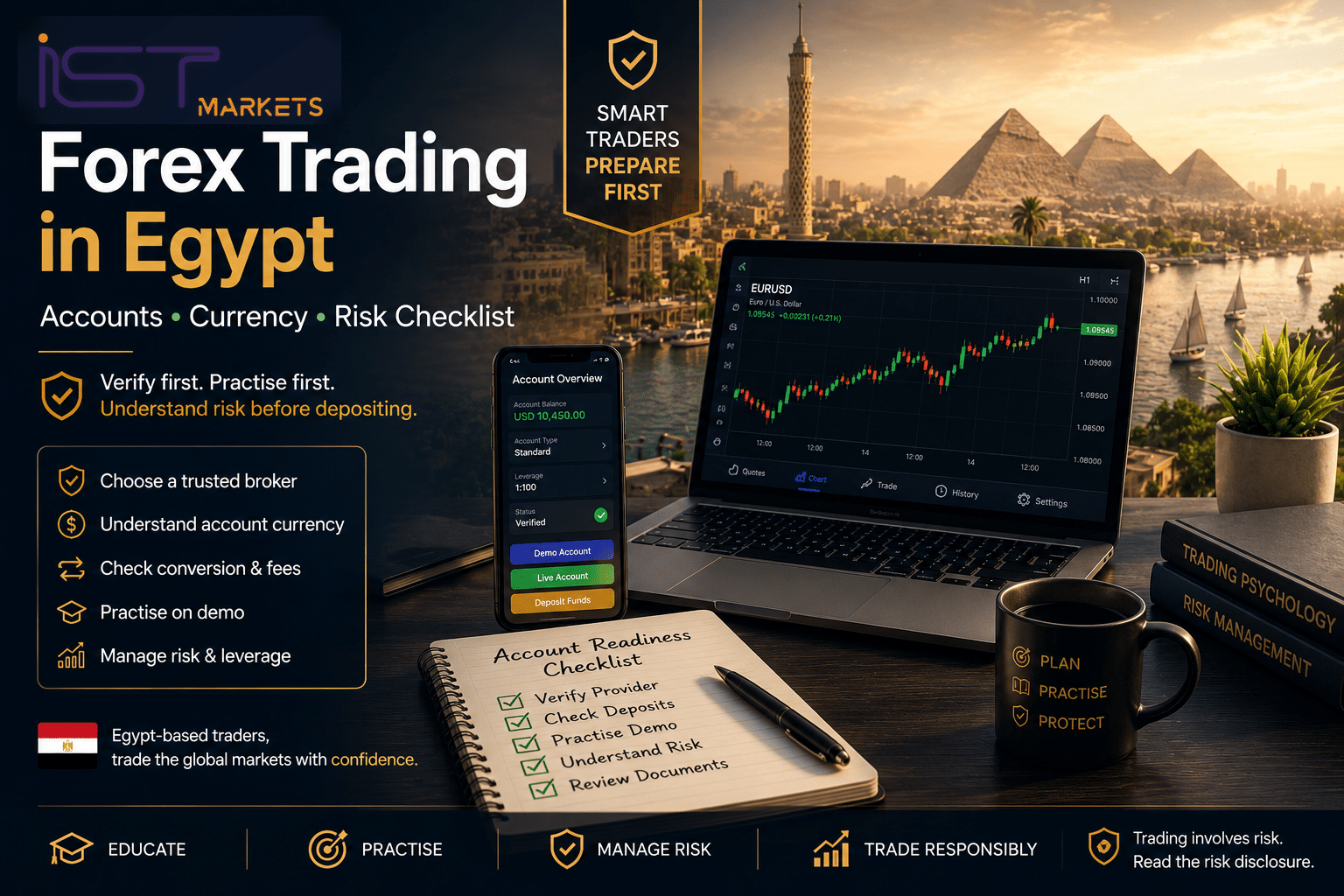
Quick Answer: What should Egypt-based traders check first?
Forex trading in Egypt means accessing currency markets through a broker account and trading platform, often with margin and leverage. For Egypt-based traders, the first check is not only the currency pair or platform. It is the full money path: your starting currency, the account currency, conversion cost, possible funding and withdrawal route, legal entity, account documents and risk disclosure. If your money starts in EGP but your trading account is denominated in another currency, currency conversion becomes part of the trading decision before the first live trade happens.
Who this guide is for — and who it is not for
- Egypt-based beginners researching forex trading before live funding.
- First-time live traders who already used demo but are not sure about funding.
- Early-stage retail traders who understand basic forex but have not calculated account-currency impact.
- Egyptians whose income, savings or budget starts in EGP but whose trading account may use another currency.
- Ranking “best forex brokers in Egypt.”
- Telling readers to open or fund a live account.
- Providing legal, tax or personal investment advice.
- Introducing brokers, referral partners or promoters planning activity from Egypt.
This article uses World Bank Egypt data for macro context, including population, GDP, GDP per capita, inflation, internet use and remittances. It uses IST Markets’ Risk Disclosure for trading-risk language related to leverage, margin, stop-loss limitations, electronic trading, OTC/off-exchange products and counterparty risk.
This guide does not make unsupported claims about Egypt-specific account availability, payment methods, local licensing or local funding routes. Any account, funding, withdrawal or platform feature must be checked against the live IST Markets website and the account documents shown during onboarding.
- It does not say forex trading is suitable for every Egypt-based trader.
- It does not confirm Egypt-specific funding or withdrawal methods.
- It does not provide legal, tax or investment advice.
- It does not rank or recommend brokers.
- It does not say demo results predict live performance.
- It does not recommend opening or funding a live account.
Content Table
1Why Egypt needs this guide
Conversion-aware trading readiness.
2Forex trading in real terms
Account, platform, currency and risk.
3Egypt Money Path Map
From EGP budget to withdrawal.
4EGP vs account currency
The mismatch many traders miss.
5Deposit vs account currency
Four currencies beginners confuse.
6Conversion is not just a rate
Rate, spread, fees, timing and withdrawal.
7Conversion stress test
Questions before live funding.
8Before-funding decision tree
Clear checks before taking action.
Why Egypt needs a conversion-aware forex trading guide
Many articles about forex trading in Egypt focus on the same surface questions: what is forex, how to choose a broker, what is leverage, and how to open an account. Those topics matter, but they miss the Egypt-specific issue that can affect a trader before the first live order: your money may start in Egyptian pounds, while your trading account may be denominated in another currency.
That account-currency mismatch matters because trading is not only a chart decision. It is a money-path decision. The trader may need to think about exchange rate, conversion spread, transfer or payment cost, timing, account currency, trading costs, withdrawal route and the rate used if funds are converted back to EGP later.
Egypt’s context makes this especially important. World Bank data shows Egypt’s 2024 population at 116,538,258, GDP at US$389.06 billion, GDP per capita at US$3,338.5, inflation at 28.3%, internet use at 75% of the population, and personal remittances received at 7.6% of GDP. These figures do not mean forex trading is suitable for everyone. They show why a large, digitally connected, currency-sensitive audience needs practical education around account currency and conversion awareness before funding.
What forex trading in Egypt means in real trading terms
Forex trading in Egypt usually means that an Egypt-based trader accesses currency markets through an online broker account and a trading platform. The trader may speculate on currency-pair movements such as EUR/USD, GBP/USD or USD/JPY, often using margin and leverage. This is different from exchanging currency at a bank or exchange office for travel or business needs.
In real trading terms, there are several layers. First, the trader chooses or reviews a broker and account. Second, the trader checks the account currency and trading conditions. Third, the trader connects to a platform, such as MT5 or another supported platform. Fourth, the trader decides whether to practise on demo or consider live funding. Fifth, the trader must understand spread, margin, leverage, slippage, swaps and possible loss.
For Egypt-based traders, the account-currency layer should not be treated as a small technical detail. If the trading account is not in EGP, then the trader is exposed to a conversion step before trading risk even begins. This does not automatically make trading unsuitable, but it does mean the trader should calculate the full route before using real funds.
| Layer | What the trader should understand | Why it matters in Egypt |
|---|---|---|
| Account currency | The currency used to show balance, margin, profit and loss. | The trader’s money may start in EGP but the account may use another currency. |
| Conversion path | How funds may be converted before reaching the account. | Conversion can affect the amount available before trading starts. |
| Platform workflow | Login, server, order placement, stop levels and position closing. | A funding decision should not come before basic platform practice. |
| Risk mechanics | Leverage, margin, spread, swaps, slippage and possible loss. | The account can be stressed quickly if position size is too large. |
Egypt Money Path Map: from EGP budget to withdrawal
The strongest way to understand forex trading in Egypt is to map the money path before mapping the chart. A trade idea may start with EUR/USD, gold or another instrument, but the trader’s real-world budget may start in EGP. Between that budget and the platform balance, several steps may affect the decision.
This map is not a payment-method promise. It is a decision framework. The exact route depends on the broker, account entity, account currency, funding provider, bank or intermediary, and the documents shown during onboarding.
| Step | What happens | What to verify |
|---|---|---|
| 1. EGP budget | The trader starts with a local-currency budget or savings amount. | What amount can I afford to lose without affecting essential needs? |
| 2. Conversion step | Funds may need to be converted into the account currency. | Which rate, spread, fee and timing apply? |
| 3. Account currency | Balance, equity, margin and profit or loss appear in the account currency. | Can I understand risk in both account currency and EGP? |
| 4. Live trading risk | Spread, leverage, margin, slippage and swaps begin to matter. | Is position size manageable after conversion? |
| 5. Withdrawal route | Funds may leave the account and may be converted again. | What currency will I receive, and what conversion cost may apply? |
If you only understand the entry price but cannot explain the money path from EGP to account currency and back again, you are not ready to treat the setup as live-ready.
The Egypt-specific problem: your money may start in EGP, but your account may not
The account currency is the currency used to measure your trading account balance, available margin, used margin, profit and loss. If an account is denominated in USD, for example, the platform may show balance and trade results in USD even if the trader originally planned their budget in EGP.
This can create a gap between how a trader thinks and how the account works. A trader may say, “I can risk a certain EGP amount,” but the platform may show margin and profit or loss in another currency. If the trader has not converted that amount mentally or practically, position sizing can become less clear.
The issue is not only the initial deposit. It is also the withdrawal. A trader should ask: if I later withdraw from the account, what currency leaves the trading account, and what currency arrives to me? Is there another conversion step? What exchange rate applies? Are there any fees from the broker, payment provider, bank or intermediary? These questions should be answered before funding, not after the first loss or first withdrawal request.
Deposit currency vs account currency vs trading pair currency vs withdrawal currency
One reason beginners misunderstand forex account funding is that several currencies may appear in the same journey. They are not the same thing. Confusing them can lead to wrong expectations about balance, profit, loss, margin and withdrawals.
| Currency type | What it means | Example question |
|---|---|---|
| Deposit currency | The currency you start with or send from your funding source. | Am I starting from EGP or another currency? |
| Account currency | The currency used to display balance, equity, margin and P/L. | Is my trading account denominated in USD, EUR or another currency? |
| Trading pair currency | The currencies inside the instrument you trade, such as EUR/USD. | Am I confusing the pair currency with my account currency? |
| Withdrawal currency | The currency you may receive after withdrawing from the account. | Will I receive EGP, account currency or another currency after withdrawal? |
Currency conversion is not just an exchange rate
Many traders think currency conversion means one simple question: “What is the exchange rate?” That is only one part of the picture. The true conversion cost can include rate, spread, transfer fee, provider fee, timing and withdrawal conversion. For Egypt-based traders, this layer can affect the trading budget before any market risk begins.
A trader may plan a budget in EGP, but the account may receive a different currency after conversion. If the trader does not know the rate used, the fee charged or the amount that will arrive, they may misjudge account size, position size and margin safety.
| Conversion layer | Meaning | Question to ask before funding |
|---|---|---|
| Exchange rate | The rate used to convert EGP into the account currency. | Which rate will be used, and when? |
| Conversion spread | The difference between buy/sell or offered/executed conversion prices. | Is the conversion rate different from the market reference rate? |
| Transfer or provider fees | Possible charges from a bank, payment provider or intermediary. | What fees apply before the funds reach the account? |
| Timing risk | The rate may change between decision, transfer and account credit. | Could the amount received differ from the amount estimated? |
| Withdrawal conversion | The reverse conversion if funds return to EGP or another local path. | What currency will I receive, and what rate applies? |
Conversion stress test: questions before using real funds
A conversion-aware trader does not only ask how much money they want to deposit. They test whether the plan still makes sense if the conversion rate, fees or withdrawal route are different from what they expected. This is not about predicting the exchange rate. It is about understanding the weak points in the funding decision.
| Stress-test question | Why it matters | Responsible response |
|---|---|---|
| If the conversion rate changes before funding, does my budget still make sense? | The amount that reaches the account may differ from the amount estimated. | Do not fund based on an outdated or assumed rate. |
| If a provider fee applies, how much will actually reach the account? | Fees can reduce available margin before the first trade. | Calculate net received amount, not only gross budget. |
| If I withdraw later at another rate, what happens to my EGP result? | The final local-currency outcome may differ from platform P/L. | Check withdrawal currency and conversion rule before funding. |
| If I lose 5% in account currency, what does that mean in EGP? | Risk should be understood in the currency of real life, not only the platform. | Translate potential loss back to EGP before live trading. |
Funding and withdrawal path awareness: what to confirm before live funding
This article does not list Egypt-specific payment or withdrawal methods because those details must be confirmed on live broker pages and account documents. That is intentional. In financial topics, a funding claim should not be guessed. A trader should verify the actual route, currency, fee, processing rules and account entity before using real funds.
The responsible question is not “Can I deposit?” It is: “Can I explain the full route from my EGP budget to the account currency, and from the account currency back to my withdrawal destination?” If the answer is no, the trader is not ready to fund live.
- What is the trading account currency?
- Which currency will I send?
- Which currency will the account receive?
- Who applies the conversion rate?
- Are there broker, bank, provider or intermediary fees?
- What happens if I withdraw later?
- Are the funding and withdrawal terms written in the account documents?
Broker brand, legal entity and account documents
Although the main angle of this guide is account currency and conversion, broker verification still matters. A broker brand is the public-facing name a trader sees on a website, platform, advertisement or social page. The legal entity is the company that may govern the account relationship. The two should not be confused.
Before funding, the trader should identify the legal entity, registered address, applicable documents, risk disclosure, complaint route and regional restrictions. IST Markets’ Legal Documents page is an example of where traders should review the documents that may apply to their account relationship.
For legal or regulatory questions specific to Egypt, traders should consult official Egyptian sources and qualified legal advice rather than relying on social media comments or broker advertisements. This article does not make a blanket legal claim about forex trading in Egypt.
Demo-first workflow: practise mechanics before live funding
A demo trading account can help Egypt-based traders learn platform workflow before using real funds. Demo practice can teach how to log in, open a chart, place an order, set stop-loss levels, modify a position and close a trade. That is useful, but it should not be misunderstood.
Demo does not prove live performance. It does not fully reproduce live emotional pressure, funding friction, conversion cost, slippage, spreads during volatile conditions or the feeling of losing real money. A trader who practises on demo still needs to review risk disclosure, account currency, conversion route and position sizing before live trading.
Risk mechanics: leverage, margin, spread, swaps, slippage and OTC risk
Currency conversion is an important Egypt-specific layer, but it is not the only risk. The trader must also understand core trading risks. IST Markets’ Risk Disclosure explains that leveraged products involve significant risk, and that a relatively small market movement can have a proportionately larger impact on deposited funds.
Leverage and margin
Leverage allows a trader to control a larger market position with a smaller amount of margin. This can make trading look accessible, but it can also magnify losses. If the market moves against the position or margin requirements increase, the account may become stressed quickly.
Spread and commissions
The spread is the difference between the buy and sell price. Some accounts or instruments may also involve commissions. A trader should review fees and trading conditions where available, but should treat the account documents and live platform conditions as the final reference.
Swaps and overnight costs
Some positions may incur swaps or overnight charges if held beyond the trading day, depending on the instrument and account terms. If the trader is already thinking in EGP but the account is in another currency, overnight cost should also be understood in account-currency terms.
Slippage and stop-loss limitations
A stop-loss is a useful risk-management tool, but it is not a guarantee of an exact exit price. IST Markets’ Risk Disclosure explains that stop-loss or stop-limit orders may not always be effective during hectic market conditions or technology limitations.
OTC and off-exchange risk
Many forex and CFD products are traded off-exchange or over the counter. IST Markets’ Risk Disclosure explains that OTC and off-exchange transactions may have fewer exchange-style protections and may be subject to a separate regulatory regime. It also explains that the online trading software is not a marketplace or exchange.
Before thinking about entry timing, calculate position size, margin impact, stop-loss distance, account-currency exposure and worst-case account stress. The entry price is not the risk plan.
Egypt beginner scenario: from EGP budget to account-currency decision
Imagine an Egypt-based trader has a fixed budget in EGP and wants to try forex trading after practising on demo. They have watched videos about EUR/USD and downloaded a platform. At this point, the easy mistake is to focus only on the chart and the entry setup.
A stronger process starts before the trade idea. The trader checks the account currency and sees that the trading account may be denominated in another currency. They ask how much of their EGP budget would actually reach the trading account after conversion. They check whether any fees or conversion spread may apply. They also ask what happens if they withdraw later.
Then they practise the trade workflow on demo. They place a demo order, set a stop-loss, change the stop level, close the position and review how the platform shows balance, margin and profit or loss. They do not treat demo gains as proof that live trading will work. They treat demo as workflow practice.
Before live funding, they read the risk disclosure and account documents. They check the legal entity and account terms. They calculate position size and margin impact. If they cannot explain the money path from EGP to account currency and back again, they do not fund yet. That is account-readiness thinking.
Common mistakes Egypt-based traders should avoid
The most common mistakes are not always chart mistakes. Many happen before the first live trade: unclear account currency, underestimated conversion cost, weak document review, oversized position size or false confidence from demo results.
| Mistake | Why it matters | Better approach |
|---|---|---|
| Focusing on the chart before account currency | The trader may not know how balance and risk are measured. | Confirm the account currency before thinking about live trades. |
| Treating conversion as only an exchange rate | Fees, spread, timing and withdrawal conversion may also matter. | Calculate the full money path, not only the first rate. |
| Ignoring withdrawal conversion | The trader may not know what they will receive if they withdraw later. | Ask about withdrawal currency and possible conversion before funding. |
| Using leverage before understanding margin | A small move can create large account stress. | Review margin impact and reduce position size if unclear. |
| Treating demo results as proof | Demo does not fully reproduce live conditions or emotions. | Use demo for mechanics only. |
| Funding before reading risk disclosure | The trader may miss leverage, OTC, stop-loss and technology risks. | Read the risk disclosure and legal documents before live funding. |
Before-funding decision tree
A checklist is helpful, but a decision tree is stronger. It tells the trader what to do when something is unclear. Use this before considering live funding.
| If you cannot answer… | Decision | Next step |
|---|---|---|
| What is my trading account currency? | Do not fund yet. | Confirm account currency in the account settings or documents. |
| How much of my EGP budget will reach the account? | Do not fund yet. | Check conversion rate, spread, fees and timing. |
| What happens if I withdraw back to EGP? | Pause. | Ask for withdrawal currency, route and conversion details in writing. |
| Which legal entity and documents apply? | Do not fund yet. | Read legal documents and account terms. |
| How leverage and margin affect my position size? | Stay on demo. | Review margin impact and position sizing before live trading. |
| Have I read the risk disclosure? | Do not fund yet. | Read the risk disclosure before any live decision. |
Personal trading research vs introducing others
Researching a broker for your own potential account is different from introducing, referring, promoting or influencing other people’s trading decisions. This article is for account-currency awareness and trading-readiness research. It is not an introducing broker or referral-partner guide.
If your activity involves referring others, sharing compensation-linked links, running trading groups, promoting a broker, teaching people to open accounts or influencing other people’s account decisions, you should not rely on a beginner or retail trading article. That type of activity may require separate legal, contractual and compliance review.
Risk reminder before the CTA
Forex trading in Egypt can be accessed online, but access is not the same as readiness. A trader may understand platform buttons but still misunderstand account currency, conversion cost, leverage, margin, spread, swaps, slippage, electronic trading risk or OTC/off-exchange risk.
Before considering live funding, verify the legal entity, understand account currency, calculate conversion impact, practise on demo, read legal documents and review the risk disclosure. If the money path is unclear, waiting is a responsible decision.
Soft CTA: Verify currency, practise workflow, read risk
Before using live funds, review the IST Markets Legal Documents and Risk Disclosure so you understand the entity, account terms, trading risks and responsibilities.
If you are still learning the platform workflow, practise first using a demo trading account. When comparing live conditions, review the relevant account types carefully before making any decision.
FAQ
What is forex trading in Egypt?
Forex trading in Egypt means accessing currency markets from Egypt through a broker account and trading platform. It often involves margin and leverage. Egypt-based traders should also check account currency, EGP conversion, funding and withdrawal path, legal entity, platform workflow and risk disclosure before considering live funding.
Do I need USD to trade forex from Egypt?
It depends on the broker, account currency and funding route. Many trading accounts may be denominated in USD or another currency, but traders should not assume. Check the account currency, conversion route, fees and withdrawal terms before funding.
What is account currency in forex?
Account currency is the currency used to display balance, equity, margin, profit and loss in the trading account. If your money starts in EGP but your account currency is different, currency conversion becomes part of the funding and risk calculation.
What is the difference between deposit currency and account currency?
Deposit currency is the currency you send from your funding source. Account currency is the currency used inside the trading account to show balance, equity, margin and profit or loss. They may be different, which can create a conversion step.
How does currency conversion affect forex trading in Egypt?
Currency conversion can affect how much money reaches the account, how the trader thinks about risk, and what may be received after withdrawal. The trader should check the exchange rate, conversion spread, fees, timing and withdrawal conversion before funding.
Is demo trading enough before live forex trading?
No. Demo trading can help with platform workflow and order practice, but it does not prove future live performance. Live trading adds real money pressure, conversion cost, slippage, spread changes, margin risk and possible loss.
What are the main risks of forex trading in Egypt?
The main risks include leverage, margin calls, fast market movement, spread changes, slippage, swap costs, stop-loss limitations, electronic trading risk, OTC/off-exchange risk, counterparty risk and account-currency or conversion-cost misunderstanding.
What should I check before funding a forex account from Egypt?
Check the legal entity, account currency, conversion route, possible fees, funding and withdrawal terms, platform login, demo/live status, risk disclosure, leverage, margin requirements and position-size impact before funding.
Can I act as an introducing broker or promoter from Egypt?
This article is not an introducing broker or promoter guide. Introducing, referring, educating or promoting trading services may require separate legal, contractual and compliance review. Do not treat personal trading research as permission to promote or refer others.