“`html
Quick Answer: What should Qatar-based beginners verify first?
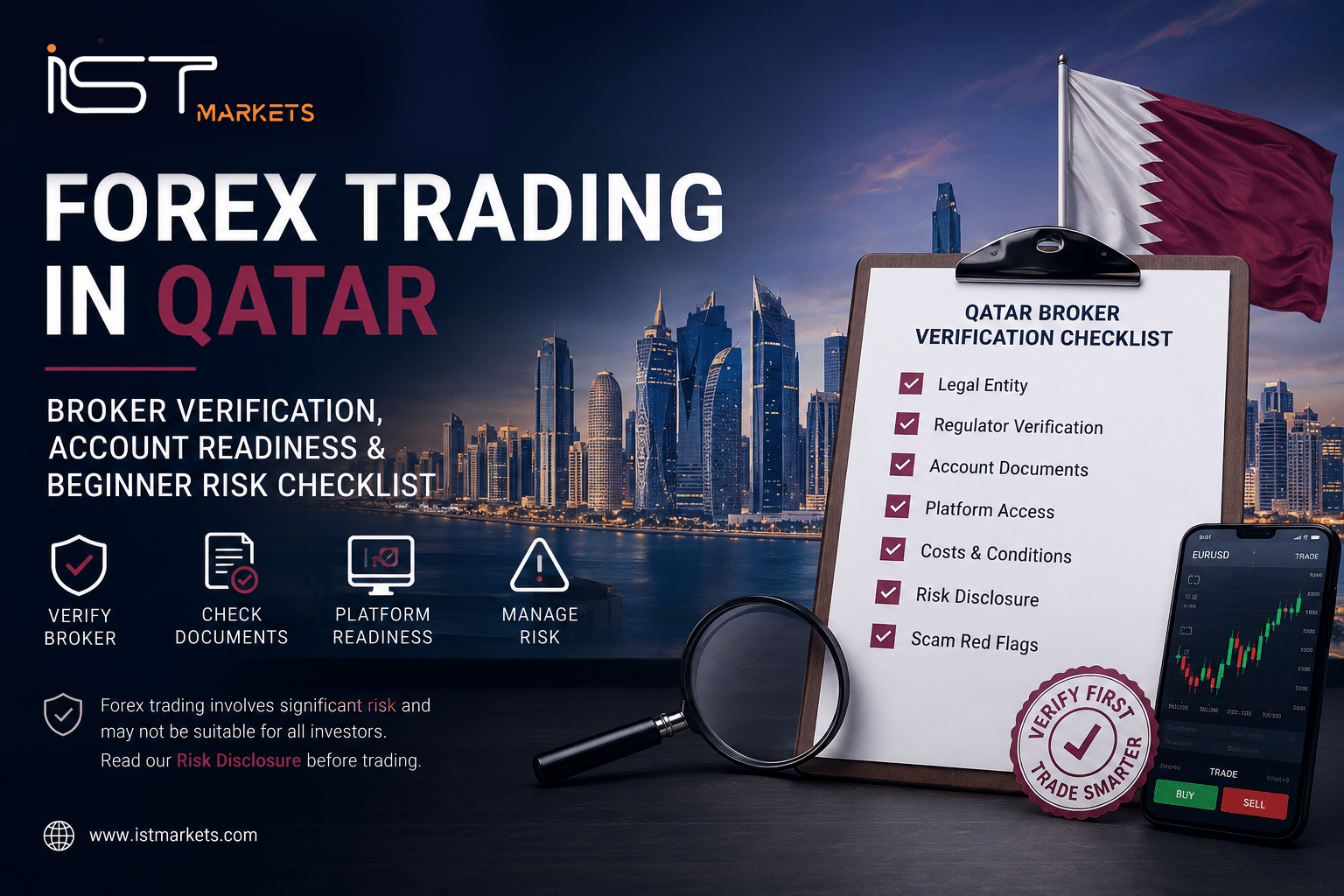
Forex trading in Qatar means accessing currency markets through a broker, trading account and platform, often with margin and leverage. Before considering live funding, Qatar-based beginners should verify the broker’s legal entity, applicable jurisdiction, regulatory claim, account documents, platform login process and risk disclosure. The key question is not only “Can I trade?” but “Do I know who holds my account, which terms apply, how the platform works, and what risks I accept?” Demo practice can help with workflow, but it does not prove future live performance.
Risk reminder before reading
Editorial Review Note
This article is a Qatar-specific verification and account-readiness guide. It is not a “best broker in Qatar” list, not a direct account-opening page, and not a guide for introducing broker, referral, solicitation or promotional activity from Qatar.
Who this guide is for — and who it is not for
This guide is for
- Qatar-based beginners researching forex trading before live funding.
- Expats in Qatar comparing broker claims, platforms or account documents.
- Early-stage traders who know basic forex terms but need a verification workflow.
- Readers who want to avoid hype, clone sites and unclear account conditions.
This guide is not for
- Providing legal advice on Qatar financial services activity.
- Telling readers to open or fund a live account.
- Ranking brokers or recommending a specific trade.
- Introducing brokers, referral partners or promoters planning activity from Qatar.
Source Snapshot
This guide uses official Qatar regulatory-awareness sources, including Qatar Financial Centre Regulatory Authority materials on authorisation, regulatory objectives and financial scams. It also uses World Bank Qatar data for context and IST Markets’ Risk Disclosure for trading-risk language.
It avoids unsupported claims about local licensing, account availability, payment methods or funding options. Any account, platform or product details should be checked against the live IST Markets website and the account documents presented during onboarding.
Content Table
1Is forex trading in Qatar legal?
The safer beginner answer.
2Why this is not generic
Qatar-specific verification angle.
3Qatar context
QFC, QCB, QFMA and jurisdiction.
4Brand vs legal entity
The check beginners often miss.
5Official-register mindset
What to verify before trusting a claim.
6Account readiness
Demo, platform, documents and terms.
7Scam and clone-site checks
Red flags before funding.
8Before-funding decision tree
Clear yes/no readiness checks.
Is forex trading in Qatar legal? The safer beginner answer
A simple yes-or-no answer can be misleading. The safer question is: which broker entity, product, jurisdiction and account documents apply to the person in Qatar? A resident or expat may find a global broker online, but that does not automatically explain the legal entity, regulator, complaint route, account terms or regional restrictions.
Qatar has more than one regulatory context. The Qatar Financial Centre Regulatory Authority says that a firm or individual conducting financial services in, or from, the Qatar Financial Centre must be authorised by QFCRA, while also stating that it only regulates firms operating within, or from, the QFC. QFCRA also explains that Qatar’s regulatory framework defines the jurisdictions of Qatar Central Bank, Qatar Financial Markets Authority and QFCRA.
For beginners, this means you should avoid treating phrases like “regulated,” “international,” “Qatar-friendly,” “licensed,” or “QFC-related” as complete answers. You should verify the legal entity, compare any regulatory claim with official sources where relevant, and read the account documents before considering live funding.
Micro CTA: Stay in research mode
Why this is not another generic forex trading guide
Many pages about forex trading in Qatar either define forex in a basic way or turn the topic into a broker list. That is not enough for a beginner who is about to make a real-money decision. A trader based in Qatar does not only need to know what a currency pair is. They need to know how to verify the broker, understand the legal entity behind the account, check the platform workflow, review account documents, avoid scam patterns and respect the risks of leveraged products.
This article is built around a different question: what should a Qatar-based beginner verify before funding a live trading account? That makes the guide more practical than a generic “what is forex” article and safer than a promotional “start trading today” page.
The goal is not to make trading sound easy. It is to help the reader slow down at the right moment: before sending funds, before trusting a regulator logo, before copying a signal, and before assuming a platform login means they are ready for live trading.
Qatar context snapshot
World Bank data shows Qatar’s 2024 population at 2,857,822, GDP at US$219.16 billion, GDP per capita at US$76,688.7 and internet use at 98% of the population. This supports the need for high-quality digital financial education. It does not mean forex trading is suitable for every resident or expat, and it does not remove the need for verification, risk review and account-document checks.
Micro CTA: Read for verification, not speed
Qatar context: QFC, QCB, QFMA and why jurisdiction matters
Forex trading in Qatar usually refers to Qatar-based residents or expats accessing global currency markets through an online broker, trading account and platform. This is different from exchanging Qatari riyal for another currency at a bank or money exchange. In online forex trading, the trader is normally speculating on price movements between currency pairs such as EUR/USD, GBP/USD or USD/JPY.
The compliance-sensitive point is that Qatar should not be described as if there is one simple regulatory answer for every broker and every product. QFCRA’s own authorisation page separates the QFC context from wider Qatar regulatory jurisdictions. A broker claim should therefore be reviewed in relation to the exact entity, activity and jurisdiction, not as a generic badge of trust.
For the beginner, this means the exact wording matters. A broker saying “regulated,” “international,” “Qatar-friendly,” “QFC,” “offshore,” or “licensed” does not answer the full question. The trader should ask: which legal entity will hold the account, which regulator or jurisdiction applies, and where can I verify that information?
| Qatar context point | What it means for beginners | Practical check |
|---|---|---|
| QFC / QFCRA | Relevant where a firm claims to conduct financial services in or from QFC. | Check the entity name, authorisation context and official QFCRA sources. |
| Qatar Central Bank | May be relevant for certain financial activities and institutions in Qatar. | Do not assume; check the exact entity and official QCB context. |
| Qatar Financial Markets Authority | May be relevant to capital-market activities and regulated market participants. | Verify whether the entity and activity match the claim being made. |
| International or offshore entity | Many global trading brands operate through entities outside the country where the client lives. | Check the overseas regulator, legal entity, account terms and risk disclosure. |
Micro CTA: Treat regulation as a verification point
Broker brand vs legal entity: the check most beginners miss
The first mistake many beginners make is checking the broker brand but not the legal entity. A brand is the public name you see in an advertisement, website, app or social media post. The legal entity is the company that may hold or govern your trading account. They are not always the same thing.
This matters because account terms, risk disclosures, complaints procedures, regional restrictions and regulatory oversight usually attach to the legal entity, not just the marketing brand. Before funding, the trader should identify the company name in the client agreement, account-opening process, legal documents and risk disclosure.
IST Markets’ own Legal Documents page explains that documents applying to a client can depend on the entity the client registers with and that the applicable entity and document set are shown during the application process. That is the kind of entity-level check traders should expect from any broker, not only from IST Markets.
The Qatar mistake
| What the beginner sees | What it does not prove | Better verification question |
|---|---|---|
| Broker brand | It does not prove the contracting entity. | Which legal company name appears in my documents? |
| Trading platform | It does not prove the broker is suitable or verified. | Which account and server am I connecting to? |
| Regulator logo | It does not prove current authorisation by itself. | Can I match the entity and authorisation on an official source? |
| Demo account | It does not prove live performance or readiness. | Have I learned workflow without confusing demo with live? |
Micro CTA: Compare names before trust
Official-register mindset: what to verify before trusting a claim
A beginner does not need to become a lawyer to make a better decision. But they do need an official-register mindset. That means treating every important claim as something to verify, not something to assume.
When a broker states that it is authorised, regulated, international, licensed, QFC-related, offshore or locally available, the trader should compare that statement with the legal documents and official registers where relevant. A mismatch does not automatically prove wrongdoing, but it should be clarified before funding.
| If a claim says… | What to verify | Why it matters |
|---|---|---|
| “QFC / QFCRA authorised” | Check the legal entity name and QFCRA context on official QFCRA resources. | QFCRA authorisation relates to firms operating in or from the QFC, not every broker a Qatar resident may find online. |
| “Qatar Central Bank” | Check the exact entity, product and official QCB context. | A regulator name should not be used as a generic trust badge. |
| “QFMA regulated” | Check whether the activity, market and entity match the claim. | Regulation depends on activity and entity, not only brand recognition. |
| “International broker” | Check the overseas regulator, legal entity, account terms and risk disclosure. | An international setup may mean the client is contracting outside Qatar. |
| No regulator named | Request written clarification before funding. | Unclear regulation and unclear entity details are not beginner-friendly conditions. |
Micro CTA: Verify before sharing funds or documents
Account readiness, not account opening
For this topic, “account readiness” is stronger than “account setup.” Setup can sound like a technical task: create profile, download platform, log in and trade. Readiness is wider. It means you understand the account type, legal entity, documents, platform, costs and risk before live funding.
A Qatar-based beginner should separate four things: the client portal, the trading account, the platform login and the live funding decision. The client portal may be used to manage personal information, verification and account settings. The trading account may be demo or live. The platform login connects the software to a specific account and server. The funding decision should come only after verification and risk review.
If the trader is still unsure how the platform works, a demo trading account can help with workflow practice. It can help a beginner learn how to log in, open a chart, place a demo order, modify stop levels and close a position. But demo should not be treated as proof that live trading will be profitable or emotionally easy.
Account-readiness rule
| Readiness layer | Beginner check | Why it matters |
|---|---|---|
| Entity readiness | I know which company and jurisdiction apply to my account. | Terms, regulator and complaints route may depend on the entity. |
| Document readiness | I have read legal documents and risk disclosure. | Marketing pages do not replace account documents. |
| Platform readiness | I can place, modify and close demo orders without confusion. | Live order mistakes can have financial consequences. |
| Risk readiness | I understand leverage, margin, spread, swaps and slippage. | The first live trade should not be the first time these concepts matter. |
Micro CTA: Practise the workflow first
Personal trading research vs introducing others
Researching a broker for your own potential trading account is different from introducing, referring, promoting or influencing other people’s trading decisions. A beginner reading this article for personal awareness is one audience. A person who wants to act as an educator, referral partner, promoter or introducing broker is a different audience with different legal and compliance considerations.
If your activity involves introducing others to a broker, promoting trading services, collecting referrals, running trading communities, sharing compensation-linked links or encouraging other people to open accounts, you should not rely on a beginner trading article. You may need a separate review of local rules, written agreements, marketing approvals, disclosure requirements and jurisdiction restrictions.
For promoters, educators or referral partners
Scam and clone-site checks: the Qatar-specific beginner filter
One of the most useful Qatar-specific additions to a beginner guide is scam awareness. Qatar-based beginners may find trading offers through social media, messaging apps, search ads, cloned websites, fake “account managers,” signal groups or investment promises. A professional-looking website is not enough.
QFCRA’s financial scams framework highlights threats such as phishing, website cloning, investment fraud, identity theft and Ponzi schemes. For a beginner, the practical lesson is simple: treat every pressure-based offer as something to verify before sending funds or documents.
| Red flag | Why it matters | What to do instead |
|---|---|---|
| Guaranteed profit or fixed monthly return | Real forex and CFD trading cannot guarantee returns. | Treat the claim as a warning sign and verify the entity. |
| Website that copies a known brand | Clone-site fraud can look convincing at first glance. | Type the official URL directly and compare legal details. |
| Pressure to deposit quickly | Urgency can be used to stop proper verification. | Pause and ask for written entity and regulatory information. |
| “Account manager” asks for transfer outside official channels | This can bypass normal account controls and documentation. | Use only official, documented processes and verify support channels. |
| Signal group claims “no loss” strategy | Signals cannot remove market, leverage or execution risk. | Do not treat signals as financial advice or proof of suitability. |
Scam check before sharing documents or funds
- Check the domain spelling and avoid links sent through unofficial messages.
- Compare the legal entity name with the account documents.
- Search official sources where relevant, not only Google results or social posts.
- Do not trust guaranteed-return claims, “no loss” systems or pressure-based offers.
- Do not send money to personal accounts or channels outside the documented process.
- Save screenshots of suspicious claims before contacting support or reporting.
Micro CTA: Stop when urgency appears
Costs and risk mechanics: spread, leverage, margin, swaps and slippage
A Qatar beginner-readiness guide should not spend thousands of words defining every forex term. But it must explain the terms that can affect real money before the first live trade.
Spread
The spread is the difference between the buy and sell price. It is one of the first costs a trader sees when entering the market. Even before a trade moves, the spread affects the break-even point. Beginners should check how spreads may vary by instrument, account type and market conditions. A separate fees or trading conditions page can help when available, but the account documents should remain the final reference.
Leverage and margin
Leverage lets a trader control a larger market position with a smaller amount of margin. It can make trading look accessible, but it can also magnify losses. IST Markets’ Risk Disclosure explains that a relatively small market movement can have a proportionately larger impact on deposited funds when products are leveraged.
Swaps and overnight costs
Some positions may incur swaps or overnight charges if held beyond the trading day, depending on the instrument and account terms. Beginners often focus on the entry price and forget the cost of holding. Before live trading, a trader should know whether an instrument or account type may involve overnight costs and whether any account structure is relevant and available under the applicable terms.
Slippage and stop-loss limitations
A stop-loss is a useful risk-management tool, but it is not a guarantee of a perfect exit price. In fast markets, gaps, disrupted conditions or technical interruptions, an order may not execute exactly as expected. That is why risk planning should not rely only on a stop-loss level. Position size matters too.
OTC and platform risk
Many forex and CFD transactions are off-exchange or OTC. IST Markets’ Risk Disclosure explains that OTC and off-exchange transactions may be less regulated or subject to a separate regime and that not all protections generally found in regulated exchange markets are present. It also explains that online trading software is not a marketplace or exchange, and that technical interruptions may affect orders.
Beginner rule
A good market idea does not protect an oversized position. Before asking whether a trade setup looks attractive, ask whether the margin, spread, stop-loss distance and position size are manageable.
Micro CTA: Risk plan before entry price
Qatar beginner scenario: from seeing an ad to verifying first
Imagine a beginner living in Doha sees an online ad about trading EUR/USD. The platform looks clean, the website has professional graphics, and a social media comment says withdrawals are easy. The beginner is tempted to fund a live account that evening.
A weak process would stop at the website and the app. A stronger process starts with verification. The beginner checks the legal entity, reads the client agreement, looks for the applicable risk disclosure, compares any regulator claim with official sources where relevant, and confirms whether the account is demo or live.
Next, the beginner practises on demo. They place a small demo order, change a stop-loss, close the position, review the spread, test the platform login and confirm they understand the difference between the client portal and trading account credentials. This does not make them ready to trade live, but it removes basic platform confusion.
Before funding, they review costs and risk. They ask: What happens if EUR/USD moves against me? How much margin is required? Could the stop-loss slip? Are there swaps if I hold overnight? Which legal entity and jurisdiction apply? If these questions are still unclear, the responsible decision is not to rush. It is to wait, verify and practise.
Common mistakes Qatar-based beginners should avoid
The most expensive beginner mistakes are often process mistakes rather than analysis mistakes. A trader may be wrong on direction, but they can also be wrong before the trade begins: wrong entity, wrong account, wrong platform, wrong position size or wrong understanding of risk.
| Mistake | Why it matters | Better approach |
|---|---|---|
| Funding before verifying the legal entity | The trader may not know which company, jurisdiction or documents apply. | Read legal documents and confirm the contracting entity first. |
| Treating a regulator logo as proof | A logo can be copied or used without enough context. | Match the entity and authorisation on official sources where relevant. |
| Confusing demo confidence with live readiness | Live trading includes real money, emotions and execution differences. | Use demo for workflow practice only. |
| Ignoring position size | A small move can stress a highly leveraged account. | Define maximum risk and margin impact before entry. |
| Trusting social proof too quickly | Screenshots, signals and comments can be incomplete or misleading. | Use official documents, verified sources and your own risk checklist. |
Before-funding decision tree
A checklist is useful, but a decision tree is stronger because it tells you what to do when something is unclear. Use this before considering live funding.
| If you cannot answer… | Decision | Next step |
|---|---|---|
| Which legal entity holds or governs my account? | Do not fund yet. | Read legal documents and request written clarification. |
| Which jurisdiction and documents apply? | Do not fund yet. | Check onboarding documents and client agreement. |
| Whether the regulatory claim is verifiable? | Pause. | Use official register sources where relevant and compare entity details. |
| Whether I am using demo or live credentials? | Do not place trades. | Confirm account type, server and platform login. |
| How leverage, margin and position size affect the trade? | Keep practising. | Review margin and position size before any live decision. |
| Whether I have read the risk disclosure? | Do not fund yet. | Read the risk disclosure and legal documents first. |
Risk reminder before the CTA
Forex trading in Qatar can be accessed online, but accessibility is not the same as readiness. A beginner may understand platform buttons but still misunderstand leverage, margin, spreads, swaps, slippage, market gaps, electronic trading risk or OTC/off-exchange risk.
Before considering live funding, verify the broker entity, read the account documents, practise the platform workflow on demo, review the risk disclosure and define a risk limit. If any part of the setup is unclear, waiting is a responsible decision.
Soft CTA: Verify first, then practise
Before using live funds, review the IST Markets Legal Documents and Risk Disclosure so you understand the entity, terms, trading risks and account responsibilities.
If you are still learning the platform workflow, practise first using a demo trading account. When comparing live account conditions, review the relevant account types carefully before making any decision.
FAQ
What is forex trading in Qatar?
Forex trading in Qatar means accessing currency markets from Qatar through a broker account and trading platform. The trader speculates on currency-pair price movements, often using margin and leverage. Beginners should verify the broker entity, account terms, platform setup and risk disclosure before considering live funding.
Is forex trading in Qatar legal?
It is better to avoid a simple yes-or-no answer without checking the exact entity, product and jurisdiction. Qatar has different financial regulatory contexts, including QFC/QFCRA, Qatar Central Bank and Qatar Financial Markets Authority. Beginners should verify the broker’s legal entity, regulator claim and account documents before using any broker.
Who is this Qatar forex guide for?
This guide is for Qatar-based beginners, cautious expats and early-stage traders researching broker verification, account readiness and trading risk before considering live funding. It is not a guide for offering financial services, promoting brokers or acting as an introducing broker from Qatar.
What should Qatar-based beginners verify before using a broker?
They should verify the legal entity, applicable jurisdiction, regulator or official register where relevant, client agreement, risk disclosure, platform login process, demo/live account status, trading costs, leverage and regional restrictions.
How do I check a forex broker in Qatar?
Start by finding the exact company name in the legal documents. Then compare any regulatory claim with official sources where relevant, check the account terms, read the risk disclosure and confirm which entity and jurisdiction apply to your account.
What are the main risks of forex trading in Qatar?
The main risks include leverage, margin calls, fast market movement, spread changes, slippage, swap costs, technology interruptions, stop-loss limitations, OTC/off-exchange risk, counterparty risk and the possibility of losing more than expected.
Is a demo account enough before live trading?
A demo account can help beginners practise platform workflow, order types and basic trade management. It is not proof of future live performance and does not fully reproduce emotional pressure, slippage, execution differences or live account stress.
What forex scams should Qatar-based beginners watch for?
Beginners should be careful with cloned websites, phishing messages, guaranteed-profit claims, pressure to deposit quickly, fake account managers, unverifiable regulator logos, signal groups promising no losses and requests to transfer money outside official channels.
References & Further Reading
- QFCRA: Authorisation
- QFCRA: Regulatory Objectives
- QFCRA: Financial Scams Framework
- QFCRA: Permitted Activities
- Qatar Central Bank
- Qatar Financial Markets Authority
- World Bank Data: Qatar
- IST Markets Legal Documents
- IST Markets Risk Disclosure
- IST Markets Demo Trading Account
- IST Markets Trading Account Types