Quick Answer: What should beginners know about forex trading in Tanzania?
Forex trading in Tanzania means accessing global currency markets through an online broker account and a platform such as MT5, often using margin and leverage. Before funding a live account, Tanzania-based beginners should understand market hours in East Africa Time, practise on demo during different sessions, observe spread and volatility changes, verify the broker entity and account terms, and read the risk disclosure. London/New York overlap can be active, but active does not mean safer or more suitable for beginners.
Risk reminder before reading
Who this guide is for — and who it is not for
This guide is for
- Tanzania-based beginners researching forex trading before live funding.
- Demo users who want to understand when to practise and what to observe.
- First-time live traders who are confused by London, New York and overlap sessions.
- MT5 users who need platform workflow practice before real money is involved.
- Readers who want a practical checklist before moving from demo to live.
This guide is not for
- Ranking “best forex brokers in Tanzania.”
- Providing legal, tax or personal investment advice.
- Claiming that one session is always safer or more profitable.
- Confirming Tanzania-specific deposit or withdrawal methods.
- Introducing brokers, referral partners or promoters planning activity from Tanzania.
Source Snapshot
This article uses official Tanzania sources for verification context, including the Capital Markets and Securities Authority and Bank of Tanzania. It uses World Bank Tanzania data for macro and digital context only, not as an argument that trading is suitable for everyone.
Market-hours guidance is based on East Africa Time and the global structure of forex sessions. Trading-risk language is aligned with risk-disclosure principles around leverage, margin, stop-loss limitations, electronic trading risk, OTC/off-exchange products and possible financial loss.
What this guide does not claim
- It does not say forex trading is suitable for every Tanzania-based trader.
- It does not say forex trading is legal for every person, broker, platform or activity in Tanzania.
- It does not state that every online forex broker promoted to Tanzanians is locally authorised.
- It does not treat MT5 as proof of broker trust or live-readiness.
- It does not say London/New York overlap is always the best time to trade.
- It does not treat demo profits as proof of live performance.
- It does not recommend opening or funding a live account.
Content Table
1Why Tanzania needs this guide
Timing, demo practice and readiness.
2Forex trading in real terms
Account, platform, sessions and risk.
3Market hours in Tanzania time
Asian, London, New York and overlap.
4London/New York overlap
Active does not mean safer.
5Demo practice by session
How to train before live trading.
6MT5 and account checks
Platform is not proof of readiness.
Why Tanzania needs a market-hours and demo-readiness guide
Many Tanzania-based beginners start with the question: “Which broker should I use?” A better first question is: “When should I practise, what changes by session, and am I ready for live risk?”
Forex is commonly described as a 24-hour, five-day market because trading moves across global financial centers. That access can be attractive, but it also creates confusion. A beginner may open a platform at night, during the London session, during the New York session, or during the London/New York overlap — and each window can feel different. Spread, liquidity, volatility, slippage risk and emotional pressure can all change.
That is why this article is not a generic “forex basics” page. It is a Tanzania demo-readiness guide. The goal is to help beginners use demo practice intelligently before funding a live account: observe different market sessions, record what changes, understand platform controls, verify account terms and review trading risk.
Tanzania’s context also supports the need for clear digital financial education. World Bank data for 2024 shows Tanzania’s population at 68,560,157, GDP at about US$78.84 billion, GDP per capita at US$1,186.7, GDP growth at 5.5%, inflation at 3.1%, and internet use at 31% of the population. These figures do not make forex trading suitable for everyone. They simply explain why online financial education should be practical, source-backed and risk-aware.
Official-source habits matter too. The Capital Markets and Securities Authority website includes complaint channels, investor education, regulatory framework, licensing information and list of licensees. Bank of Tanzania provides resources around financial sector supervision, payment and settlement systems, currency, financial markets and licensed institutions. This article does not claim that every online forex broker promoted to Tanzanians is locally authorised. Instead, it teaches the safer habit: verify the exact entity, account documents and relevant official source where a claim is made.
Micro CTA: Start with time and practice
What forex trading in Tanzania means in real trading terms
Forex trading in Tanzania usually means that a Tanzania-based trader accesses global currency markets through an online broker account and a trading platform such as MT5. The trader may speculate on currency pairs such as EUR/USD, GBP/USD or USD/JPY. This is different from exchanging Tanzanian shillings for travel, business payments or personal foreign-currency needs.
In real trading terms, the setup has several layers: broker brand, legal entity, account type, account currency, platform login, demo or live environment, market session, spread, leverage, margin, slippage and risk disclosure. A beginner who focuses only on the chart may miss the account and risk environment behind the chart.
| Layer | What it means | Tanzania beginner check |
|---|---|---|
| Broker brand | The public name seen online, in ads, groups or referral messages. | Do not stop at the brand; identify the legal entity and documents. |
| Platform login | The access used to view charts, place orders and manage positions. | Confirm demo/live status, server and account environment. |
| Market session | The active trading window, such as Asian, London or New York sessions. | Practise during different sessions before live trading. |
| Trading conditions | Spreads, commissions, swaps, execution and margin rules. | Review account terms and fees before funding. |
| Risk exposure | The effect of leverage, price movement, slippage and position size. | Read the risk disclosure and calculate margin impact first. |
Forex market hours in Tanzania time
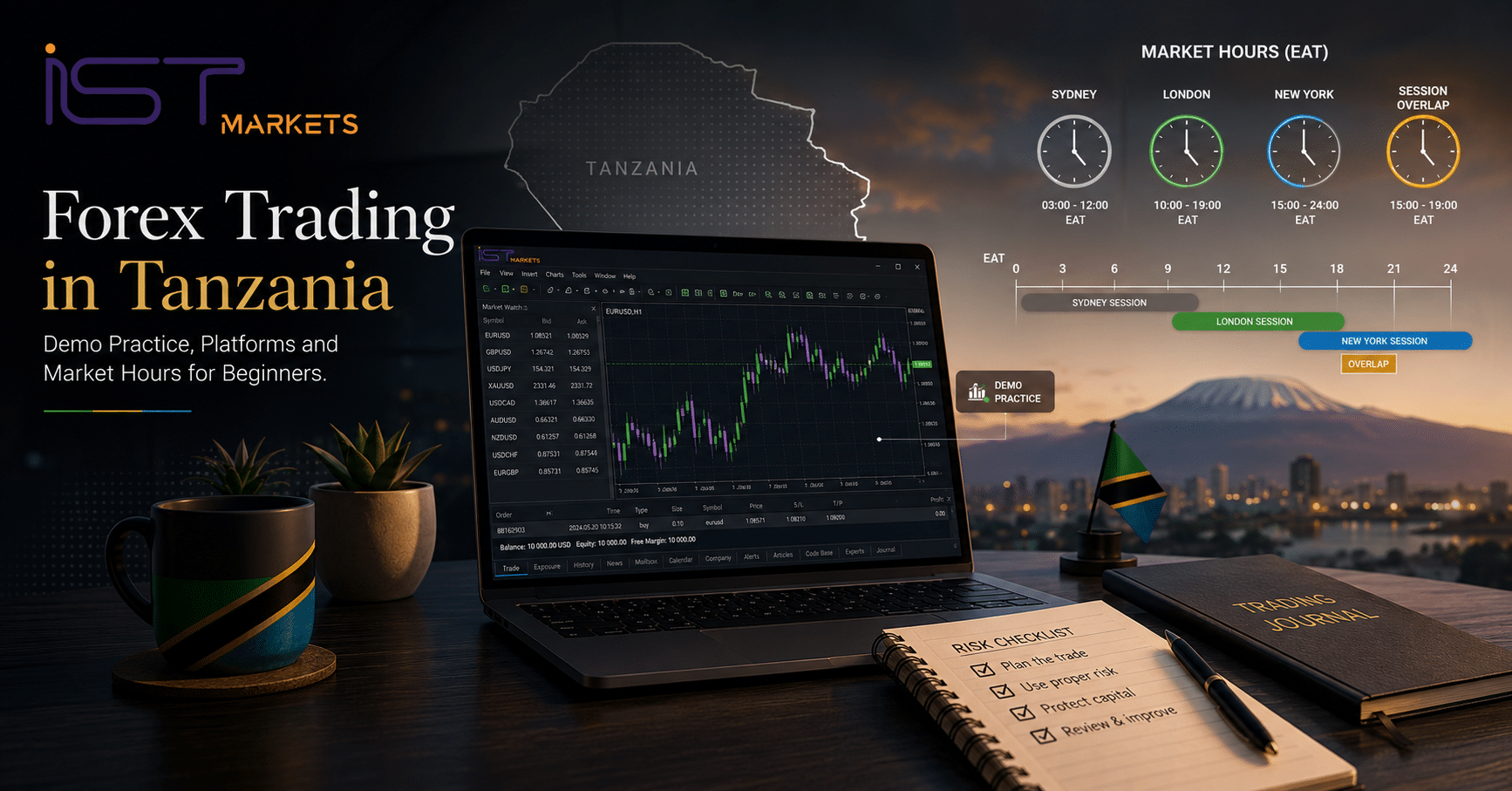
Tanzania uses East Africa Time, UTC+3. Dar es Salaam does not show a clock change during 2026, which makes local planning simpler. However, London and New York can shift relative to Tanzania when those markets move between standard time and daylight-saving time. For that reason, session times should be treated as practical guides, not permanent rules.
The forex market is usually described as operating 24 hours a day, five days a week because trading moves through major financial centers including Sydney, Tokyo, London and New York. But “open” does not mean “equally active.” Different sessions can behave differently, and beginners should observe this on demo before considering live exposure.
| Session | Approx. UTC window | Approx. Tanzania time | Beginner use | Risk note |
|---|---|---|---|---|
| Asian / Tokyo activity | Around 00:00–09:00 UTC | Around 03:00–12:00 EAT | Useful for observing quieter movement and practising platform workflow. | Liquidity varies by pair; some pairs may move slowly or have wider spreads. |
| London / European activity | Around 08:00–17:00 UTC | Around 11:00–20:00 EAT | Good demo window for observing stronger activity in major pairs. | More activity can mean faster movement and faster mistakes. |
| New York / North American activity | Around 13:00–22:00 UTC | Around 16:00–01:00 EAT | Useful for observing U.S. data/news reactions on demo. | News releases can cause volatility, spread changes and slippage. |
| London/New York overlap | Around 13:00–17:00 UTC | Around 16:00–20:00 EAT | Important demo observation window because activity can be high. | Active does not mean safer. Beginners should study it before live exposure. |
Timing rule
London/New York overlap: active does not mean safer
Many beginners hear that the London/New York overlap is one of the most active periods in forex. That can be true for many major pairs because two large financial centers are active at the same time. But the beginner mistake is to translate “active” into “better” or “safer.”
For Tanzania-based beginners, the London/New York overlap is a session to study on demo first, not a shortcut to live trading. During this window, price may move faster, spreads may change around news, and emotional pressure may increase. If a trader has not practised placing, modifying and closing trades during active windows, the first live experience can be stressful.
Overlap rule
The London/New York overlap is not a signal. It is a market condition. Beginners should observe it on demo, record how it behaves, and only consider live exposure after account terms and risk controls are clear.
| Overlap observation | What a beginner should record | Why it matters |
|---|---|---|
| Spread behaviour | Does spread stay stable or change around events? | Spread affects entry and exit cost. |
| Candle speed | How quickly do prices move after entry? | Fast candles can pressure beginners into impulsive actions. |
| Stop-loss behaviour | Does price approach or pass stop levels quickly? | Beginners must understand that stop-loss orders are not perfect guarantees. |
| Emotional pressure | Do you rush, widen stops, overtrade or close too early? | Live trading adds real money pressure on top of session speed. |
Demo practice by session: how beginners should train before live trading
Most beginner articles say “use a demo account.” That advice is useful, but incomplete. A Tanzania-based beginner should not only practise randomly. They should practise by session and keep a short journal. The purpose is to understand how the same pair and the same platform can behave differently across quiet periods, London activity, New York activity and overlap windows.
A demo trading account can help you practise platform workflow: login, order placement, stop-loss, take-profit, modification, closing positions and reading margin. It should not be used as proof that live trading will be profitable.
| Demo drill | What to do | What to record | Why it matters |
|---|---|---|---|
| Same pair, different sessions | Observe one major pair across Asian, London and overlap windows. | Spread, candle speed, slippage feel and emotional pressure. | Shows that market timing changes trading conditions. |
| London/New York overlap observation | Watch price movement without rushing to trade every move. | Setup quality, speed, spread, false breaks and reaction time. | Prepares the trader for fast conditions before live exposure. |
| News-window observation | Observe high-impact news on demo without increasing size. | Spikes, spread widening, stop behaviour and order hesitation. | Teaches that active news periods can be dangerous for beginners. |
| Full platform workflow | Place, modify, protect and close a demo trade. | Entry, stop, exit, margin, history and mistakes. | Avoids learning basic controls with real funds. |
A 7-day demo timing plan for Tanzania-based beginners
| Day | Practice focus | Goal |
|---|---|---|
| Day 1 | Log in, confirm demo server, place one small practice order. | Learn platform controls without pressure. |
| Day 2 | Practise stop-loss, take-profit and manual close. | Make risk-control buttons familiar. |
| Day 3 | Observe a quieter session. | Compare slower movement and spread behaviour. |
| Day 4 | Observe London session. | Understand stronger activity and faster candles. |
| Day 5 | Observe London/New York overlap. | Study speed, pressure and false moves. |
| Day 6 | Observe a news window on demo. | Learn why news volatility can be risky. |
| Day 7 | Review journal, mistakes and unanswered questions. | Decide whether more demo practice is needed before live funding. |
Micro CTA: Practise workflow, not confidence
MT5 is a platform, not live-readiness proof
MT5 can help traders view charts, place orders, use indicators, monitor positions and review trade history. MetaTrader 5 is described as a platform for forex and stock markets, and MetaQuotes states that it is a software development company and does not provide investment or brokerage services. That distinction matters.
A platform login does not prove that the broker entity is clear, that withdrawal terms are reliable, that account conditions are suitable, or that a beginner is ready for live trading. The platform is the tool. The account documents and risk disclosure define the environment behind the tool.
| Check | Why it matters | IST internal link for more detail |
|---|---|---|
| Legal entity and documents | You need to know which company and terms govern the account relationship. | Legal Documents |
| Demo practice | You should practise login, orders, stop-loss and session behaviour before live funding. | Demo Trading Account |
| Market hours | Sessions affect liquidity, volatility, spread and news risk. | Market Hours and Events |
| Account type | Account conditions can affect spreads, commissions, margin and fees. | Trading Account Types |
| Trading costs | Spread, commission and overnight costs affect real results. | Fees |
| Trading risk | Leverage, margin, slippage and stop-loss limitations should be understood first. | Risk Disclosure |
Platform-readiness rule
Risk rules: volatility, spread, slippage, leverage and news
Market hours matter because they change conditions, but the main live-trading risks remain the same: spread, commission, leverage, margin, slippage, stop-loss limitations, electronic trading interruptions, news volatility, weekend gaps, OTC/off-exchange risk and counterparty risk.
Leverage and margin
Leverage allows a trader to control a larger position with a smaller margin amount. That can make a trade look easy to open, but it can also increase the speed and size of losses. During active sessions, price can move quickly enough to pressure an account before a beginner has time to react.
Spread and session changes
Spreads can vary across instruments and market conditions. A trader may see tighter spreads during high-liquidity periods and wider spreads during quieter or disrupted periods. Beginners should review fees and trading conditions before making any live decision.
News and volatility
London/New York overlap can be active, but some of the fastest movement may occur around major economic releases, central bank updates or geopolitical news. Beginners should not treat news volatility as a shortcut. A fast candle can move in either direction and may trigger slippage or stop-loss execution differences.
Stop-loss limitations
A stop-loss can help manage risk, but it is not a guarantee of an exact exit price. Fast markets, gaps, illiquidity or technology interruptions can affect execution. Position size should therefore be managed before the trade is placed.
OTC and off-exchange risk
Many forex and CFD products are traded over the counter or off-exchange. These products may not have the same protections as exchange-traded products. Traders should understand the counterparty relationship, account documents, execution model and risk disclosure before using live funds.
Live-risk rule
Before thinking about entry timing, calculate position size, margin impact, stop-loss distance and worst-case account stress. The session is not the risk plan.
Tanzania beginner scenario: from demo timing to live-account decision
Imagine a beginner in Dar es Salaam, Arusha or Mwanza downloads MT5 and opens a demo account. They practise in the evening after work and notice that price movement feels faster during some hours. They hear that the London/New York overlap can be active, so they consider funding a live account to trade during that window.
A weak process would be to fund quickly because the market looks active. A stronger process starts with observation. The trader uses demo for several sessions and records time, pair, spread, speed, stop placement, emotional pressure and whether they followed a written plan.
Next, the trader checks the account environment. Which legal entity governs the account? What account type applies? What spreads or commissions may apply? Is the platform login demo or live? What happens around news releases? How much margin is used by one trade? Have they read the risk disclosure?
If the trader cannot answer these questions, they do not fund yet. They continue practising. That is not hesitation; it is responsible live-readiness thinking.
Common mistakes Tanzania-based beginners should avoid
Many beginner mistakes happen before the first live trade. They come from misunderstanding market hours, trusting demo results too quickly, ignoring account terms or trading active sessions without risk planning.
| Mistake | Why it matters | Better approach |
|---|---|---|
| Thinking “24/5” means every hour is equally suitable | Liquidity, spread and volatility can vary by session and news events. | Practise different sessions on demo and keep a session journal. |
| Trading London/New York overlap too early | Fast conditions can create emotional and execution pressure. | Observe the overlap on demo before any live exposure. |
| Treating demo profit as live readiness | Demo does not reproduce real money pressure or all live conditions. | Use demo to practise workflow, timing and risk controls. |
| Ignoring market news | News can create volatility, spread changes and slippage. | Check market events before trading and avoid unclear conditions. |
| Using leverage without margin understanding | Small price movement can stress the account quickly. | Calculate position size and margin before any live decision. |
| Trusting screenshots or social posts | They may omit entity, terms, risk, spread and withdrawal rules. | Use written documents, official sources and risk disclosures. |
Before-live decision tree
A checklist tells you what to review. A decision tree tells you what to do if something is unclear. Use this before funding or switching from demo to live trading.
| If you cannot answer… | Decision | Next step |
|---|---|---|
| Which legal entity governs my account? | Do not fund yet. | Read legal documents and account terms. |
| Is this platform login demo or live? | Do not trade live yet. | Confirm login type, server and account environment. |
| Which session am I practising? | Stay on demo. | Record session time, spread, volatility and decision quality. |
| How does leverage affect margin and possible loss? | Stay on demo. | Review margin, position size and risk disclosure. |
| What happens during news volatility? | Do not trade news live yet. | Observe news windows on demo and study spread/slippage behaviour. |
| Have I read the risk disclosure? | Do not fund yet. | Read the Risk Disclosure before any live decision. |
Personal trading research vs introducing others
Researching forex trading for your own possible account is different from introducing, referring, promoting or influencing other people’s trading decisions. This article is for personal trading-readiness research. It is not an introducing broker, referral partner or promoter guide.
If your activity involves referring others, sharing compensation-linked links, running trading groups, promoting a broker, teaching people to open accounts or influencing account decisions, you should not rely on a retail trading article. That type of activity may require separate legal, contractual and compliance review.
For promoters, educators or referral partners
Risk reminder before the CTA
Timing is not protection. A good-looking session does not remove leverage risk. A platform login does not prove account suitability. A demo profit does not prove live performance. A stop-loss does not guarantee a perfect exit price. An active market does not mean a beginner should trade live.
Before considering live funding, verify the legal entity, read account terms, understand market sessions in Tanzania time, practise the platform workflow on demo, check market events, calculate margin impact and review the risk disclosure. If any part is unclear, waiting is a responsible decision.
Soft CTA: Practise timing, verify terms, then decide
Before using live funds, review the IST Markets Legal Documents and Risk Disclosure so you understand the entity, account terms, trading risks and responsibilities.
If you are still learning platform workflow or session timing, practise first using a demo trading account. Demo practice helps you learn platform controls and market behaviour, but it does not prove future live results.
When comparing live conditions, review the relevant account types, fees and market hours and events carefully before making any funding decision.
FAQ
What is forex trading in Tanzania?
Forex trading in Tanzania means accessing global currency markets from Tanzania through an online broker account and trading platform, often using margin and leverage. Beginners should check account terms, platform setup, market hours, demo workflow and risk disclosure before live funding.
How does forex trading in Tanzania work for beginners?
A beginner usually tests a platform such as MT5 on demo, learns order workflow, studies market sessions in Tanzania time, reviews account terms, checks spreads and fees, and understands leverage, margin and slippage before considering a live account.
What are the forex market hours in Tanzania?
Tanzania uses East Africa Time, UTC+3. As a practical guide, Asian activity may run around 03:00–12:00 EAT, London around 11:00–20:00 EAT, New York around 16:00–01:00 EAT, and London/New York overlap around 16:00–20:00 EAT. Times can shift relative to Tanzania when London or New York changes daylight-saving schedules.
Is London/New York overlap good for beginners?
It can be useful to study because it is often active, but it is not automatically safer or better for beginners. Faster movement can create emotional pressure, slippage and quicker losses. Beginners should observe the overlap on demo before considering live exposure.
Is demo trading enough before live forex trading?
No. Demo trading can help with platform workflow, order practice and session observation, but it does not prove future live performance. Live trading adds real money pressure, spread changes, slippage, margin risk and possible loss.
Is MT5 enough to start trading live?
No. MT5 is a trading platform, not a broker verification badge or live-readiness proof. It can help with charts, orders and workflow practice, but traders still need to verify the legal entity, account terms, fees, risk disclosure and live-account conditions.
What should I check before funding a forex account in Tanzania?
Check the broker’s legal entity, account documents, platform login, demo/live status, account type, spreads, fees, market hours, news events, leverage, margin requirements and risk disclosure before funding.
What are the main risks of forex trading in Tanzania?
The main risks include leverage, margin calls, fast market movement, spread changes, slippage, stop-loss limitations, electronic trading risk, OTC/off-exchange risk, counterparty risk, news volatility and demo-to-live overconfidence.
Can I promote or introduce others to forex trading from Tanzania?
This article is not an introducing broker or promoter guide. Introducing, referring, educating or promoting trading services may require separate legal, contractual and compliance review. Do not treat personal trading research as permission to promote or refer others.
References & Further Reading
- World Bank Data: Tanzania
- Capital Markets and Securities Authority Tanzania
- Bank of Tanzania
- Timeanddate: Dar es Salaam Time Zone
- MetaTrader 5 Official Website
- Investopedia: Why Is the Forex Market Open 24 Hours a Day?
- IST Markets Market Hours and Events
- IST Markets Demo Trading Account
- IST Markets Trading Account Types
- IST Markets Fees
- IST Markets Legal Documents
- IST Markets Risk Disclosure