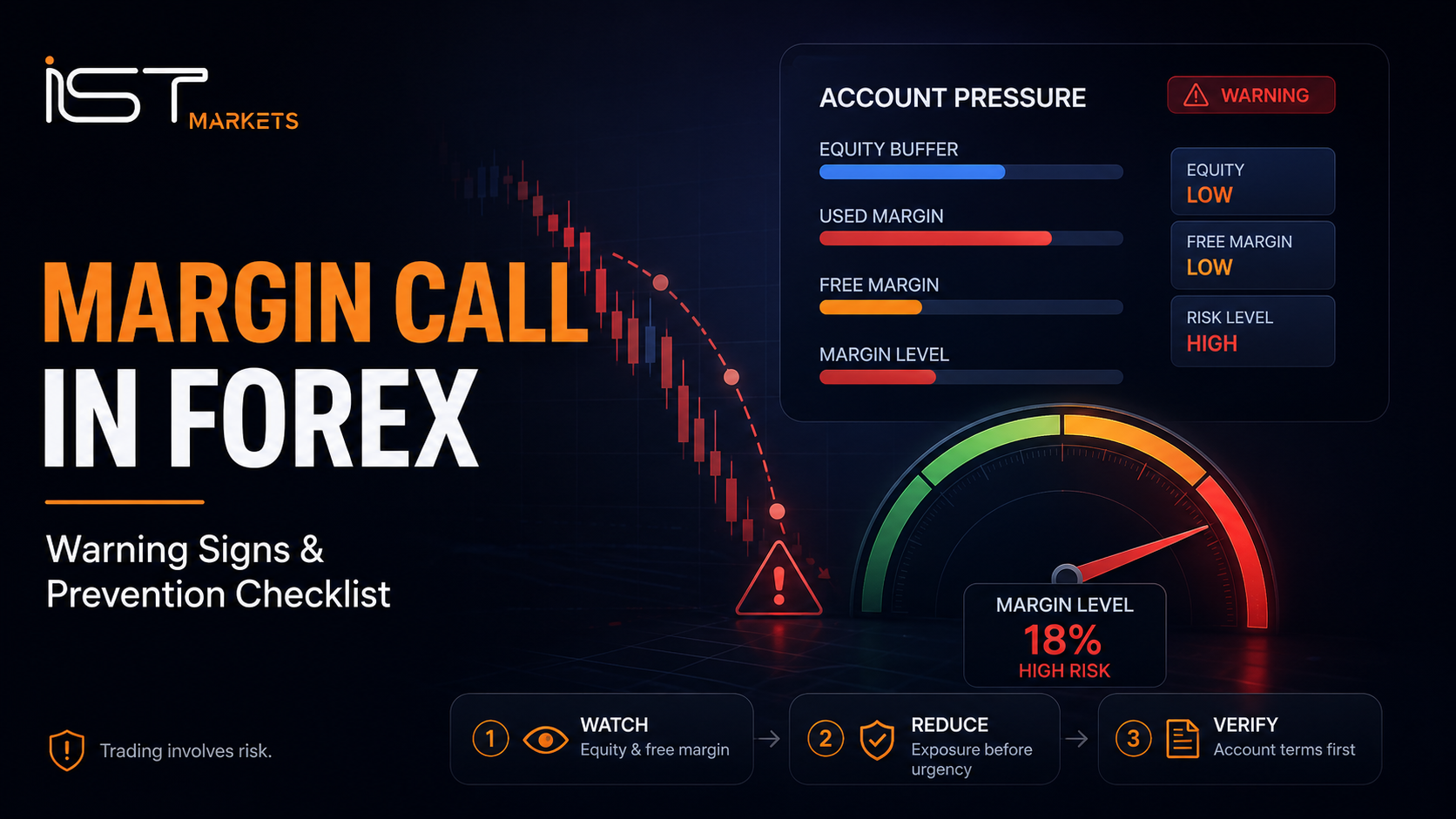
What Is a Margin Call in Forex? Beginner Warning Signs and Prevention Checklist
A practical risk-first guide for beginners who have heard the term margin call, but need to understand margin level, equity, free margin, stop out risk and warning signs before trading live.
Quick Answer: What is a margin call in forex?
A margin call in forex is a warning that your account has moved too close to its required margin limits because losses have reduced equity or free margin. It is not just a platform notification; it is a sign of margin pressure. Beginners should watch margin level, equity, used margin, free margin, leverage, position size, spreads, slippage and stop out risk before trading live. If margin pressure continues, the broker or platform may restrict new trades, request more funds, or close positions according to account terms.
This guide explains margin calls as a risk-management warning system, not as a simple platform alert. The goal is to help beginners recognise margin pressure before it becomes forced position closure or emotional decision-making.
This guide uses IST Markets Risk Disclosure, investor-risk education from CFTC, NFA, FCA and ESMA, and beginner education references for margin-level formulas. Formula examples are simplified for education and should be checked against live platform specifications, account terms and product conditions before trading.
Content Table
1What a margin call meansA warning sign, not just a notification.
2Official risk contextWhy the topic is treated seriously.
3Margin pressure timelineFrom normal trade to stop out risk.
4How margin call worksEquity, used margin and margin level.
5Margin call vs stop outWhat beginners often confuse.
6Warning signsWhat beginners should monitor.
7Simple exampleHow equity pressure builds.
8What to do / avoidA practical behaviour guide.
What margin call forex means in real trading terms
Margin call forex refers to a warning condition that occurs when a leveraged trading account no longer has enough margin buffer relative to open positions. In simple terms, the account is under stress because open losses have reduced equity, used margin is taking up too much of the account, or free margin is becoming too low.
A margin call should not be understood as a random pop-up. It is a risk signal. It tells the trader that the account is moving closer to a point where new trades may be restricted, additional funds may be requested, or positions may be closed according to account terms.
Beginners often ask, “What happens if I get a margin call?” A better question is: “What account behaviour led to the margin call?” The answer is usually connected to oversized positions, insufficient equity, overuse of leverage, ignoring margin level, or holding trades through volatile conditions without enough buffer.
Official risk context: why margin pressure deserves attention
Margin calls matter because they are connected to leveraged trading risk, not just platform design. IST Markets’ Risk Disclosure explains that leveraged products involve significant risk, that small market movements can have a larger impact on deposited funds, and that traders may be called upon to pay additional funds if the market moves against them or margin levels are increased.
Investor-protection authorities also treat retail forex and CFD-style products carefully. CFTC rules require forex-specific risk disclosure statements in the retail forex context, and FCA rules for retail CFDs include leverage limits and margin close-out requirements. These references are used here as risk-education context, not as country-specific legal advice.
| Risk source | Relevant point | How beginners should use it |
|---|---|---|
| IST Markets Risk Disclosure | Leverage, margin calls, stop-loss limitations, liquidation risk and off-exchange risks. | Read the risk disclosure before using live funds. |
| CFTC / NFA | Retail forex is treated as a high-risk area requiring specific disclosures and oversight. | Treat margin and leverage as risk controls, not only trading features. |
| FCA / ESMA | Retail CFD protections include leverage limits, margin close-out and risk warnings. | Understand that margin close-out is a serious investor-protection issue. |
Margin pressure timeline: how a normal trade can become urgent
A margin call often feels sudden, but margin pressure usually develops in stages. The earlier a trader recognises those stages, the easier it is to make a calm decision before the account is under severe stress.
| Stage | What happens | Beginner risk | Better response |
|---|---|---|---|
| Normal position | Equity and free margin are still healthy. | Trader may become overconfident. | Monitor equity, used margin and margin level from the start. |
| Early pressure | Floating loss begins reducing equity. | Trader may ignore the change because balance looks unchanged. | Compare current equity with the original risk plan. |
| Warning zone | Free margin shrinks and margin level drops. | Trader may add another position or widen stops emotionally. | Reduce exposure before the situation becomes urgent. |
| Margin call stage | The account reaches warning or restriction conditions. | Panic decisions become more likely. | Follow the written plan; do not improvise under pressure. |
| Stop out risk | Positions may be closed according to platform and account terms. | Trader may lose control over timing and position selection. | The goal is to manage risk before reaching this stage. |
How margin call forex works: key mechanics explained clearly
A margin call is connected to several platform metrics. Beginners should understand these terms before opening a live leveraged position. The exact levels for margin call and stop out vary by broker, account type, product and platform settings, so always check the current account terms and risk documents.
| Term | Simple meaning | Why it matters |
|---|---|---|
| Balance | Settled account value before open profit or loss. | It may not show current floating loss pressure. |
| Equity | Balance plus or minus open floating profit or loss. | Falling equity is one of the clearest signs of account stress. |
| Used Margin | Margin locked by open positions. | High used margin leaves less room for adverse movement. |
| Free Margin | Equity not currently used as margin. | Low free margin means the account has less buffer. |
| Margin Level | A percentage comparing equity to used margin. | It is a key health metric for margin call and stop out risk. |
| Stop Out | A platform/account event where positions may be automatically closed. | The trader may lose control over which positions are closed and when. |
A common educational formula is:
This formula is educational. Platform calculations, product rules and threshold levels can vary, so traders should review their live account terms before relying on any number.
Margin call vs stop out: what is the difference?
Beginners often confuse margin call and stop out. They are connected, but they are not the same. A margin call is usually a warning or restriction stage. A stop out is more severe and may involve automatic position closure according to platform and account rules.
| Concept | Stage | Who may act? | Why it matters |
|---|---|---|---|
| Margin Call | Warning / restriction / account stress | The trader may still have choices depending on account terms. | It is a late warning that risk has already built up. |
| Stop Out | Severe account event | The platform may close positions according to rules. | Control over timing and position selection may be reduced. |
| Margin Level | Monitoring metric | The trader monitors it before alerts appear. | It helps show account pressure before a severe event. |
The exact level where a margin call or stop out occurs can differ by account type, trading product and platform rules. This is why a beginner should not rely on a universal percentage found online without checking the account documents.
Warning signs before a margin call happens
A margin call often feels sudden to beginners, but the warning signs usually appear earlier. The aim is to recognise margin pressure before the platform forces the issue.
| Warning sign | What it may mean | Better response |
|---|---|---|
| Equity falling quickly | Open losses are reducing the account’s real-time value. | Reduce exposure or close risk according to a written plan. |
| Free margin shrinking | The account has less room to absorb further movement. | Avoid opening new positions and review current risk. |
| Margin level dropping | Equity is becoming weaker relative to used margin. | Treat this as a risk warning, not as a normal screen number. |
| Multiple positions open together | Exposure may be larger than the trader realises. | Check total exposure, not each trade separately. |
| Spreads widening or price moving fast | Costs and slippage risk may increase. | Avoid adding risk during volatile periods you do not understand. |
| Adding to a losing trade | Used margin can rise while equity is already falling. | Pause and reassess the whole account, not only the new entry. |
Simple example: how margin pressure builds
The table below is a simplified educational example. It does not represent a specific IST account, instrument or live platform threshold. It is designed to show how equity and margin level can change as floating losses increase.
| Account Stage | Balance | Floating P/L | Equity | Used Margin | Margin Level |
|---|---|---|---|---|---|
| Position just opened | $1,000 | $0 | $1,000 | $250 | 400% |
| Trade moves against trader | $1,000 | -$300 | $700 | $250 | 280% |
| Loss deepens | $1,000 | -$650 | $350 | $250 | 140% |
| Critical pressure | $1,000 | -$800 | $200 | $250 | 80% |
Notice that the balance stayed at $1,000 in the example, but equity fell as the open loss grew. That is why watching balance alone can be misleading. Margin pressure builds through equity, used margin and margin level.
Costs, slippage and volatility can bring margin pressure closer
A margin call is not only caused by a bad directional decision. It can also be worsened by trading costs, fast markets, poor timing and overexposure. Beginners should understand how spreads, swaps and slippage affect a leveraged account.
Spread widening
The spread is the difference between buy and sell prices. During volatile or low-liquidity periods, spreads can widen. If the position is large, spread movement can immediately affect equity and free margin.
Slippage
Slippage occurs when an order executes at a different price than expected. A stop-loss can support risk management, but it may not always fill at the exact requested price during fast-moving markets, gaps or thin liquidity.
Swap and holding costs
If a position remains open overnight, financing adjustments may apply depending on the product and account terms. These costs can affect equity over time, especially when positions are held while already under pressure.
Beginner scenario: the trader who watched balance only
Imagine a beginner opens a leveraged forex position and sees that the account balance is still $1,000. The trader feels calm because the balance has not changed. But the open trade is losing money, so equity is falling. Free margin is shrinking. Margin level is dropping.
The trader does not notice the warning signs because they are focused on whether price will “come back.” Instead of reducing risk, they add another position. Now used margin increases, free margin falls further and the account has less room to absorb another adverse move.
This is how margin pressure becomes urgent. The margin call is not the real mistake. The mistake happened earlier: oversized exposure, weak monitoring, no clear stop plan and no understanding of margin level.
What to do — and what not to do — during margin pressure
This section is not a trading recommendation. It is a behaviour checklist to help beginners avoid reactive decisions when account pressure rises.
| Situation | Better response | Avoid |
|---|---|---|
| Equity is falling | Review exposure and compare it with the written risk plan. | Waiting only because you hope the market returns. |
| Free margin is shrinking | Avoid new trades and review whether current exposure is too large. | Adding positions emotionally. |
| Margin level drops quickly | Reduce risk before urgency if the trade no longer fits the plan. | Depositing more money without reviewing the original mistake. |
| Spreads widen or price moves fast | Pause if the volatility is not understood. | Increasing lot size to recover quickly. |
| A stop-loss is near | Follow the plan you accepted before entering. | Moving the stop randomly because the loss feels uncomfortable. |
Common mistakes beginners should avoid with margin calls
Most margin call mistakes happen before the actual margin call. The table below converts common beginner errors into practical prevention steps.
| Mistake | Why it is risky | Better approach |
|---|---|---|
| Thinking a margin call is the first warning | Equity and free margin usually showed stress earlier. | Monitor margin level before it becomes urgent. |
| Using large position size | A small move can create a large equity impact. | Size trades based on equity and maximum acceptable loss. |
| Opening many correlated trades | Several positions may lose at the same time. | Review total exposure, not only individual trades. |
| Ignoring spreads and slippage | Costs can worsen account pressure during volatile periods. | Check fees, execution conditions and market timing. |
| Adding funds without reviewing risk | It may delay the problem without fixing exposure. | Review whether the trade, size and risk plan are still valid. |
| Treating demo confidence as proof | Demo does not fully reflect live emotional pressure. | Use demo to practise monitoring margin metrics, not to prove future results. |
Before you deposit: ask these 6 questions
Before using live funds, a beginner should be able to answer these questions without guessing. If the answer is unclear, demo practice and document review may be more appropriate than live trading.
- Do I know the margin call and stop out levels that apply to my account?
- Can I find balance, equity, used margin, free margin and margin level on the platform?
- Do I understand how spread widening and slippage can affect equity?
- Do I know my maximum acceptable loss before opening a trade?
- Have I practised margin monitoring on a demo account?
- Have I read the risk disclosure, legal documents and account terms?
Margin call forex prevention checklist before taking action
Use this checklist before trading live and again before increasing position size. The goal is not to guarantee safety. The goal is to recognise margin pressure before it becomes urgent.
| Readiness area | What to confirm | Decision signal |
|---|---|---|
| Platform readiness | You know where balance, equity, used margin, free margin and margin level appear. | Practise on demo if these numbers are unfamiliar. |
| Position-size readiness | You know how much equity can be lost if the trade goes wrong. | Reduce exposure if one trade can seriously damage the account. |
| Margin-level readiness | You understand the margin call and stop out levels that apply to your account. | Check account terms before trading live. |
| Cost readiness | You understand spread, slippage, swap and possible execution limitations. | Avoid large exposure during market conditions you do not understand. |
| Document readiness | You have reviewed risk disclosure, legal documents and account conditions. | Do not rely only on platform access or account approval. |
| Emotional readiness | You have a written plan for what to do if equity falls. | Pause if your plan is only to hope, deposit more or wait. |
Where this guide fits in your learning path
Margin calls sit between leverage education and live risk management. Before trading live, beginners should understand how leverage creates exposure, how margin supports open positions, how equity changes in real time and how stop out may occur if margin requirements are not maintained.
Risk reminder before the CTA
Before trading live, read the risk disclosure, understand margin requirements, review account terms and practise monitoring equity, free margin and margin level on demo. A margin call can happen when floating losses reduce the account’s margin buffer. If the account reaches a stop out level, positions may be closed according to platform and account terms.
A responsible beginner does not wait for a margin call to manage risk. Risk should be reduced when the warning signs first appear, not after the account is already under severe pressure.
Soft CTA: Practise margin monitoring before trading live
Before using live funds, review the IST Markets risk disclosure, check the legal documents, practise through a demo account, compare account types, and review trading fees and costs before deciding whether live leveraged trading is appropriate for you.
Practise first. Verify first. Treat margin level as an account-health signal, not just a number on the platform.
FAQ
What is margin call forex in simple terms?
A margin call in forex is a warning that your account has moved too close to its required margin limits. It usually happens when floating losses reduce equity or free margin while used margin remains high.
How does a margin call work for beginners?
A margin call works by warning the trader that the account’s margin buffer has become too low. Depending on account terms, the trader may need to reduce exposure, deposit funds, or risk positions being closed if margin pressure continues.
What is the difference between margin call and stop out?
A margin call is usually a warning or restriction stage. A stop out is a more severe event where positions may be automatically closed according to platform and account rules. Exact thresholds vary by broker, account type and product.
What causes a margin call in forex?
A margin call may be caused by falling equity, excessive position size, high used margin, low free margin, overuse of leverage, correlated trades, spread widening, slippage or market volatility.
What should I check before a margin call happens?
Check equity, used margin, free margin, margin level, total exposure, position size, spread, slippage, swap costs, stop-loss plan and account terms before trading live.
Can a margin call close my trades?
A margin call itself may be a warning or restriction, but if margin pressure continues and the account reaches a stop out level, positions may be closed automatically according to the platform and account terms.
How can beginners reduce margin call risk?
Beginners can reduce margin call risk by using smaller position sizes, monitoring margin level, avoiding overexposure, using stop-loss planning, understanding spreads and slippage, and practising on demo before trading live.
Is demo trading enough to practise margin calls?
A demo account can help beginners practise reading equity, free margin and margin level, but demo results do not prove future live performance. Live trading adds real financial pressure, execution risk and emotional decisions.
References & Further Reading
- IST Markets Risk Disclosure
- IST Markets Legal Documents
- IST Markets Demo Trading Account
- IST Markets Trading Account Types
- IST Markets Trading Fees and Costs
- CFTC — Foreign Currency Trading
- NFA — Forex Transactions Regulatory Guide
- ESMA — CFD Product Intervention Obligations
- FCA — Restricting CFD Products Sold to Retail Clients