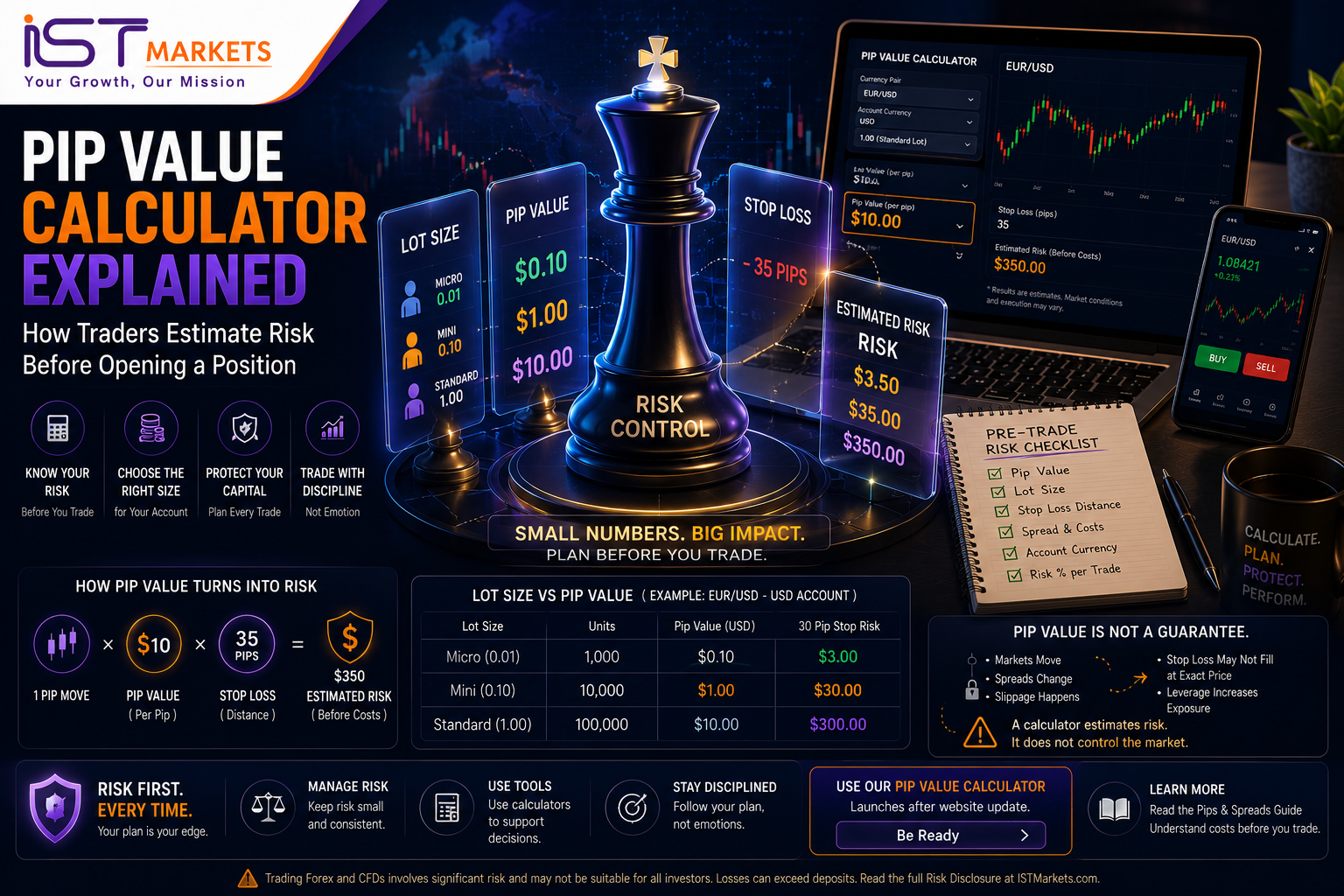
Pip Value Source & Risk Snapshot
| Source | What It Confirms | Why It Matters |
|---|---|---|
| IST Markets Pips & Spreads Guide | Explains pips, pipettes, pip value and spread as trading cost. | Supports the article’s core idea: pip movement must be translated into money risk. |
| Investopedia Lot-Size References | Micro, mini and standard lots represent different position sizes. | Helps validate why the same pip move creates different money exposure. |
| IST Markets Forex Profit Calculator | Uses inputs such as pair, entry, exit, lot size, pip value and account currency for planning. | Connects pip value with pre-trade P/L estimation. |
| IST Markets Risk Disclosure | Highlights leverage, margin calls, stop-loss limits, gaps, outages and OTC/counterparty risk. | Keeps calculator education grounded in live-market limitations. |
Content Table
- Quick Answer: What does a pip value calculator show?
- What is pip value in forex?
- Pip value is a risk translation tool, not just a formula
- Why pip value changes with position size
- Step-by-step pip value example
- Account currency and pair type can change the result
- Pip value, stop loss and risk amount
- Common beginner misconceptions about pip value
- When to use a pip value calculator
- Calculator limitations beginners must understand
- Pre-position risk checklist
- Risk reminder before using calculators live
- Soft CTA: Use the Pip Value Calculator after launch
- FAQ
Quick Answer: What does a pip value calculator show?
A pip value calculator shows how much money one pip of price movement is worth for a specific position size, currency pair and account currency. That matters because pips are only price distance; pip value translates that distance into possible money impact. A 30-pip stop loss can be a small test on a micro lot, a meaningful loss on a mini lot and a large loss on a standard lot. Beginners should use pip value before opening a position to compare lot sizes, estimate risk amount, understand stop-loss impact and avoid choosing a trade size that is too large for the account.
Forex and CFD trading involves risk. A calculator can support planning, but it cannot guarantee execution price, stop-loss fills, profit, or protection from volatility, spread changes, slippage, leverage risk or margin calls.
What is pip value in forex?
Pip value is the cash value of a one-pip move for your selected trade size. A pip tells you how far price moved. Pip value tells you what that move may mean in your account balance.
For most major currency pairs, one pip is usually the fourth decimal place, or 0.0001. If EUR/USD moves from 1.0850 to 1.0851, that is a one-pip move. For many JPY pairs, one pip is usually the second decimal place, or 0.01. Many platforms also show pipettes, which are fractional pips. A pipette is one-tenth of a pip.
This is where beginners often make a hidden mistake. They may say, “I made 30 pips,” but that statement does not show whether the result was small, moderate or oversized. Thirty pips on a micro lot is not the same as thirty pips on a standard lot.
A practical beginner definition is:
Pip value = the money gained or lost when the market moves one pip for your selected position size.
That is why a pip value calculator is not just a math tool. It is a pre-trade risk tool. It connects four things that beginners must understand before clicking: currency pair, lot size, stop-loss distance and account currency.
Pip value is a risk translation tool, not just a formula
The safest way to understand pip value is to treat it as a translation layer:
| Trading Concept | What beginners often see | What pip value translates it into |
|---|---|---|
| Pip movement | “The market moved 30 pips” | How much that move is worth in money |
| Lot size | “I opened 0.10 lots” | How much each pip affects the account |
| Stop loss | “My stop is 40 pips away” | Estimated loss if the stop is triggered |
| Spread | “The platform shows bid and ask” | Entry cost before the trade moves in your favour |
| Account currency | “My account is in USD, EUR, GBP or another currency” | Whether the pip value needs conversion |
The key lesson is simple: pips do not create risk by themselves. Position size turns pip movement into money risk. A beginner who understands this will usually make better sizing decisions than a trader who only asks whether the setup looks attractive.
Why pip value changes with position size
Pip value changes mainly because position size changes. In forex, position size is often expressed in lots. A standard lot is commonly 100,000 units of the base currency, a mini lot is 10,000 units and a micro lot is 1,000 units.
For USD-quoted pairs such as EUR/USD or GBP/USD in a USD account, the common pip values are easy to understand:
| Lot Type | Position Size | Approx. Pip Value on EUR/USD | 30-Pip Stop Risk | Beginner Meaning |
|---|---|---|---|---|
| Micro lot | 0.01 lot / 1,000 units | About $0.10 per pip | About $3 | Useful for learning workflow and small tests |
| Mini lot | 0.10 lot / 10,000 units | About $1 per pip | About $30 | Risk becomes more noticeable |
| Standard lot | 1.00 lot / 100,000 units | About $10 per pip | About $300 | Mistakes become expensive quickly |
The market move is the same in all three rows. The risk is different because the trade size is different.
Leverage does not change pip value itself. Instead, leverage can make it easier to open a larger position with less margin. That is where beginners can get into trouble: the platform may allow the position, but the account may not be prepared for the risk.
Step-by-step pip value example
Let’s use a simple EUR/USD example with a USD account. This is the easiest case because USD is the quote currency.
Suppose a beginner is comparing three position sizes with the same 50-pip stop loss:
| Position Size | Approx. Pip Value | 50-Pip Stop Loss | Estimated Risk Before Costs |
|---|---|---|---|
| 0.01 lot | $0.10 per pip | 50 pips | About $5 |
| 0.10 lot | $1.00 per pip | 50 pips | About $50 |
| 1.00 lot | $10.00 per pip | 50 pips | About $500 |
The chart setup is identical. The stop-loss distance is identical. The difference is position size.
For USD-quoted pairs in a USD account, a simplified calculation is:
Pip value = position size × pip size
For one standard lot on EUR/USD:
100,000 units × 0.0001 = approximately $10 per pip
For one mini lot:
10,000 units × 0.0001 = approximately $1 per pip
For one micro lot:
1,000 units × 0.0001 = approximately $0.10 per pip
This simplified example is useful for learning, but it is not enough for every instrument. JPY pairs, non-USD account currencies, crosses, metals and CFDs can use different pip conventions, conversion rates or contract specifications. That is where a forex pip calculator becomes more useful than mental math.
Account currency and pair type can change the result
A pip value calculator can return different results depending on account currency. If your account is in USD and you trade EUR/USD, the calculation is straightforward. If your account is in GBP and you trade EUR/USD, the pip value may need conversion into GBP. If you trade EUR/JPY or GBP/JPY, the pip size and conversion logic can also differ.
Beginners should pay attention to three inputs:
| Input | Why it matters |
|---|---|
| Currency pair | Determines pip size and whether the quote currency matches the account currency |
| Lot size | Determines how much each pip is worth |
| Account currency | Determines whether pip value needs conversion |
| Current price or conversion rate | Helps convert pip value into the account currency |
| Contract specification | Important for non-forex CFDs, metals, indices or symbols with different settings |
A calculator is especially useful when the trade is not a simple USD-quoted pair in a USD account. It reduces guesswork, but the trader still needs to check the platform’s symbol specification and understand that live execution can differ from a pre-trade estimate.
Pip value, stop loss and risk amount
Pip value becomes most useful when combined with a stop loss. The risk estimate is:
Estimated risk = pip value × stop-loss distance
Then add practical trading costs where relevant: spread, commission, possible slippage and overnight costs.
| Example | Pip Value | Stop Distance | Estimated Risk Before Costs |
|---|---|---|---|
| Small demo test | $0.10 | 25 pips | $2.50 |
| Moderate position | $1.00 | 25 pips | $25 |
| Larger position | $10.00 | 25 pips | $250 |
| Wider stop on mini lot | $1.00 | 80 pips | $80 |
This table shows why beginners should not choose lot size first. A better process is:
- Decide the maximum amount you are prepared to risk.
- Identify a logical stop-loss distance.
- Calculate the pip value that matches that risk.
- Choose position size only after the risk makes sense.
If the stop loss is wide and the account is small, the answer may be to reduce the lot size or skip the trade. That is not weakness. It is risk control.
Common beginner misconceptions about pip value
| Misconception | Better explanation |
|---|---|
| “More pips means more profit” | Pips are distance. Profit or loss depends on pip value and position size. |
| “Leverage changes pip value” | Leverage does not change pip value directly, but it can allow larger positions that increase exposure. |
| “A calculator controls risk” | A calculator estimates risk. It does not control execution, slippage or gaps. |
| “A tight stop always means low risk” | A tight stop can still be expensive if lot size is too large. |
| “A demo result proves live readiness” | demo practice helps workflow, but live trading changes psychology and execution conditions. |
| “All symbols calculate the same way” | Pairs, account currencies and CFD contract specifications can change the calculation. |
This is one of the main reasons beginners should use a pip value calculator before trading. It helps them catch sizing mistakes before the market exposes them.
When to use a pip value calculator
Use a pip value calculator before opening a position, especially when:
- You are changing lot size.
- You are trading a pair you do not usually trade.
- Your account currency differs from the quote currency.
- Your stop loss is wider or tighter than usual.
- You are moving from demo to live trading.
- You are comparing micro, mini and standard lot exposure.
- You are trading during volatile conditions where spread and slippage may matter more.
A good calculator routine does not have to be complicated. It should answer one question clearly:
If my trade idea is wrong and my stop is hit, how much could I lose before extra costs?
After that, the trader should still consider spread, commission, slippage, swaps, gaps, liquidity and margin pressure.
Calculator limitations beginners must understand
A pip value calculator is useful, but it is not a shield. It does not guarantee that a stop loss will fill at the exact selected price, especially during fast markets, gaps, low liquidity or platform interruptions. It also does not predict whether the trade will win.
Think of the calculator as a planning estimate, not a promise. It can help you prepare, but the final live result can still differ because of:
| Limitation | Why it matters |
|---|---|
| Spread | You may start the trade at a cost because of the bid/ask difference |
| Slippage | Execution can occur at a different price from the expected price |
| Gaps | Price can jump over levels during certain conditions |
| Commission | Some accounts may include separate trade costs |
| Swaps | Overnight positions may incur financing costs |
| Margin pressure | Leveraged positions can create margin-call risk |
| Platform or connectivity issues | Order placement or management can be affected by outages or delays |
This is the YMYL-sensitive part of the topic: the calculator helps estimate risk, but the trader remains responsible for position size, trade selection and whether the risk is acceptable.
Pre-position risk checklist
Before opening a position, use this checklist:
| Question | Why it matters |
|---|---|
| Have I confirmed the currency pair or symbol? | Similar-looking symbols can have different specifications |
| Do I know the pip size? | Non-JPY and JPY pairs can use different decimal conventions |
| Have I checked the lot size? | Lot size is the main driver of pip value |
| Do I know my account currency? | Conversion may affect the final pip value |
| Have I calculated stop-loss distance in pips? | Risk cannot be estimated without distance |
| Have I estimated risk amount? | Pip value × stop distance shows the basic risk estimate |
| Have I considered spread and costs? | Costs affect the final result |
| Is the trade size realistic for my account? | A position can be technically possible but financially unsuitable |
| Have I practised this on demo? | demo helps build workflow without live funds |
| Have I read the risk disclosure? | Calculations do not remove trading risk |
If several answers are unclear, the professional decision may be to wait, reduce size or practise on demo.
Risk reminder before using calculators live
Pip value calculations are helpful, but forex and CFD trading involves significant risk. Leveraged positions can magnify losses. Stop-loss orders may not always execute at the exact selected price. Spreads can widen, slippage can occur, markets can gap, and platform or connectivity issues can affect order handling.
Beginners should not treat a pip value calculator as a signal or as proof that a trade is safe. It is one part of pre-trade planning. Use it with position sizing, risk limits, demo practice and a clear understanding of the instrument being traded.
Soft CTA: Use the Pip Value Calculator after launch
When the IST Markets pip value calculator is available, use it before opening a position to estimate how lot size, pip value, stop-loss distance and account currency may affect risk. Until then, build the habit manually: calculate pip value, multiply by stop distance, add costs where relevant, and ask whether the potential loss is acceptable.
You can also read the pips and spreads guide to understand how pip movement and spread costs work together. Calculators and guides support better planning, but they do not guarantee outcomes or remove live-market risk.
FAQ
Use the Pip Value Calculator Before You Open a Position
Estimate pip value, stop-loss distance and risk amount before moving from analysis to execution.
Use Pip Value Calculator
Read Pips & Spreads Guide
Calculators support planning. They do not guarantee live trading outcomes.
Sources & Further Reading