AI Market Summary Source & Risk Snapshot
| Source | What It Supports | Why It Matters |
|---|---|---|
| IST Markets AI Trading in 2026 | AI can help organise research and risk checks, but should not be treated as a guaranteed forecast, signal or replacement for risk management. | Keeps the article focused on responsible use, not AI hype. |
| NIST AI Risk Management Framework | AI systems should be used with risk-management and trustworthiness considerations. | Supports verification, human oversight and caution. |
| IOSCO AI in Capital Markets | AI in capital markets creates issues around investor protection, market integrity and financial stability. | Supports strong boundaries between information and action. |
| SEC / NASAA / FINRA Investor Alert | Warns investors about frauds involving purported use of AI and emerging technologies. | Adds an overtrust and AI-hype safety layer. |
| IST Markets Risk Disclosure | Highlights leverage, margin calls, stop-loss limitations, gaps, outages, OTC and counterparty risk. | Keeps AI tools clearly separated from risk control or guaranteed outcomes. |
Content Table
- Quick Answer: Are AI market summaries trading signals?
- What AI market summaries can and cannot do
- Market summary vs analysis vs signal
- The Signal Boundary Test
- How traders should verify AI summaries
- What AI may miss in fast markets
- Responsible workflow before acting
- Responsible prompting for traders
- What AI should never decide for you
- AI fraud and overtrust warning
- Common mistakes with AI market tools
- Responsible AI checklist
- Risk reminder before the CTA
- Soft CTA: Use AI market tools responsibly
- FAQ
Quick Answer: Are AI market summaries trading signals?
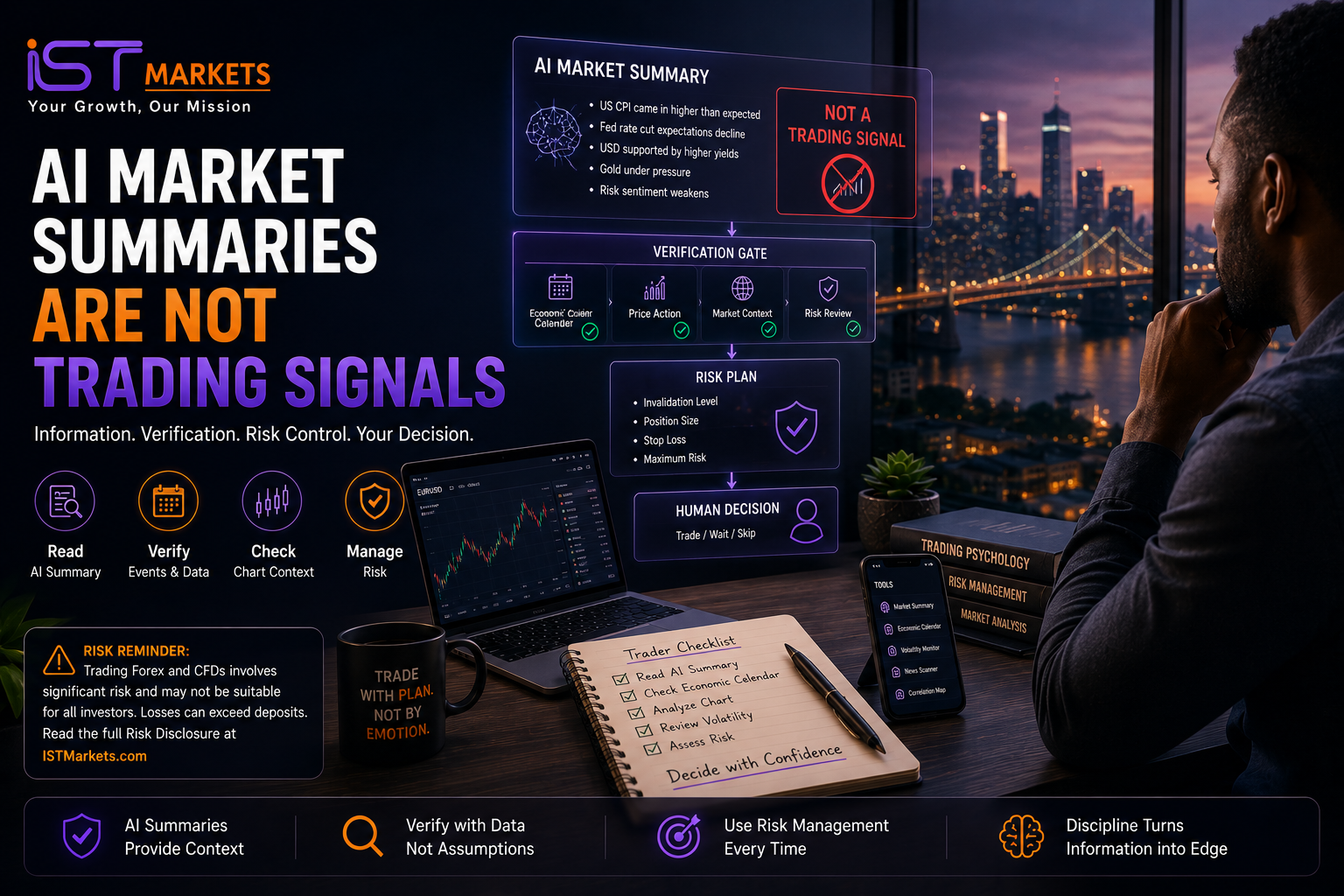
AI market summaries are not trading signals. They can help traders understand market context, news themes, price-action narratives, volatility drivers and events to verify, but they should not be treated as instructions to buy, sell, enter, exit or size a position. The responsible workflow is simple: read the AI summary, separate facts from interpretation, check the economic calendar, compare it with live price action, review spreads and volatility, build a risk plan, then decide whether to act or skip. AI can speed up research, but it can be stale, incomplete, overconfident or wrong in fast markets.
AI market tools can support research and education, but they do not remove trading risk. Forex and CFD trading can involve leverage, margin calls, spread widening, slippage, gaps, volatility, platform interruptions and losses. This guide is educational only and does not provide investment advice, trading signals or a recommendation to buy or sell.
What AI market summaries can and cannot do
AI market summaries are useful because markets are noisy. A trader may be watching currencies, indices, gold, oil, central-bank speeches, inflation data and breaking news at the same time. A good summary can organise that information into a readable snapshot: what moved, what traders are watching and which events may matter next.
That is valuable, but it is only the beginning of the decision process.
A market summary can help with:
- summarising major news and market drivers;
- explaining why a currency, commodity or index may be volatile;
- identifying events worth checking on an economic calendar;
- organising possible narratives around price movement;
- helping a trader prepare better questions before analysis;
- creating a checklist for risk review.
A market summary cannot reliably decide:
- whether a trader should buy or sell;
- the correct entry price;
- the correct stop-loss or take-profit level;
- the correct lot size;
- whether live execution will match the idea;
- whether a fast market has already invalidated the summary;
- whether the information fits the trader’s account, experience or risk tolerance.
The safest way to use AI market summaries is to treat them as a research layer, not a decision engine. They can reduce confusion, but they should not create false certainty.
Market summary vs analysis vs signal
One of the biggest risks with AI market tools is language confusion. A summary may sound confident, and confidence can make a beginner treat it like a signal. Traders need a clear boundary between information, interpretation and action.
| Type | What it means | Useful question | What it should not become |
|---|---|---|---|
| Market summary | A brief explanation of what markets are watching or reacting to. | What happened and why does it matter? | A command to enter a trade. |
| Market analysis | A structured interpretation of drivers, chart context and possible scenarios. | What conditions would support or weaken this view? | A guaranteed forecast. |
| Trading signal | A specific instruction or setup, often with entry, stop loss and target. | Does this fit my independent plan and risk rules? | Blind action without verification. |
| Risk plan | A pre-trade framework for position size, invalidation and possible loss. | What can I lose if I am wrong? | An afterthought once the trade is open. |
A responsible trader can read a summary, consider analysis and still decide not to trade. The decision to skip is not a missed opportunity if the information is unclear, late or too risky.
The Signal Boundary Test
Before acting on any AI-generated market note, ask whether it has crossed from information into instruction. This test helps traders avoid turning a summary into a hidden signal.
| Boundary question | If the answer is yes | Safer response |
|---|---|---|
| Does it say buy, sell, go long or go short? | It is no longer just a summary. | Treat it as a potential signal and verify independently. |
| Does it include entry, stop loss or target levels? | It is giving trade-setup language. | Check whether it fits your own method and risk plan. |
| Does it ignore timing, spread, volatility or calendar risk? | The output is incomplete. | Do not act until those checks are complete. |
| Does it sound certain about future price direction? | Confidence may be misleading. | Look for evidence, not tone. |
| Are you entering only because the AI sounded convincing? | You are outsourcing judgement. | Pause and return to your trade plan. |
A useful rule: if the output tells you what to do, slow down. If it tells you what to verify, it is more likely to be useful.
How traders should verify AI summaries
Verification is what turns AI from a shortcut into a research assistant. The trader should not ask, “Is the AI right?” The better question is, “What evidence would confirm, weaken or invalidate this summary?”
A responsible verification process includes:
- Check the timestamp of the summary.
- Review the economic calendar for recent or upcoming events.
- Compare the summary with the current live chart.
- Check whether price is near support, resistance, session highs or session lows.
- Review spread and liquidity conditions.
- Decide where the idea becomes invalid.
- Calculate position size and possible loss before entry.
- Decide whether the trade is worth taking, delaying or skipping.
| Verification point | What to check | Why it matters |
|---|---|---|
| Timestamp | When was the summary generated? | A correct summary can become stale quickly. |
| Economic calendar | CPI, jobs data, central-bank decisions, speeches | Scheduled events can change volatility and direction. |
| Live chart | Current price action, trend, support and resistance | The chart may already have moved beyond the summary. |
| Spread and liquidity | Bid/ask spread and session conditions | Costs and slippage can change the risk profile. |
| Risk plan | Stop distance, position size, maximum loss | A summary does not define account risk. |
| Source quality | Is the claim based on confirmed news or assumption? | Traders should separate facts from narratives. |
The goal is not to prove the AI wrong. The goal is to prevent a readable summary from becoming an untested trade.
What AI may miss in fast markets
Fast markets are where AI summaries can become most dangerous. A summary may correctly describe what happened five minutes ago, while the current market has already moved into a different phase.
AI may miss or understate:
- a sudden central-bank headline;
- a data revision after the first economic release;
- widening spreads during a news spike;
- low-liquidity conditions around session opens or closes;
- a price gap after a weekend or holiday;
- a reversal caused by profit-taking;
- a platform delay, outage or execution limitation;
- whether a stop-loss level is realistic in current volatility.
For example, an AI summary may say the US dollar weakened after inflation data. A beginner may then assume EUR/USD should continue rising. But if the first move is already extended, spreads are wider, and price is approaching resistance, the risk may be very different from the summary.
Fast markets require a stricter process: verify the live chart, wait for conditions to stabilise if needed, and reduce the temptation to chase the first headline candle.
Responsible workflow before acting
A stronger workflow is a decision ladder. Each step should be completed before the next one.
| Step | Action | Decision question |
|---|---|---|
| 1. Read | Read the AI market summary. | What is the summary claiming? |
| 2. Separate | Split confirmed facts from interpretation. | What is verified and what is assumed? |
| 3. Verify | Check calendar, news source, chart and timing. | Is the context still current? |
| 4. Contextualise | Compare with price action, levels and volatility. | Is the market still tradable under my rules? |
| 5. Risk check | Review spread, stop distance and position size. | What can I lose if wrong? |
| 6. Decide or skip | Act only if it fits your plan. | Is this my decision or the AI’s wording? |
Practical scenario: AI summary to responsible decision
Imagine an AI market summary says: “Gold is supported after weaker US inflation data as yields fall and the dollar softens.” A beginner sees the summary and feels tempted to buy immediately. A responsible workflow would be different: 1. Check the economic calendar to confirm the inflation release and whether more data or a central-bank speaker is due. 2. Open the live XAUUSD chart and check whether price has already made a large move. 3. Mark nearby support and resistance. 4. Review spread and recent candle size. 5. Define where the idea is invalid before thinking about possible reward. 6. Calculate position size based on stop distance. 7. Decide whether to trade, wait for a cleaner setup, practise on demo, or skip. The AI summary helped identify a theme. It did not provide an entry, a risk amount or a personal recommendation.
Responsible prompting for traders
The way a trader asks AI questions can make the output safer or more dangerous. Poor prompts ask AI to decide. Better prompts ask AI to organise information and identify what still needs verification.
| Risky prompt | Better responsible prompt |
|---|---|
| Should I buy EUR/USD now? | Summarise the current drivers affecting EUR/USD and separate confirmed facts from assumptions. |
| Give me a gold trading signal. | Explain what is moving gold today and list the chart and calendar items I should verify before any decision. |
| What trade will profit today? | Build a neutral pre-trade checklist for reviewing volatility, spread, support, resistance and risk. |
| Is this setup safe? | List the risks that could invalidate this setup, including news, slippage, spread widening and stop-loss limitations. |
| What lot size should I use? | Explain the inputs I should calculate before deciding position size, without recommending a specific trade. |
A responsible prompt should keep the AI in a support role. It should ask for context, questions and checks, not personal financial advice.
What AI should never decide for you
AI can be useful for organisation, but some decisions must remain with the trader and their documented plan.
AI should not decide:
- whether you should trade live today;
- how much money you should risk;
- whether you should ignore your stop loss;
- whether you should chase a fast move;
- whether a signal group is trustworthy;
- whether a trade suits your personal financial situation;
- whether an execution price, spread or stop level is acceptable;
- whether a loss is “worth recovering” with a larger trade.
This boundary is important because the output may sound fluent even when it is incomplete. In trading, fluent language is not the same as verified evidence.
AI fraud and overtrust warning
A second risk is marketing language. Some tools, groups or channels may use the word “AI” to make claims sound more advanced than they are. Traders should be cautious with any service that presents AI as a guaranteed forecasting engine, a no-loss system, an automatic income tool or a secret signal source.
Warning signs include:
- guaranteed profit language;
- screenshots of large gains without verified context;
- pressure to deposit quickly;
- refusal to explain risk;
- no clear disclaimer;
- no explanation of data sources or limitations;
- claims that AI removes the need for risk management.
A trustworthy tool should make its limitations clear. It should encourage verification and risk planning, not urgency.
Common mistakes with AI market tools
| Mistake | Why it happens | Better habit |
|---|---|---|
| Treating a summary as a signal | The language sounds confident. | Ask what still needs verification. |
| Ignoring timestamp | The trader assumes the output is current. | Check when the summary was generated. |
| Skipping the economic calendar | AI mentions the driver, but the trader does not verify the event. | Review scheduled events before trading. |
| Ignoring spread and volatility | The trader focuses only on direction. | Check execution conditions before entry. |
| Asking AI for a trade | The trader wants certainty. | Ask AI for a checklist, not instructions. |
| Overtrusting AI branding | “AI” sounds advanced. | Look for limitations, risk warnings and source transparency. |
| Removing personal responsibility | The trader blames the tool. | Make every live decision through your own plan. |
The professional approach is not anti-AI. It is anti-blind-action.
Responsible AI checklist
Use this checklist before acting on any AI market summary.
| Question | Yes / No |
|---|---|
| Do I know when the summary was generated? | |
| Have I separated confirmed facts from interpretation? | |
| Have I checked the economic calendar? | |
| Have I compared the summary with the live chart? | |
| Have I checked spread, session and volatility conditions? | |
| Do I know where the idea becomes invalid? | |
| Have I calculated position size and possible loss? | |
| Am I following my own plan rather than the AI’s tone? | |
| Would I still consider this setup if the AI had not mentioned it? | |
| Am I prepared to skip the trade if conditions are unclear? |
If several answers are “No,” the safer decision may be to wait, verify more or practise on demo.
Risk reminder before the CTA
AI market summaries can make research faster, but they cannot remove trading risk. Forex and CFD trading can involve leverage, margin calls, spread widening, slippage, stop-loss limitations, gaps, platform interruptions, liquidity changes and losses. A summary may be delayed, incomplete, misunderstood or based on assumptions.
No AI tool, market summary, calendar check, chart setup or risk calculator can guarantee profit or prevent loss. Traders should use AI as one input in a broader decision process and read the risk disclosure before trading live.
Soft CTA: Use AI market tools responsibly
IST Markets’ AI Market Pulse, once available, should be treated as an informational support tool: useful for organising themes, checking what to verify and improving market awareness. It should not be treated as a trading signal, a forecast guarantee or a replacement for risk management.
Use AI market tools responsibly. Then continue learning risk management, market hours, pips-and-spreads-in-forex-trading/” target=”_blank” rel=”noopener”>pips, spreads, position sizing and trading discipline before making live decisions.
FAQ
Are AI market summaries trading signals?
No. AI market summaries are informational tools. They can explain market context and drivers, but they should not be treated as instructions to buy, sell, enter, exit or size a position.
How should traders use AI market summaries?
Traders should use AI market summaries as a starting point for research. The next steps are to verify the calendar, check live price action, review spread and volatility, define risk and decide whether the setup fits their own plan.
What is the difference between AI analysis and a trading signal?
AI analysis explains possible drivers, scenarios or conditions. A trading signal usually gives a specific instruction such as entry, stop loss and target. Analysis can inform research, but it should not automatically become action.
What can AI miss in fast markets?
AI can miss breaking headlines, data revisions, sudden spread widening, liquidity changes, price gaps, fast reversals and execution limitations. It can also produce a summary that was correct earlier but is stale by the time the trader reads it.
How do I verify an AI market summary?
Check the timestamp, economic calendar, live chart, price levels, spread, volatility and risk plan. Separate confirmed facts from interpretation and avoid acting if the summary does not fit your strategy.
Can AI market tools improve trading decisions?
They can improve research organisation and help traders ask better questions, but they cannot guarantee better decisions. The quality of the final decision depends on verification, discipline, risk management and market conditions.
Should beginners rely on AI forex summaries?
Beginners can use AI forex summaries for education and market awareness, but they should not rely on them for trade instructions. Demo practice, risk education and independent verification are essential before live trading.
Use AI Market Tools Responsibly
Use AI summaries to organise what to verify — not as trading instructions, forecasts or personal financial advice.
Explore AI Market Pulse After Launch
Learn Risk Management
AI tools can support research, but they do not remove market, execution or leverage risk.