Regional Source Snapshot
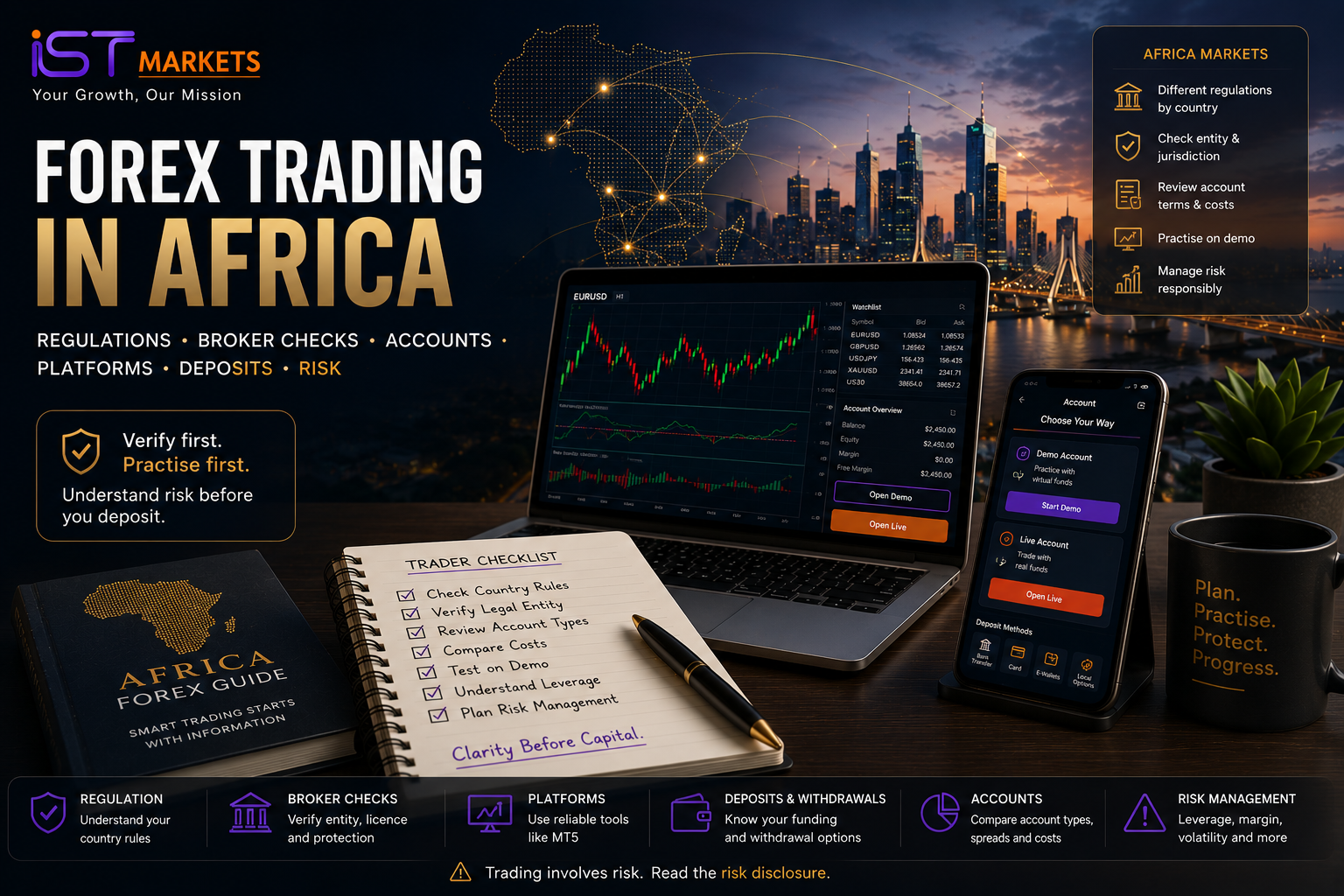
This regional guide uses a verification-first framework because African traders may face different rules depending on their country, the provider’s legal entity and the product being offered. South Africa has FSCA public tools for regulated entities and authorised FSP checks. Kenya has specific Capital Markets Online Foreign Exchange Trading Regulations that define dealing brokers, non-dealing brokers and money managers. Nigeria’s SEC has published a public notice warning that leveraged online retail forex trading was unregulated in that notice and may be subject to abuse. IOSCO’s retail market conduct work also highlights risks from self-directed online trading, high-risk leveraged products, social media marketing and cross-border retail activity. IST Markets references are used for platform, account and risk framing.
| Source area | Used for | How beginners should apply it |
|---|---|---|
| South Africa / FSCA | Regulated entities and FSP search | Check the exact provider/entity rather than relying on a badge or advert. |
| Kenya / CMA and Kenya Law | Online forex regulatory categories | Understand whether the service is promoted as broker access, dealing, non-dealing or money management. |
| Nigeria / SEC | Public notice on online retail forex trading | Do not treat popularity, influencer claims or adverts as regulatory comfort. |
| IOSCO | Retail trading, social media and high-risk product trends | Be alert to online promotions, copy-trading claims and leveraged product marketing. |
| IST Markets | Risk disclosure, legal documents, MT5, demo, account types, market hours | Use internal pages to compare account structure, platform workflow and risk documents before live trading. |
Content Table
Why forex trading differs across African markets
The phrase “forex trading in Africa” sounds simple, but it hides a practical problem: Africa is not one regulatory, banking or account-opening environment. A trader in Johannesburg, Lagos, Nairobi, Accra, Cairo, Casablanca or Kampala may see the same platform screenshots, the same MT5 interface and the same social-media promises, but the actual account relationship can be different.
That difference may affect eligibility, the legal entity, the contract, the regulator, the products available, the maximum leverage, deposits and withdrawals, currency conversion, complaint routes and how disputes are handled. A broker group may use one brand name publicly while onboarding different clients through different entities. A trading platform may look identical, but the legal relationship behind the platform may not be identical.
This is why a regional pillar page should not tell every African beginner to follow one shortcut. The stronger approach is to help traders ask the right questions in the right order: Where am I located? Which entity will open my account? What authority supervises that entity, if any? Is the product offered to my country? What risk documents apply? Do I understand leverage and margin before I fund?
The first sign of a serious trading decision is not confidence. It is documentation. If a beginner cannot find the legal entity, account agreement, risk disclosure, execution policy, fee information and complaint route, the decision is not ready. A premium platform experience, a fast app and a persuasive advert do not replace these checks.
Jurisdiction reality box: “regulated broker” is not a complete answer
Many beginners ask whether a broker is regulated. The better question is more specific: which legal entity is regulated, by which authority, for which products, and does that arrangement apply to my account?
| Question | What it protects against | Beginner action |
|---|---|---|
| What is the exact company name on the account agreement? | Confusing brand name with contracting entity | Match the website claim with the entity in your documents. |
| Which regulator or register is named? | Vague “globally regulated” claims | Search the official register where available. |
| What product is being offered? | Assuming one licence covers every product | Check whether forex, CFDs, derivatives or money-management services are in scope. |
| What country is your account onboarded under? | Assuming another country’s protection applies to you | Check country eligibility and entity terms. |
| What happens if there is a complaint? | Not knowing the escalation route | Read complaints, legal and dispute documents before funding. |
A website badge can be a starting point, not the final proof. A screenshot in a Telegram group, a logo in a social post or a claim from an influencer is not the same as checking the official source and reading the contract. For African beginners, this distinction matters because many services are cross-border and may use different entities for different regions.
Country context: South Africa, Kenya, Nigeria and beyond
Africa-wide content should organise the market without pretending that every country has the same rules. The table below is a practical orientation layer. It is not legal advice and should not replace checking the latest regulator guidance in your country.
| Country / context | What beginners should understand | Verification habit |
|---|---|---|
| South Africa | South Africa has an established financial-services regulatory environment and public FSCA tools for regulated entities and FSP checks. | Search the exact entity, not just the brand. Check authorisation scope and the entity named in your client agreement. |
| Kenya | Kenya has a dedicated framework for online foreign exchange trading, with categories such as dealing broker, non-dealing broker and money manager. | Match the promoted service to the relevant role. Broker access, dealing, non-dealing and money management are not the same thing. |
| Nigeria | Nigeria has strong retail interest in forex, but SEC public notices require careful reading. Leveraged online retail forex trading has been described as unregulated in the public notice and subject to abuse risk. | Do not treat popularity as regulation. Check current SEC guidance, entity documents, payment terms and whether claims are promotional. |
| Other African markets | Some countries may have less visible retail forex guidance, different banking rules or no dedicated online forex/CFD retail framework. | Check the local regulator, whether the service is permitted, the account entity, payment route and complaint process. |
South Africa: verify the entity and product scope
South Africa is often considered one of the more structured African markets for financial-services supervision, but that does not mean every trading advert aimed at South Africans is automatically suitable. A beginner should confirm the provider’s exact legal entity, authorisation status and whether the product being offered matches the authorisation claim.
The mistake to avoid is seeing “FSCA” on a page and assuming every product, every account entity and every cross-border arrangement is covered. A serious check compares the entity name in the account opening process with the entity shown in official tools, then reviews product scope, risk documents and account terms.
Kenya: understand the provider role
Kenya deserves careful treatment because its online foreign exchange framework distinguishes between provider roles. A dealing online foreign exchange broker, non-dealing online foreign exchange broker and money manager are different concepts. A trader using a platform, receiving education, joining a copy group, giving discretion to another person or opening a broker account may be entering very different arrangements.
The beginner question should be: what exactly is being offered? If someone is managing funds, that is not the same as platform access. If a provider claims broker status, the trader should verify the role and source rather than relying on a sales message.
Nigeria: popularity does not equal regulatory comfort
Nigeria has a large audience for online forex education, platforms and trading communities. That makes caution more important, not less. The SEC public notice on online retail forex trading warned that leveraged online retail forex trading was unregulated in that notice and may be subject to abuse. For Nigerian beginners, the safer wording is not “forex is simply allowed” or “forex is simply banned.” The safer approach is to verify current public guidance, provider registration claims, the contracting entity, payment route, risk documents and whether any marketing claim is supported by official sources.
The mistake to avoid is choosing a provider because an influencer says withdrawals are fast. Speed of withdrawal, screenshots and testimonials do not answer the core questions: who holds the account relationship, what law applies, what risks are disclosed and what protection or complaint route exists.
Beyond the three countries: build a local source habit
For other African markets, the first habit is to search your local financial regulator or central-bank guidance before funding an account. Some markets may not have a dedicated retail forex/CFD framework. Others may issue warnings about unregistered investment schemes, offshore providers or unauthorised marketing. The absence of an obvious article online does not mean the service is suitable for everyone.
Country context also affects practical issues: deposit currency, conversion costs, bank processing, identity verification, mobile money availability, local tax treatment, market-hour routine and customer support hours. A beginner who ignores these details can choose a platform that looks good but does not fit their real trading environment.
Africa broker verification ladder
A checklist is helpful, but a ladder is stronger because it forces the trader to complete one layer before moving to the next. African beginners should not jump from an advert directly to a deposit. Move through the layers below.
| Step | Question | Why it matters | Decision rule |
|---|---|---|---|
| 1. Country eligibility | Does the provider accept clients from my country? | A service may be unavailable or restricted in your location. | If unclear, do not fund. |
| 2. Legal entity | Which company will contract with me? | The brand and account entity may differ. | Match the entity in the agreement. |
| 3. Regulator / public source | Can I verify the claim officially? | Marketing badges can be misused. | Use regulator registers or public notices where available. |
| 4. Product scope | Is the entity allowed to offer this service or product? | Not all authorisations cover all activities. | Check forex, CFD, derivatives or money-management scope. |
| 5. Terms and costs | What are spread, commission, swaps, leverage, margin and withdrawals? | Costs and restrictions affect the real account experience. | Read the documents before deposit. |
| 6. Risk controls | Can I set and review stop loss, take profit, margin and exposure? | Platform comfort reduces avoidable operational errors. | Test on demo first. |
| 7. Live readiness | Can I explain my risk before each trade? | Trading without risk rules is not readiness. | Move live only if the risk process is clear. |
This ladder helps beginners avoid a common trap: treating broker selection as a popularity contest. The right question is not “which platform is famous?” The right question is “can I verify the entity, understand the product and manage the risk before I trade?”
Practical scenario: copying advice from another African country
Imagine a beginner in Country A reads a forum post from a trader in Country B. The post says: “Use this broker, choose this account type, deposit this way and trade during the London/New York overlap.” The beginner copies the process without checking whether the provider accepts clients in Country A, which legal entity will open the account, whether the licence claim applies, whether the payment route is supported, or whether local rules create extra restrictions.
At first, everything looks normal. The platform opens, the chart moves and the account dashboard looks professional. But later the trader discovers that the entity in the agreement is different from the one promoted in the post, the complaint route is not what they expected, the account terms differ from the other trader’s country, and the payment method has extra conditions.
The lesson is simple: country advice is not portable unless the entity, eligibility, regulation, account terms and payment route are also portable. A trading routine that works operationally for one African trader may be inappropriate for another if the legal and account context is different.
Red flags African beginners should not ignore
Many avoidable problems start before the first trade. They start when a beginner accepts weak evidence as proof. Be especially careful with these red flags.
| Red flag | Why it matters | Better response |
|---|---|---|
| “Regulated globally” with no entity or licence detail | It may not tell you who you contract with or what applies to your country. | Ask for the exact entity and verify official sources. |
| Guaranteed daily profit or guaranteed withdrawals | Trading outcomes and processing conditions cannot be promised safely. | Treat it as a major warning sign. |
| Telegram or WhatsApp pressure to deposit quickly | Urgency can bypass verification and risk checks. | Pause and check documents independently. |
| High leverage promoted without margin education | Leverage can magnify losses and trigger margin calls. | Learn margin before using live funds. |
| Demo results shown as proof of live performance | Demo practice does not reproduce real-money psychology or all live conditions. | Use demo for workflow only, not as a guarantee. |
| No clear risk disclosure or legal documents | You may not understand execution, costs, complaints or account limits. | Do not fund until documents are clear. |
| Influencer proof instead of official verification | Testimonials and screenshots can be incomplete or misleading. | Use official registers, notices and provider documents. |
| Copy-trading or managed-account claims without role clarity | You may be giving discretion or following signals without understanding responsibility. | Check whether it is education, signal, broker service or money management. |
Red flags do not always prove fraud. They prove that more verification is needed before money is involved. In a high-risk leveraged market, caution is not pessimism; it is part of the process.
Demo accounts, MT5, account types and market hours
After country and broker checks, the next layer is platform readiness. Many African beginners access markets through MT5 because it provides charts, watchlists, order tickets, account monitoring and risk-control fields such as stop loss and take profit. But platform access does not make a trader ready. The beginner must know how the workflow behaves before live funds are involved.
A demo account is useful because it lets the trader practise the mechanics: opening a chart, building a watchlist, checking spread, placing a market order, placing a pending order, setting stop loss and take profit, reviewing margin and closing a position. Demo practice should be realistic. If the trader uses oversized positions on demo, ignores stop loss or trades randomly because the money is virtual, the demo account can create false confidence.
Account types also matter. Beginners should compare minimum deposit requirements, spread model, commission, swaps, leverage, margin rules, product access and support. A lower-cost account is not automatically suitable if the trader does not understand execution and risk. A higher-feature account is not automatically better if it encourages complexity before the trader has a process.
Market hours are another regional issue. African traders often plan around London, New York or the London/New York overlap, but local time differs across the continent. A trader in Nairobi, Lagos, Johannesburg and Casablanca may experience the same global session at different local times. The best routine is not the most active session; it is the session where the trader is awake, calm, prepared and able to manage risk.
| Readiness area | What to practise | Why it matters |
|---|---|---|
| Demo workflow | Watchlist, chart, order ticket, SL/TP, margin review | Reduces avoidable platform mistakes. |
| MT5 chart routine | Timeframes, support/resistance, clean chart layout | Prevents indicator overload and rushed decisions. |
| Account type review | Spread, commission, swaps, leverage and products | Shows how costs and rules affect trades. |
| Market hours | Local trading windows and major events | Helps avoid tired or news-driven overtrading. |
| Risk process | Position size, stop distance and maximum loss | Keeps decision-making grounded in risk. |
The right sequence is not “open live first and learn later.” It is verify first, practise platform workflow, understand account terms, then decide whether live trading is appropriate.
Trading costs, leverage and risk rules
Forex trading in Africa often attracts beginners because the entry process can look simple: open an account, download the platform, deposit and trade. The real risk is that simplicity hides costs and leverage. Every beginner should understand the main cost and risk variables before trading live.
| Variable | What it means | Why beginners should care |
|---|---|---|
| Spread | The difference between bid and ask price | It is a cost that affects every trade. |
| Commission | A separate fee on some account types | It changes break-even and strategy suitability. |
| Swap / overnight cost | Cost or adjustment for holding positions overnight | It matters for multi-day trades. |
| Slippage | Execution at a price different from the requested price | Fast markets may not fill exactly where expected. |
| Leverage | Controlling larger exposure with smaller margin | It can amplify both gains and losses. |
| Margin call / stop-out | Account equity becomes too low to support open positions | Positions may be closed automatically under account rules. |
| Stop-loss limitation | A stop loss may not execute at the exact level requested | Gaps and volatility can make losses larger than planned. |
A beginner should write risk rules before trading. Examples include: no trade without a stop plan, no trade if the loss amount is unclear, no increasing lot size to recover losses, no trading around major news without a plan, no funding before reading the withdrawal terms and no relying on social-media signals as a substitute for personal risk control.
Do not confuse a small deposit with small risk. A small account with high leverage and oversized positions can lose money quickly. Risk is not only how much you deposit; it is position size, stop distance, leverage, volatility, spread, slippage and discipline.
Entity, eligibility and terms checklist
This is the most important checklist for a regional Africa hub because it connects the legal side with the practical trading side. Before funding a live account, answer these questions in writing.
| Area | Question to answer | Where to look |
|---|---|---|
| Entity | What exact company name will hold my account relationship? | Account application, client agreement, website footer, legal documents. |
| Country eligibility | Does the provider accept clients from my country? | Terms, onboarding screen, restricted-country list, support confirmation. |
| Regulatory claim | Can I verify the named entity through an official source? | Regulator register, public notices, licence search where available. |
| Product scope | Does the claimed authorisation match the service offered? | Licence category, product disclosures, legal documents. |
| Account terms | What spread, commission, leverage, swaps and margin rules apply? | Account types page, contract specifications, platform information. |
| Deposits and withdrawals | What currency, method, timing, fees and verification steps apply? | Funding terms, cashier area, legal documents, support pages. |
| Execution | What happens with slippage, gaps and order execution? | Execution policy, risk disclosure, platform order notes. |
| Complaints | Who do I contact if there is a dispute? | Complaints policy, legal documents, regulator guidance if applicable. |
If any answer is missing, treat that as a reason to slow down. A trustworthy trading process does not rely on urgency. It relies on clarity.
Regional beginner checklist
Use this as the final pre-live review. It is designed for African beginners comparing broker access, regulation, accounts, platforms and risk rules.
| Checklist item | Status |
|---|---|
| I know whether the provider accepts clients from my country. | |
| I know the exact legal entity I will contract with. | |
| I checked regulatory claims through official sources where possible. | |
| I understand whether local warnings, restrictions or licensing rules may apply. | |
| I read the risk disclosure, legal documents and execution policy. | |
| I understand the account type, spread, commission, swaps and leverage. | |
| I tested MT5 or the trading platform on demo. | |
| I can place and review orders, stop loss and take profit without confusion. | |
| I know my local market-hour routine and avoid trading when rushed. | |
| I have a maximum risk rule per trade and per day. | |
| I know how deposits, withdrawals and verification steps work. | |
| I am not relying on signals, social media or AI tools as a substitute for my own risk plan. |
If you cannot tick these items, the next step is usually more research and demo practice, not a live deposit. Demo does not guarantee future live results, but it gives you time to learn workflow and reduce avoidable mistakes.
Risk reminder before the CTA
Forex and CFD trading are leveraged products and may not be suitable for all investors. Losses can occur quickly. Depending on account terms and market conditions, losses may exceed the initial deposit. Spreads can widen, markets can gap, stop-loss orders may not execute at the requested level, positions can be closed under margin rules and platform or connection interruptions can affect outcomes.
This page is a regional education hub. It is not personal financial advice, legal advice, a broker recommendation, a trading signal or a guarantee of outcome. Always check the latest local guidance, the legal entity, risk disclosure, account terms and your own financial situation before deciding whether to trade live.
Soft CTA: Compare account options, then start with demo
If you are comparing forex trading in Africa, start with structure, not speed. Review your country context, verify the provider and legal entity, compare account options and practise the platform workflow on demo before using live funds.
Explore IST Markets account types to understand available account structures, then practise order workflow through a demo account. Before any live decision, read the Risk Disclosure, Legal Documents and Order Execution Policy so that the decision is based on clarity, not urgency.
Helpful resources and further reading
- IST Markets Risk Disclosure
- IST Markets Legal Documents
- IST Markets Trading Account Types
- IST Markets Demo Trading Account
- IST Markets MetaTrader 5 Platform
- IST Markets Market Hours and Events
- FSCA Regulated Entities
- FSCA Search Authorised and Applied FSPs
- CMA Kenya Regulatory Framework – Regulations
- Kenya Capital Markets Online Foreign Exchange Trading Regulations
- Nigeria SEC Public Notice on Online Retail Forex Trading
- IOSCO Retail Market Conduct Task Force Final Report