Account / CFD / Demo
Forex Account Types Explained: Standard, Raw-Spread, Islamic and Demo Accounts
A practical account-choice guide for traders comparing standard pricing, raw-spread pricing, swap-free eligibility, demo practice and total trading cost.
Source Snapshot
This account guide uses IST Markets account, fee, demo, Islamic account and risk materials as the primary source pack. The focus is not to push one account type. The goal is to show how account structure affects cost visibility, holding cost, platform practice and risk planning.
| Source area | Used for | How traders should apply it |
|---|---|---|
| IST Markets account types | Classic, Premium and VIP structure; spread/commission model; platform and account conditions | Compare account types using the current account page before registration. |
| IST Markets fees and costs | Spread, commission, swaps, currency conversion and fee notes | Look at total cost, not only the lowest visible spread. |
| IST Markets Islamic account | Swap-free/Ujrah explanation and eligibility framing | Do not assume swap-free means cost-free; review disclosed fees and terms. |
| IST Markets demo account | Demo workflow, virtual funds and real-time market practice | Practise order workflow before live trading; do not treat demo results as future proof. |
| IST Markets risk disclosure and CFD account guidance | Leverage, margin, slippage, gaps and trading-cost risks | Read risk documents before choosing live account settings. |
Content Table
Forex account types at a glance
Forex account types are not only labels. They define how trading costs appear, which conditions apply, what minimum funding may be required, whether overnight holding costs are treated in a standard or swap-free way, and whether the account is for practice or live capital. For beginners, the best first step is to separate account function from account marketing.
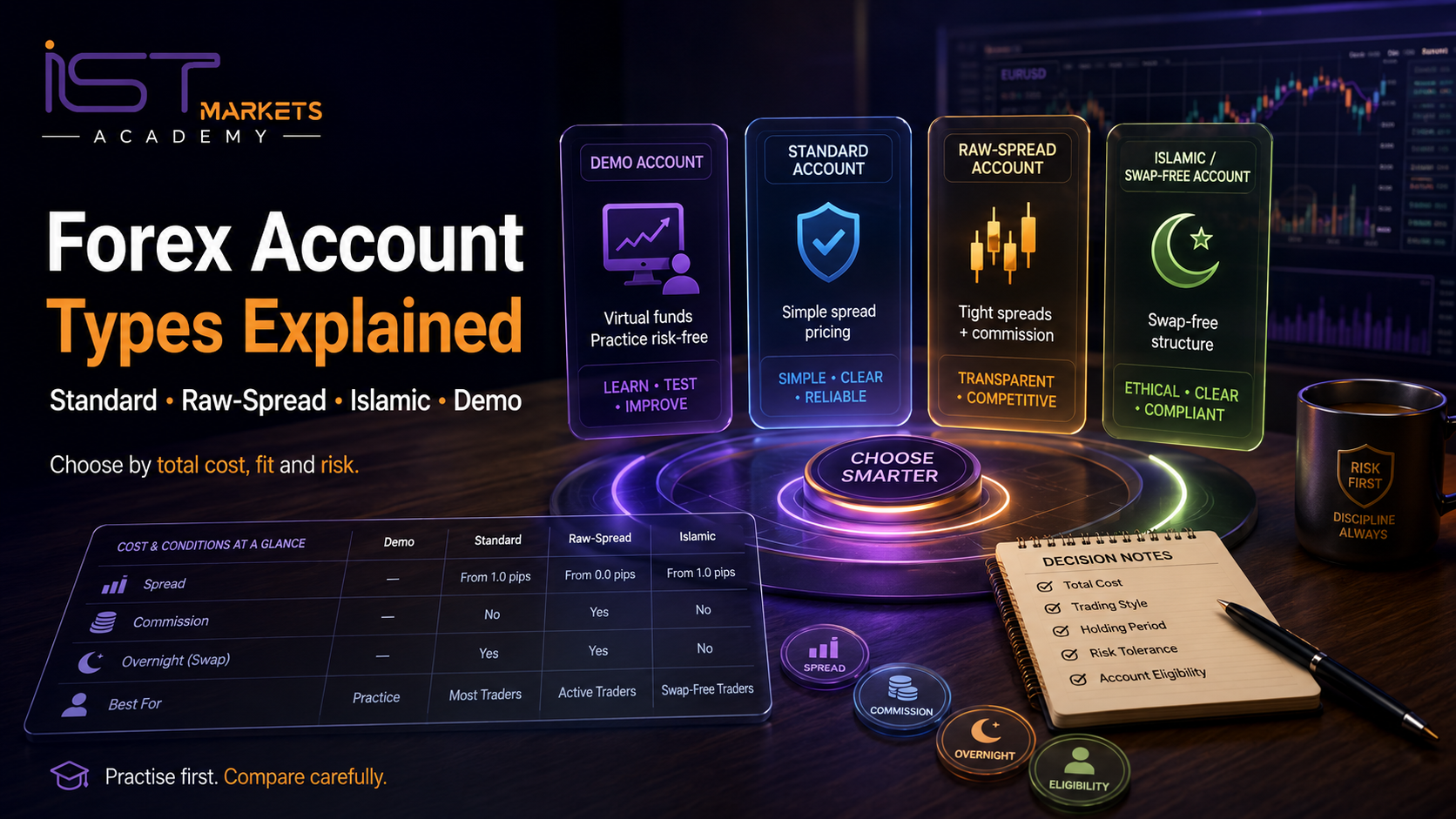
A demo account is for platform practice and learning order workflow with virtual funds. A standard-style account usually offers simple spread-based pricing. A raw-spread account is built around tighter visible spreads plus commission. An Islamic or swap-free account addresses overnight financing treatment for eligible clients, but it still needs clear fee and product-term review.
| Account type | Primary purpose | Cost structure to review | Beginner decision point |
|---|---|---|---|
| Demo account | Practice platform workflow without live capital | No live trading cost; virtual environment | Use before comparing live account behaviour or order controls. |
| Standard / spread-based account | Simple live pricing structure | Cost is mainly visible through the spread, plus possible swaps and other applicable costs | Often easier for beginners to understand because there is no separate commission line on many trades. |
| Raw-spread account | Tighter visible spreads for more active or cost-sensitive styles | Lower spread plus commission; total cost depends on trade size and frequency | Do not choose only because the spread looks lower; calculate commission and trading style fit. |
| Islamic / swap-free account | Avoid interest-based overnight swaps for eligible clients | No interest-based rollover; may include disclosed administrative fees or restrictions | Check eligibility, instrument coverage, holding periods and fee schedule before use. |
Demo account: practice without live capital risk
A demo account should be treated as the training room, not as a prediction engine. It helps a beginner learn where the watchlist is, how order tickets work, how stop loss and take profit are entered, how margin appears on the platform, and how different lot sizes change exposure. IST Markets describes its demo environment as offering virtual funds, access to multiple markets and real-time market conditions for platform practice.
The key value of demo is repetition. A beginner should place practice trades, modify stop levels, review history and learn how spreads move during active sessions. Demo can reduce workflow mistakes, but it cannot prove live performance.
Standard account: simple pricing structure
A standard or spread-based account is often the easiest model for beginners to understand because the main cost is usually included in the bid/ask spread. The trader sees the difference between the buying and selling price and can estimate the cost of entering and exiting. That does not mean the account is automatically cheaper. It means the pricing structure is simpler to read.
For a beginner who trades occasionally and still needs to learn platform behaviour, simplicity can matter more than headline spread reduction. A standard account still requires attention to spreads, swaps, currency conversion, margin and slippage.
Account specifications should be checked from the current account types page before opening a live account. The account label alone is not enough.
Raw-spread account: tighter spreads and commission considerations
A raw-spread account is usually designed for traders who care about tight visible spreads and are willing to account for a separate commission. This can be useful for high-frequency traders, scalpers, algorithmic strategies or users who measure cost very precisely. But raw spread does not mean free trading. The total trading cost is spread plus commission, plus any other applicable costs such as swaps, slippage or currency conversion.
The common beginner mistake is simple: the trader sees a low spread and assumes the account is automatically better. But if the trader places small, infrequent or poorly planned trades, the commission structure may not create a meaningful advantage. If the trader does not calculate lot size and commission correctly, the cost comparison becomes misleading.
| Cost item | Standard-style thinking | Raw-spread thinking | What to calculate |
|---|---|---|---|
| Spread | Usually the main visible cost | Often lower, but not the full cost | Average spread during the sessions you actually trade. |
| Commission | May be zero on certain account structures | Usually charged separately per side or round turn | Commission × lot size × number of trades. |
| Trading frequency | Less frequent trades may make simplicity valuable | High frequency increases the importance of precise cost tracking | Cost per trade and total monthly trading cost. |
| Slippage and volatility | Can still affect fills | Can still affect fills | Execution quality and market conditions, not only account type. |
Islamic/swap-free account: what it can and cannot mean
An Islamic forex account, often called a swap-free account, is designed for eligible clients who do not want interest-based overnight rollover swaps. The important detail is that swap-free does not mean cost-free. Depending on the provider, account terms and instruments, a swap-free model may include disclosed administrative fees, product restrictions, holding-period rules or other conditions.
IST Markets describes its Islamic account as removing interest-based rollover swaps and replacing them, where applicable, with a fixed administrative service fee disclosed in advance by instrument. That distinction matters because a transparent swap-free account should be evaluated by what it removes, what it charges instead, which instruments are covered and whether the account remains aligned with the client’s eligibility and trading needs.
Beginners should avoid treating Islamic account language as a generic promise. Review the account terms, instrument list, fee schedule and eligibility requirements.
| Question to ask | Why it matters |
|---|---|
| Does swap-free mean no overnight interest-based swap? | This is the central feature, but it does not remove all possible costs. |
| Is there a fixed administrative service fee? | A disclosed fee may replace swap treatment where applicable. |
| Which instruments are eligible? | Coverage can differ by product, account type or entity terms. |
| Do spreads and commissions follow the selected account type? | Swap-free status may not change the underlying spread/commission model. |
| Are there holding period or abuse-prevention rules? | Long holding periods or unusual trading patterns may be treated differently under terms. |
How beginners should choose an account type
A beginner should choose an account type by matching need, cost structure and risk capacity. The wrong approach is to ask “which account is best?” without context. A better question is: “which account structure can I understand, test, afford and manage responsibly?”
Start by deciding whether you are still learning the platform. If yes, use demo first. Next, compare whether you want simple spread-based pricing or whether you can accurately track raw-spread commission. Then consider whether overnight holding is part of your approach. If you hold positions overnight, swaps or swap-free terms may matter more. Finally, check eligibility, minimum deposits, platform availability, leverage, margin rules and risk documents.
| Trader need | Account type to examine first | Why |
|---|---|---|
| Learning platform workflow | Demo account | No live capital while learning orders, stops, margin and platform navigation. |
| Simple cost visibility | Standard / spread-based account | Fewer cost lines for beginners to track, though spreads still vary. |
| Active short-term trading with cost tracking | Raw-spread account | Tighter visible spreads may help only if commission and volume are calculated. |
| Avoiding interest-based overnight swaps | Islamic / swap-free account | Requires eligibility and fee schedule review; not automatically cost-free. |
| Holding positions overnight | Standard or Islamic terms depending on eligibility | Swaps or service fees can matter more than entry spread alone. |
Account type comparison table
| Feature | Demo account | Standard / spread-based account | Raw-spread account | Islamic / swap-free account |
|---|---|---|---|---|
| Live capital risk | No live capital risk; virtual funds | Yes | Yes | Yes, if used as live account |
| Main purpose | Practice and platform learning | Simple live pricing | Tighter spread plus commission model | Avoid interest-based rollover swaps where eligible |
| Cost focus | Workflow practice, not live costs | Spread, swaps, slippage and any applicable fees | Spread + commission + slippage + swaps where applicable | Spread/commission model plus disclosed swap-free fee structure where applicable |
| Best for | Beginners and strategy testing | Traders who want simpler pricing | Active traders who track total costs carefully | Eligible traders who need swap-free treatment |
| Main mistake | Treating demo profits as proof | Ignoring spread widening or swaps | Ignoring commission and overtrading | Assuming swap-free means cost-free |
| Before choosing | Practise order workflow repeatedly | Check spread range, platform and terms | Calculate commission by lot size and frequency | Review eligibility, fee schedule and covered instruments |
Common mistakes beginners make with forex account types
Most beginner mistakes happen when a trader focuses on one attractive feature and ignores the full account structure. Low spreads can distract from commission, and swap-free can be mistaken for free.
| Mistake | Why it is risky | Better approach |
|---|---|---|
| Choosing raw spread only because the spread looks lower | Commission and trade frequency may change the real cost | Compare spread plus commission under your actual lot size. |
| Skipping demo because live trading feels more serious | Platform mistakes become financial mistakes | Practise orders, stops, modifications and history review first. |
| Assuming Islamic means no costs at all | Swap-free accounts may still have disclosed service fees or rules | Read the fee schedule and eligibility terms. |
| Ignoring overnight costs | Swaps or service fees can accumulate for longer-held positions | Check holding style before account choice. |
| Comparing accounts without checking country/entity eligibility | Not every feature may apply to every user or jurisdiction | Review the account page, terms and client portal before funding. |
| Treating account type as a risk-control tool | Risk depends on position size, leverage, stops and behaviour | Use account type as structure; use risk management as protection. |
Pre-live account checklist
Before funding a live forex account, use a simple checklist to reduce avoidable confusion before real money is involved.
| Check | Question | If unclear |
|---|---|---|
| Account purpose | Am I practising, trading live, avoiding swaps, or seeking tighter spreads? | Start with demo and read account definitions again. |
| Cost model | Do I understand spread, commission, swap/service fee and conversion cost? | Do not choose the account yet. |
| Trading frequency | Will I trade often enough for raw pricing to matter? | Compare monthly cost estimates, not only one trade. |
| Holding period | Will I hold positions overnight? | Review swaps or swap-free terms carefully. |
| Eligibility | Is this account available to me under the current entity and country rules? | Confirm through official account pages or support. |
| Risk documents | Have I read risk disclosure, legal documents and execution policy? | Read before funding live. |
Risk reminder before the CTA
Account type can improve clarity, but it does not remove trading risk. Leveraged forex and CFD trading can move quickly. Spreads can widen during volatility or low liquidity. Orders may be affected by slippage or gaps. Stop-loss orders are risk tools, not guarantees of a specific exit price. Margin calls and forced close-outs can occur when exposure is too large for account equity.
Before using live funds, know your maximum risk per trade, position size, stop-loss distance, margin exposure and total cost assumptions.
Soft CTA: Compare account types, then start with demo
If you are comparing forex account types, start with the account structure you can understand and test. Compare spread-based pricing, raw-spread commission, Islamic or swap-free terms, platform access and eligibility before funding live.
Explore IST Markets account types, review the fees and costs, check Islamic account terms if relevant, and practise first through a demo account. Before any live decision, read the Risk Disclosure and Legal Documents.