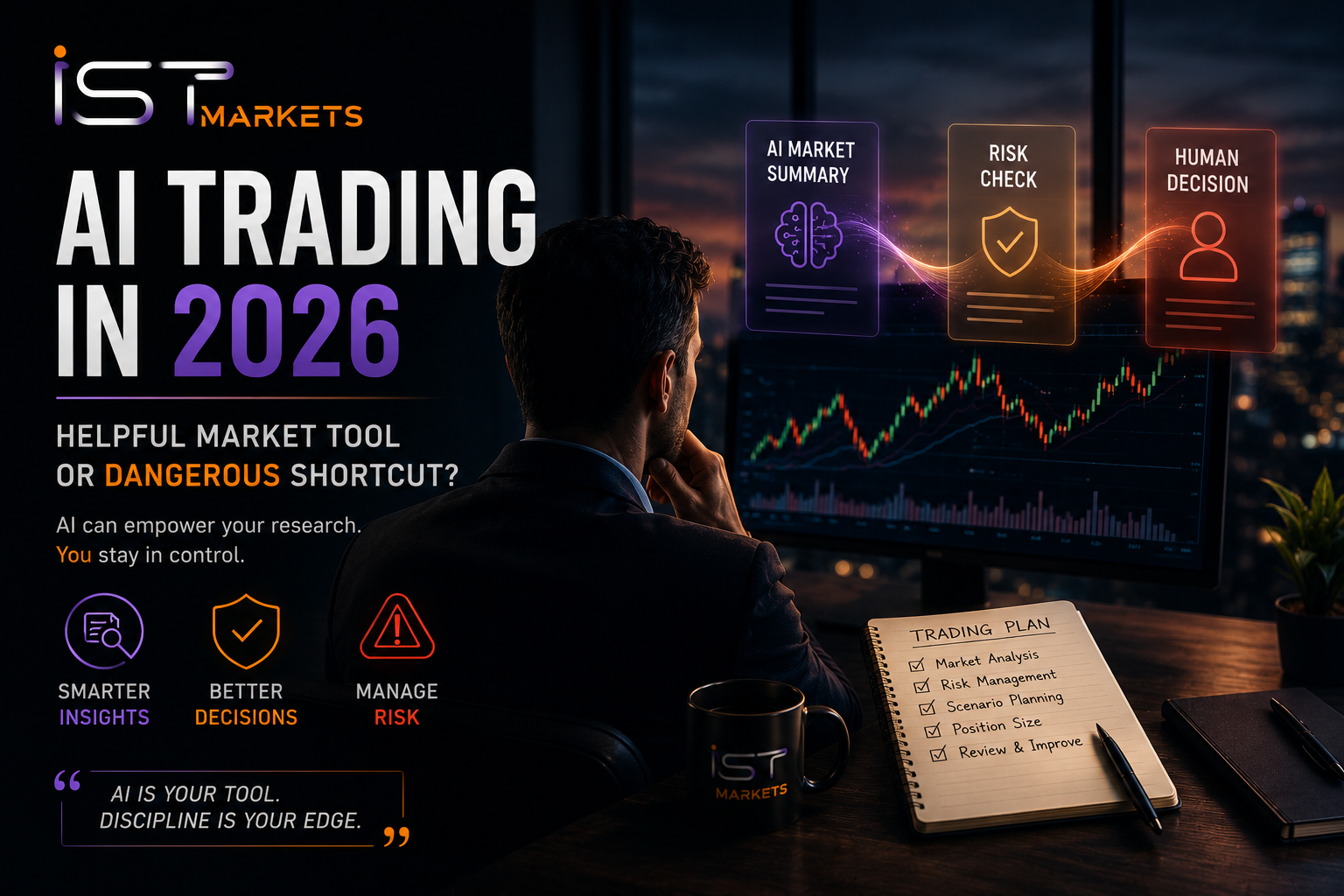
AI Trading in 2026: Responsible Use Snapshot
| Question | Responsible Answer | Why It Matters |
|---|---|---|
| Can AI predict forex markets? | No tool can reliably remove uncertainty or guarantee direction. | Forex reacts to changing data, liquidity, positioning, policy, and surprise events. |
| Where can AI help? | Research organisation, market summaries, scenario planning, journaling, and checklist discipline. | It improves preparation when the trader remains responsible for decisions. |
| Where is AI risky? | Blind signals, over-automation, weak prompts, hallucinated facts, and untested strategies. | Mistaking confidence for accuracy can increase losses. |
| Best beginner rule | Use AI to ask better questions, not to skip risk management. | The trade still carries real market, leverage, margin, and execution risk. |
Content Table
- Quick Answer: Is AI Trading Useful or Risky?
- What Traders Mean by AI Trading in 2026
- AI Trading Tools in 2026: Four Categories Beginners Should Separate
- Where AI Can Genuinely Help Traders
- Where AI Becomes Dangerous
- AI Market Summary vs AI Trading Signal
- Safe vs Unsafe AI Trading Scenario
- Beginner Mistakes with AI Trading Tools
- Responsible AI Trading Checklist
- AI Reliability Checks Before Trusting a Market Summary
- How IST Frames AI Tools Responsibly
- FAQ
Quick Answer: Is AI Trading Useful or Risky?
AI trading is useful when it supports research, summarises market drivers, organises news, checks a trading plan, or helps a trader review risk. It is risky when it is used as a shortcut to enter trades without understanding market context, leverage, margin, volatility, spread, slippage, or account exposure.
The right question is not “Can AI make money for me?” The better question is: “Can AI help me prepare better while I remain responsible for the decision?” That distinction is the difference between responsible AI trading and dangerous automation hype.
What Traders Mean by AI Trading in 2026
In 2026, the phrase AI trading can mean several different things. Some traders use AI to summarise economic news. Others use AI trading tools to scan charts, group market themes, support journaling, explain indicators, backtest ideas, or generate automated rules. More advanced users may connect AI to workflow tools, alerts, or trading algorithms.
That wide meaning is part of the problem. A beginner might hear “AI forex trading” and assume it means a system that can predict the next market move. In reality, AI is usually better at organising information than guaranteeing market direction. It may explain what happened, compare possible scenarios, or summarise event risk, but it cannot remove uncertainty from live markets.
Financial markets are adaptive. Prices move because of data, expectations, liquidity, central bank policy, positioning, risk sentiment, headlines, and surprises. AI can help traders process information faster, but speed is not the same as truth, and confidence in a written summary is not the same as trading edge.
AI Trading Tools in 2026: Four Categories Beginners Should Separate
Not every AI trading tool does the same job. One of the safest ways for beginners to think about AI trading in 2026 is to separate tools by purpose. A news summariser, a chart scanner, a backtesting assistant, and an automated execution system carry very different levels of risk.
This matters because many promotional pages use the phrase “AI trading” as if it means one product. In practice, the risk changes depending on whether the tool is only explaining information or whether it is influencing live trade decisions.
| AI Tool Type | Typical Use | Beginner Risk Level | Responsible Boundary |
|---|---|---|---|
| AI market summary | Summarises news, events, economic data, or market themes. | Lower | Use it for context only, then verify the source and timing. |
| AI research assistant | Organises watchlists, scenarios, journals, and checklists. | Moderate | Keep human judgment and risk review in the process. |
| AI signal or alert tool | Highlights possible setups or market conditions. | High | Never treat alerts as instructions to trade. |
| AI automation | Connects rules, models, or signals to automated workflows. | Very high | Requires testing, monitoring, limits, and clear stop conditions. |
For most beginner traders, the safest starting point is the first two categories: summaries and research support. The more a tool moves toward signals or execution, the stronger the need for testing, documentation, risk limits, and human oversight.
Where AI Can Genuinely Help Traders
AI can be genuinely useful when it reduces confusion and improves preparation. For beginner-to-intermediate traders, the strongest use cases are usually not “buy or sell” decisions. They are workflow use cases.
| AI Can Help With | Responsible Use | What It Cannot Do |
|---|---|---|
| Market summaries | Summarise central bank events, inflation releases, risk sentiment, and key headlines. | Guarantee how EUR/USD, gold, or indices will move next. |
| Scenario planning | Compare what could happen if data beats, misses, or matches expectations. | Know which scenario the market will choose. |
| Backtesting support | Help structure test rules, variables, and trade journal fields. | Prove future live performance. |
| Risk management review | Check if a plan considers stop distance, position size, event risk, and volatility. | Make leveraged trading safe. |
| Education | Explain terms such as volatility, spread, margin, and slippage in plain language. | Replace official documents, risk disclosure, or trader responsibility. |
The strongest practical use is this: AI helps traders slow down, organise context, and check assumptions before taking risk. It should make the trader more disciplined, not more impulsive.
Where AI Becomes Dangerous
AI becomes dangerous when traders confuse fluency with accuracy. A tool can produce a confident market summary that sounds professional while still missing data, using stale information, over-simplifying the setup, or inventing a relationship that is not actually supported by the market.
This risk is especially important in AI forex trading because currency markets are sensitive to timing. A summary written before a jobs report, central bank speech, liquidity shock, or geopolitical headline can become outdated quickly. A model may not know whether spreads widened, whether yields reversed, or whether the market has already priced in the information.
Other risks include hallucination, weak prompts, overfitting in backtests, false pattern recognition, automation errors, and blind trust in generated explanations. A trader who cannot explain the trade without AI should not treat AI as confirmation.
AI Market Summary vs AI Trading Signal
One of the most important boundaries in AI trading is the difference between a market summary and a trading signal. A summary explains information. A signal tells a trader what action to consider. Beginners should not blur those two roles.
| Category | AI Market Summary | AI Trading Signal |
|---|---|---|
| Purpose | Organise context and explain market drivers. | Suggest a potential trade action. |
| Typical wording | “Markets are watching CPI, yields and dollar reaction.” | “Buy EUR/USD now.” |
| Beginner use | Useful for preparation and question-building. | Risky if followed without independent analysis. |
| Risk control | Should lead to a checklist. | Must never replace position sizing and risk review. |
Safe vs Unsafe AI Trading Scenario
Safe use: A trader asks an AI tool to summarise the main event risks before the U.S. CPI release. The tool lists inflation expectations, U.S. yields, DXY reaction, possible gold volatility, and key times to watch. The trader then checks the economic calendar, reviews spread risk, decides not to trade during the release, and uses the summary only to prepare scenarios.
Unsafe use: A trader asks AI whether EUR/USD looks bullish. The response sounds confident, so the trader enters a live leveraged trade without checking the source, price level, stop distance, position size, calendar risk, spread, or risk disclosure. The issue is not that AI was used. The issue is that AI replaced the trader’s process.
The safe version uses AI as a research assistant. The unsafe version uses AI as a decision-maker. That distinction should guide every beginner who explores AI trading tools.
Beginner Mistakes with AI Trading Tools
- Believing AI can predict the market. AI can support analysis, but it cannot guarantee direction.
- Treating summaries as signals. A market summary is not an instruction to trade.
- Ignoring data freshness. A correct summary can become outdated after a major release or headline.
- Skipping source checks. Generated text should be checked against primary market data and official sources where relevant.
- Over-automating too early. Automation without controls can magnify mistakes quickly.
- Trusting backtests blindly. Backtests can overfit past data and fail in live conditions.
- Ignoring spreads, slippage and volatility. Live trading conditions can differ from a clean AI scenario.
- Using AI to justify emotional trades. If a trader wants confirmation badly enough, any tool can become an excuse.
- Forgetting leverage and margin. Even a well-researched idea can lose money when position size is wrong.
Responsible AI Trading Checklist
Before using AI in a trading workflow, beginners should apply a checklist that separates information support from decision-making.
| Checklist Question | Why It Matters |
|---|---|
| Is this a summary or a signal? | A summary can inform research; a signal can lead to action risk. |
| Do I know the source and time of the data? | Markets move quickly; stale context can mislead. |
| Can I explain the trade without AI? | If not, the trader may be outsourcing judgment. |
| Have I checked volatility and spread risk? | Execution conditions can change the result. |
| Is position size defined before entry? | Risk management must come before the trade. |
| Have I read the risk disclosure? | Leveraged products involve real risk, regardless of the tool used. |
AI Reliability Checks Before Trusting a Market Summary
Before a trader relies on an AI market summary, there are three reliability questions to ask. First, is the information current? Second, can the claim be checked against market data or a credible source? Third, does the summary explain uncertainty, or does it sound too certain?
A useful AI summary should make uncertainty clearer. It should help the trader identify what to watch: the next data release, the key central bank comment, the yield reaction, the dollar response, or the volatility level. A weak AI summary often jumps too quickly from information to conclusion.
- Check freshness: Was the summary produced before or after the latest price move, data release, or headline?
- Check source quality: Does the output point to data, official releases, or known market drivers?
- Check uncertainty: Does it present scenarios, or does it pretend there is only one outcome?
- Check execution reality: Does it mention spread, slippage, volatility, session timing, or liquidity?
- Check your own plan: Can the trade idea pass your risk rules without the AI explanation?
How IST Frames AI Tools Responsibly
IST Markets’ responsible approach to trading tools is built around education, context, transparency, and risk awareness. AI should not be presented as a profit machine or a replacement for trader judgment. It should help users understand market context, organise information, review possible risks, and prepare better questions.
When an IST AI Market Pulse page or similar feature is launched, the safest positioning is clear: market summaries and workflow support are not personalised advice, trading signals, or guaranteed outcomes. Traders should still review market data, legal documents, execution terms, and the risk disclosure before trading.
This fits the broader IST education layer: market tools can support informed decisions, but leveraged forex and CFD trading still involves margin risk, volatility risk, slippage, gaps, outages, and the possibility of losing capital.
Risk Reminder Before Using AI Tools
AI tools, market summaries, automation, backtests, calculators, alerts, and demo results do not guarantee live trading performance. Forex and CFD trading involves significant risk and may not be suitable for all investors. Leverage can magnify losses as well as gains. Use market tools responsibly and read the full risk disclosure before trading.
Use Market Tools Responsibly
Use AI and market tools to organise research, review scenarios, and improve your trading process — not to replace risk management.
Explore trading tools
Read the risk disclosure
Tools are informational and educational. They do not provide guaranteed outcomes or personal financial advice.
FAQ: AI Trading in 2026
Can AI predict forex markets?
No AI tool can reliably predict forex markets or remove uncertainty. AI can help organise information and compare scenarios, but market direction still depends on changing data, liquidity, policy, positioning, volatility, and unexpected events.
Is AI trading safe for beginners?
AI trading is safer when beginners use AI for education, summaries, and preparation rather than signals or automation. It becomes risky when beginners trade live only because an AI-generated summary sounds confident.
How do traders use AI in forex?
Traders may use AI to summarise news, organise macro events, compare scenarios, support backtesting workflows, review trading journals, explain indicators, or check whether a trading plan includes risk management steps.
What are the risks of AI trading tools?
Risks include hallucinated information, stale data, overconfidence, weak prompts, false pattern recognition, overfitted backtests, automation errors, and ignoring leverage, margin, spread, slippage, and volatility.
What is the difference between an AI summary and a trading signal?
An AI summary explains market context. A trading signal suggests an action such as buying or selling. Beginners should treat summaries as research support and should not follow signals without independent analysis and risk controls.
Can AI help with risk management?
AI can help review a risk checklist, highlight event risk, or organise a trading plan. However, it cannot make leveraged trading safe or guarantee that a stop-loss, strategy, or automated system will work in live conditions.
Should I automate trades with AI?
Beginners should be cautious with automation. Any automated workflow should be tested, monitored, and controlled with clear risk limits. Automation can execute mistakes faster if the logic, data, or risk settings are wrong.