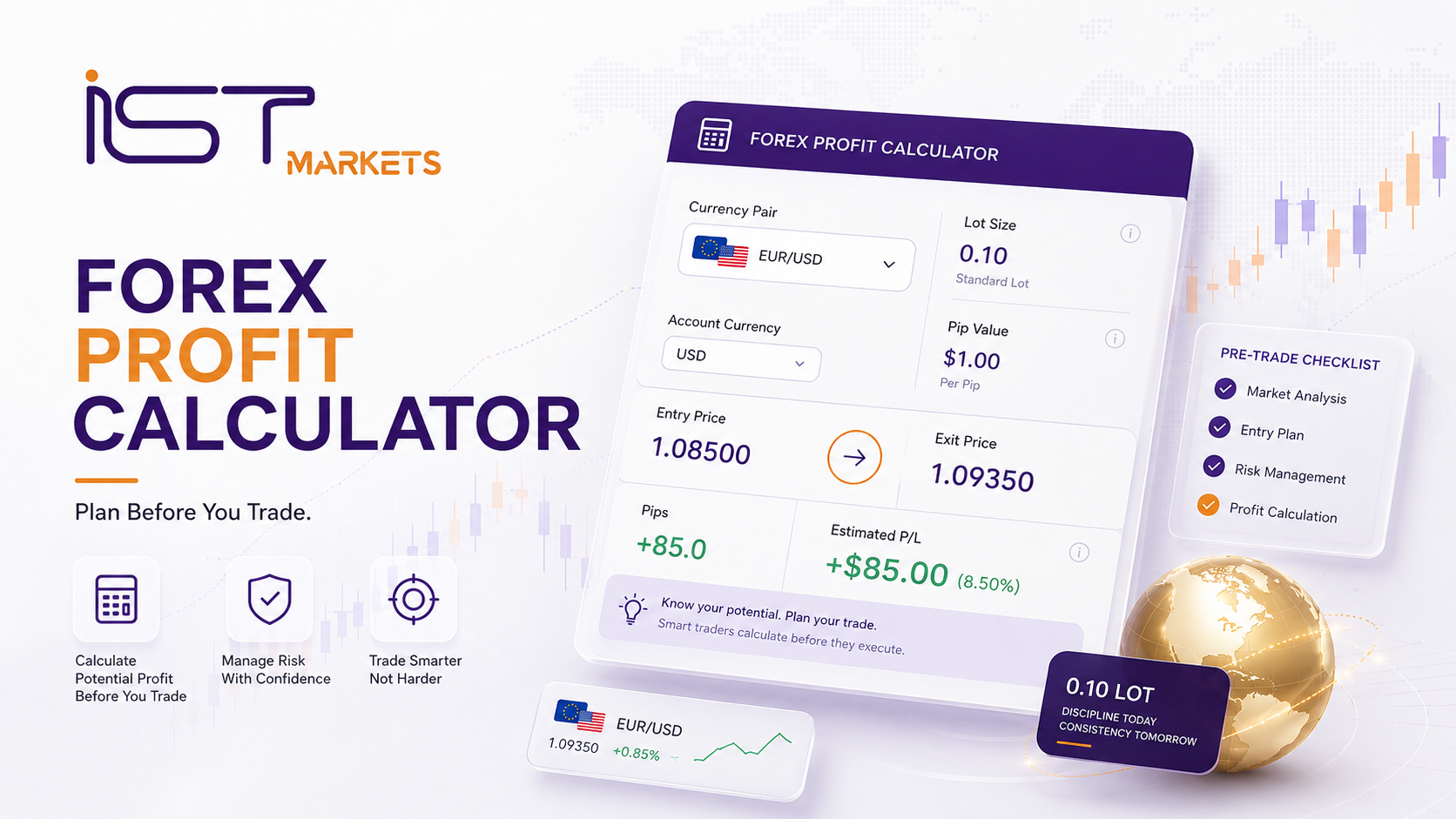
Pre-Trade Calculator Snapshot
| Input | What It Means | Why It Matters |
|---|---|---|
| Currency pair | The forex pair being tested, such as EUR/USD. | Different pairs can have different pip values and quote conventions. |
| Entry and exit price | The planned opening and closing levels. | They determine the pip movement used in the estimate. |
| Lot size | The position size, such as 0.10 lot. | Bigger size means each pip is worth more money. |
| Account currency | The currency your account is denominated in. | A conversion may be needed if P/L is generated in another currency. |
Content Table
- Quick Answer: What Does a Forex Profit Calculator Do?
- When Should Traders Use a Forex Profit Calculator?
- Inputs You Need Before Calculating Profit or Loss
- Step-by-Step Example: Calculating a Forex Trade Outcome
- What the Calculator Does Not Include
- Profit Estimate vs Real Trading Result
- Common Mistakes When Using a Profit Calculator
- Pre-Trade Calculator Checklist
- FAQ
Quick Answer: What Does a Forex Profit Calculator Do?
A forex profit calculator estimates the possible profit or loss of a forex trade before you place it. It usually uses the currency pair, position size, entry price, exit price, pip movement, pip value and account currency to show an estimated monetary outcome.
The calculator is useful because it turns a price move into a number you can compare with your account size and risk plan. It does not tell you whether to enter a trade, and it does not guarantee what you will receive in a live market. The best use is simple: estimate possible P/L before trading, then decide whether the risk still makes sense.
When Should Traders Use a Forex Profit Calculator?
Beginner traders often think about profit first: “How much could I make if EUR/USD moves 30 pips?” A more professional question is: “How much could I gain or lose, and is that risk acceptable for my account?” A forex trading calculator helps answer that second question.
Use a calculator before opening a trade when you want to test a potential entry and exit, compare different lot sizes, understand how pip value changes with position size, or check whether your possible loss is too large. It is also useful after a trade to compare the planned estimate with the actual live result and understand the difference.
Best use cases
- Checking possible profit or loss before placing an order.
- Comparing 0.01, 0.10 and 1.00 lot outcomes.
- Testing whether a stop-loss distance fits your account risk.
- Understanding how spreads and costs can affect the final result.
- Practising a trade scenario on a demo account before using live funds.
Inputs You Need Before Calculating Profit or Loss
A forex profit loss calculator is only as useful as the inputs you give it. If the pair, lot size or exit price is wrong, the estimate will not help your planning. Before using any calculator, make sure you understand the main inputs.
| Input | Plain-English Meaning | Planning Question |
|---|---|---|
| Pair | The market you want to test, such as EUR/USD. | Which currency pair am I calculating? |
| Entry price | The price where the trade opens. | What price am I planning to enter at? |
| Exit price | The price where the trade closes. | Where is my target or stop level? |
| Lot size | The size of the position, such as 0.10 lot. | How much money does each pip represent? |
| Pip value | The monetary value of one pip for your position size. | What does a one-pip move mean in my account currency? |
| Account currency | The currency used to display your account balance. | Will the result need conversion? |
If you are still unsure what pips, pip value or spread mean, review the IST Markets guide to pips and spreads before using a calculator for live planning.
Step-by-Step Example: Calculating a Forex Trade Outcome
Here is a simple educational example. This is not a trade recommendation; it only shows how a forex P&L calculator can turn price movement into an estimated result.
Scenario: EUR/USD, 0.10 lot, USD account
- Pair: EUR/USD
- Position size: 0.10 lot, approximately 10,000 units
- Entry price: 1.0850
- Exit price: 1.0880
- Price movement: 0.0030, or 30 pips
- Approximate pip value for 0.10 lot on EUR/USD in a USD account: about $1 per pip
| Calculation Step | Example | Estimated Result |
|---|---|---|
| Find pip movement | 1.0880 – 1.0850 | 30 pips |
| Apply pip value | 30 pips × $1 per pip | About $30 gross estimated profit |
| Reverse example | Exit at 1.0820 instead | About $30 gross estimated loss |
Limitation note: This is a simplified gross estimate. The live result can differ because of the spread paid to enter or exit, slippage, commission, swap/overnight costs, account currency conversion, market gaps or execution conditions.
What the Calculator Does Not Include
A profit calculator forex tool is helpful, but beginners should understand what may sit outside the simple estimate. Even a well-designed calculator cannot know every live-market variable before the trade happens.
- Spread: the gap between bid and ask prices can reduce the net result.
- Slippage: fast markets can execute at a different price from the one expected.
- Swap: holding a trade overnight can create a cost or credit.
- Commission: some account types may charge a separate trading commission.
- Currency conversion: profit or loss may need conversion into your account currency.
- Market gaps: prices can jump between levels, especially around news or market reopenings.
Profit Estimate vs Real Trading Result
The calculator gives you a planning estimate. The trading platform shows the real result after the trade is executed and costs are applied. Beginners should compare both, especially while practising on demo.
| Calculator Estimate | Live Result May Differ Because… | What Beginners Should Do |
|---|---|---|
| Uses planned entry and exit | Your actual execution price can differ. | Allow room for slippage and spread. |
| May show gross P/L | Commission or swaps can change net P/L. | Check account costs and fees. |
| Assumes a chosen lot size | Using a larger size changes every pip value. | Test smaller and larger sizes before deciding. |
| Shows a number quickly | It does not judge whether the trade is suitable. | Use the estimate inside a broader risk plan. |
Common Mistakes When Using a Profit Calculator
- Treating the result as guaranteed. The number is an estimate, not a promise.
- Ignoring the spread. Spread can reduce the practical outcome, especially on small targets.
- Using the wrong lot size. A small change in size can greatly change the monetary result.
- Forgetting account currency. Conversion can affect displayed P/L.
- Ignoring swaps. Overnight holding can add costs or credits.
- Only calculating profit. Always calculate the possible loss as well.
- Not checking margin impact. Profit and loss is only one part of pre-trade planning; margin still matters.
- Using calculators as signals. A calculator does not tell you whether a trade has a valid setup.
Pre-Trade Calculator Checklist
Use this checklist before relying on a forex P&L calculator estimate.
- I have selected the correct currency pair.
- I know my planned entry price and exit price.
- I have checked the pip movement.
- I have chosen the correct lot size.
- I know the approximate pip value for the position.
- I understand that spread may reduce the result.
- I have considered slippage in fast markets.
- I have checked whether swaps or commission may apply.
- I have calculated possible loss, not only possible profit.
- I have compared the result with my account risk limit.
Risk Reminder Before You Trade
Forex and CFD trading involves significant risk and may not be suitable for all investors. Leverage can magnify both gains and losses. Spreads, slippage, margin calls, volatility, gaps, platform outages and execution issues can affect your final result. A calculator can support planning, but it cannot guarantee execution price, profitability or risk control. Read the risk disclosure before trading.
Use the Profit Calculator Before You Trade
Estimate potential profit or loss, compare lot sizes and practise the scenario before using live capital.
Use the Profit CalculatorPractice on demo
Calculator results and demo practice are educational tools only and do not guarantee live trading outcomes.
FAQ: Forex Profit Calculator
What does a forex profit calculator do?
It estimates possible profit or loss for a forex trade using inputs such as pair, entry price, exit price, lot size, pip value and account currency.
How do I calculate forex profit and loss?
A simple estimate is pip movement multiplied by pip value for the position size. For EUR/USD, a 30-pip move on a 0.10 lot position in a USD account is approximately $30 before costs.
What inputs do I need for a forex profit calculator?
You usually need the currency pair, trade direction, entry price, exit price, position size, pip value and account currency. Some calculators may also include commission or swap fields.
Why can calculator results differ from live trading?
Live results can differ because of spread, slippage, commission, swaps, currency conversion, market volatility, gaps and execution conditions.
Can a profit calculator predict whether a trade will win?
No. A calculator can estimate the money value of a possible price movement, but it cannot predict market direction or guarantee a profitable trade.
How do I practice using a profit calculator safely?
Use the calculator with demo account scenarios. Compare estimated P/L with demo trade results, then review how spread, lot size and execution affected the outcome.
Should I calculate possible loss before possible profit?
Yes. Beginners should calculate the possible loss first, then decide whether the trade fits their risk limit and account size.