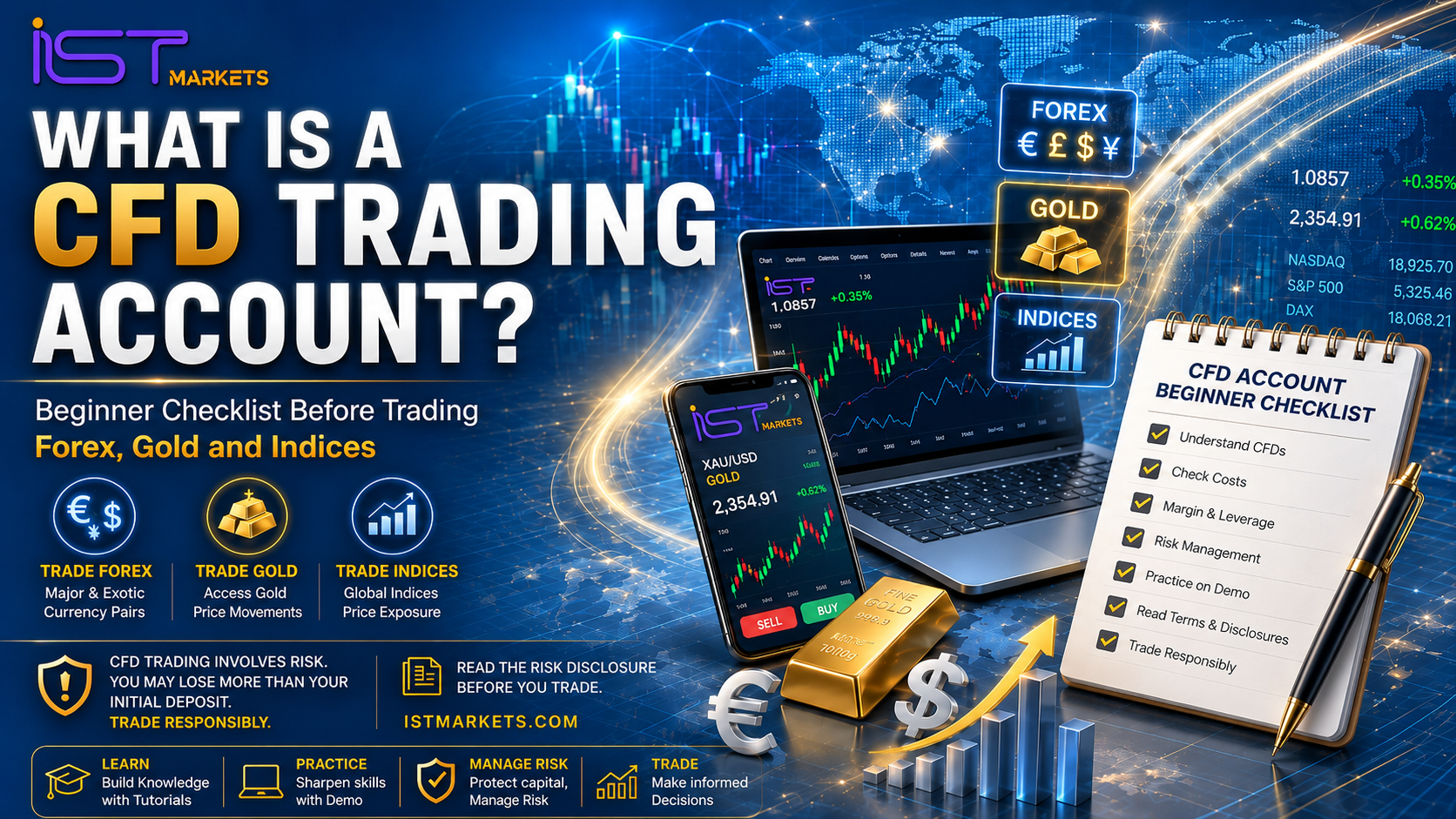
CFD Account Readiness Snapshot
| Beginner Question | What to Understand | Why It Matters |
|---|---|---|
| What am I opening? | A CFD account, not a traditional investing account. | You speculate on price movement without owning the underlying asset. |
| What can go wrong? | Leverage, margin calls, volatility, spread widening, slippage and swaps. | Small price moves can have a large impact on account equity. |
| What markets can I access? | Forex, gold and other commodities, indices, shares and other instruments depending on availability. | One account may provide broad market access, but each product has different conditions. |
| Should I go live immediately? | Practise first with a demo account and compare account options. | Demo helps with platform confidence but cannot guarantee live results. |
Content Table
- Quick Answer: What Is a CFD Trading Account?
- CFD Trading Account vs Investing Account
- Who a CFD Trading Account Is For — and Who Should Wait
- What Markets Can a CFD Account Give Access To?
- One CFD Account, Three Market Exposures
- Check the Contracting Entity and Product Terms
- Official Checks Before Opening a CFD Account
- Costs Beginners Must Understand Before Trading
- CFD Trading Cost Stack Beginners Should Check
- Margin and Leverage: Why Account Size Matters
- Practical Scenario: Forex, Gold and Indices Through CFDs
- The CFD Account Readiness Flow
- CFD Account Readiness Checklist
- Demo First or Live Account?
- Common Mistakes Before Opening a CFD Account
- Mini Glossary: CFD Account Terms in Plain English
- FAQ
Quick Answer: What Is a CFD Trading Account?
A CFD trading account is an account used to trade contracts for difference. A CFD is a derivative product that lets traders speculate on the price movement of an underlying asset without owning that asset. The underlying asset could be a currency pair, gold, an oil market, an index such as the S&P 500, or a share CFD, depending on the provider’s product list and regional availability.
The important point for beginners is that a CFD account is not the same as buying an asset for long-term ownership. You are not buying physical gold. You are not buying shares directly. You are not exchanging one currency for travel money. You are opening a leveraged trading position based on a market price.
That makes CFD accounts flexible, but also risky. Traders should understand costs, margin, leverage, execution and risk disclosure before they move from learning to live trading.
CFD Trading Account vs Investing Account
Many beginners confuse a CFD account with an investing account. The difference is important. An investing account is usually used to buy and hold an asset, such as shares or ETFs, where the investor may own the asset or a legal interest in it. A CFD account is used to trade price movements through a contract.
With CFDs, you may be able to go long if you expect a price to rise or go short if you expect a price to fall. This flexibility can be attractive, but it also means the account is designed for active trading decisions, not simple asset ownership.
| Feature | CFD Trading Account | Investing Account |
|---|---|---|
| Asset ownership | No ownership of the underlying asset. | May involve ownership of shares, funds or other assets. |
| Purpose | Speculate on price movements. | Build or hold an investment position. |
| Direction | Potential to trade rising or falling prices. | Usually focused on buying and holding, depending on product. |
| Leverage | Commonly available and can magnify gains and losses. | Often unleveraged unless margin investing is used. |
| Costs | Spread, commission, swap/overnight charges and possible conversion costs. | Brokerage, custody, fund charges or exchange-related costs may apply. |
| Main risk focus | Leverage, margin calls, volatility, slippage and counterparty risk. | Market decline, issuer risk, liquidity risk and investment horizon. |
This difference should shape the account decision. If your goal is long-term ownership, a CFD account may not be the right tool. If your goal is to trade price movements in markets such as forex, gold and indices, then a CFD account may provide that access, but only if you understand the risks.
Who a CFD Trading Account Is For — and Who Should Wait
A CFD trading account is not automatically right for every beginner. It can be useful for learners who want flexible market access and who are willing to understand leverage, margin, spreads, swaps, commissions and product terms before they trade. It may be unsuitable for users who expect guaranteed returns, do not understand leveraged loss risk, or cannot afford to lose the capital they trade with.
| A CFD trading account may suit learners who… | It may not suit users who… |
|---|---|
| Understand that CFDs are leveraged products. | Expect guaranteed returns or “safe” trading outcomes. |
| Want access to forex, gold and indices without owning the underlying asset. | Do not understand margin, leverage or the possibility of rapid losses. |
| Are willing to practise on demo before using live capital. | Feel pressured to trade quickly because of advertising, social media or FOMO. |
| Can read risk disclosure, product terms and account specifications before depositing. | Cannot afford to lose the capital they plan to trade with. |
What Markets Can a CFD Account Give Access To?
A CFD trading account can provide access to several asset classes from one platform, depending on the provider’s product range, account type and regional rules. At IST Markets, CFD materials describe access to assets such as forex, commodities, indices, stocks and other instruments, with trading available through MetaTrader 5.
For beginners, the practical question is not only “what can I trade?” but “do I understand the contract behind each market?” A forex CFD, a gold CFD and an index CFD can behave differently because each market has different spreads, volatility, session behaviour, contract specifications and margin requirements.
| Market | What You Are Speculating On | Beginner Check |
|---|---|---|
| Forex CFDs | Price movement between currency pairs such as EUR/USD or GBP/USD. | Spread, lot size, leverage, pip value and session volatility. |
| Gold CFDs | Movement in the quoted gold price without holding physical gold. | Volatility, contract size, spread and margin requirement. |
| Index CFDs | Movement in an equity index such as a U.S., European or regional benchmark. | Index session, spread, dividend adjustments, contract value and leverage. |
| Share CFDs | Movement in a company share price without owning the share directly. | Corporate actions, spreads, commissions and market hours. |
One CFD Account, Three Market Exposures
One reason beginners search for a CFD trading account is that a single platform may provide exposure to several markets. The important detail is that the trader is accessing price movement through a contract, not taking ownership of the underlying asset.
| Market | What the Trader Accesses Through CFDs | What They Do Not Own |
|---|---|---|
| Forex | Price movement in currency pairs such as EUR/USD, GBP/USD or other available forex CFDs. | They do not take physical currency delivery for travel or settlement. |
| Gold | Price movement in gold through a commodity CFD where available. | They do not own physical gold bars, coins or allocated metal. |
| Indices | Price movement in an index CFD such as a major U.S., European or global index where available. | They do not own the individual shares inside the index. |
This distinction supports one of the most important beginner questions: yes, a CFD account can give access to forex and gold if those instruments are available, but access is not the same as ownership, and each instrument has its own spread, margin, trading hours and risk conditions.
Check the Contracting Entity and Product Terms
Before opening a CFD trading account, beginners should check the exact contracting entity shown in the account application and client agreement. A trading brand may provide access through a specific legal entity, and the account terms that apply to you should be clear before you deposit.
This matters because product availability, regulatory protections, complaint routes, leverage limits, margin terms, account conditions and order-handling rules can differ depending on the entity and jurisdiction that apply to the account. The safest approach is to read the legal documents, risk disclosure, product terms and account specifications before making a live-account decision.
Official Checks Before Opening a CFD Account
A beginner should not rely only on the account-opening button. A better decision comes from checking the main product, cost, legal and risk pages before funding a live account.
| What to Check | Where to Review It | Why It Matters |
|---|---|---|
| CFD product access | Trade CFDs page | Confirms the markets described, such as forex, commodities, gold, indices or shares. |
| Account model | Account Types page | Shows whether pricing is spread-only, commission-based, or linked to a specific account tier. |
| Spreads, swaps and commissions | Fees page | Helps beginners understand the cost of opening, holding and closing trades. |
| Margin and leverage risk | Risk Disclosure | Explains risks such as margin calls, slippage, gaps, volatility and potential losses. |
| Order handling and legal terms | Legal Documents | Clarifies responsibilities, order rules, margin terms and execution-related documents. |
| Demo practice | Demo Account page | Lets beginners practise platform workflow before using real money. |
| Contracting entity | Regulation & Client Asset Protection + account application | Shows which legal entity and protection framework may apply to the account. |
Costs Beginners Must Understand Before Trading
A CFD account can look simple at account opening, but trading costs can affect every position. Beginners should understand the cost model before they choose an account type or place a live trade. IST Markets account pages describe different account structures, including spread-only models and raw-spread accounts where commission applies, so traders should compare current account specifications before deciding.
| Cost or Condition | What It Means | Why Beginners Should Check It |
|---|---|---|
| Spread | The difference between buy and sell price. | It affects entry and exit cost, especially for frequent trades. |
| Commission | A trading fee charged on certain account types or instruments. | Raw spreads may still involve commission. |
| Swap / overnight fee | A charge or credit for holding positions overnight. | It matters for trades held beyond one session. |
| Currency conversion | Conversion between account currency and instrument currency. | It can affect deposits, withdrawals or trading results. |
| Funding rules | Deposit and withdrawal methods, timing, KYC and third-party charges. | Withdrawal expectations should be checked before funding. |
| Slippage | Execution at a different price than expected. | Fast markets can change the actual result of a trade. |
Cost transparency is part of account readiness. A beginner should be able to explain the cost of entering, holding and exiting a CFD trade before opening a live account.
CFD Trading Cost Stack Beginners Should Check
Beginners should think of CFD costs as a stack, not as one single line item. A trade can be affected by more than the visible spread, especially if the position is held overnight or traded during volatile conditions.
| Cost Component | Plain-English Meaning | Beginner Question |
|---|---|---|
| Spread | The difference between the buy and sell price. | How wide is the spread on the instrument I want to trade? |
| Commission | A separate fee that may apply on some account types. | Is this account spread-only or commission-based? |
| Swap / overnight cost | A charge or credit that may apply when a position is held overnight. | What happens if I keep this CFD open after the trading day? |
| Currency conversion | A possible conversion impact when account currency and product currency differ. | Is my account currency different from the instrument’s quoted currency? |
| Slippage risk | A possible difference between requested price and executed price in fast markets. | Am I trading during news, gaps or low-liquidity periods? |
Margin and Leverage: Why Account Size Matters
Margin and leverage are the main reasons a CFD trading account can be risky for beginners. Margin is the amount required to open or maintain a leveraged position. Leverage allows you to control a larger market exposure with a smaller amount of capital.
This does not make the trade safer. It makes the exposure larger relative to the money in your account. A small account can be put under pressure quickly if the position size is too large or the market moves sharply.
For example, a beginner may deposit a small amount and open a leveraged position that is much larger than the account balance. If the market moves against the position, losses can reduce equity quickly. If equity falls too far, margin warnings or forced closures can occur depending on the provider’s rules and account terms.
Practical Scenario: Forex, Gold and Indices Through CFDs Without Owning the Asset
Scenario: Layla is interested in three markets: EUR/USD, gold and a U.S. stock index. She does not want to physically exchange currencies, buy gold bars, or purchase all the individual shares inside an index. A CFD account can allow her to speculate on the price movement of these markets from one trading platform.
If Layla trades EUR/USD through a forex CFD, she is speculating on the exchange-rate movement. If she trades gold through a commodity CFD, she is speculating on gold’s quoted price without owning physical metal. If she trades an index CFD, she is speculating on the movement of the index price rather than buying every company in the index.
The flexibility is useful, but Layla still needs to check spread, leverage, margin, trading hours, swap charges and product terms for each market. A gold CFD may move differently from a forex CFD. An index CFD may have different session behaviour and adjustments. One account can provide access, but every instrument still needs its own risk check.
The CFD Account Readiness Flow
A beginner does not need a complex trading theory before opening a CFD account. They need a clear decision flow that stops them from treating market access as preparation.
This flow keeps the account decision practical. You understand what a CFD is, compare the account structure, practise the platform, review the costs, read the risk documents and only then decide whether live CFD trading is appropriate for your financial situation and experience level.
CFD Account Readiness Checklist
Use this checklist before opening or funding a live CFD account. If you cannot answer these points clearly, stay in learning mode and use a demo account first.
- I understand that CFDs do not give me ownership of the underlying asset.
- I know which markets I want to trade and why: forex, gold, indices or others.
- I have checked the contract size, spread and trading hours for each instrument.
- I understand margin and how leverage can magnify losses.
- I know whether my account uses spread-only pricing or commission-based pricing.
- I have checked swap or overnight charges for positions held after market close.
- I understand that stop-loss orders may not always execute at the exact requested price in all market conditions.
- I have read the risk disclosure and legal documents.
- I have compared account options before choosing a live account.
- I have practised with a demo account and understand the platform workflow.
- I can define my maximum risk per trade before entering the market.
- I accept that demo practice does not guarantee live trading results.
Demo First or Live Account?
For most beginners, the better first step is a demo account. A demo account can help traders practise placing orders, using stop-loss and take-profit levels, reviewing charts and understanding how different markets behave on a platform. IST Markets demo materials describe virtual funds, access to forex, commodities and indices, and the ability to test platform functionality before live trading.
However, demo trading should be framed correctly. It is useful for practice, not proof. It removes real-money pressure, and live execution may feel different because spreads, slippage, emotions and account equity are real.
| Question | Demo Account | Live CFD Account |
|---|---|---|
| Money at risk? | Virtual funds only. | Real capital at risk. |
| Best use | Platform practice, order testing and learning product behaviour. | Risk-controlled trading after preparation. |
| Emotional pressure | Lower because funds are not real. | Higher because losses are real. |
| Readiness signal | You can use the platform and explain your trade plan. | You can manage risk with real money and accept losses. |
A calm path is: learn the product, practise on demo, compare account options, read risk documents, define risk per trade, and only then consider live trading if it is suitable for your financial situation and experience level.
Common Mistakes Before Opening a CFD Account
- Thinking a CFD account means asset ownership. A CFD tracks price movement; it does not make you the owner of the underlying asset.
- Opening a live account before understanding leverage. Leverage can magnify losses as well as gains.
- Ignoring margin requirements. Margin pressure can lead to forced closures if equity falls too far.
- Comparing only spreads, not total cost. Commission, swaps and conversion can also matter.
- Trading gold like forex or indices like gold. Each product has different volatility, session behaviour and contract terms.
- Skipping demo practice. Demo cannot guarantee results, but it can reduce platform mistakes.
- Not reading the risk disclosure. Risk documents explain scenarios beginners often underestimate.
- Trusting tools or AI as certainty. Tools can support research, but they do not remove market risk or create guaranteed outcomes.
- Starting with no risk limit. Every trade should have a predefined risk amount before entry.
Risk Reminder Before Opening a CFD Account
Forex and CFD trading on margin involves significant risk and may not be suitable for all investors. Leverage can magnify losses as well as gains. Spreads, swaps, commissions, slippage, gaps, margin calls, platform interruptions and market volatility can affect your results. Only trade with money you can afford to lose and consider independent advice if you are unsure.
Compare CFD Account Options Before You Trade
Review spreads, commissions, margin, platform access and risk documents before opening a live CFD trading account.
Compare account options
Practice with a demo account
Demo trading is for practice and education only. It does not guarantee live-account results.
Mini Glossary: CFD Account Terms in Plain English
Beginners do not need to memorise every technical term before using a demo account, but they should understand the core language before live trading.
| Term | Plain-English Meaning |
|---|---|
| CFD | Contract for difference; a product based on price movement without owning the underlying asset. |
| Underlying asset | The market the CFD price is based on, such as gold, forex or an index. |
| Margin | The amount required to open or maintain a leveraged CFD trade. |
| Leverage | A mechanism that increases market exposure and can magnify both gains and losses. |
| Spread | The difference between the buy and sell price. |
| Swap | An overnight holding cost or credit that may apply when a position remains open. |
| Commission | A separate trading fee that may apply on some account types. |
FAQ: CFD Trading Account for Beginners
What is a CFD trading account?
A CFD trading account is an account that lets traders speculate on the price movement of underlying assets such as forex, gold, indices or shares through contracts for difference, without owning the underlying asset.
How is a CFD account different from an investing account?
A CFD account is used to trade price movements through derivatives, usually with leverage. An investing account is usually used to buy and hold assets directly or through investment products.
What should beginners check before opening a CFD account?
Beginners should check the provider, account type, product terms, spread, commission, swap charges, margin requirements, leverage, platform access, funding rules, execution policy and risk disclosure.
Can you trade forex and gold with a CFD account?
Yes, a CFD account can provide access to forex and gold CFDs if those instruments are offered by the provider and available for your account type and region. You speculate on price movement without owning physical currency or gold.
What are the main risks of CFD trading?
The main risks include leverage, margin calls, volatility, spread widening, slippage, overnight charges, market gaps, platform interruptions, liquidity risk and the possibility of losing trading capital.
How can traders practise before using real money?
Traders can practise with a demo account that uses virtual funds. Demo practice can help with platform workflow, order types and risk planning, but it does not guarantee live trading results.
Is CFD trading suitable for beginners?
CFD trading may not be suitable for all beginners because it involves leverage and real financial risk. Beginners should learn first, practise on demo, read the risk disclosure and only consider live trading if they understand the risks and can afford potential losses.
Can I trade gold with a CFD trading account?
A CFD trading account may give access to gold CFDs if gold is available in the provider’s product list. The trader speculates on the gold price movement through a contract and does not own physical gold. They should check spread, margin, trading hours, swap costs and product terms before trading.
Is a CFD trading account the same as owning stocks or gold?
No. A CFD trading account gives exposure to price movement through a contract for difference. It does not give the same ownership rights as buying shares directly, and it does not mean the trader owns physical gold or the individual assets inside an index.