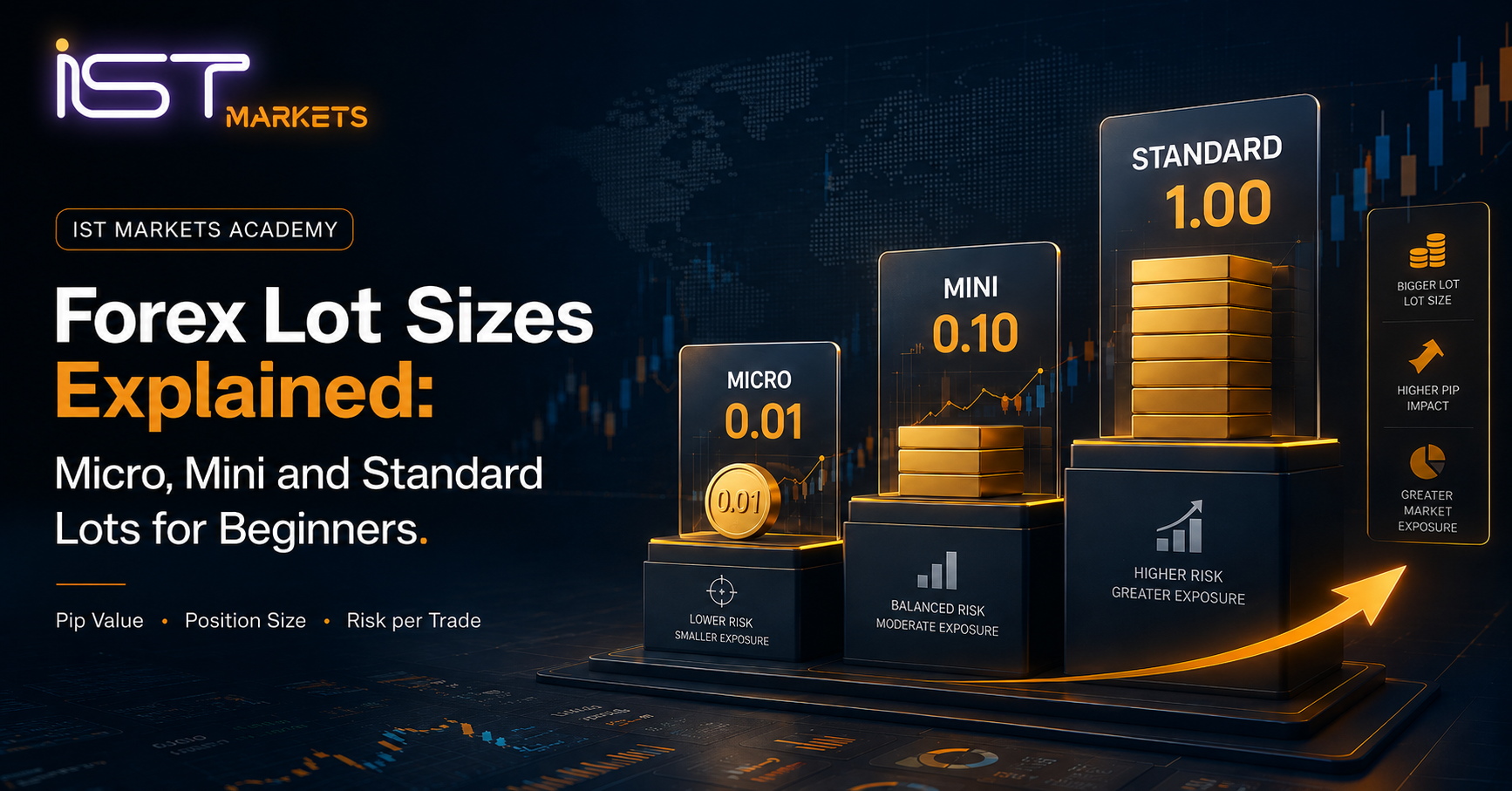
Forex Lot Sizes Explained: Micro, Mini and Standard Lots for Beginners
A risk-first beginner guide to understanding how lot size changes pip value, position size, account exposure and risk per trade before using live funds.
Quick Answer: What is forex lot size?
The numbers 0.01, 0.10 and 1.00 can look small on a trading platform, but they can represent very different levels of risk. Forex lot size is the trade volume selected when opening a forex position. It affects pip value, which affects how much the account may gain or lose when price moves. A standard lot is commonly 100,000 currency units, a mini lot is 10,000 units, and a micro lot is 1,000 units. Beginners should check pip value, stop-loss distance, account equity, leverage, margin, spread, slippage and risk per trade before using live funds.
Risk reminder before reading
Editorial Review Note
This guide explains lot size as a risk-planning decision, not just a platform input. The goal is to help beginners connect micro lots, mini lots and standard lots to pip value, stop-loss distance, account equity, costs and risk per trade before trading live.
Source Snapshot
This guide uses IST Markets Risk Disclosure, investor-risk education from CFTC/NFA and ESMA/FCA, and educational lot-size references for formula validation. Examples are simplified for learning and should be checked against live platform specifications, account terms, contract specifications and product conditions before trading.
No-pressure position-size education promise
What this guide will not do
Content Table
1What lot size meansTrade volume, not just a number.
2Decision ladderHow to think before choosing size.
3Official risk contextWhy trade size matters.
4Micro, mini, standardThe core comparison table.
5Pip valueWhy lot size changes P/L.
6Risk formulaStop distance × pip value.
7Account sensitivitySame trade, different account impact.
8Lot size vs leverageWhat beginners confuse.
What forex lot size means in real trading terms
Forex lot size is the volume of a forex trade. It tells the platform how large the position should be. For beginners, this is one of the most important risk concepts because lot size affects pip value. Pip value affects how much money the account may gain or lose when the market moves.
The numbers shown on many platforms can look small: 0.01, 0.10 or 1.00. But those numbers can represent very different trade sizes. A beginner may think “1.00” means one small trade. In standard forex lot terms, 1.00 lot commonly means a much larger position than 0.01 lot.
A lot size is not just a technical setting. It is a risk decision. A trader can be right about direction but still choose a position size that is too large for the account. In that case, a normal price movement may create stress, trigger emotional decisions, or create margin pressure.
Core idea
| Term | Simple meaning | Why beginners confuse it |
|---|---|---|
| Lot size | Standardised trade volume used by the platform. | The platform number can look small while the exposure is meaningful. |
| Position size | The actual size of the open trade. | Traders may copy another person’s size without matching account equity. |
| Exposure | The market value controlled by the position. | Leverage can make exposure feel smaller than it really is. |
| Pip value | The money impact of one pip movement. | A trader may count pips without knowing the money impact. |
This is why beginners should not ask only, “How many lots can I open?” A better question is: “If the market moves against me by my planned stop-loss distance, how much can I lose?” That question turns lot size from a platform input into a risk-management decision.
The forex lot size decision ladder beginners should use
The safest way to understand lot size is to treat it as part of a decision ladder. Do not start with volume. Start with the question that protects the account: “What loss could this trade create if I am wrong?”
| Step | Beginner question | What it protects against |
|---|---|---|
| 1 | What lot size am I considering? | Opening a position without understanding volume. |
| 2 | What is the approximate pip value? | Counting pips without understanding money impact. |
| 3 | What is my stop-loss distance? | Entering a trade before defining possible loss. |
| 4 | What is my estimated risk before costs? | Being surprised by the account impact. |
| 5 | What are the spread, slippage, swap and margin effects? | Ignoring live-market costs and execution limitations. |
| 6 | Does this fit my account equity and risk limit? | Using a position size that is too large for the account. |
Decision rule
Official risk context: why lot size deserves attention
Lot size matters because it changes how much exposure the trader controls. IST Markets’ Risk Disclosure explains that leveraged trading can involve significant risk, margin calls, stop-loss limitations, slippage, gaps and losses. A larger position size can make those risks affect the account faster.
Investor-protection authorities also treat retail forex and CFD-style products carefully. CFTC materials highlight forex-specific risk disclosure requirements in the retail forex context, while ESMA’s CFD product intervention measures included leverage limits, margin close-out rules and negative balance protection. These references are used as risk-education context, not as jurisdiction-specific legal advice.
| Risk source | Relevant point | Beginner takeaway |
|---|---|---|
| IST Markets Risk Disclosure | Leveraged trading, margin calls, stop-loss limits, slippage and gap risks. | Read the risk disclosure before using live funds. |
| CFTC / NFA | Retail forex is treated as a high-risk area requiring specific disclosures and oversight. | Treat lot size as part of risk control, not only trade entry. |
| ESMA / FCA | Retail CFD protections include leverage limits, margin close-out and standardised risk warnings. | Understand that position size and margin are investor-protection issues. |
Micro, mini and standard lots: the beginner comparison table
Forex is commonly described in lot sizes. The three core terms beginners usually see are micro lot, mini lot and standard lot. Some platforms may also offer nano or custom volumes, but the table below covers the most widely taught lot-size structure.
| Lot size | Common trade volume | Common platform volume | Approx. pip value on many USD-quoted pairs | Beginner meaning |
|---|---|---|---|---|
| Micro lot | 1,000 currency units | 0.01 lot | About $0.10 per pip | Smaller pip impact, often used for learning position-size behaviour. |
| Mini lot | 10,000 currency units | 0.10 lot | About $1 per pip | Ten times the pip impact of a micro lot. |
| Standard lot | 100,000 currency units | 1.00 lot | About $10 per pip | Large impact if account size is small or risk is not clearly planned. |
These pip-value figures are common approximations for many USD-quoted pairs, such as EUR/USD. Pip value can change when the account currency, quote currency, exchange rate, pair type or contract specification is different. For metals, indices, commodities or other CFDs, contract specifications may differ from standard forex pairs.
Why lot size changes pip value and account impact
A pip is a unit of price movement. But price movement alone does not tell a beginner how much money is at risk. Pip value does that. Pip value answers: “If the market moves one pip, how much could this position gain or lose before costs?”
This is where lot size becomes practical. A 30-pip movement does not have the same account impact on every lot size. The same price movement can be small, meaningful or severe depending on position size.
| Position size | Approx. pip value | 30-pip move against position | Before-cost account impact |
|---|---|---|---|
| 0.01 lot / micro lot | About $0.10 per pip | About -$3 | Smaller learning impact, still real risk. |
| 0.10 lot / mini lot | About $1 per pip | About -$30 | Meaningful account movement for many beginners. |
| 1.00 lot / standard lot | About $10 per pip | About -$300 | Large impact if account size is small. |
Beginner trap
The practical risk formula: stop distance × pip value
A beginner should not choose lot size first. A better workflow starts with how much loss the account can accept if the trade is wrong, then connects that number to stop-loss distance and pip value.
Estimated trade risk = Stop-loss distance in pips × Pip value
This is a simplified educational formula. It does not include spread, slippage, swaps, commissions, currency conversion, gaps or platform-specific rules.
For example, if the planned stop-loss distance is 25 pips and the approximate pip value is $1, the estimated before-cost risk is about $25. If the pip value is $10, the same 25-pip stop becomes about $250 before costs. The market distance did not change. The lot size changed the money impact.
Helpful internal learning path
Account size sensitivity: the same lot size can feel different
Lot size cannot be judged in isolation. The same estimated loss can be small for one account and serious for another. This is why copying another trader’s lot size can be risky, even if the trade idea looks similar.
| Same estimated trade risk | Account A | Account B | Lesson |
|---|---|---|---|
| Estimated loss before costs | $30 | $30 | The trade risk looks identical in dollars. |
| Account equity | $300 | $3,000 | The account context is very different. |
| Account impact | 10% | 1% | The same dollar risk can create very different pressure. |
This example is not a recommendation for any risk percentage. It simply shows why lot size should be judged relative to account equity, not only as a platform volume number.
Forex lot size vs leverage: what beginners often confuse
Lot size and leverage are connected, but they are not the same. Lot size controls the position volume. Leverage affects how much margin may be required to open that position. A beginner can misunderstand this and think that lower required margin means lower risk. It does not.
| Concept | What it affects | Beginner risk |
|---|---|---|
| Lot size | Trade volume and pip value impact. | A larger lot can make each pip movement more financially significant. |
| Leverage | Required margin and access to larger exposure. | It may allow the trader to open a position larger than the account can comfortably withstand. |
| Margin | Funds required to keep the position open. | Free margin can shrink if the position moves against the account. |
Leverage does not directly change pip value. Lot size and the currency pair mainly drive pip value. Leverage changes the margin requirement and can make it easier to open larger exposure than a beginner planned.
What lot size can and cannot tell you
Lot size is important, but it is not enough by itself. It helps estimate exposure and pip impact, but it cannot tell you whether a trade is appropriate, whether the strategy is valid, or whether the trade fits your financial situation.
| Lot size can help you understand | Lot size cannot tell you alone |
|---|---|
| Trade volume. | Whether the trade should be opened. |
| Approximate pip impact. | Whether the market analysis is correct. |
| Estimated loss when combined with stop distance. | Whether the stop-loss will fill exactly. |
| Margin and account-pressure direction. | Whether the trade is safe or suitable. |
Beginner scenario: choosing 0.01, 0.10 or 1.00 lots
Imagine a beginner opens a trading platform and sees the volume field. The options look simple: 0.01, 0.10 or 1.00. The trader may think these are small numbers, but in forex lot-size terms they can represent very different levels of exposure.
If the beginner chooses 0.01 lot, each pip may have a smaller money impact on many USD-quoted pairs. If the beginner chooses 0.10 lot, each pip may be about ten times larger. If the beginner chooses 1.00 lot, each pip may be about one hundred times larger than 0.01 lot.
The mistake is not using a specific lot size. The mistake is choosing volume before checking pip value, stop-loss distance, margin requirement and account equity. Lot size should be the result of a risk plan, not the first decision.
| Rushed path | Risk-first path |
|---|---|
| Chooses volume because it “looks small”. | Checks pip value before choosing volume. |
| Ignores stop-loss distance. | Estimates risk using stop distance × pip value. |
| Looks only at possible profit. | Checks possible loss first. |
| Uses leverage to open a larger position. | Uses lot size to keep account risk visible. |
| Copies another trader’s lot size. | Adjusts position size to personal account equity, stop distance and risk limit. |
Costs, margin and execution limits beginners should check
Lot size does not work alone. It interacts with trading costs, margin requirements, leverage and execution conditions. A larger lot can make the same spread, slippage or overnight cost more noticeable in account terms.
Spread
The spread is part of the cost of entering a trade. If position size is large, the spread cost can have a larger money impact. Beginners should not evaluate lot size without reviewing trading fees and market conditions.
Slippage
Slippage occurs when an order executes at a different price than expected. Larger positions may make slippage more financially noticeable. A stop-loss can support risk planning, but it may not always execute at the exact requested price during fast-moving markets, gaps or low-liquidity conditions.
Margin and free margin
A platform may allow a larger lot because leverage reduces the margin required to open the position. That does not make the trade lower risk. The account still reacts to the full position exposure. If lot size is too large, equity and free margin can fall quickly when the position moves against the account.
Swaps and holding costs
If a position is held overnight, swap or financing adjustments may apply depending on the product and account terms. The larger the position size, the more noticeable these adjustments can become.
Mini case: why 0.10 lot can feel different after costs
Cost-readiness rule
Common forex lot size mistakes beginners should avoid
Most lot-size mistakes happen before the trade opens. The trader chooses volume before understanding the account impact. The table below turns common mistakes into practical prevention checks.
| Mistake | Why it is risky | Better approach |
|---|---|---|
| Choosing lot size by guessing | The trader may not know the money impact per pip. | Calculate pip value and estimated risk before entry. |
| Thinking 1.00 is only “one trade” | A standard lot can have a much larger pip impact than a micro lot. | Understand volume units behind platform numbers. |
| Copying a signal provider’s lot size | Their account equity, stop distance and risk tolerance may be completely different. | Translate any idea into your own risk plan first. |
| Ignoring stop-loss distance | A wider stop means larger estimated loss at the same pip value. | Estimate risk using stop distance × pip value. |
| Using leverage as permission | Lower required margin does not reduce market exposure. | Choose lot size based on risk, not maximum platform capacity. |
| Using the same lot size on every pair | Pip value and volatility can vary by pair and account currency. | Recalculate when the pair, account currency or stop distance changes. |
| Increasing lot size after a loss | This can turn recovery attempts into larger account damage. | Pause and review the plan before changing volume. |
| Ignoring spread and slippage | Costs can change the real account impact of the trade. | Review costs and execution conditions before trading live. |
| Treating demo profit as proof | Demo results do not fully recreate live emotion or execution pressure. | Use demo to practise position sizing, not to prove future results. |
Before you trade live: ask these 8 lot-size questions
Before using live funds, a beginner should be able to answer these questions clearly. If the answer is unclear, demo practice and document review may be more appropriate than live trading.
- Do I know whether I am using a micro, mini, standard or custom lot size?
- Do I know the approximate pip value for this pair and account currency?
- Do I know my stop-loss distance in pips before opening the trade?
- Have I estimated the possible loss before spread, slippage, swap, commission and gaps?
- Does this position size fit my account equity and risk limit?
- Have I checked margin requirement and free margin impact?
- Have I checked whether this pair or instrument has different contract specifications?
- Have I practised this lot size on demo before using real funds?
Forex lot size checklist before taking action
Use this checklist before opening a live position or increasing volume. The goal is not to remove risk. The goal is to make the risk visible before money is exposed.
| Readiness area | What to confirm | Decision signal |
|---|---|---|
| Lot-size readiness | You know whether the volume is micro, mini, standard or a custom size. | Do not trade live if the platform volume is unclear. |
| Pip-value readiness | You know the approximate money impact per pip. | Use a calculator or demo to practise before live trading. |
| Risk-readiness | You know estimated loss if the stop-loss is reached. | Reduce size if the loss can seriously damage the account. |
| Cost-readiness | You understand spread, slippage, swap, commission and conversion impact. | Review trading fees and market conditions before opening a position. |
| Margin-readiness | You know required margin and free margin impact. | Do not rely on leverage as permission to oversize. |
| Product-readiness | You understand that contract specifications may differ across symbols. | Do not assume every instrument behaves like EUR/USD. |
| Document-readiness | You have reviewed risk disclosure, legal documents and account terms. | Do not rely only on platform access or account approval. |
Where this guide fits in your learning path
Lot size sits between market analysis and risk management. A trader may have a view on direction, but the account impact is determined by position size, pip value, stop-loss distance and trading costs.
Smart learning path
Risk reminder before the CTA
Before trading live, read the risk disclosure, understand lot size, calculate pip value, review account terms and practise position sizing on demo. A lot size that feels small on the platform can still create meaningful losses if pip value, leverage and stop-loss distance are not understood.
A responsible beginner does not choose the largest lot size available. The better question is whether the position size fits the account, the stop-loss plan and the trader’s ability to accept the potential loss.
Soft CTA: Build your lot-size routine before using live funds
Before using real funds, review the IST Markets risk disclosure, check the legal documents, practise through a demo account, compare account types, and review trading fees and costs before deciding whether live leveraged trading is appropriate for you.
Practise first. Verify first. Treat lot size as a risk decision, not just a platform number.
FAQ
What is forex lot size in simple terms?
Forex lot size is the volume of a forex trade. It affects pip value, which affects how much the account may gain or lose when the market moves.
What does 0.01 lot mean in forex?
In many forex platforms, 0.01 lot commonly refers to a micro lot, or 1,000 currency units. On many USD-quoted pairs, this is often about $0.10 per pip, but actual pip value can vary by pair, account currency and contract specification.
Is 1.00 lot the same as one small trade?
No. In common forex lot terms, 1.00 lot usually refers to a standard lot of 100,000 currency units. The number may look small on the platform, but the exposure and pip value can be significant.
What is the difference between micro, mini and standard lots?
A micro lot is commonly 1,000 currency units, a mini lot is 10,000 units, and a standard lot is 100,000 units. The larger the lot size, the larger the typical pip value and potential account impact.
How does forex lot size affect risk?
Lot size affects risk because it changes pip value. A larger pip value means each pip of market movement has a larger money impact. Risk also depends on stop-loss distance, leverage, spread, slippage and account equity.
What should beginners check before choosing lot size?
Beginners should check pip value, stop-loss distance, estimated loss, account equity, margin requirement, leverage, spread, slippage, swap, conversion and account terms before choosing lot size.
Is a micro lot safer than a standard lot?
A micro lot usually has a smaller pip impact than a standard lot, but no lot size is automatically safe. Risk still depends on stop-loss distance, leverage, volatility, spread, slippage and account size.
Can demo trading help me practise lot size?
A demo account can help beginners practise choosing volume, reading pip value, setting stop-loss distance and estimating risk. Demo results do not prove future live performance because live trading adds real financial pressure and execution risk.
Does leverage change pip value?
Leverage does not directly change pip value. Lot size and the currency pair mainly drive pip value. Leverage affects required margin and how easily a trader can open larger exposure.
What mistakes should beginners avoid with forex lot size?
Beginners should avoid guessing volume, copying another trader’s lot size, ignoring pip value, ignoring stop-loss distance, increasing lot size after losses, using the same lot size on every pair, and using leverage as permission to open larger positions.
References & Further Reading
- IST Markets Risk Disclosure
- IST Markets Legal Documents
- IST Markets Demo Trading Account
- IST Markets Trading Account Types
- IST Markets Trading Fees and Costs
- IST Markets Pip Value Calculator Explained
- IST Markets Forex Leverage Explained
- IST Markets Margin Call Forex Guide
- CFTC — Foreign Currency Trading
- NFA — Forex Transactions Regulatory Guide
- ESMA — CFD Product Intervention Measures
- BabyPips Forexpedia — Lot