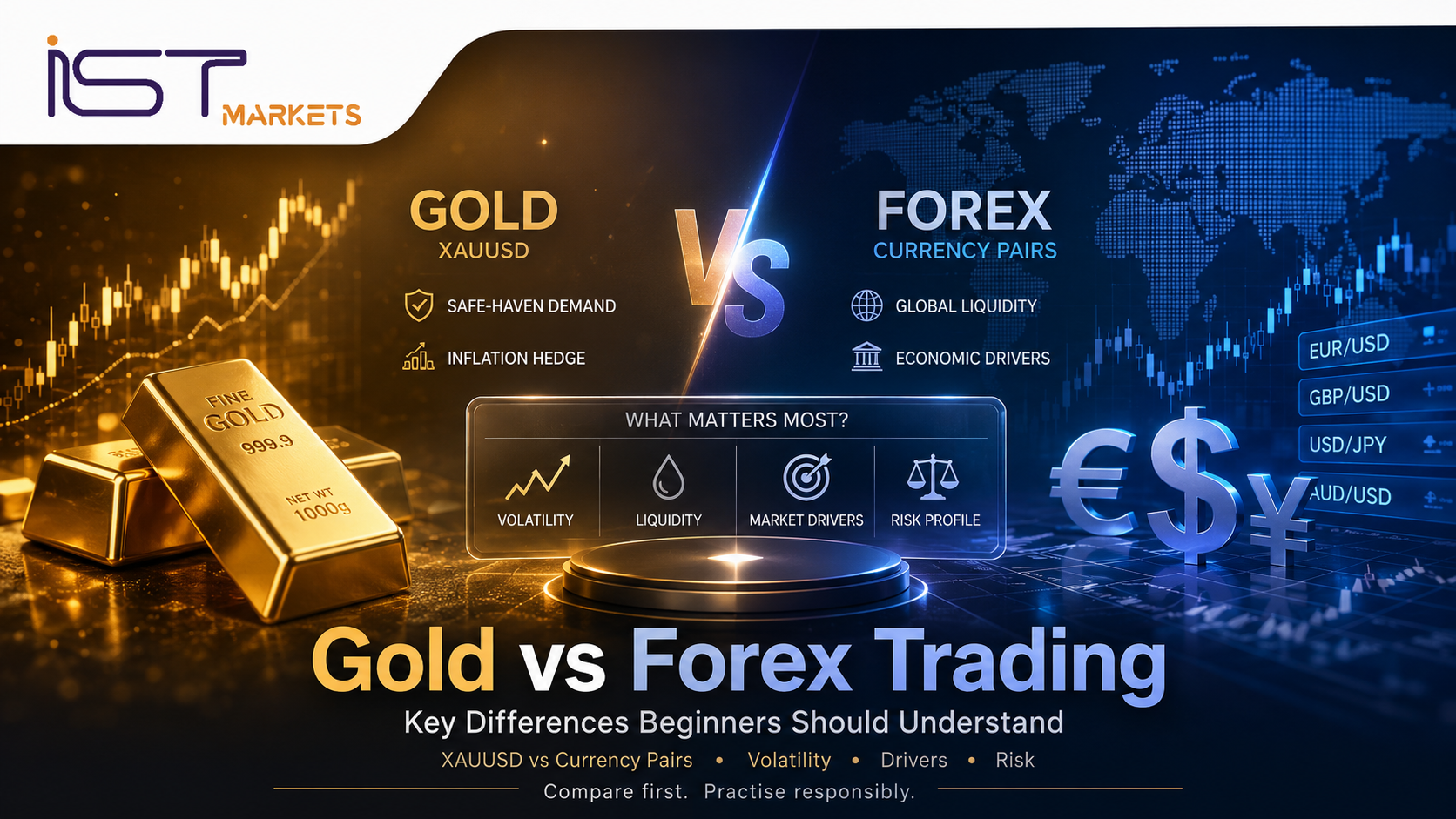
Gold vs Forex Trading: Key Differences Beginners Should Understand
A comparison-first guide for beginners deciding whether to study currency pairs, gold/XAUUSD, or both — focused on market behavior, volatility, drivers, risk translation and demo practice.
Quick Answer
Gold vs forex trading is not a question of which market is automatically better. Forex usually gives beginners more currency-pair choice, tighter conditions on major pairs, and clearer two-currency logic. Gold, traded as XAUUSD, can look simpler because it is one instrument, but it can move sharply around the US dollar, Treasury yields, inflation data, central-bank expectations and risk sentiment. A beginner should compare behavior, volatility, spread, stop distance, position size and event risk before choosing. The practical answer is: study both on demo, start with the market you can understand and size responsibly, and avoid treating gold’s faster movement as an easier opportunity.
Risk reminder
Source Snapshot
This guide links the comparison to IST Markets’ risk disclosure, forex education, gold education and demo resources. It also uses non-competitor market references including BIS, World Gold Council, CME Group and World Bank for macro and market-context support.
Content Table
Start with behavior, not definitions.2Suitability, not superiority
Choose by fit, not hype.3Main differences
XAUUSD vs currency-pair logic.4Volatility behavior
Why gold can feel faster.5Market drivers
Dollar, yields, inflation and fundamentals.6Liquidity and hours
Depth does not remove execution risk.7Risk translation
Same lot size does not equal same risk.8CPI scenario
EUR/USD vs XAUUSD before inflation data.9Common mistakes
Specific mistakes beginners make.10Demo drills
Practical exercises before live funds.11Decision checklist
A market suitability checklist.12FAQ
Natural beginner questions answered.
Quick Comparison: Gold vs Forex at a glance
The simplest way to compare gold vs forex trading is to begin with behavior, not labels. Forex trading usually means trading currency pairs such as EUR/USD, GBP/USD or USD/JPY. Gold trading through XAUUSD means trading the price of gold quoted against the US dollar. Both can be accessed through CFD-style trading platforms, both can involve leverage, and both require a plan for spread, slippage, stop distance and position size.
The mistake many beginners make is assuming that forex is complicated because there are many pairs, while gold is easy because there is only one main symbol to watch. In practice, gold can be more emotionally difficult because one instrument can react to multiple drivers at once: the dollar, yields, inflation, geopolitical stress and risk sentiment. Forex pairs also have drivers, but major pairs can sometimes be easier to classify because each side of the pair belongs to a currency and an economy.
| Comparison point | Gold / XAUUSD | Forex major pairs |
|---|---|---|
| Main structure | Gold quoted against the US dollar | One currency valued against another |
| Beginner appeal | One popular instrument, strong movement, clear symbol | Many pair choices, familiar currencies, active sessions |
| Main risk | Fast movement, wider stop distance, event sensitivity | Overtrading many pairs, misunderstanding pair logic, correlation |
| Common driver | US dollar, yields, inflation, safe-haven demand, uncertainty | Interest rates, growth, inflation, central banks, currency fundamentals |
| Liquidity feel | Can be active, but conditions may change around news or session changes | Major pairs are generally deep, but not every pair or session behaves the same |
| Beginner learning use | Studying event risk and volatility control | Learning pair logic, sessions, spreads and macro basics |
| Better question | Can I size this volatility? | Can I understand this pair and its drivers? |
Suitability, not superiority
A serious comparison should avoid saying that gold is “better” or forex is “safer.” Neither statement is reliable. The better question is whether the market matches the beginner’s current knowledge, attention span, risk limit and emotional control.
If a trader wants a slower learning curve, a major forex pair may be easier to observe first because the trader can focus on spread, session timing, one pair, and the relationship between two currencies. If a trader is attracted to fast movement and major news reactions, gold can be useful to study on demo, but only if the trader respects wider stop distances and avoids oversizing.
Suitability decision box
| Question | What it may suggest |
|---|---|
| Do I need a calmer learning environment? | Start by observing one or two major FX pairs on demo. |
| Do I understand how the US dollar and yields affect gold? | XAUUSD may be worth studying on demo. |
| Do I chase large candles? | Avoid making gold your first live market. |
| Can I calculate position size from stop distance? | You are closer to comparing both markets responsibly. |
| Do I know what spreads and slippage look like around news? | Practise events on demo before any live decision. |
| Can I walk away when there is no clear setup? | You may be ready to build a structured watchlist. |
Main differences between gold and forex trading
Forex pairs compare two currencies. EUR/USD, for example, reflects the euro against the US dollar. If a trader studies EUR/USD, they should think about euro-area data, US data, central-bank expectations, dollar strength, session timing and risk sentiment. That sounds like a lot, but the pair structure is logical once the trader understands that one currency is being priced against another.
XAUUSD is different. It is gold priced in US dollars. Gold does not have a central bank, interest rate or employment report of its own. Instead, it reacts to the environment around it: the dollar, bond yields, inflation expectations, central-bank policy, investment demand, geopolitical stress and broader uncertainty.
Internal learning path: if currency-pair logic is still unclear, read what forex trading is and the guide explaining how currency pairs work. If gold is the main focus, read the XAUUSD beginner guide before moving to live exposure.
Volatility: why gold can move differently
Gold often attracts beginners because it appears to move faster than many major currency pairs. That movement can be useful for learning how markets react to news, but it can also punish poor sizing. A wider candle does not mean an easier trade. It often means the stop distance, spread sensitivity and emotional pressure are also larger.
Forex volatility varies by pair. EUR/USD may behave differently from GBP/JPY, USD/JPY or an emerging-market pair. Gold volatility also changes by session, news timing and risk environment. Before comparing two symbols, beginners should not ask which one moved more today. They should ask: how far does this instrument normally move, what stop distance would make sense, how much would that stop cost, and can my account handle it?
| Behavior | Gold / XAUUSD | Forex majors |
|---|---|---|
| Reaction to US data | Often highly sensitive to CPI, jobs, Fed expectations, dollar and yields | Depends on the pair and which currency is affected |
| Volatility feel | Can move in wider bursts, especially around news | Varies by pair; majors may feel smoother but can still move sharply |
| Beginner mistake | “Gold moves more, so I can make more” | “I can trade many pairs because they all look similar” |
| Risk focus | Stop distance, lot size, news timing, spread changes | Pair selection, session timing, correlation, central-bank drivers |
| Best learning use | Event risk, dollar/yield relationship, volatility discipline | Pair logic, trend structure, economic comparison, spread awareness |
| Main discipline | Do not oversize because the chart looks clear | Do not over-diversify into correlated pairs |
Market drivers: dollar, yields, inflation and currency fundamentals
Gold and forex can react to the same economic event in different ways. A US inflation release can move the US dollar, Treasury yields, gold and stock indices. But the interpretation is not always one-directional. A higher-than-expected CPI reading might initially support the dollar if traders expect tighter policy, but gold may reverse if the market had already priced the result, if real yields fail to confirm the move, or if risk sentiment changes after the release.
Forex drivers are usually expressed through relative expectations. If US rates are expected to remain higher than euro-area rates, EUR/USD may feel pressure. If the market revises the outlook for the Bank of England or the Bank of Japan, GBP or JPY pairs may react. Forex is comparative by design.
Gold drivers are more environmental. Gold may respond to dollar strength, real yields, inflation uncertainty, geopolitical stress, central-bank buying and investor demand. That does not make it predictable; it means the trader needs a broader pre-trade checklist.
| Driver | Why it matters for gold | Why it matters for forex |
|---|---|---|
| US dollar | Gold is globally priced in USD, so dollar strength can affect XAUUSD | USD strength or weakness directly affects USD pairs |
| Yields / rates | Higher yields can raise opportunity cost for non-yielding gold | Rate expectations are central to currency valuation |
| Inflation | Can influence gold demand and central-bank policy expectations | Can shift interest-rate expectations for currencies |
| Risk sentiment | Gold may attract attention during uncertainty, but not always in a straight line | Safe-haven currencies and risk-sensitive currencies can move differently |
| Central banks | Gold has no central bank, but reacts to Fed policy and global demand | Each major currency is tied to a central bank and economy |
| Economic data | US data can move gold through dollar/yield channels | Data affects the currency connected to that economy |
Trading hours and liquidity considerations
Forex is one of the deepest global markets, but beginners should not turn that into a false sense of safety. Liquidity is not identical across every pair, every session or every market condition.
Major currency pairs often have more consistent trading conditions than exotic or thinly traded pairs. But even major pairs can experience wider spreads or fast movement around high-impact news. Gold can also be very active, but activity does not automatically mean controlled execution. During major US releases or sudden risk events, gold can move quickly, and stop orders may not execute exactly as expected.
Market depth does not remove execution risk
Risk translation: why the same trade size is not the same risk
The most dangerous comparison is visual: “EUR/USD moved this much and gold moved that much.” Beginners must translate movement into money risk. The same lot size, the same number of points, or the same chart shape does not mean the same risk across markets.
A gold trade with a wide stop may represent a much larger account impact than a smaller stop on a major FX pair. A forex pair with a tight spread may still be risky if the trader opens too many correlated USD positions. Risk is not only the symbol. It is the combination of stop distance, position size, volatility, spread, slippage, margin and the trader’s ability to follow the plan.
| Risk question | Why it matters |
|---|---|
| What is the normal stop distance for this market today? | Gold may need more room than a calmer FX pair. |
| What is the cost of that stop in account currency? | The chart distance must become money risk. |
| Is the spread normal or widened? | High-impact news can change trading conditions. |
| Am I trading one idea or several correlated ideas? | Multiple USD pairs can behave like one large USD position. |
| Can I accept no trade as a decision? | If not, volatility may push emotional entries. |
Practical scenario: EUR/USD vs XAUUSD before a US inflation release
Imagine a beginner is watching EUR/USD and XAUUSD one hour before a US CPI release. Gold has been moving faster than EUR/USD all morning, so the trader feels gold offers the “better opportunity.” That thought is already risky because it is based on speed, not preparation.
Before choosing either market, the trader should ask: Is CPI expected to change the market’s view of US interest rates? Is the US dollar already moving before the release? Are Treasury yields confirming or contradicting the first reaction? Is XAUUSD near support, resistance or a recent liquidity area? Is EUR/USD reacting to dollar strength, euro weakness, or both? Is the spread normal enough to manage the trade? What stop distance would be realistic, and what would that cost?
Suppose CPI comes above forecast. The first reaction may be stronger dollar and lower gold. EUR/USD may drop and XAUUSD may fall quickly. But after the first move, gold can reverse if the market was already positioned for a hot CPI reading, if core details are less aggressive, if yields fail to follow, or if traders take profit after the initial move. EUR/USD can also reverse if the dollar reaction fades.
Scenario lesson
Common mistakes beginners make
| Mistake | Why it hurts beginners | Better approach |
|---|---|---|
| Assuming gold is easier because it is one symbol | One symbol can still have many drivers | Learn dollar, yields, inflation and event risk first |
| Comparing XAUUSD and EUR/USD with the same lot size | The account impact may be completely different | Calculate risk from stop distance and position size |
| Ignoring the US dollar in gold trades | Gold is quoted in USD and often reacts to dollar moves | Track dollar context and yields as filters |
| Trading too many forex pairs | Many pairs may repeat the same USD idea | Focus on one or two major pairs while learning |
| Trading CPI or NFP without a plan | First reactions can reverse quickly | Use a pre-event checklist and demo practice |
| Treating demo wins as live readiness | Live execution and emotions are different | Use demo to build process, not confidence alone |
| Choosing the fastest market | Speed can increase mistakes and slippage | Choose the market you can manage responsibly |
Beginner demo drills
The best way to compare gold and forex is to study both in a controlled way before live funds. Demo practice does not remove risk in live trading, but it helps beginners learn platform workflow, market rhythm and risk calculation.
| Drill | How to do it | What it teaches |
|---|---|---|
| CPI watch drill | Observe EUR/USD and XAUUSD before, during and after CPI | How the same event can affect markets differently |
| Stop-distance drill | Mark a reasonable stop on each chart without entering | Whether gold requires wider risk room |
| Spread journal drill | Record spreads before and after high-impact news | How conditions change during event risk |
| USD context drill | Watch gold alongside the US dollar and yields commentary | Why XAUUSD is not just a chart pattern |
| One-market week | Study only EUR/USD for one week, then only XAUUSD for one week | Which market you understand better |
| No-trade drill | Write down why you skipped a volatile move | Builds discipline and reduces FOMO |
Gold vs forex decision checklist
A beginner who wants a clearer learning path may start with one major forex pair on demo, especially if they are still learning spreads, pips, sessions, stop loss and position sizing. A beginner who is especially interested in gold should still begin on demo and build a separate XAUUSD routine around volatility, the dollar, yields and news timing.
A balanced beginner approach is to choose one primary market for learning and one secondary market for observation. For example, a trader might actively practise EUR/USD order workflow on demo while only journaling gold reactions around US data. After several weeks, the trader can compare which market produced better decision quality, not better imaginary profit.
| Checklist item | Gold / XAUUSD | Forex pairs |
|---|---|---|
| I understand the main drivers | Dollar, yields, inflation, uncertainty | Interest rates, growth, inflation, central banks |
| I know normal volatility | Measure recent daily and session movement | Compare by pair and session |
| I can size the stop | Wider stops may be needed | Stop distance varies by pair |
| I check events first | CPI, NFP, Fed, geopolitical risk | Currency-specific data and central banks |
| I avoid overtrading | Do not chase every gold candle | Do not open too many correlated pairs |
| I use demo properly | Practise event reaction and risk sizing | Practise pair selection and execution workflow |
| I can explain my reason to skip | No trade is part of discipline | No trade is part of discipline |
Smart internal reading path
If the reader is still learning the basics, the best next step is not another market prediction. Start with the complete forex guide, then read how currency pairs work, then compare that with the gold trading beginner guide.
Before trading around CPI, NFP or Fed decisions, use the market hours and events page to check timing. Before moving from demo to live, review the Risk Disclosure and Legal Documents.
Risk reminder before the CTA
Gold and forex can both involve leverage, margin requirements, spread changes, slippage, gaps and fast price movement. Stop-loss orders may reduce risk but cannot guarantee execution at the exact requested price in all conditions. A demo account is useful for practice, but live trading involves real money, execution pressure and emotional decision-making. Do not choose gold or forex because someone online says one is easier. Choose only after you understand the instrument, risk size, market drivers and terms that apply to your account.
Soft CTA: Practise both markets on demo first
If you are comparing gold vs forex trading, practise both markets on demo before committing live funds. Use one demo workflow for a major FX pair such as EUR/USD and one separate workflow for XAUUSD. Compare not only results, but the quality of your decisions.
Explore IST Markets’ demo account to practise forex, commodities and indices in a platform environment before live trading. Then continue with the forex beginner guide, the gold trading beginner guide and the market-hours and events page.
FAQ
Is gold trading better than forex for beginners?
Gold is not automatically better than forex. Gold can look simpler because it is one main symbol, but it may move sharply around US data, dollar moves, yields and uncertainty. Beginners should compare both on demo and choose the market they understand and can size responsibly.
What is the difference between XAUUSD and currency pairs?
XAUUSD is gold quoted against the US dollar. Currency pairs compare one currency against another, such as EUR/USD. Gold has no central bank of its own, so traders often watch the dollar, yields, inflation and risk sentiment. Currency pairs usually depend on the fundamentals of both currencies.
Is gold more volatile than forex?
Gold can feel more volatile than some major forex pairs, especially around high-impact US data or risk events. However, forex volatility varies by pair. A major pair may behave differently from a cross or exotic pair. Traders should measure recent movement, spread and stop distance before comparing risk.
Can I trade both gold and forex with the same account?
This depends on the broker, account type, platform access, jurisdiction and product availability. Traders should check the provider’s market list, account terms, margin requirements, trading conditions and risk documents before assuming the same account gives access to both.
What drives gold prices differently from currencies?
Gold is often influenced by the US dollar, real yields, inflation expectations, central-bank demand, safe-haven demand, investment flows and risk sentiment. Currencies are influenced by relative interest rates, economic data, central-bank policy, growth expectations and political or market risk.
Should beginners trade gold or forex first?
Many beginners may find it easier to learn with one major forex pair first, while observing gold on demo. But this depends on the trader’s discipline and knowledge. A beginner who studies XAUUSD carefully, sizes risk conservatively and avoids news chasing can also use gold as a learning market on demo.
Why does gold move during US inflation data?
US inflation can affect expectations for Federal Reserve policy, the US dollar and Treasury yields. Because gold is priced in dollars and does not pay interest, changes in dollar strength and yield expectations can influence XAUUSD. The first move after the data is not always the final direction.
References & Further Reading
- IST Markets Risk Disclosure
- IST Markets: What is Forex Trading?
- IST Markets: Gold Trading for Beginners
- IST Markets Demo Trading Account
- BIS 2025 Triennial Central Bank Survey: FX turnover
- World Gold Council: Gold Outlook
- World Gold Council: Gold Market Commentary
- CME Group: Gold and the U.S. Dollar
- World Bank Blogs: When uncertainty rises, gold rallies