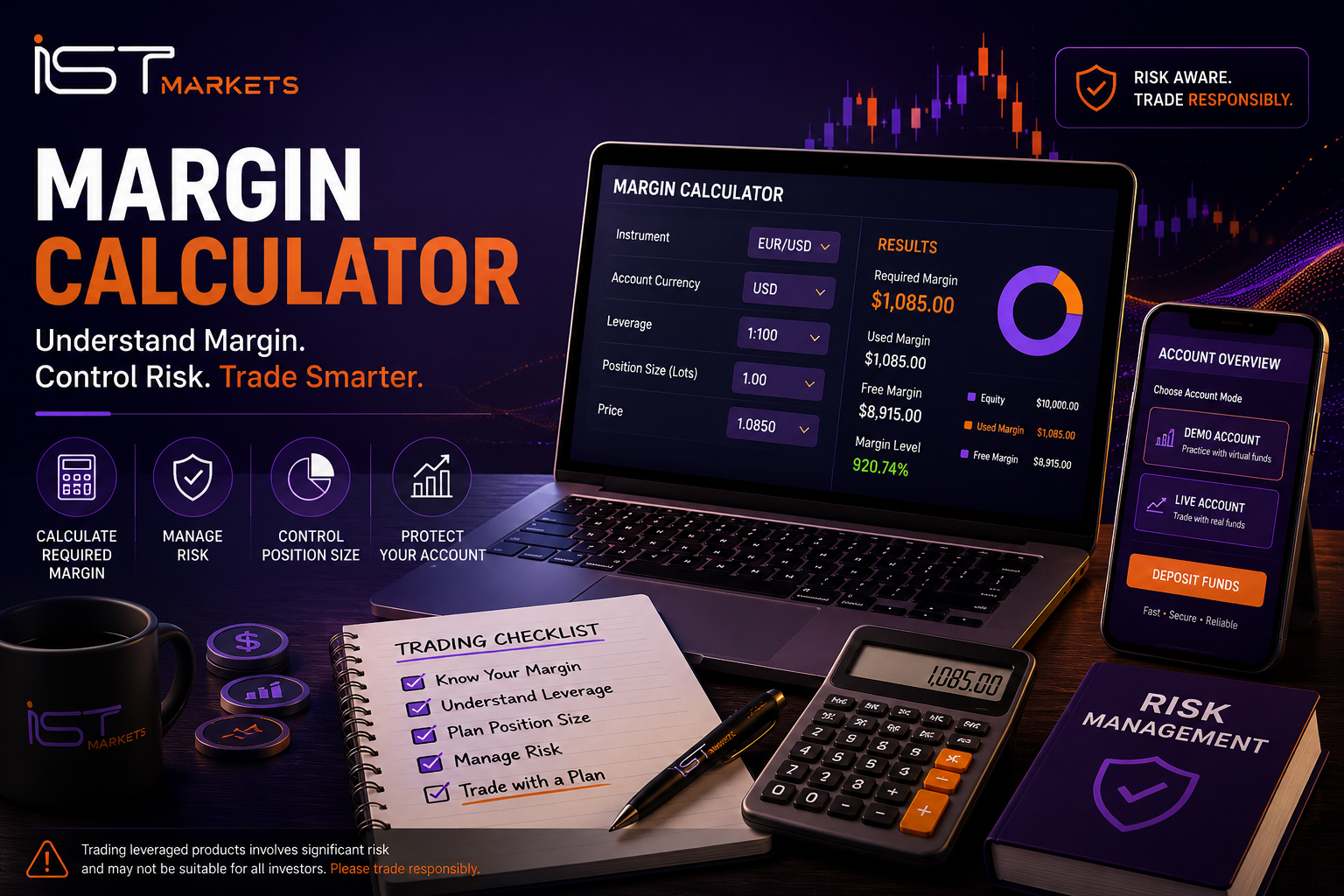
Margin Calculator Explained: How to Calculate Margin and Control Position Size
A practical guide for beginners using leverage — explaining required margin, free margin, used margin, equity, margin level, position size and margin-call risk before opening a trade.
Quick Answer: What does a margin calculator show?
A margin calculator estimates how much margin may be required to open a leveraged trade based on the instrument, trade size, leverage and account currency. Its real value is not only the required-margin number. It helps traders check whether the position size is too large, how much free margin may remain, and whether the account could become vulnerable to margin-call or stop-out pressure if the market moves against the position.
Risk reminder before reading
Source Snapshot
This guide is designed to support the IST Markets margin calculator workflow after launch. It connects margin calculation with leverage education, position-size control and risk disclosure. External references include investor-protection and risk materials from CFTC, FCA, ESMA and reputable trading-education sources.
Content Table
Margin is collateral, not maximum loss.2What the calculator does not tell you
Calculator output is not trade permission.3How to calculate margin
Required margin, free margin and margin level.
4How leverage affects margin
Lower margin does not mean lower risk.
5Forex margin calculator example
A numeric EUR/USD scenario.
6Margin call vs stop out
What beginners often confuse.
7Position size vs entry timing
Why size can matter more than being early.
What is margin in trading?
Margin in trading is the amount of money required to open and maintain a leveraged position. A beginner should think of it as required collateral. It is not usually a trading fee, and it is not the maximum amount the trader can lose.
This distinction matters because many beginners look at margin the wrong way. They may see that a trade only requires a small amount of margin and assume the trade itself is small. In reality, the position may create much larger market exposure than the margin figure suggests.
That is the purpose and danger of leverage. Leverage allows a trader to control a larger position with less upfront capital. But gains and losses are still connected to the larger position size, not only to the margin amount shown at entry.
Beginner translation
A margin calculator helps because it makes the hidden exposure more visible. Instead of asking only “Can I open this trade?”, a better trader asks: “If I open this trade, how much margin will be used, how much free margin will remain, and what happens if the market moves against me?”
| Term | Simple meaning | Why it matters |
|---|---|---|
| Required margin | The margin needed to open a position. | It shows how much of your equity may be set aside to support the trade. |
| Used margin | The total margin committed to all open positions. | High used margin can reduce flexibility if the market moves against you. |
| Free margin | Equity minus used margin. | It shows the account room remaining after open positions are considered. |
| Equity | Balance plus or minus floating profit or loss. | Falling equity can move the account toward margin stress. |
| Margin level | Equity divided by used margin, usually shown as a percentage. | It can help indicate how stressed the account is becoming. |
What a margin calculator does not tell you
This is the most important idea in the article: a margin calculator answers a technical question, not a full trading decision.
The technical question is: “How much margin may be required to open this trade?” The risk question is different: “Should I use this much exposure at all?”
Many beginners stop after the first answer. They see that the platform may allow the trade and treat that as permission. A more disciplined trader goes further. They compare required margin with equity, free margin, stop-loss distance, possible slippage, existing open trades and market conditions.
Decision rule
This is why a margin calculator should slow the trader down before the trade, not make the trade feel easier to open. A large position can look comfortable when the required margin is small, but the account may still react aggressively to normal price movement.
How to calculate margin, free margin and margin level
A margin calculator does the calculation for you, but understanding the basic formulas helps you avoid blind trust in a number. Exact platform calculations can vary by product, account currency, contract specification and provider rules, but the simplified logic is useful for learning.
| Formula | What it helps you understand |
|---|---|
| Notional Value = Trade Size × Market Price | The real market exposure behind the position. |
| Required Margin = Notional Value ÷ Leverage | The approximate margin needed to open the trade. |
| Free Margin = Equity − Used Margin | How much room remains after open positions are considered. |
| Margin Level = (Equity ÷ Used Margin) × 100 | How stressed the account may be relative to margin already used. |
The formula that many beginners miss is free margin. Required margin shows what is needed to open the position. Free margin shows what remains after the position is open. That remaining room can matter more than the entry itself when the market becomes volatile.
Practical interpretation
How does leverage affect margin?
Leverage changes how much required margin is needed for the same trade size. Higher leverage lowers the margin required to open a position, but it does not reduce the market risk of that position.
This is where beginners often get trapped. A higher leverage setting can make a large position look affordable because the required margin is smaller. But the account is still exposed to the movement of the full position size.
Leverage vs required margin example
The table below uses a hypothetical $10,000 notional position. Actual margin requirements can vary by instrument, account type, entity, jurisdiction and market conditions.
| Leverage | Approx. required margin on $10,000 notional | Beginner interpretation |
|---|---|---|
| 1:30 | About $333.33 | More margin is required, which may naturally limit over-sizing. |
| 1:50 | About $200 | The same exposure uses less margin, but risk still depends on trade size. |
| 1:100 | About $100 | The lower margin requirement can create a false feeling of comfort. |
| 1:200 | About $50 | The trade may look easier to open, but exposure remains large. |
Key point
Forex margin calculator example: EUR/USD trade
Imagine a beginner has a $1,000 trading account and wants to check a possible EUR/USD trade before entering. The goal is not to predict whether EUR/USD will rise or fall. The goal is to decide whether the position size is reasonable for the account.
Assume the following example:
- Account equity: $1,000
- Instrument: EUR/USD
- EUR/USD price: 1.1000
- Account leverage: 1:100
- No other open positions in this simplified example
Three position sizes, same account
| Position size | Approx. notional value | Approx. required margin at 1:100 | Approx. free margin before loss | Risk signal |
|---|---|---|---|---|
| 0.05 lot | About $5,500 | About $55 | About $945 | More flexible, but still requires risk planning. |
| 0.20 lot | About $22,000 | About $220 | About $780 | Needs a clear stop, controlled loss and strong discipline. |
| 0.50 lot | About $55,000 | About $550 | About $450 | High pressure for many beginners; small moves can feel emotionally large. |
This table shows why position size can matter more than entry timing. The same account, instrument and leverage can create very different pressure depending on trade size. A beginner may spend one hour trying to improve the entry by a few pips, while ignoring that the position size is already too aggressive for the account.
What happens if equity falls?
Using the 0.20 lot example, the approximate required margin is $220. If the account starts with $1,000 equity, free margin may be around $780 before any floating loss. If the trade later shows an open loss of $500, equity may fall to about $500. Used margin may still be around $220, so margin level may fall to roughly 227%.
If the open loss grows further, equity and free margin can fall quickly. Whether a margin call, restriction or stop out occurs depends on the broker, entity, account type, product and applicable rules. The practical lesson is simple: a position that looked manageable at entry can become dangerous when equity drops.
The real calculator question
Do not only ask: “What margin is required?” Ask: “How much room will I still have if the trade goes wrong?” That second question is where risk control begins.
Margin call vs stop out: what is the difference?
A margin call generally means the account has become stressed because equity has fallen too low relative to the margin used by open positions. Depending on account rules, it may result in a warning, restrictions on opening new trades, or a need to reduce exposure.
A stop out is usually more serious. It refers to a level where positions may be closed automatically according to provider rules. The exact process and threshold can differ by broker, entity, product and jurisdiction.
| Concept | Simple meaning | Risk takeaway |
|---|---|---|
| Margin call | A warning or restriction when equity becomes too low relative to used margin. | The account is already under pressure. Do not treat it as a normal trading condition. |
| Stop out | Automatic closing of positions under account rules when margin level becomes too low. | The platform may act before the trader chooses to close manually. |
| Negative balance protection | A protection available in some regulatory settings or entities. | It should not be used as a reason to oversize trades or ignore risk. |
Important warning
Why position size matters more than a perfect entry
Beginners often obsess over entry timing because it feels like the most important part of trading. A better entry can help, but it cannot fix an oversized position. If the position size is too large, normal market movement can feel like a crisis.
A good entry with too much size can still damage the account. A slightly imperfect entry with controlled size may be easier to manage. This is why a margin calculator belongs before the trade, not after the trader has already decided the setup is attractive.
The calculator helps shift the trader from chart excitement to account reality. It forces a better question: “Can my account survive this trade if I am wrong?”
That question is more useful than asking whether the entry is perfect. Markets can reverse, spreads can widen, news can surprise traders and stops may slip during fast conditions. Position size is one of the few variables a trader can control before the trade begins.
Common margin mistakes beginners make
Most margin mistakes happen because beginners read the margin calculator as a green light instead of a risk check. The tool is useful, but only if the trader asks the right follow-up questions.
| Mistake | Why it is dangerous | Better approach |
|---|---|---|
| Thinking margin is a fee | The trader ignores the larger exposure behind the trade. | Treat margin as collateral required to support leveraged exposure. |
| Choosing size from maximum leverage | The trade may look affordable even when account pressure is too high. | Choose position size from risk tolerance and stop distance. |
| Ignoring free margin | The account may have little room for normal volatility. | Check free margin after the trade, not only required margin before the trade. |
| Adding trades after losses | Used margin can rise while equity is already falling. | Pause and recalculate total exposure before adding positions. |
| Forgetting spreads and slippage | Fast markets can widen costs and affect exits. | Use calculator output as preparation, not as a guarantee. |
| Treating margin level as a safety promise | Margin level can change quickly as equity changes. | Monitor equity, used margin, free margin and open risk together. |
Margin risk checklist before opening a leveraged trade
Use this checklist before opening a leveraged trade. It turns the margin calculator from a basic number tool into a practical risk-management process.
| Check | Question to answer | If unclear |
|---|---|---|
| Instrument | What market am I trading and what margin rules apply? | Check product specifications before entering. |
| Position size | How large is the trade in notional value? | Reduce size until exposure is clear. |
| Leverage | How much leverage is being applied? | Review the leverage guide before trading live. |
| Required margin | How much margin will be used? | Do not open the trade until you understand the calculation. |
| Free margin | How much room remains after entry? | Reduce size or skip the trade if room is too narrow. |
| Loss scenario | What happens to equity if the trade moves against me? | Run a smaller scenario before entering. |
| Margin call rules | What warning or stop-out levels apply to my account? | Read account terms and risk disclosure first. |
Calculation assumptions and limitations
The examples in this article are educational and simplified. They are designed to explain margin logic, not to reproduce every live platform calculation. Real margin calculations may differ depending on the instrument, account type, contract specification, account currency, entity, jurisdiction, market price, trading session and provider rules.
The examples also do not guarantee execution quality or trading outcomes. Spreads, commissions, swaps, slippage, gaps and volatility can all affect live results. A calculator can support preparation, but it cannot remove trading risk.
Risk reminder before the CTA
A margin calculator can improve preparation, but it cannot make a leveraged trade safe. Calculator outputs are based on inputs and assumptions. Real trading may involve changing prices, changing spreads, slippage, gaps, platform conditions, account rules, swaps, commissions and volatility.
Before using live funds, read the risk disclosure, understand your account terms and confirm the margin rules that apply to your product and entity. If you cannot explain the required margin, free margin, stop-loss risk and margin-call scenario before entering, the trade is not ready.
Soft CTA: Use the Margin Calculator after launch
When the IST Markets margin calculator is available, use it before opening a leveraged trade. Check required margin, free margin and position-size impact before focusing on entry timing.
You can also review the leverage guide and risk disclosure before trading with live funds.
FAQ
What does a margin calculator show?
A margin calculator estimates the required margin for a trade based on the instrument, trade size, leverage and account currency. It can also help traders review used margin, free margin and whether a position size may be too large for their account.
How do I calculate margin for forex trading?
A simplified formula is: required margin equals notional trade value divided by leverage. If the account currency is different from the instrument’s currency, conversion may be needed. Actual platform calculations can vary by product, account type and market conditions.
Is margin the maximum I can lose?
No. Margin is not the maximum loss. It is the amount required to support a leveraged position. Losses depend on position size, market movement, spread, slippage, stop execution, account rules and other trading conditions.
How does leverage affect margin?
Higher leverage lowers the required margin for the same position size. However, it does not reduce market risk. Lower required margin can make it easier to open larger positions, which may increase the risk of margin stress if the trade moves against the account.
What is a margin call?
A margin call generally happens when account equity falls too low relative to the margin required for open positions. Depending on account rules, the trader may receive a warning, be restricted from opening new positions, or face automatic position closures.
What causes a margin call in forex?
A margin call can be caused by falling equity, oversized positions, high used margin, adverse price movement, widening spreads, slippage or adding too many trades. The exact trigger depends on the broker, entity, account type and margin rules.
How can I reduce margin-call risk?
You cannot remove trading risk, but you can reduce margin-call risk by using smaller position sizes, avoiding excessive leverage, monitoring free margin, using planned stop losses, avoiding overtrading and checking margin requirements before opening a trade.