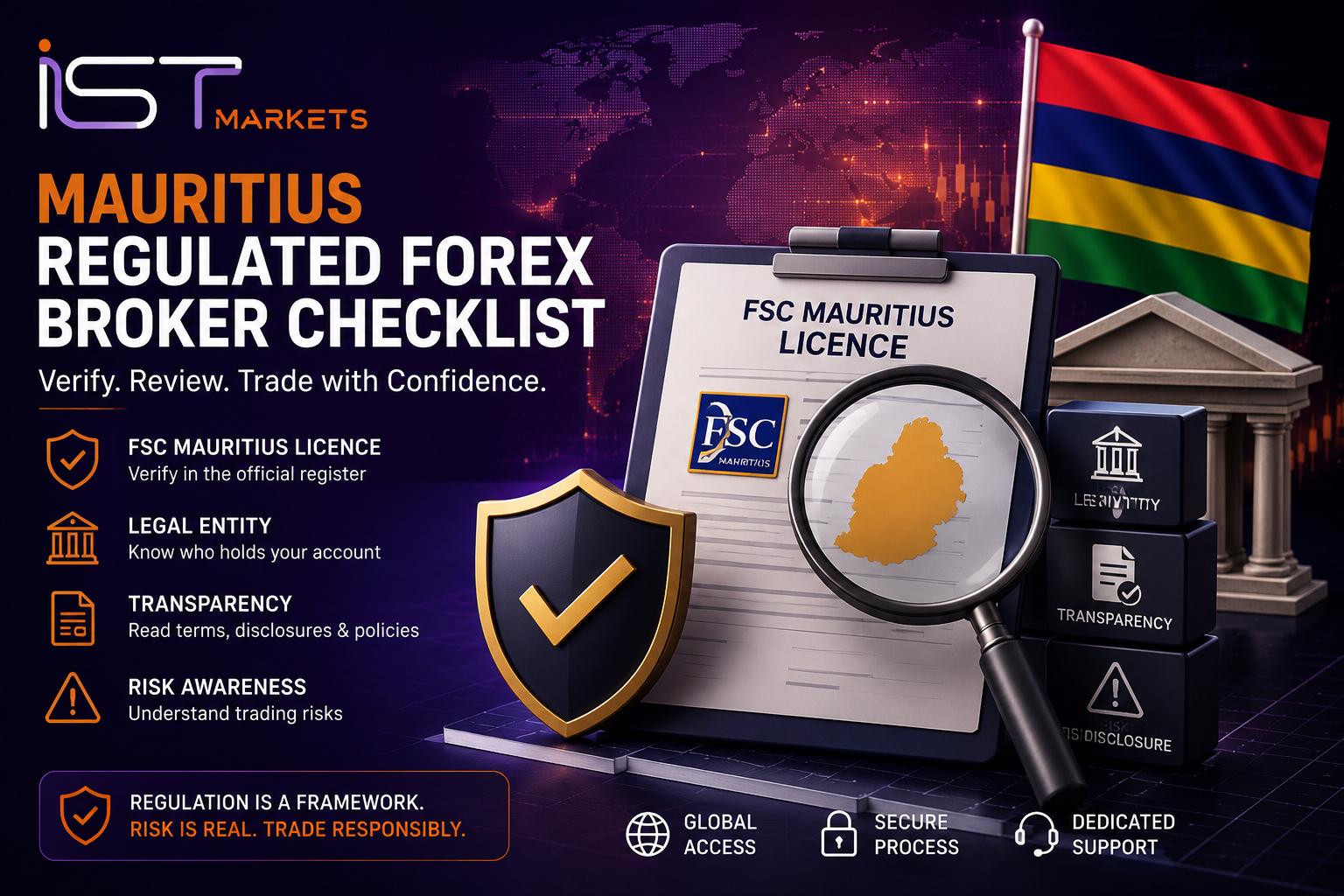
How to Check a Mauritius Regulated Forex Broker: FSC Licence, Entity and Risk Checklist
A practical due-diligence guide for international traders reviewing Mauritius-regulated forex brokers, FSC licence claims, legal entities, account terms, client-fund disclosures and trading-risk limits before funding a live account.
Quick Answer: How do you check a Mauritius regulated forex broker?
To check a Mauritius regulated forex broker, verify the exact legal entity, FSC Mauritius licence number, regulator register listing, registered address, account-opening documents, risk disclosure, terms and conditions, client-fund information and regional restrictions. Traders should not rely only on a website footer, regulator logo or the phrase “licensed broker.” Regulation can support oversight and transparency, but it does not remove forex trading risk, guarantee profits or make every account condition suitable for every trader.
This guide is written as an educational verification framework, not as a licensing promotion. Traders should verify the legal entity, licence number, regulator register, legal documents and risk disclosures before opening or funding a live trading account.
This guide uses official FSC Mauritius materials, IST Markets legal documents, IST Markets risk disclosure and practical broker-verification logic. The goal is to help traders review regulation, jurisdiction and transparency through documents and verifiable information, not marketing language.
Content Table
1What FSC regulation means
Licensing, supervision and transparency.
2What regulation can and cannot do
Why a licence is not a risk guarantee.
3Claim vs verified licence
How to separate wording from evidence.
4FSC licence verification steps
A register-first workflow.
5Entity, jurisdiction and terms
Why all three matter.
6Client funds and disclosures
What to read before funding.
What does FSC Mauritius regulation mean for forex brokers?
A Mauritius regulated forex broker usually refers to a broker or trading entity licensed by the Financial Services Commission, Mauritius, commonly known as FSC Mauritius. For international traders, this matters because a regulatory claim should connect to a real legal entity, a licence category, a licence number, a registered address and a clear set of legal documents.
FSC Mauritius is the integrated regulator for the non-bank financial services sector and global business in Mauritius. Its role includes licensing, regulation, supervision, enforcement of compliance requirements, investor protection, consumer education and measures against financial fraud and money laundering. That makes the regulator relevant when a broker claims to be licensed in Mauritius.
However, the key question is not only “Is the broker regulated?” The more useful question is: “Which legal entity will hold my account, what licence does that entity hold, which jurisdiction applies to me, and what documents govern my trading relationship?”
This is especially important because trading brands may operate across more than one legal entity. A trader should not assume that the brand name alone tells the full regulatory story. The account-opening flow, client agreement and legal document set are what normally identify the entity the trader is contracting with.
Mauritius regulation: what it can and cannot guarantee
Regulation can support credibility, but it should not be misunderstood. A licence can indicate that a broker entity operates within a regulatory framework. It can support supervision, disclosure, compliance expectations and enforcement mechanisms. It does not make forex or CFD trading safe, predictable or profitable.
A regulated broker can still offer products that involve leverage, margin, volatility, spread movement, execution risk, counterparty risk and the possibility of losses. A licence applies to the legal entity; market risk still belongs to the trading activity.
| Regulation can support | Regulation does not guarantee | What the trader should still check |
|---|---|---|
| A licensing and supervisory framework. | That trading will be profitable. | Risk disclosure, leverage, margin and suitability. |
| A clearer legal entity and regulator. | That every region has the same terms or protections. | Applicable entity, client location and document set. |
| A framework for compliance and disclosure. | That spreads, slippage or market gaps cannot affect execution. | Order execution policy, terms and product conditions. |
| Supervisory and enforcement tools. | That no operational, counterparty or trading risk exists. | Counterparty risk, complaints process and client-fund disclosure. |
Licence claim vs verified licence: what traders should compare
A serious trader should separate marketing wording from verifiable information. The phrase “regulated broker” is not enough by itself. The evidence should be specific, consistent and easy to check.
| Website statement | Why it is not enough alone | Stronger verification evidence |
|---|---|---|
| “Regulated in Mauritius” | It may be only a general footer statement. | Legal entity, FSC licence number and official register match. |
| “Licensed forex broker” | It may not show the exact licence category. | Licence category, regulator name and applicable document set. |
| “Client funds are protected” | It may be too broad without limitations. | Written client-fund policy, limitations and applicable entity. |
| “Transparent trading conditions” | It may be general marketing language. | Fees, order execution policy, margin rules, swaps and risk disclosure. |
| “International broker” | It does not explain which entity applies to the trader. | The exact legal entity that will hold the account and the trader’s regional eligibility. |
The more precise the information, the easier it is for a trader to verify it. Clear entity details, licence information and document access are part of the trust assessment.
How to verify an FSC Mauritius licence step by step
The strongest way to check a Mauritius regulated forex broker is to start with the official regulator register and then compare what you find with the broker’s own legal documents.
Platform comparison should come after entity, licence and document verification. A clean interface does not replace regulatory due diligence.
| Step | What to do | Why it matters |
|---|---|---|
| 1. Identify the legal entity | Find the company name shown in the legal documents and account-opening process. | The brand name may not be the contracting entity. |
| 2. Find the licence number | Look for the FSC licence number and licence category where available. | A precise claim is easier to verify than a generic “regulated” statement. |
| 3. Use the FSC register | Search the official FSC Mauritius Register of Licensees. | The regulator register is stronger evidence than a website badge. |
| 4. Compare details | Compare entity name, licence number, address and status with the broker’s documents. | Mismatched details should be clarified before funding. |
| 5. Read the document set | Review terms, risk disclosure, execution policy, AML/KYC, complaints and client-fund documents. | These documents define practical account conditions and risks. |
| 6. Confirm regional eligibility | Check whether your country is accepted and whether restrictions apply. | International access can differ by client location and entity. |
Legal entity, jurisdiction and account terms: why all three matter
Many traders think regulation is one simple question. In practice, it has several layers. The brand is what you recognise. The legal entity is the company you may contract with. The regulator is the authority that licenses or supervises that entity. The account terms define how your trading relationship works. Your own country may affect whether services are available to you.
| Layer | What it means | What to verify |
|---|---|---|
| Brand | The trading name visible to users. | Do not rely on brand name alone. |
| Legal entity | The company that holds your account agreement. | Company name, registration number and address. |
| Regulator | The authority licensing or supervising the entity. | Regulator name, licence number and official register listing. |
| Account terms | The legal rules governing trading, fees, orders and responsibilities. | Terms, risk disclosure, execution policy and funding conditions. |
| Client location | Your country or jurisdiction. | Availability, restrictions and applicable documents. |
For IST Markets, the legal documents page explains that the documents applying to a client depend on the entity the client registers with, and that the applicable entity and document set are made clear during the application process. This type of entity-level distinction is important for international traders before funding an account.
Client funds, risk disclosure and trading conditions
Client-fund language should be reviewed carefully. Traders should not assume protections that are not written in the relevant policy or legal documents. Look for clear explanations about how client funds are handled, which entity is responsible, what limitations apply, and what the trader should understand before depositing.
The same applies to risk disclosure. A serious regulated broker should make risk documents easy to find before account funding. These should explain leveraged trading risk, margin calls, OTC/CFD risk, counterparty risk, order execution limitations, electronic trading risk, weekend gaps and market conditions that may affect pricing or execution.
IST Markets’ risk disclosure explains that trading leveraged products involves significant risk, that a small market movement can have a proportionately larger impact on funds, and that a client may lose initial margin and additional funds deposited to maintain a position. It also discusses OTC/off-exchange transactions and counterparty risk. These are central risk considerations for live trading.
Practical scenario: checking a licence claim before depositing
Imagine an international trader sees a broker website that says “regulated in Mauritius.” A light review may stop at the footer. A stronger review begins with the legal entity.
The trader opens the broker’s legal documents and finds the company name, registered address, regulator and licence number. Then the trader searches the official FSC Mauritius Register of Licensees using the legal entity name, not only the trading brand. If the register information is consistent with the website and documents, the trader moves to the next step.
Next, the trader reads the risk disclosure, terms and conditions, order execution policy, complaints procedure and client-fund information. They check whether their country is accepted, whether regional restrictions apply, which account type they are considering, and whether they understand margin, leverage, spreads, swaps, slippage and withdrawal conditions.
At the end of the process, the trader may still decide to wait. That can be a responsible outcome. Good due diligence should make it easier to pause when something is unclear.
Common mistakes international traders make
The biggest mistake is treating regulation as a shortcut. A licence can be important, but it is not a substitute for reading the documents and understanding the trading conditions.
| Mistake | Why it is risky | Better approach |
|---|---|---|
| Checking only the broker brand name | The account may be held under a specific legal entity. | Verify the exact company name in the legal documents and onboarding flow. |
| Assuming regulation removes trading risk | Leverage, margin, volatility and execution risks still exist. | Read the risk disclosure and trade only if the risks are understood. |
| Not reading account terms | Fees, margin rules, order handling and restrictions may be defined there. | Review terms and conditions before funding a live account. |
| Ignoring regional differences | Different countries may receive different services, restrictions or document sets. | Confirm the applicable entity and eligibility for your country. |
| Trusting screenshots or social posts | Screenshots, testimonials and influencer claims can be incomplete or misleading. | Use official registers, legal documents and written disclosures. |
Red flags when reviewing offshore forex broker regulation
Offshore forex broker regulation is not automatically good or bad. The practical question is whether the broker is transparent, verifiable and clear about the limits of regulation. The warning signs below should encourage a trader to slow down before opening or funding a live account.
- The website claims regulation but does not show the legal entity or licence number.
- The regulator logo appears without a clear register link or document set.
- The licence number does not match the legal entity name.
- The broker uses the brand name everywhere but makes the contracting entity difficult to identify.
- Risk disclosure is missing, vague, hard to access or written like a sales page.
- The broker promotes guaranteed returns, low-risk trading or fixed income from forex.
- Account terms, fees, swaps, margin rules, withdrawal rules or client-fund information are unclear.
- A representative encourages funding before the trader has reviewed legal and risk documents.
- Demo performance, AI tools, calculators or signals are presented as proof of future live results.
Questions to ask before opening a forex account
Before opening an account with any Mauritius regulated forex broker, international traders should ask questions that connect the regulatory claim to practical account conditions.
| Question | Why it matters | Where to check |
|---|---|---|
| Which legal entity will hold my account? | Different entities may mean different terms or restrictions. | Onboarding documents, legal documents and client portal. |
| What licence does the entity hold? | The licence should match the exact legal entity, not only the brand. | Broker regulation page and FSC register. |
| What documents govern the account? | Terms, risk disclosure and execution policies define practical obligations. | Legal documents page and client agreement. |
| How are client funds described? | Fund handling should be transparent and not assumed from marketing copy. | Client-fund policy or official disclosure. |
| What are the trading risks? | Leverage, margin, slippage and OTC risks can affect results. | Risk disclosure, terms and execution policy. |
| Are there regional restrictions? | Services may not be available in certain countries. | Website footer, legal documents and account-opening process. |
Mauritius regulated forex broker checklist
Use this checklist before opening or funding a live account with a Mauritius regulated forex broker. The goal is not to make the trader suspicious of every broker. The goal is to make trust evidence-based.
| Verification step | What to confirm | Decision signal |
|---|---|---|
| Legal entity | Exact company name used in the account agreement. | Proceed only when the entity is clear. |
| Regulator | FSC Mauritius or another named authority. | Do not rely only on a logo or footer phrase. |
| Licence number | Licence number and licence category where available. | Compare it with the official regulator register. |
| Registered address | Address stated in legal documents and regulatory information. | It should match the entity being reviewed. |
| Risk disclosure | Leverage, margin, OTC/CFD, volatility and execution risks. | Do not trade live until the risks are understood. |
| Terms and conditions | Order rules, margin, fees, market gaps, responsibilities and definitions. | Clarify unclear terms before funding. |
| Client-fund information | How client funds are described and what limitations apply. | Do not assume protections not written in official documents. |
| Complaint process | How complaints are handled and escalated. | A serious broker should make this easy to find. |
| Regional restrictions | Countries or jurisdictions where services are restricted. | Confirm that the service is available in your country. |
If something does not match, what should a trader do?
If the entity name, licence number, registered address or document set does not match, pause the process before funding. Request written clarification from the broker, re-check the official register, review the complaints procedure, and keep records of the information you reviewed.
A mismatch does not always indicate misconduct. It may reflect an outdated page, a regional entity difference or a document-version issue. Even so, it should be clarified before live funds are involved.
Risk reminder before the CTA
A Mauritius forex licence can support credibility, but it does not replace personal due diligence. Trading forex and CFDs on margin involves risk. A trader can lose money even when using a licensed broker, especially if leverage, position size, volatility, execution risk and market gaps are not understood.
Before funding a live account, read the legal documents, confirm the applicable entity, review the risk disclosure and understand the account conditions. If any legal, regulatory, funding or risk information is unclear, ask for clarification before depositing.
Soft CTA: Verify before funding a live account
Before trading live, review the IST Markets legal documents, confirm which entity applies to your account, and check the relevant regulatory and risk information.
You can also read the risk disclosure and compare account types before deciding whether a live account is appropriate for you.
FAQ
How do I check a Mauritius regulated forex broker?
Check the broker’s legal entity, FSC Mauritius licence number, regulator name, registered address, account terms, risk disclosure and client-fund information. Then compare the entity and licence details with the official FSC Mauritius Register of Licensees.
How do I verify an FSC Mauritius licence?
Start with the legal entity name, not only the trading brand. Search the official FSC Mauritius Register of Licensees, compare the licence number and company name with the broker’s legal documents, and confirm that the same entity appears in your account-opening documents.
What does FSC Mauritius regulation mean?
FSC Mauritius regulation means the licensed entity operates within a Mauritius regulatory framework for non-bank financial services and global business. It can involve licensing, supervision, compliance expectations and enforcement. Traders should still verify the exact entity, licence category and documents that apply to their account.
Is a Mauritius regulated forex broker safe?
Regulation can support oversight and transparency, but it does not make forex trading safe or risk-free. Traders still face leverage risk, margin calls, market volatility, slippage, execution limitations and possible losses.
Does regulation remove forex trading risk?
No. Regulation does not remove forex trading risk or guarantee profits. It may provide a framework for oversight and disclosure, but trading outcomes still depend on market conditions, leverage, position size, execution and the trader’s decisions.
What is the difference between a broker brand and a legal entity?
The broker brand is the trading name customers recognise. The legal entity is the company that may hold your account agreement. A brand may operate through more than one entity, so traders should verify which entity applies to their account.
What should I read before opening a live forex account?
Read the legal documents, terms and conditions, risk disclosure, order execution policy, AML/KYC policy, complaints procedure, fees, account conditions, client-fund information and regional restrictions before funding a live account.
References & Further Reading