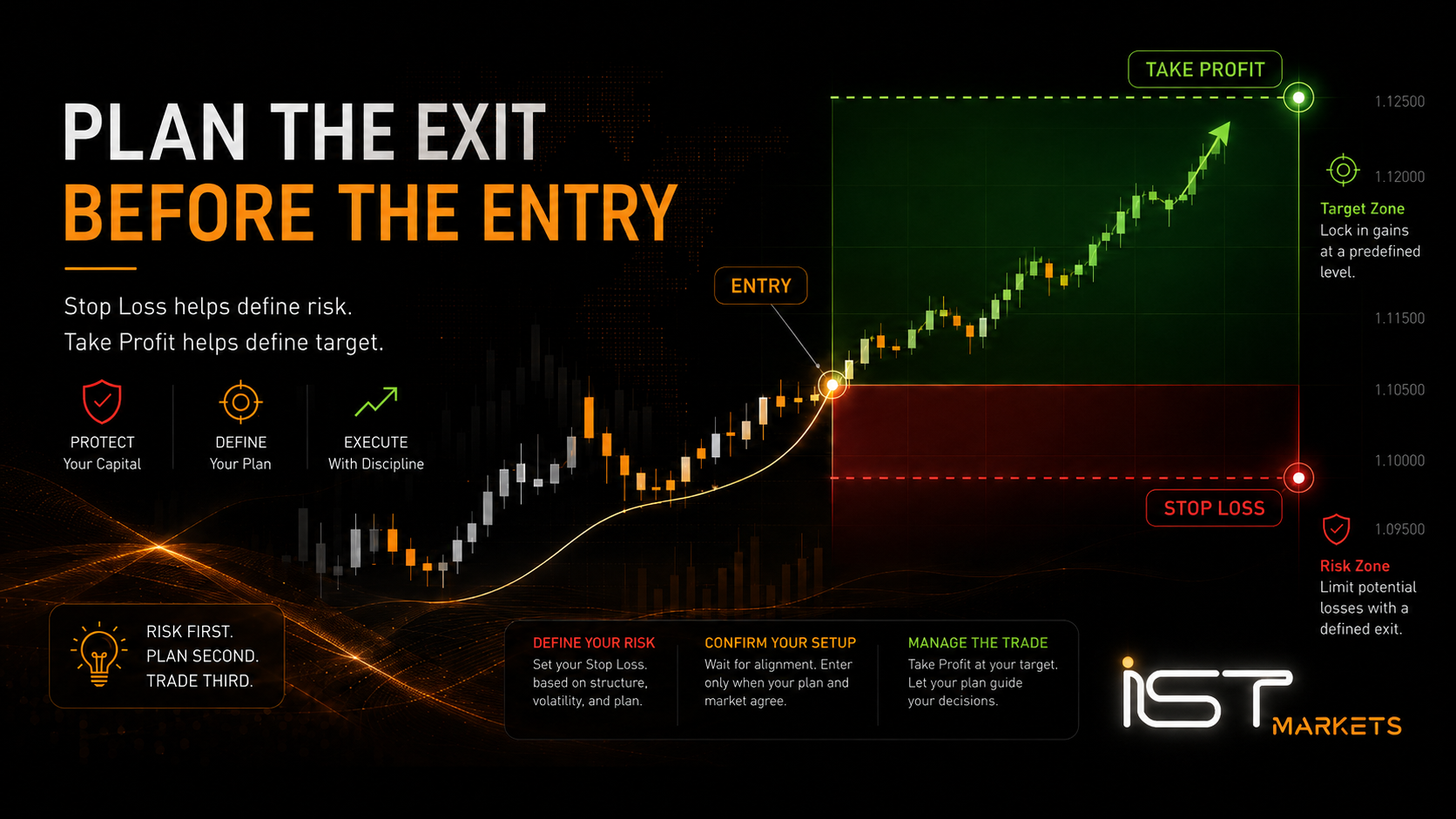
Stop Loss and Take Profit Explained: Practical Risk Tools for New Traders
A practical beginner guide to planning exits before entering a trade — without treating stop loss or take profit orders as guaranteed outcomes.
Quick Answer: What is stop loss and take profit?
Stop loss and take profit are order tools traders use to plan exits before or after opening a trade. A stop loss is designed to close a position if price moves against the plan, while a take profit is designed to close a position if price reaches the planned target. They can support discipline and risk planning, but they do not guarantee exact execution. Beginners should also check slippage, volatility, spread, swaps, position size, margin impact, platform rules and account terms before using live funds.
Risk reminder before reading
Editorial Review Note
This guide treats stop loss and take profit as exit-planning tools, not guaranteed outcomes. The goal is to help new traders define risk, target and trade invalidation before using live funds.
Source Snapshot
This guide uses IST Markets Risk Disclosure, IST Order Execution Policy, IST trading fees and pip value education, official retail-forex risk context, ESMA investor-protection context for CFDs, and established educational references for stop loss and take profit definitions. Examples are simplified for learning and should be checked against live platform specifications, account terms and product conditions.
No-pressure education promise
What this guide will not do
Content Table
1What SL and TP meanExit planning in real terms.
2Why exits matterPlan the exit before the entry.
3SL vs TP comparisonWhat each tool does.
4Buy vs sell tradesWhere SL/TP usually sit.
5Exit Plan Reality CheckSix checks before trusting SL/TP.
6Numeric exampleEntry, SL, TP and pip value.
7Can vs cannot doUseful, but not guarantees.
8Risk contextSlippage, gaps and volatility.
What stop loss and take profit mean in real trading terms
Stop loss and take profit are exit-planning tools. They help a trader define in advance where a trade should close if the plan is wrong, and where it may close if the planned target is reached.
A stop loss is designed to close a position if price reaches a level that goes against the trade plan. A take profit is designed to close a position if price reaches a planned target. In simple terms, stop loss answers: “Where is this trade wrong?” Take profit answers: “Where is the planned exit if the idea works?”
Core idea
This is the key difference between planning and certainty. SL/TP tools can reduce emotional decision-making, but their value depends on how they are placed, how trade size is selected, what the market is doing, and whether live execution matches the plan.
Why exits matter before funding or trading live
Many new traders focus on the entry first. They ask, “Where should I buy?” or “Where should I sell?” A stronger starting point is: “If I am wrong, where do I exit?” and “If the trade works, where is a reasonable target?”
Planning exits before entry helps reduce emotional decisions. Without a predefined exit plan, a trader may widen the stop loss after price moves against them, close too early because of fear, remove the take profit because of greed, or hold a losing trade because the invalidation point was never clear.
| Without exit planning | With exit planning |
|---|---|
| Risk is discovered after entry. | Risk is estimated before entry. |
| The trader may move exits emotionally. | The trader has a clearer structure to review. |
| Position size may be too large for the stop distance. | Position size can be checked against planned risk. |
| The target may be vague or unrealistic. | The target can be reviewed before live exposure. |
Stop loss vs take profit: comparison table
Stop loss and take profit are often used together, but they answer different questions. New traders should understand both before opening a live trade.
| Tool | Main purpose | Beginner warning |
|---|---|---|
| Stop Loss | Plans an exit if the trade moves against the idea. | It may not fill at the requested price during fast markets, gaps or low liquidity. |
| Take Profit | Plans an exit if price reaches the target area. | It does not guarantee profit if the target is not reached, execution differs, or the trade is closed earlier. |
| Both together | Create a planned range between possible loss and possible target. | They do not replace position sizing, cost checks, margin awareness or risk disclosure review. |
Stop loss and take profit on buy vs sell trades
New traders often understand SL/TP better when they see the direction. A buy trade and sell trade use the same idea, but the levels sit on different sides of the entry.
| Trade type | Stop loss usually sits | Take profit usually sits | Beginner warning |
|---|---|---|---|
| Buy / Long | Below entry. | Above entry. | A stop below entry can still slip in fast markets or gaps. |
| Sell / Short | Above entry. | Below entry. | A target below entry is not guaranteed to be reached. |
The logic is simple: in a buy trade, the trader usually wants price to rise; in a sell trade, the trader usually wants price to fall. But execution, spread, slippage and volatility still matter in both directions.
The Exit Plan Reality Check
Before trusting a stop loss and take profit setup, use this six-part check. It helps separate a planned exit from a weak guess on the chart.
| Check | Question to ask | Why it matters |
|---|---|---|
| Invalidation Check | Does the stop loss show where the trade idea is wrong? | A random stop may be hit by normal volatility. |
| Target Check | Is the take profit based on a realistic target area? | A far target can look attractive but may be difficult to reach. |
| Volatility Check | Could normal movement trigger the stop too early? | Tight stops can fail even when the broader idea is not invalidated. |
| Cost Check | Have spread, swaps, commissions and slippage been considered? | Costs can change the practical result of an exit plan. |
| Size Check | Does the position size fit the stop distance and account equity? | A stop loss does not help much if the trade size is too large. |
| Execution Check | Could fast markets, gaps or platform conditions affect execution? | Orders support planning, but execution may differ from the requested level. |
Practical example: entry, stop loss, take profit and money risk
A simple example can show why SL/TP must connect with pip value and position size.
| Input | Example |
|---|---|
| Entry | 1.1000 |
| Stop Loss | 1.0950 |
| Take Profit | 1.1100 |
| Planned risk | 50 pips before costs |
| Planned reward | 100 pips before costs |
| Risk-reward ratio | 1:2 before costs and execution differences |
This does not mean the trade is good. It only means the planned reward is twice the planned risk before costs and execution differences. The trader still needs to ask whether the stop is logical, whether the target is realistic, and how much account money is exposed.
| Same stop distance | Pip value | Planned risk before costs |
|---|---|---|
| 50 pips | $1 per pip | $50 |
| 50 pips | $5 per pip | $250 |
| 50 pips | $10 per pip | $500 |
Key lesson
What stop loss and take profit can and cannot do
The clearest way to understand SL/TP is to separate discipline from certainty. They can support a disciplined plan, but they cannot guarantee the market outcome.
| SL/TP can help with | SL/TP cannot guarantee |
|---|---|
| Planning exits before entry. | Exact execution price. |
| Reducing emotional decisions. | No slippage. |
| Defining planned risk and target. | No gaps or sudden volatility. |
| Building a repeatable routine. | Profit, safety or suitability for every trader. |
Key mechanics, costs, risks and limitations
Stop loss and take profit settings are usually visible on a trading platform, but the final result depends on more than the numbers entered into the order window. Spread, slippage, swaps, commissions, liquidity, volatility and margin conditions can all affect the real trading outcome.
| Situation | What can happen |
|---|---|
| Fast news move | A stop may fill worse than expected, or spreads may widen. |
| Weekend or session gap | Price may reopen beyond the planned stop level. |
| Low liquidity | Execution quality and spreads may change. |
| Very tight stop | Normal market noise may trigger the exit early. |
| Distant take profit | The target may look attractive but remain unrealistic. |
| Manual changes after entry | The trader may break the original plan because of fear or greed. |
Important execution note
Helpful internal learning path
SL/TP are tools, not the strategy
A stop loss can close a weak trade, but it cannot make the weak trade good. A take profit can mark a target, but it cannot make price reach that target. New traders should treat SL/TP as tools inside the plan, not as the plan itself.
| Tool | What it controls | What it does not control |
|---|---|---|
| Stop Loss | Planned exit if trade fails. | Whether the setup is valid. |
| Take Profit | Planned exit if target is reached. | Whether price will reach the target. |
| Platform order | Execution instruction. | Future market behaviour. |
| Calculator | Estimated planning number. | Future performance or exact live execution. |
Beginner scenario: when exits are planned too late
Imagine a new trader sees a chart setup and enters quickly. After entry, the trade moves against them. Only then does the trader ask, “Where should my stop loss be?” The stop is placed far away because the trader does not want the trade to close. The position size was chosen first, so the money risk is now larger than expected.
On another trade, the trader places a take profit far away because the possible reward looks exciting. But the target is not based on market structure, volatility or a clear plan. Price gets close, reverses, and the trader manually removes the target because of emotion.
Weak exit plan vs stronger exit plan
A stop loss or take profit level is only useful when the plan behind it is clear. The goal is not just to place two lines on the chart. The goal is to understand why those levels exist.
| Area | Weak exit plan | Stronger exit planning |
|---|---|---|
| Stop loss | Random pip number or placed only to avoid losing too much. | Based on where the trade idea is invalidated. |
| Take profit | Far target chosen to make the reward look attractive. | Based on structure, volatility, prior levels or strategy logic. |
| Position size | Chosen before the stop distance is known. | Adjusted after stop distance and money risk are checked. |
| Costs | Ignored because the chart looks clean. | Reviewed before the trade becomes live. |
| Practice | Skipped because the trader wants to act quickly. | Practised on demo first, without treating demo as proof of future results. |
Stop loss, take profit, risk-reward and position sizing
Stop loss and take profit are closely connected to risk-reward ratio and position sizing. The stop loss defines the planned risk area. The take profit defines the planned reward area. Position sizing decides how much account money is exposed between entry and stop loss.
Simple planning chain
This is why beginners should not set SL/TP in isolation. A 30-pip stop can be small or large depending on lot size and pip value. A good-looking target can still be weak if the stop is too tight, the position size is too large, or the cost of the trade is ignored.
Common stop loss and take profit mistakes beginners should avoid
| Mistake | Why it is risky | Better approach |
|---|---|---|
| Trading without a stop plan | The trader may hold losses emotionally. | Define the invalidation level before entry. |
| Setting the stop too tight | Normal volatility can trigger the exit early. | Consider whether the stop reflects real invalidation. |
| Setting the stop too wide for the account | Money risk may become too large. | Adjust position size to the stop distance. |
| Moving the stop after entry | The original risk plan breaks down. | Change the plan only for a clear, pre-defined reason. |
| Choosing unrealistic take profit targets | A target can look attractive but rarely get reached. | Base targets on market context and strategy logic. |
| Ignoring spread and slippage | The final result can differ from the planned result. | Review costs and execution conditions before trading live. |
| Treating demo execution as proof | Demo practice does not guarantee future live results. | Use demo to practise the workflow, not to prove performance. |
Stop loss and take profit checklist before taking action
Use this checklist before relying on SL/TP orders in a live trade. If several answers are unclear, the exit plan may need more work before live exposure.
| Readiness question | Ready? | Why it matters |
|---|---|---|
| I know where the trade idea is wrong. | Yes / No | This supports a more logical stop loss. |
| I know why the take profit target is realistic. | Yes / No | Targets should not be chosen only because they look attractive. |
| I know the stop distance in pips or points. | Yes / No | Distance affects position sizing and account risk. |
| I know the money risk using pip value and size. | Yes / No | Pips alone do not show account impact. |
| I checked spread, swaps, commissions and slippage risk. | Yes / No | Costs and execution can change the final result. |
| I reviewed major news or volatility risk. | Yes / No | Fast markets can affect order execution. |
| I practised SL/TP order placement on demo first. | Yes / No | Practice supports workflow discipline, but does not prove live performance. |
What to do after reading this
The next step is not to search for a perfect stop loss or a perfect target. The next step is to practise a repeatable exit-planning process.
- Open a demo platform and choose a practice setup.
- Mark where the trade idea would be wrong.
- Mark a realistic target area.
- Check the stop distance and pip value.
- Adjust position size so the money risk is understood.
- Review spread, slippage, swaps, commissions and news risk.
- Practise placing and reviewing SL/TP before using live funds.
Risk reminder before the CTA
Before using live funds, review the risk disclosure, legal documents, order execution policy, account terms, trading fees and platform conditions. Stop loss and take profit orders can support exit planning, but they cannot guarantee execution, profit, loss limitation, market direction or suitability for every trader.
A responsible trader does not use SL/TP as a safety guarantee. The better approach is to use them as part of a wider plan that includes position sizing, pip value, costs, margin awareness, volatility preparation and discipline.
Soft CTA: Practise your exit plan before using live funds
Before placing live trades, review the IST Markets risk disclosure, check the legal documents, understand the order execution policy, practise through a demo account, and review trading fees and costs.
Practise first. Verify first. Treat stop loss and take profit as exit-planning tools, not guarantees.
Final Takeaway
Stop loss and take profit are useful because they make the exit plan visible before the trade becomes emotional. Their real value comes when they are combined with position sizing, pip value, cost awareness, execution awareness and practice.
FAQ
What is stop loss and take profit in simple terms?
Stop loss and take profit are order tools used to plan exits. A stop loss is designed to close a trade if price moves against the plan, while a take profit is designed to close a trade if price reaches a planned target.
How does stop loss and take profit work for beginners?
A beginner can use stop loss and take profit to define the planned exit before entering a trade. The stop loss helps mark where the trade idea may be wrong, and the take profit helps mark the planned target if the idea works.
Does a stop loss guarantee my maximum loss?
No. A stop loss can help define planned risk, but it does not guarantee exact execution. Fast markets, gaps, low liquidity, slippage and technical conditions may affect the final exit price.
Can take profit guarantee I will make money?
No. A take profit order is designed to close a trade if price reaches a planned target, but it does not guarantee that the target will be reached or that execution will always match the plan.
Should beginners set stop loss and take profit before entering a trade?
Beginners should usually practise defining exits before entry because it supports better planning. However, the exact placement depends on the trade plan, market conditions, position size, platform tools and account terms.
What should I check before using stop loss and take profit?
Check the reason for the stop, the realism of the target, stop distance, pip value, position size, spread, slippage, swaps, commissions, volatility, margin impact, account terms and risk disclosure.
What is the difference between stop loss and stop limit?
A stop loss is commonly used to trigger an exit when price reaches a set level. A stop-limit adds a limit condition, which can control price but may increase the chance that the order is not filled. Beginners should understand their platform’s order rules before using advanced order types.
References & Further Reading
- IST Markets Risk Disclosure
- IST Markets Order Execution Policy
- IST Markets Legal Documents
- IST Markets MT5 for Beginners
- IST Markets Demo Trading Account
- IST Markets Trading Fees and Costs
- IST Markets Pip Value Calculator Explained
- IST Markets First Live Trade Checklist
- BabyPips Forexpedia — Stop Order
- BabyPips Forexpedia — Take Profit
- CFTC — Foreign Currency Trading
- eCFR — 17 CFR § 5.5 Risk Disclosure Statement
- NFA — Forex Regulatory Guide
- ESMA — CFD Product Intervention Obligations