⏱ Temporal Note: This article reflects conditions as of April 2026. Rate expectations change — verify current FOMC guidance and CME FedWatch probabilities before making any trading decisions.
On This Page
TL;DR — Key Takeaways
- The Fed meets 8 times per year — each meeting is a potential volatility event for all USD pairs
- Markets move on expectations, not just the decision — a “priced-in” outcome can produce almost no movement
- The dot plot and press conference often matter more than the rate headline itself
- EUR/USD and USD/JPY are the most directly reactive pairs
- Preparation — not prediction — is the consistent edge around FOMC events
The Federal Reserve is the most watched institution in global financial markets. Its interest rate decisions shape the cost of capital across the world’s largest economy — and because so much of global trade, debt, and investment is denominated in US dollars, those decisions ripple through every major currency pair within seconds of announcement.
This article covers how the Fed’s decision-making process works, why rate decisions move forex markets, which pairs react most and how, and how traders approach FOMC events in practice.
Understanding FOMC Decisions
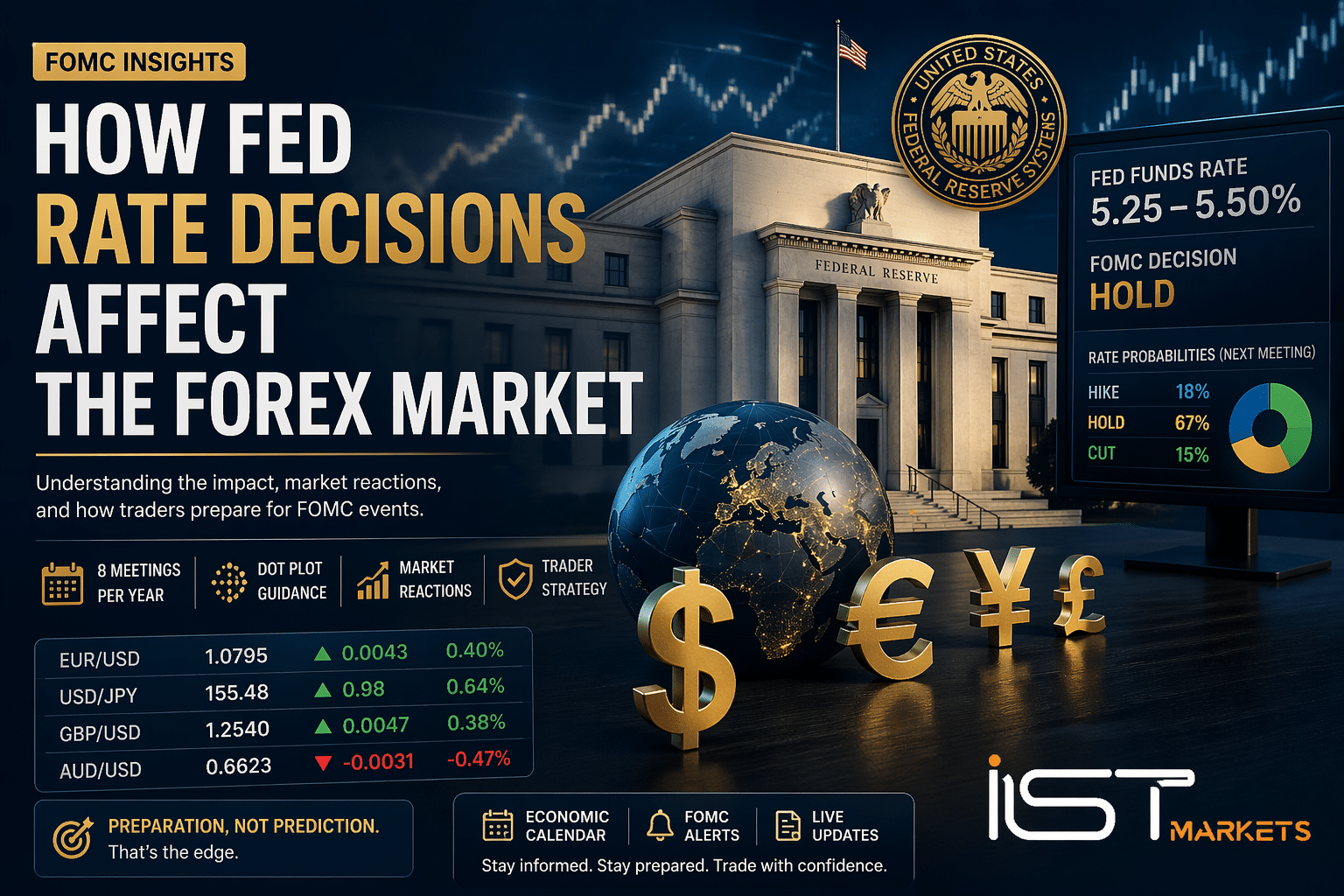
The Federal Open Market Committee (FOMC) meets 8 times per year on a pre-announced schedule. Each meeting produces a policy decision, a written statement, and — at the March, June, September, and December meetings — a dot plot and updated economic projections.
The Three Outcomes
Rate Hike ↑
Signals the economy is running too hot or inflation is too high. Typically in 25bp increments — though 50bp and 75bp hikes have occurred during accelerated cycles. Historically tends to strengthen the dollar.
Rate Cut ↓
Signals growth support or response to economic deterioration. Typically in 25bp increments. Tends to weaken the dollar — though the relationship is not always immediate or linear.
Hold (No Change) →
Impact depends entirely on the accompanying guidance — particularly the statement language and dot plot. A hold with hawkish guidance can strengthen the dollar as much as a small hike.
What Matters Beyond the Headline
| Element | Timing | Why It Moves Markets |
|---|---|---|
| Rate Decision | 2:00 PM ET | Initial algorithmic reaction — often partially reverses |
| Statement | 2:00 PM ET | Word-by-word parsing — single phrase changes can move 50+ pips |
| Dot Plot | 2:00 PM ET (quarterly) | Median dot shift = most market-moving element of quarterly meetings |
| Press Conference | 2:30 PM ET | Q&A can reverse or amplify the initial statement reaction |
Key principle: The forex market does not react to what the Fed does — it reacts to how the outcome differs from what was already priced in. A fully expected decision may produce almost no movement. An unexpected hold, or a dot plot showing fewer future cuts than the market assumed, can move USD pairs 100+ pips in minutes.
How Rate Decisions Move Currency Markets
The Rate Differential Channel
The most direct mechanism: higher US rates make USD-denominated assets more attractive relative to equivalent instruments in other currencies. Capital flows toward yield. When the Fed hikes while the ECB holds, the yield on a 2-year US Treasury rises above the equivalent German Bund yield — attracting European and Asian capital into USD assets and strengthening the dollar.
The Expectations Channel
This is where most of the market movement actually occurs — often weeks before the meeting itself. Markets continuously price in the probability of each outcome via federal funds futures. By the time most FOMC meetings arrive, the decision is 80–95% priced in. This is why the actual announcement can produce less movement than the repricing that precedes it.
The meetings that generate the most volatility are those where the market was wrong about the decision, wrong about the guidance, or surprised by the press conference.
The Risk Sentiment Channel
Aggressive Fed hikes raise the cost of dollar funding globally — tightening financial conditions and reducing appetite for risk assets. This tends to strengthen the dollar broadly, including against commodity-linked currencies like AUD and CAD. Conversely, rate cuts that signal genuine economic concern can trigger risk-off moves that initially strengthen safe-haven currencies (JPY, CHF) even as they weaken the dollar on a rate basis.
Historical Impact Analysis
The 2022–2023 Hiking Cycle
The Fed’s most aggressive tightening cycle since the 1980s — raising rates from near-zero to 5.25–5.50% through 11 hikes during the 2022–2023 tightening cycle — produced sustained dollar strength through most of 2022. EUR/USD fell from approximately 1.14 in January 2022 to a 20-year low near 0.96 by September 2022. USD/JPY rose from approximately 115 to a 32-year high above 150 by October 2022.
The largest single-meeting moves occurred when hike size surprised: the June 2022 75bp hike — the first 75bp move since 1994 — produced the largest single-day dollar move of the cycle.
The “Higher for Longer” Phase (2023–2024)
Once hiking stopped, the key driver shifted from hike size to the expected timeline for cuts. Meetings where the dot plot or press conference pushed back against early cut expectations strengthened the dollar; meetings where the Chair signalled more openness to cuts weakened it — even with no change in the actual rate. The rate held constant for over a year, yet USD pairs moved significantly at every meeting based on guidance alone.
The Early Cutting Phase (Beginning in Late 2024)
The first cut of a cycle often produces counterintuitive initial reactions. When the Fed began cutting in late 2024, some cuts were accompanied by dovish guidance that weakened the dollar, while others were accompanied by higher dot plots for 2025 — signalling fewer future cuts — that initially strengthened it.
Historical takeaway: The rate decision headline is a starting point, not the full story. The statement, dot plot, and press conference together determine the sustained directional move — and historical cycles consistently show that guidance surprises outweigh decision surprises in market impact.
Which Pairs React Most — and How
| Pair | Reaction Type | Primary Driver |
|---|---|---|
| EUR/USD | Direct, high liquidity | Fed-ECB rate differential |
| USD/JPY | Direct + risk sentiment | US-Japan rate differential |
| GBP/USD | Direct + higher beta | Risk sentiment + rate differential |
| AUD/USD | Risk sentiment primary | Risk-on/off + commodity prices |
| USD/CAD | Mixed — offset by oil | USD direction vs. oil price |
General patterns — individual meeting reactions vary by surprise direction and magnitude.
EUR/USD — The Benchmark FOMC Pair
EUR/USD is the most liquid pair and the most direct expression of the Fed-ECB differential. Typical FOMC day pattern: a spike or drop in the minutes after the 2:00 PM ET decision, a potential partial reversal as the full statement is digested, then a second directional move during the press conference that often determines the close-of-day direction. The initial spike is frequently a false signal driven by algorithmic reactions to the headline before the full statement is processed.
USD/JPY — The Rate Differential Amplifier
USD/JPY reacts strongly to FOMC decisions because the US-Japan rate differential is its dominant driver. A hawkish surprise can push USD/JPY significantly higher. A dovish surprise that also signals economic concern can produce JPY strength via two channels simultaneously — narrowing rate differential and risk-off safe-haven demand — making moves potentially larger than on EUR/USD.
GBP/USD — Higher Beta, Same Direction
GBP/USD reacts in the same direction as EUR/USD but with higher volatility due to sterling’s higher beta to risk sentiment. FOMC decisions that shift global risk appetite can produce outsized GBP moves relative to EUR.
AUD/USD — Risk Sentiment Proxy
Commodity-linked currencies are primarily affected through risk sentiment. An aggressive hawkish surprise tends to produce dollar strength and a simultaneous risk-off move — both forces push AUD/USD lower, often producing larger-than-expected moves on FOMC days compared to normal AUD/USD volatility.
Trading the Announcement
The approaches below describe how traders commonly manage FOMC events. They do not constitute a recommendation to execute any specific trade.
What Most Traders Get Wrong
The most common error is attempting to predict the FOMC outcome and positioning accordingly before the announcement. Most traders — including professionals — are not consistently right about FOMC surprises. Positioning ahead of the event based on a directional prediction adds risk without a reliable edge. The more consistent approach is managing what happens after the announcement, not anticipating it.
Approach 01
Wait for the Dust to Settle
Avoid trading in the 30 minutes immediately following the announcement (2:00–2:30 PM ET) and focus on the sustained directional move that emerges after the press conference ends (typically 3:00–3:30 PM ET). The post-press conference direction more reliably reflects the market’s updated view of the rate path.
Approach 02
Reduce Exposure Before, Re-establish After
Close or reduce positions in the hours before the announcement and re-establish once direction is confirmed. This accepts missing the initial move in exchange for avoiding the stop-hunting volatility that characterises the announcement window.
Approach 03
Use the Event for Re-entry, Not Initiation
In a clear macro trend, FOMC events sometimes provide an opportunity to re-enter in the trend direction at better levels — particularly if the initial reaction moves against the trend and then reverses back. This requires a pre-defined macro view and patience to wait for the post-conference move.
⚠ Spreads widen significantly around FOMC announcements — often to 3–5x normal levels on major pairs. This affects the cost of any trade placed during the announcement window and should be factored into position sizing.
For news trading strategies and detailed event management frameworks, our strategy guide covers the full approach. For volatility trading approaches around high-impact events, see our dedicated guide.
Preparation Strategy
The Week Before
- Check current rate expectations via CME FedWatch — understand what is already priced in before forming a view on the potential surprise direction. Our guide on how to read rate probabilities walks through the tool step by step
- Read recent Fed communication — Chair speeches, regional Fed president speeches, and the previous meeting’s minutes provide clues about where thinking is heading
- Identify the specific uncertainty — is it the decision itself, the dot plot, the pace of future cuts, or the inflation assessment? The source of uncertainty determines where the biggest reaction is likely to come from
- Mark your economic calendar — decision at 2:00 PM ET, statement simultaneously, press conference at 2:30 PM ET
The Day of the Meeting
- Check current spreads on your pairs — they often begin widening hours before the announcement
- Decide your approach before the announcement — commit to a plan before the volatility starts, not during it
- Avoid emotional decisions in the 2:00–2:30 PM ET window — rapid, often contradictory price action in this period is typically reactive, not analytical
After the Meeting
- Update your rate differential view — if the dot plot or statement changed the expected path of rates, update your fundamental view on USD pairs accordingly
- Review open positions against the updated outlook — positions justified by the previous rate expectation may need reassessment
Frequently Asked Questions
How often does the Fed make interest rate decisions?
The FOMC meets 8 times per year. The March, June, September, and December meetings include the dot plot and updated economic projections — making them typically the highest-impact events of the calendar.
Why do forex markets sometimes move opposite to what the decision suggests?
Markets price in expectations before the meeting. If a 25bp cut is 90% expected and delivered exactly as anticipated, the reaction may be minimal or temporarily inverse — a “buy the rumour, sell the fact” dynamic. The sustained move reflects how the guidance, dot plot, and press conference compare to what was already priced in.
Which forex pair reacts most to Fed decisions?
EUR/USD and USD/JPY are typically the most directly reactive. EUR/USD because it is the most liquid pair and most closely tied to the Fed-ECB differential. USD/JPY because the US-Japan rate differential is its primary driver and FOMC decisions can simultaneously affect both the differential and risk sentiment.
What is the dot plot and why does it matter?
The dot plot shows where each FOMC member expects rates to be at the end of each of the next several years. When the median dot shifts — showing more or fewer expected cuts than the market anticipated — it is typically the most market-moving element of the quarterly FOMC meetings. A shift of even one expected cut can move EUR/USD 50–80 pips.
Should I trade during the FOMC announcement?
Most experienced traders either reduce exposure before the announcement or wait for the post-press conference move before acting. The 2:00–2:30 PM ET window is characterised by high volatility, wide spreads, and rapid reversals that make execution difficult and costly.
How do I prepare for an FOMC meeting?
Check current rate expectations via CME FedWatch, review recent Fed communication, decide your approach before the announcement, and monitor spread widening. Mark the exact times on your economic calendar: decision at 2:00 PM ET, press conference at 2:30 PM ET.
The Federal Reserve’s rate decisions are not just US events — they are global market events that reset currency dynamics for weeks at a time.
The traders who navigate them most consistently are not those who predict outcomes correctly more often. They are those who understand the expectations already priced in, manage their exposure around the volatility, and reassess their positions against the updated rate outlook once the dust settles. Preparation — not prediction — is the edge.
⚠ Risk Warning
Trading forex and leveraged products involves substantial risk and may not be suitable for all investors. You may lose some or all of your invested capital. Losses can exceed the margin deposited. These products are traded OTC and carry counterparty risk. Past performance is not indicative of future results. Market analysis reflects conditions at the time of writing and may not reflect current conditions. This content is educational and informational only — not personal investment advice or a recommendation to execute any specific trade. Service availability and regulatory protections may vary by jurisdiction and contracting entity.
Access the IST Markets Economic Calendar
FOMC dates · Rate decisions · NFP · CPI · All high-impact events
Premium alerts so you never miss a market-moving release
Sources & Further Reading
- Federal Reserve — FOMC Meeting Calendar and Statements
- CME Group — FedWatch Tool — Fed Funds Rate Probabilities
- CME Group — How Do FX Markets Respond to US Rate Cuts?
- BIS — Triennial Central Bank Survey, 2025
- Federal Reserve — Summary of Economic Projections (SEP)