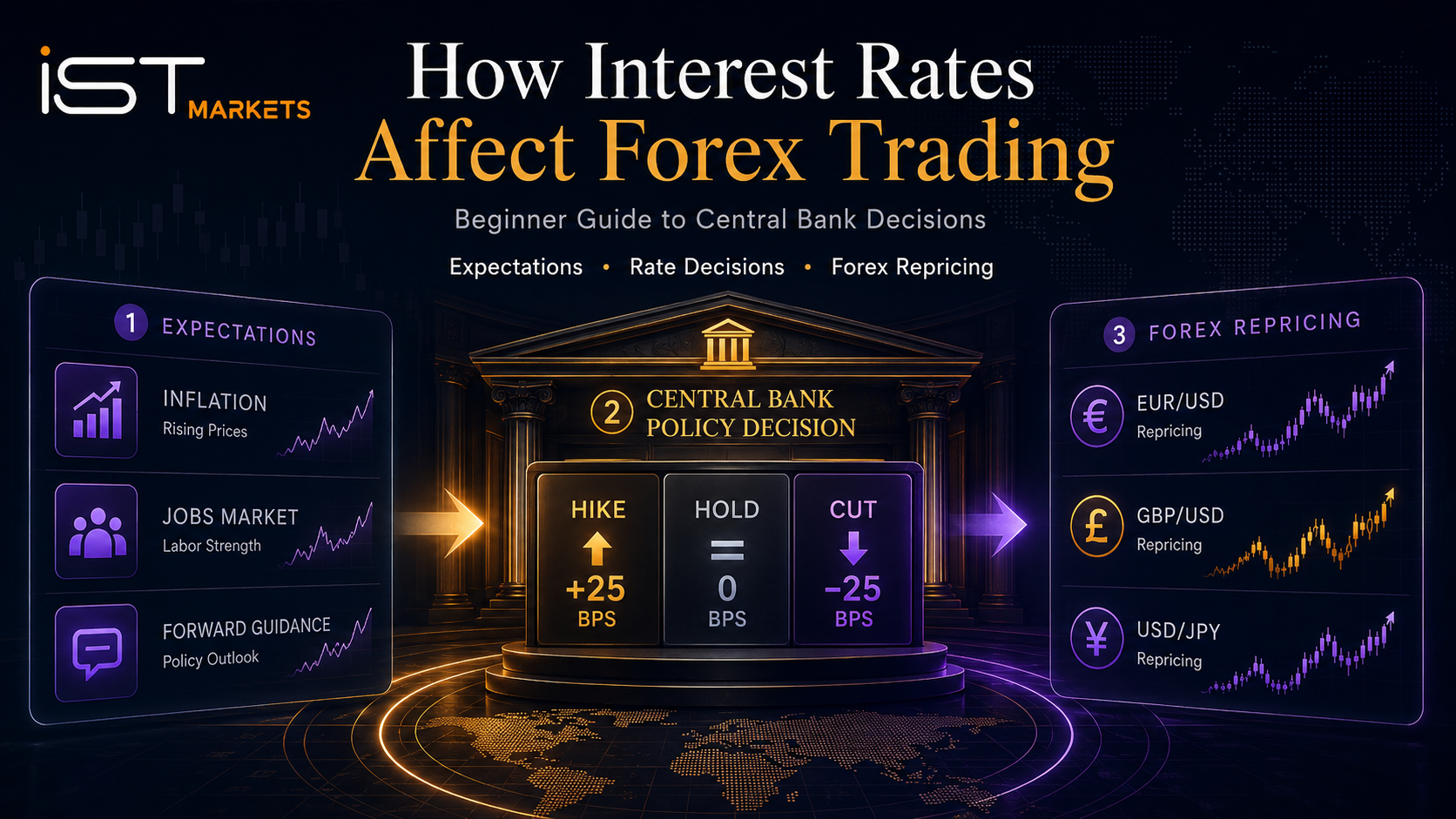
How Interest Rates Affect Forex Trading: Beginner Guide to Central Bank Decisions
A practical guide to rate hikes, rate cuts, forward guidance and market pricing—designed to help traders understand central-bank events without turning them into automatic buy or sell signals.
Quick Answer: How do interest rates affect forex trading?
Interest rates affect forex trading by changing expectations about relative returns, inflation, growth and the future policy paths of two economies.
A rate hike may support a currency when it is more restrictive than markets expected, but the same currency may fall if the hike was already priced in or accompanied by softer guidance. Rate cuts do not automatically weaken currencies either. Beginners should compare the decision with prior expectations, read the statement and projections, analyse both central banks in the currency pair and review spread, slippage, leverage and margin risk before taking action.
Important risk reminder
Understanding a central-bank decision does not make the market reaction predictable. Rate announcements can create rapid volatility, wider spreads, gaps, slippage and reversals between the statement and press conference. Leverage can magnify losses and margin pressure. This guide is educational only and does not provide a trading signal, personal financial advice or a recommendation to trade any event.
Source and editorial methodology
This guide uses official central-bank and statistical sources for monetary-policy, inflation and labour-market explanations. IST Markets risk, execution, fee and legal documents support the account-cost and trading-risk sections. Market reactions are presented as conditional analytical frameworks—not guaranteed cause-and-effect rules. Current rates, meeting dates, forecasts and market-implied probabilities should always be checked against the latest official information.
Interest rates and forex at a glance
| Beginner question | Decision-led answer |
|---|---|
| Do rate hikes always strengthen a currency? | No. The reaction depends on expectations, forward guidance and the other central bank in the pair. |
| Do rate cuts always weaken a currency? | No. A smaller-than-expected cut or less-dovish path can support a currency. |
| What matters most? | The change in the expected relative policy path—not the headline decision alone. |
| What should beginners check? | Expectations, statement language, votes, projections, the other currency and execution conditions. |
| Is an economic calendar a signal? | No. It is a preparation tool for timing, forecasts and event risk. |
The core principle: markets trade the expected policy path
A central bank sets or influences important short-term interest rates, but forex markets rarely react to the current policy rate in isolation. Traders, banks and investors continually estimate what policymakers may do at later meetings and how that expected path compares with the path in another economy.
The Federal Reserve explains that longer-term market rates are linked to expectations about how monetary policy and the economy may develop, not only to the current federal funds rate. Read the
Federal Reserve’s official monetary-policy explanation.
Federal Reserve research also shows that changes in monetary-policy expectations can have meaningful exchange-rate effects, although the size and direction remain conditional. See its
analysis of monetary policy and exchange rates.
The useful question is not only “Did the bank hike or cut?”
It is “Did the future policy path become more or less restrictive than markets expected—and how did that change compare with the other currency?”
Central banks make forward-looking decisions because monetary policy reaches demand, borrowing, employment and inflation with delays. The
Bank of England’s official monetary-policy guidance
states that the full economic effect of an interest-rate change can take around 18–24 months. Policymakers therefore consider where inflation and growth may be heading—not only where they are today.
The expectation-to-execution chain
Market expectations
↓
Central-bank decision and communication
↓
Repricing of the future rate path
↓
Relative change between two currencies
↓
Price reaction and execution conditions
↓
Trade, wait, practise or skip
Central-bank terms beginners should understand
| Term | Beginner definition | Why it matters |
|---|---|---|
| Basis point | One hundredth of a percentage point. A 25-basis-point move equals 0.25 percentage point. | It describes rate changes and surprises precisely. |
| Hawkish | More concerned about inflation or more open to tighter policy. | A hawkish shift may increase expected rates or delay expected cuts. |
| Dovish | More concerned about growth or more open to easier policy. | A dovish shift may bring expected cuts forward. |
| Forward guidance | Communication about how future policy may develop. | Guidance can move currencies without an immediate rate change. |
| Priced in | An outcome markets had already expected and partly reflected in prices. | A fully expected decision can create a limited or reversed reaction. |
| Rate differential | The difference between relevant rates or yields in two economies. | Forex compares two relative return and policy outlooks. |
| Real rate | An interest rate considered after expected inflation. | A high nominal rate may be less attractive when inflation is also high. |
The three expectations behind every rate decision
Beginners often treat the forecast in an economic calendar as the complete market expectation. It is useful, but it is only one of three layers.
The median or range of forecasts collected from economists. This is usually the figure shown beside an event in an economic calendar.
The future path reflected in rates, futures or overnight-index-swap markets where available. These estimates change as data and risk conditions change.
The direction suggested by previous statements, projections, minutes, speeches and press conferences.
These layers can disagree. Economists may expect a hold while market pricing still assigns some probability to a cut. Policymakers may have previously guided toward patience, while new inflation or labour data causes traders to expect a more restrictive message.
How beginners can check expectations
- Check the decision and press-conference times.
- Record the consensus forecast and previous decision.
- Read the previous official central-bank statement.
- Check whether later hikes or cuts are already expected.
- Define what would count as a genuine surprise before the announcement.
Use the IST guide to
using an economic calendar before trading
to organise timing, forecasts, revisions and event-risk checks. The calendar is a preparation tool—not a direction signal.
The IST Rate Decision Decoder
The IST Rate Decision Decoder separates a central-bank event into three stages. Its purpose is to slow the decision process down and prevent the trader from reacting only to the first headline or candle.
Stage 1: Before the decision—what is already priced in?
- What outcome does the consensus expect: hike, cut or hold?
- How many basis points are expected?
- What path is expected for the following meetings?
- What did the bank communicate at its previous meeting?
- Which inflation, employment or growth data changed?
- What is expected from the bank behind the other currency?
- What currency exposure is already open in the account?
Stage 2: During the event—what actually changed?
| Event layer | What to read | Decision question |
|---|---|---|
| Headline decision | Hike, cut, hold and size of the move. | Was it different from expectations? |
| Policy statement | Language on inflation, growth, labour and risk. | What wording changed from the previous statement? |
| Votes | Unanimity, dissents and preferred alternatives. | Is support for the current policy becoming stronger or weaker? |
| Projections | Inflation, growth, unemployment and policy expectations. | Did the expected future path change? |
| Press conference | Explanation, conditions, uncertainty and Q&A. | Does the governor confirm or soften the written message? |
Stage 3: After the event—how did markets reprice?
- Did expected rates for later meetings move?
- How did government-bond yields reflect the interpretation?
- Did the currency move broadly or only against one counterpart?
- Did the first move survive the statement and press conference?
- Did the relative policy gap widen or narrow?
- Did spreads and liquidity conditions improve?
- Has price moved too far for the original risk plan?
First move, second move and broader repricing
First move: the headline, algorithms, stop orders and immediate liquidity.
Second move: traders read the statement, votes and projections.
Broader repricing: the press conference and rates markets reshape expectations for future meetings. None of these phases guarantees a lasting direction.
Rate hikes, rate cuts and holds: reaction matrix
The words “hike,” “cut” and “hold” describe the immediate decision. They do not describe the complete policy message or guarantee the currency response.
| Decision type | Accompanying message | Possible interpretation | Beginner caution |
|---|---|---|---|
| Hawkish hike | Larger move or more tightening than expected. | May support the currency if the policy path is repriced higher. | Check whether the surprise was genuinely new. |
| Dovish hike | Expected hike with guidance that the cycle may be ending. | The currency may weaken after an initial rise. | Do not trade the word “hike” alone. |
| Hawkish hold | No change now, but future tightening remains possible. | The currency may strengthen despite no immediate move. | A hold is not automatically neutral. |
| Dovish hold | No change, with clearer willingness to ease later. | Expected rates may decline and pressure the currency. | Compare the timing with the other bank. |
| Hawkish cut | Smaller cut or fewer future cuts than markets priced. | The currency may recover despite the reduction. | A cut is not automatically bearish. |
| Dovish cut | Larger cut or faster easing than expected. | May pressure the currency as expected returns fall. | Execution risk may rise sharply. |
How to use this matrix
This is an interpretation framework, not a signal. Positioning, simultaneous data, risk sentiment, liquidity and the other central bank can produce a different reaction.
Pair-first analysis: compare two central banks
Forex prices one currency against another. An apparently hawkish Federal Reserve message may not support the U.S. dollar against every currency if the other central bank becomes even more restrictive. A dovish bank may still see its currency outperform when the other side of the pair becomes more dovish.
| Bank behind Currency A | Bank behind Currency B | Relative interpretation |
|---|---|---|
| More hawkish | Unchanged | Currency A may receive relative support. |
| Hawkish | Even more hawkish | Currency A may still underperform Currency B. |
| Dovish | More dovish | Currency A may outperform on a relative basis. |
| Unchanged | Expectations shift sharply | The pair can move without a surprise from Bank A. |
For EUR/USD, compare the ECB with the Federal Reserve. For GBP/USD, compare the Bank of England with the Federal Reserve. For USD/JPY, Fed expectations interact with Bank of Japan policy, Japanese yields, global risk conditions and carry positioning.
Pair-first rule
Do not stop after deciding whether one central bank was hawkish or dovish. Decide whether its expected policy path changed more or less than the path behind the other currency.
Continue with a central-bank-specific guide
ECB policy and EUR/USD
Compare ECB expectations with the Federal Reserve side of EUR/USD.
Bank of England and GBP/USD
Understand Bank Rate, MPC voting and relative BoE–Fed expectations.
Browse the complete
IST Markets Central Banks & Rates hub
for additional policy-focused guides.
Inflation and jobs data are policy inputs—not automatic signals
Central banks examine a wide range of economic evidence. Inflation data can change expectations when it alters the perceived persistence of price pressure. Labour-market data can affect expectations through employment, unemployment, wages, participation and demand conditions.
The European Central Bank aims for inflation of 2% over the medium term and uses an integrated framework combining economic, monetary and financial analysis. Read the
ECB monetary-policy strategy.
Official inflation and employment releases should be checked through primary statistical sources. For the United States, use the
BLS Consumer Price Index
and
BLS Employment Situation.
Euro-area inflation can be checked through
Eurostat HICP,
while UK data is available through the
Office for National Statistics inflation section
and its
UK labour-market overview.
A single report rarely explains an entire central-bank decision. Markets may examine:
- Headline and underlying inflation measures.
- Monthly momentum and annual comparisons.
- Services inflation, wages and inflation expectations.
- Employment growth, unemployment and participation.
- Revisions to earlier data.
- Growth, financial conditions and stability risks.
The useful question is not simply “Was inflation high?” It is “Did the report change the expected timing or size of future policy action?”
Continue with the IST guides to
inflation data and forex trading
and
jobs reports, NFP and currency moves.
Why currencies can move against the headline
Why can a currency fall after a rate hike?
- The hike was already fully priced in.
- The increase was smaller than expected.
- The bank signalled that the hiking cycle may be ending.
- Growth or inflation projections were revised lower.
- Voting showed less support for additional tightening.
- Bond yields fell as markets priced fewer future hikes.
- The other central bank became relatively more hawkish.
- Traders closed crowded positions after the announcement.
Why can a currency rise after a rate cut?
- The cut was already expected.
- The reduction was smaller than markets priced.
- The bank reduced the likelihood of further cuts.
- The decision reduced fears of a deeper slowdown.
- The currency had already been sold heavily.
- The other central bank delivered a more dovish message.
Currencies respond to changes in the expected relative policy path—not to the labels “hike” and “cut” alone.
How should traders use bond yields and related markets?
Related markets can provide context for how investors interpreted a central-bank event. They should not be treated as independent confirmation signals.
| Market | What it may reflect | Important limitation |
|---|---|---|
| Government-bond yields | Rate, inflation and growth expectations. | Supply, liquidity and safe-haven demand can also move yields. |
| Rate futures or OIS | Repricing of possible future decisions. | Implied probabilities change and are not guarantees. |
| Broader FX performance | Whether the reaction is broad or pair-specific. | Every counterpart currency has its own drivers. |
| Equities and volatility | Growth expectations and risk appetite. | Sector-specific moves may not represent broad risk. |
| Gold | Real-rate expectations, dollar moves and defensive demand. | Several competing factors can affect gold simultaneously. |
Instead of asking whether yields “confirmed the trade,” ask whether they moved consistently with the initial policy interpretation. A currency rise alongside falling expected rates may indicate that positioning, risk sentiment or weakness in the counterpart currency is more important.
Practical beginner scenarios
Scenario note
The following examples are hypothetical and are provided only to explain how market expectations can affect a currency reaction. They do not describe a current event, forecast future performance or represent a trading recommendation.
Scenario 1: The dovish hike
Imagine markets expect a central bank to raise rates by 25 basis points. The bank delivers exactly that increase. A beginner reads “central bank raises rates” and immediately buys the currency.
The rest of the event reveals a different picture:
- The bank says inflation is slowing more clearly.
- Its growth projection is revised lower.
- Several policymakers believe policy may already be restrictive enough.
- The governor reduces expectations of further hikes.
- Government-bond yields fall after the announcement.
| What the beginner sees | What markets may be reading | What should be checked? |
|---|---|---|
| “Rates increased.” | The increase was fully expected. | Was there a genuine surprise? |
| The currency jumps. | Algorithms react to the headline. | Did the move survive the statement? |
| The currency reverses. | Markets price the end of the hiking cycle. | Did future-rate expectations fall? |
| The trader enters late. | Liquidity is unstable and the original setup has changed. | Are spread and risk still acceptable? |
Scenario lesson
The bank raised rates, but the market traded the expected end of the hiking cycle. A beginner may decide to observe, wait for the press conference, reassess after liquidity improves or skip the event.
Scenario 2: The hawkish cut
Now imagine markets expect a 50-basis-point cut, but the bank cuts by only 25 basis points. The statement says inflation remains a concern and policymakers do not expect a rapid sequence of further reductions.
The headline still says “central bank cuts rates,” but the delivered easing is smaller than markets priced. Expected rates move higher relative to the pre-meeting path, yields rise and the currency strengthens.
The market was positioned for more easing than the central bank delivered.
A central-bank policy rate is not the same as retail swap
A policy rate is an official monetary-policy tool. The overnight swap or financing amount shown on a retail platform is a separate account-level cost or credit associated with holding a position beyond the relevant rollover time.
Interest-rate differentials can influence currency pricing and may be one factor behind overnight financing calculations, but the displayed account swap is not simply the central-bank rate copied into the platform.
| Policy rate | Retail overnight swap |
|---|---|
| Set or influenced by a central bank. | Applied according to instrument, direction, market rates and account specifications. |
| Affects broad financial conditions. | Affects the cost or credit of holding a position overnight. |
| One input into market-rate expectations. | Can differ by instrument, position direction, date and account terms. |
Before holding a position through rollover, check the live instrument specification and applicable terms. Review the IST Markets
fees and overnight swap information
instead of estimating the account charge from a headline policy rate.
Trading costs, execution risks and account readiness
Correctly interpreting a central-bank decision does not guarantee a profitable trade. Economic interpretation and executable market conditions are separate questions.
| Risk category | Examples | Preparation response |
|---|---|---|
| Interpretation risk | Ignoring prior pricing, guidance or the other currency. | Write down the expected outcome and alternatives first. |
| Timing risk | Entering before the full statement or press conference. | Separate the headline from later communication stages. |
| Execution risk | Wider spread, slippage, gaps and limited liquidity. | Accept that the expected price may not be available. |
| Account risk | High leverage, low free margin and correlated positions. | Reduce exposure or avoid the event. |
| Holding-cost risk | Swap, spread, commission and conversion costs. | Check live specifications before opening the trade. |
The IST Markets
Order Execution Policy
explains that slippage may be positive or negative and may become more likely in fast, volatile or low-liquidity conditions. Stop orders can be triggered at one level but executed according to the available price and liquidity after activation.
Leveraged trading can magnify the effect of relatively small price movements on account equity and margin. Review the
IST Markets Risk Disclosure
and the guide to
how forex leverage can magnify gains and losses
before considering exposure around a high-impact announcement.
The legal documents that apply can depend on the entity under which an account is registered. Review the
IST Markets Legal Documents hub
and the documents applicable to your account.
Common mistakes beginners should avoid
| Mistake | Why it weakens the decision | Better routine |
|---|---|---|
| Assuming every hike is bullish | It ignores prior pricing and guidance. | Compare the delivered path with expectations. |
| Assuming every cut is bearish | The cut may be smaller or less dovish than expected. | Read the size, guidance and next steps. |
| Entering on the headline | The statement and conference may change the interpretation. | Review the full event sequence. |
| Analysing one central bank | FX compares two policy outlooks. | Use pair-first analysis. |
| Treating yields as a signal | Yields can move for several reasons. | Use them as contextual evidence. |
| Confusing policy rate with swap | They have different functions. | Check the live instrument specification. |
| Using an AI summary as a signal | It may omit votes, revisions or wording changes. | Verify important claims against official releases. |
| Increasing leverage because the news looks clear | Execution and interpretation remain uncertain. | Define risk independently of confidence. |
Interest rates forex trading checklist
Before the decision
During and after the decision
Risk reminder before taking action
Even a well-researched interpretation can lead to a losing trade. Prices may move before an order is filled, and stop orders may execute at a different level during gaps or fast conditions. Review the
Risk Disclosure,
Order Execution Policy
and the legal documents applicable to your account before trading leveraged products.
Practise the decision process before trading the event
Start with the
economic-calendar preparation guide
to identify the event, forecast and communication schedule. Continue through the
IST Markets Academy
and
risk-management education hub
before considering live exposure.
A demo environment may help you practise locating releases, comparing scenarios and observing platform behaviour. Demo conditions do not prove future live spreads, fills, slippage, emotions or trading results.
Final takeaway
Interest rates affect forex through expectations about future policy, relative returns, inflation, growth and financial conditions. The strongest beginner routine is to identify what was priced in, read what changed, compare both central banks, observe how markets repriced and then decide whether execution conditions justify trading, waiting, practising or skipping the event.
Frequently Asked Questions
How do interest rates affect forex trading?
Interest rates affect forex when they change expectations about relative returns and future central-bank policy. Traders compare the expected rate paths of both economies in a currency pair rather than looking at one policy rate alone.
Why can a currency fall after an interest-rate hike?
A currency can fall when the hike was fully expected, smaller than expected or accompanied by guidance that future tightening may be limited. Lower projections, divided votes, falling yields or a more hawkish move from the other central bank can also affect the reaction.
Can a currency rise after a central bank cuts rates?
Yes. A currency may rise when the cut was already priced in, smaller than expected or accompanied by guidance that further cuts are unlikely. It may also outperform when the other central bank becomes more dovish.
What does “priced in” mean before a rate decision?
Priced in means traders had already expected an outcome and partly reflected it in market prices. A decision can match the headline forecast but still move markets if its communication changes expectations for later meetings.
What is the difference between hawkish and dovish policy?
Hawkish language generally shows greater concern about inflation or a willingness to keep policy restrictive. Dovish language generally shows greater concern about growth or a willingness to ease policy. Both terms should be compared with prior expectations.
Should beginners trade during central-bank announcements?
Beginners do not need to trade central-bank announcements. These events can involve wider spreads, slippage, gaps and rapid reversals. Observing the event, practising in demo or waiting for conditions to stabilise may be more appropriate.
Is a central-bank policy rate the same as forex swap?
No. A central-bank policy rate influences broad market conditions, while retail swap is an account-level overnight financing amount that depends on the instrument, position direction, market rates and applicable account terms.
References and Further Reading
Official monetary-policy sources
- Federal Reserve — Monetary Policy: Goals and Transmission
- Federal Reserve — FOMC Meeting Calendars and Information
- Federal Reserve — Monetary Policy and Exchange Rates
- European Central Bank — Monetary Policy Strategy
- European Central Bank — Monetary Policy Decisions
- Bank of England — Monetary Policy
- Bank of England — Monetary Policy Reports
Official inflation and labour-market sources
- U.S. Bureau of Labor Statistics — Consumer Price Index
- U.S. Bureau of Labor Statistics — Employment Situation
- Eurostat — Harmonised Indices of Consumer Prices
- UK Office for National Statistics — Inflation and Price Indices
- UK Office for National Statistics — Labour Market Overview
IST Markets risk, costs and education
- IST Markets — Risk Disclosure
- IST Markets — Order Execution Policy
- IST Markets — Legal Documents
- IST Markets — Trading Fees and Overnight Swap
- How to Use an Economic Calendar Before Trading
- Inflation Data and Forex Trading
- Jobs Reports, NFP and Currency Moves
- Federal Reserve Rate Decisions and Forex
- ECB Policy and EUR/USD
- Bank of England Policy and GBP/USD
- Forex Leverage Explained
How this article is maintained
Review this article when central-bank frameworks, publication formats, statistical methodologies, IST account terms, fees, risk documents or execution policies change materially. Current rates, forecasts, meeting times and market-implied probabilities should always be verified against the latest official information.