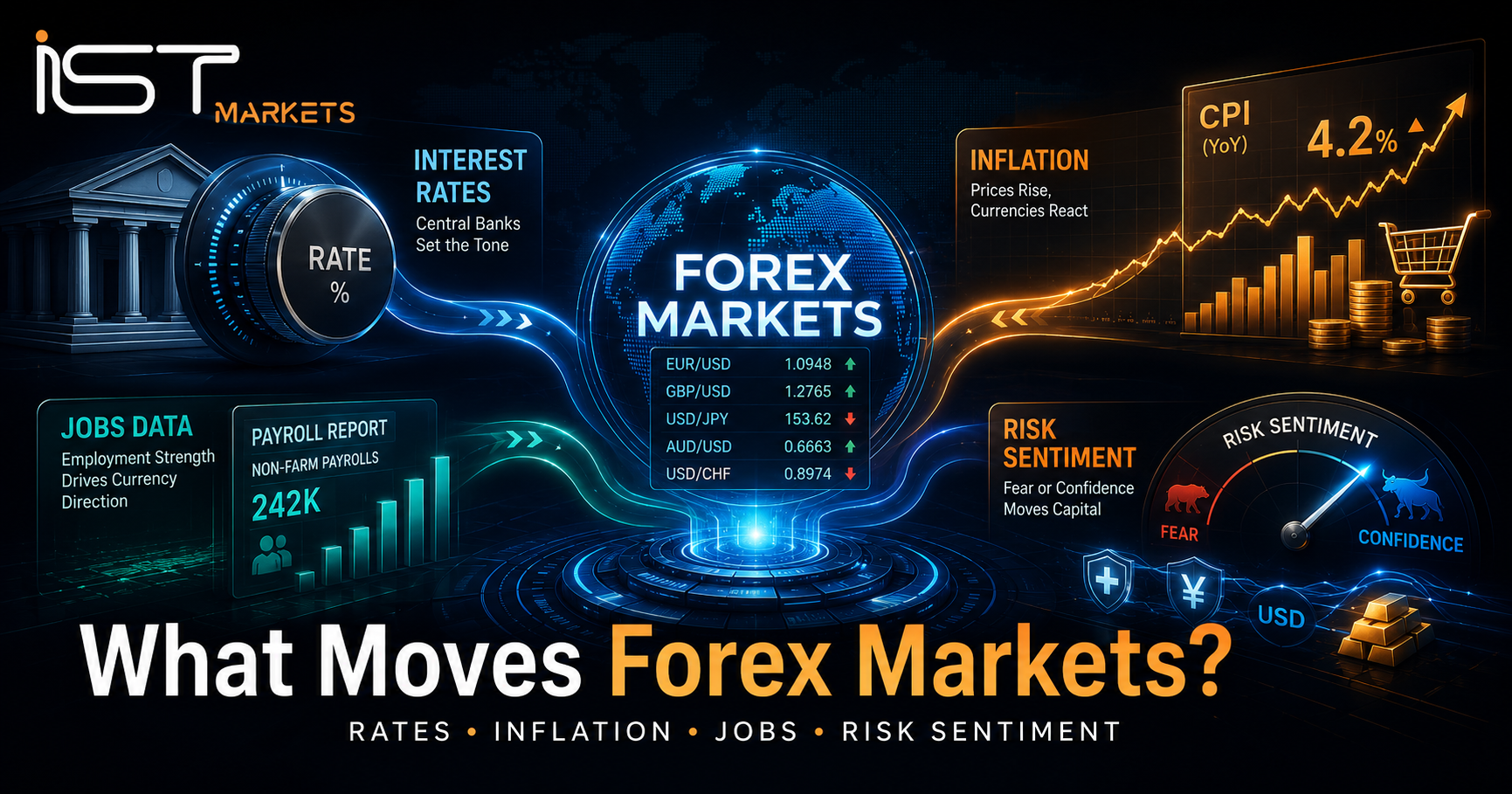
What Moves Forex Markets? Interest Rates, Inflation, Jobs Data and Risk Sentiment
A pair-first market-driver guide for traders who understand charts but want to know why currencies move when economic expectations, central-bank policy and global risk conditions change.
Quick Answer: What moves forex markets?
Forex markets move when new economic, monetary-policy or risk information changes the relative outlook for one currency compared with another. Interest-rate expectations, inflation, jobs data, growth, central-bank communication and risk sentiment can all affect demand for currencies. The reaction depends less on whether a number looks “good” or “bad” and more on how it compares with forecasts, what markets had already priced in, and whether it changes the expected policy path. Beginners should analyse both sides of the currency pair, confirm the reaction across related markets and review execution risk before acting.
Important risk reminder
Understanding macro drivers does not make a market reaction predictable. News events can create sharp volatility, wider spreads, slippage, gaps and rapid reversals. Leverage can magnify both losses and trading costs. This guide is educational only and does not provide trading signals, personal financial advice or a recommendation to trade any event.
Source and editorial methodology
This guide uses official central-bank and statistical sources for monetary-policy, inflation and labour-market definitions. IST Markets risk and execution documents are used for trading-risk wording. Market interpretations are presented as conditional frameworks—not guaranteed cause-and-effect rules. Current data, forecasts and event times should always be checked against the relevant official release.
What this guide verifies
| Source layer | What it supports |
|---|---|
| Federal Reserve | Monetary-policy goals, interest-rate transmission, expectations and exchange-rate channels. |
| European Central Bank | The euro-area inflation target and integrated policy analysis. |
| Bank of England | Bank Rate, the UK inflation target and the delayed effect of policy decisions. |
| U.S. Bureau of Labor Statistics | Official CPI definition and the structure of employment, unemployment, earnings and hours data. |
| IST Markets documents | Leverage, margin, liquidity, gaps, electronic trading and order-execution risks. |
The core principle: forex trades relative expectations
A currency does not have one independent price. EUR/USD, GBP/JPY and AUD/CAD compare one currency with another. That means the market is continually comparing two economies, two central banks, two expected interest-rate paths and two sets of risks.
This is why a strong U.S. report does not automatically mean every dollar pair must move in the same direction. The report must first be compared with expectations. Traders then decide whether it changes the expected Federal Reserve path, whether the change is larger than developments affecting the other currency, and whether the market had already priced the outcome.
↓
Actual Result vs Market Expectation
↓
Change in Expected Central-Bank Path
↓
Relative Advantage Between the Two Currencies
↓
Market Confirmation or Rejection
↓
Execution and Risk Decision
Trader’s takeaway
The market does not trade an economic headline in isolation. It trades the difference between the new information and the expectations already embedded in prices.
The five layers of forex market movement
| Driver layer | What it includes | The practical question |
|---|---|---|
| Policy expectations | Interest rates, central-bank statements, projections and voting. | Did the expected rate path become tighter or easier? |
| Inflation and real returns | Headline inflation, core inflation, wages and inflation expectations. | Did inflation change expected policy or inflation-adjusted returns? |
| Growth and labour markets | Jobs, unemployment, wages, GDP, surveys and consumption. | Is the economy stronger or weaker than markets expected? |
| Risk and capital flows | Equities, volatility, liquidity demand, carry trades and safe havens. | Are investors seeking return, liquidity or protection? |
| Positioning and execution | Priced-in expectations, crowded trades, liquidity, spread and slippage. | Is the information genuinely new, and is execution risk acceptable? |
The IST Macro Reaction Map
Use these six questions before treating any macroeconomic release as a trading idea.
What changed—rates, inflation, employment, growth, risk or official policy?
How does the actual result compare with the forecast, previous value and revisions?
Does the release change expected central-bank tightening, easing or timing?
What is changing for the currency on the other side of the pair?
Do yields, equities, gold, volatility and broader FX confirm the interpretation?
Are spread, slippage, liquidity, leverage and total open risk acceptable?
The first three questions explain the economic message. The final three decide whether the message is clear enough—and whether the market conditions are suitable enough—to justify any action.
How interest rates move forex markets
Interest rates influence currencies mainly through expectations about relative returns and future central-bank policy. If investors expect rates or bond yields in one country to remain higher than in another, assets denominated in the higher-yielding currency may become relatively more attractive.
The current policy rate matters, but the expected path often matters more. A central bank can leave rates unchanged and still move its currency sharply if its statement, projections, votes or press conference change what traders expect next.
| Rate factor | What traders monitor | Why it matters |
|---|---|---|
| Current policy rate | The official rate set by the central bank. | It influences short-term funding and financial conditions. |
| Expected policy path | Expected cuts, hikes and timing. | Markets price the future—not only today’s rate. |
| Central-bank guidance | Statements, forecasts, votes and press conferences. | The tone may change expectations without an immediate rate move. |
| Yield differentials | The gap between comparable government yields. | The relative return matters to currency demand. |
| Real returns | Interest rates adjusted for expected inflation. | A high nominal rate can be less attractive when inflation is also high. |
Why can a currency fall after a rate hike?
A rate hike can fail to support a currency when the decision was already fully priced, the increase was smaller than expected, policymakers signalled that the cycle may be ending, or markets became more concerned about economic weakness. The other central bank may also have delivered an even more restrictive message.
Direct answer
Interest rates can move currencies when they change the expected relative return on assets and the future policy gap between two economies. The surprise relative to expectations matters more than the direction of the rate decision alone.
How inflation affects currencies
Inflation data matters because central banks use monetary policy to maintain price stability. CPI tracks changes in consumer prices, but traders should not reduce an inflation report to a single annual headline.
Markets often examine monthly and annual changes, headline and core measures, services inflation, housing components, wages and revisions. They also ask whether the change is broad and persistent or driven by one volatile component.
| Inflation outcome | Possible market interpretation | Why the reaction may differ |
|---|---|---|
| Above forecast | Tighter policy or slower rate cuts may be considered. | The outcome may already be priced in. |
| Below forecast | Earlier or faster easing may be considered. | Risk appetite or growth expectations may dominate. |
| Headline hot, core softer | A temporary energy or food effect may be suspected. | Markets may focus on the more persistent core trend. |
| High inflation and weak growth | Stagflation risk and a difficult policy trade-off. | Higher rates may not be viewed as economically positive. |
| Strong headline, weak details | Mixed policy signal. | The first market move may reverse after the report is read fully. |
Higher inflation can support a currency when it causes markets to price a more restrictive central-bank path. It can weaken the currency when investors focus on lower purchasing power, weaker real returns, supply shocks, falling growth or doubts about policy credibility.
For a deeper event-specific process, read the IST guide to
how inflation data affects forex markets.
Jobs data: more than the payroll headline
Employment data matters because it provides information about growth, household income, wage pressure and potential inflation. In the United States, the Employment Situation includes both household and establishment data and covers far more than the nonfarm payroll number.
| Jobs component | What it can indicate | Why traders check it |
|---|---|---|
| Nonfarm payrolls | Change in payroll employment. | The most visible headline, but not the whole report. |
| Unemployment rate | Labour-market slack. | It can contradict or confirm the payroll message. |
| Average hourly earnings | Wage growth and potential price pressure. | Wages can influence inflation and policy expectations. |
| Participation rate | How many working-age people are active in the labour force. | It can change how the unemployment rate is interpreted. |
| Weekly hours | Changes in labour demand before hiring or layoffs. | Employers may change hours before changing headcount. |
| Prior revisions | A revised view of previous months. | Negative revisions can weaken an apparently strong headline. |
A payroll beat can still produce a weak or mixed currency reaction when unemployment rises, wage growth slows or previous months are revised lower. The report matters only after traders decide whether the complete labour-market picture changes the expected central-bank path.
For a deeper breakdown, read
how jobs reports and NFP can affect currencies.
Risk sentiment, capital flows and safe-haven currencies
Forex markets are also moved by changes in investor appetite for risk. During risk-on periods, capital may move toward higher-yielding, growth-sensitive or carry-related assets. During risk-off periods, investors may reduce leverage, seek liquidity or move toward defensive currencies and assets.
USD, JPY and CHF are commonly monitored during stress, but they are not interchangeable and they do not strengthen automatically every time stocks fall.
| Risk environment | Possible forex channel | Important limitation |
|---|---|---|
| Global liquidity stress | Demand for U.S. dollar liquidity may rise. | Aggressive Fed-cut expectations can weaken the dollar. |
| Carry-trade unwind | Funding currencies such as JPY may strengthen. | Yield differentials and Bank of Japan expectations still matter. |
| European uncertainty | CHF demand may increase. | Swiss policy and local factors can alter the move. |
| Broad risk-on recovery | Growth-sensitive and higher-yielding currencies may benefit. | The reaction may reverse if rate expectations change. |
| Commodity shock | Exporter and importer currencies may react differently. | The economic effect depends on the country and commodity. |
The stronger question is not “which currency is always safe?” It is “which currency is expressing the current risk driver most clearly?”
Explore the IST guides to
stock-market volatility and safe-haven flows
and
how VIX relates to currency markets.
Why can “good news” weaken a currency?
This is one of the most important questions for beginners. A positive headline can be followed by currency weakness for several reasons:
| Reason | What it means |
|---|---|
| Already priced in | Traders expected the result and positioned before the release. |
| Details weaker than the headline | Core data, wages, revisions or participation may contradict the main figure. |
| Policy path unchanged | The number is not strong enough to alter central-bank expectations. |
| The other currency improved more | FX compares two outlooks, not one economy in isolation. |
| Cross-market rejection | Bond yields or related markets fail to confirm the currency move. |
| Crowded positioning | Traders use the event to take profit or reduce existing exposure. |
| Liquidity-driven first reaction | The first spike reflects algorithms, stops or thin order books rather than durable repricing. |
Pair-first analysis: study both currencies
Imagine U.S. data is stronger than expected. That may support the dollar, but the final EUR/USD response still depends on euro-area data, ECB expectations, European yields and the positioning already built into the pair.
The same U.S. release can produce a different reaction in USD/JPY because Japanese yields, carry-trade positioning and safe-haven demand introduce another set of variables. A currency can strengthen against one counterpart and weaken against another at the same time.
Pair-first rule
Never finish the analysis after asking whether one economy is strong. Ask whether its outlook improved more or deteriorated less than the outlook behind the other currency.
Cross-market confirmation: what else should traders watch?
Other markets can help confirm or challenge a forex interpretation. They are context tools—not independent trading signals.
| Confirmation market | What it may show | Limitation |
|---|---|---|
| Government bond yields | Changes in growth, inflation or rate expectations. | Yields can move for supply, liquidity or risk reasons too. |
| Dollar index | Whether dollar strength is broad or isolated. | Its composition is weighted toward specific currencies. |
| Equity indices | Growth expectations and risk appetite. | A sector-specific move may not create broad FX flows. |
| Gold | Real-rate, dollar, inflation or defensive demand. | Several drivers can affect gold simultaneously. |
| VIX | Equity-market stress and demand for protection. | VIX does not mechanically move currencies. |
| Risk-sensitive FX pairs | Whether defensive or carry-unwind flows are broad. | Local central-bank factors can distort the signal. |
What else can move forex markets?
Interest rates, inflation, employment and risk sentiment are major drivers, but they are not the only ones. Currency markets may also react to:
- Growth data: GDP, business surveys, retail sales and industrial activity.
- Trade and commodity flows: particularly for economies exposed to oil, metals or agricultural exports.
- Fiscal policy: taxation, spending, deficits and sovereign-risk concerns.
- Political and geopolitical developments: elections, conflict, sanctions and trade restrictions.
- Central-bank intervention: verbal warnings, direct currency operations or policy coordination.
- Positioning and liquidity: crowded trades, month-end flows, option levels and thin market conditions.
Official intervention can create especially sharp moves, but it should not be treated as predictable. Read the IST guide to
central-bank intervention in forex
for a deeper explanation.
Practical scenario: the payroll headline trap
Imagine a hypothetical U.S. jobs report with the following results:
- Payroll growth is above forecast.
- The unemployment rate rises.
- Average hourly earnings slow.
- The previous two months are revised lower.
A beginner sees “payrolls beat expectations” and immediately buys the dollar. The first move supports the decision, but it reverses minutes later.
The stronger analysis would ask:
- Is the report genuinely strong or internally mixed?
- Does softer wage growth reduce inflation pressure?
- Do negative revisions weaken the employment trend?
- Did bond yields confirm tighter policy expectations?
- Did the dollar strengthen broadly or only against one currency?
- Did the reaction survive beyond the first liquidity spike?
- Were spread and slippage still acceptable?
The real lesson
The trade is not the payroll headline. The decision is whether the full report changed the expected policy path and whether markets confirmed that repricing.
Common mistakes beginners should avoid
| Mistake | Why it weakens the decision | Better routine |
|---|---|---|
| Treating strong data as automatically positive | It ignores forecasts and prior pricing. | Compare actual, forecast and market expectations. |
| Analysing only one currency | Every FX pair compares two outlooks. | Study both sides of the pair. |
| Reading the headline only | Details and revisions may change the message. | Read core components and revisions. |
| Focusing only on the current rate decision | Markets often trade the future policy path. | Review guidance, projections and votes. |
| Assuming safe havens always behave the same | The type and location of the shock matter. | Identify the driver and confirm the flow. |
| Chasing the first candle | The first move may reflect algorithms or thin liquidity. | Wait for structure and confirmation when appropriate. |
| Treating an AI summary as a signal | A summary may miss revisions, details or context. | Verify against the official release. |
| Ignoring open exposure and margin | News can increase total portfolio risk quickly. | Review all correlated positions before the event. |
What moves forex markets checklist
Before the event
After the release
Learn how to structure this preparation process in the IST guide to
using an economic calendar before trading.
Risk reminder before taking action
Even a correct macro interpretation can lead to a losing trade. Markets may react differently from historical patterns, and prices can move before orders are filled. Stop orders may execute at a different level during gaps or fast markets. Review the
IST Markets Risk Disclosure
and
Order Execution Policy
before trading leveraged products.
Practise the reaction process before trading the event
Use the
economic-calendar preparation guide
to identify major releases, then use the
IST Markets Academy
to study inflation, employment, volatility and central-bank events in more detail.
A demo environment can help you practise finding releases, marking sensitive pairs and reviewing platform behaviour. It cannot prove future live spreads, fills, slippage, emotions or trading results.
Final Takeaway
Forex markets move when new information changes the relative outlook between two currencies. The strongest analysis connects the surprise in the data to the expected central-bank path, compares both sides of the pair, checks confirmation across markets and filters the idea through execution and risk conditions.
Frequently Asked Questions
What moves forex markets?
Forex markets move when economic data, monetary policy, capital flows or risk conditions change the relative outlook for one currency compared with another. Interest-rate expectations, inflation, employment, growth and risk sentiment are major drivers.
Why do interest rates move currencies?
Interest-rate expectations can change the relative return offered by assets denominated in a currency. Markets compare the expected policy and yield path of both economies in the currency pair.
How does inflation affect forex?
Inflation can move currencies when it changes expected central-bank policy or real returns. Higher inflation may support a currency through tighter-policy expectations, but it can weaken it when growth, purchasing power or credibility concerns dominate.
How does the jobs report affect the dollar?
The jobs report can affect the dollar by changing expectations for U.S. growth, wage pressure, inflation and Federal Reserve policy. Payrolls should be read with unemployment, wages, participation, hours and revisions.
Why can a currency fall after strong economic data?
Strong data may already be priced in, contain weaker internal details or fail to change the expected policy path. Profit-taking, crowded positioning or a stronger change affecting the other currency can also reverse the initial reaction.
What is risk-on and risk-off in forex?
Risk-on describes conditions where investors are more willing to hold growth-sensitive or higher-yielding assets. Risk-off describes conditions where investors reduce risk, seek liquidity or move toward defensive currencies and assets.
What should beginners check before trading economic news?
Check the event time, forecast, previous figure, possible revisions, central-bank expectations, both currencies in the pair, open exposure, spread, liquidity and slippage risk. The economic calendar is a preparation tool—not a trading signal.
References and Further Reading
Official monetary-policy and statistical sources
- Federal Reserve — Monetary Policy: Goals and Transmission
- European Central Bank — Monetary Policy Strategy
- Bank of England — Monetary Policy
- U.S. Bureau of Labor Statistics — Consumer Price Index
- U.S. Bureau of Labor Statistics — Employment Situation
IST Markets risk, execution and education
- IST Markets — Risk Disclosure
- IST Markets — Order Execution Policy
- How to Use an Economic Calendar Before Trading
- Inflation Data and Forex Trading
- Jobs Reports, NFP and Currency Moves
- Stock-Market Volatility and Safe-Haven Currencies
- VIX and Forex Trading
- Central-Bank Intervention in Forex
Review this article whenever central-bank frameworks, statistical methodologies, IST risk documents, execution policies or related internal guides change materially. Current event figures and forecasts should always be taken from the relevant official release.