At a Glance
| Question | Decision-Led Answer |
|---|---|
| What is the main link? | Stock-market volatility can trigger safe haven flows in forex. |
| Main safe haven currencies | USD, JPY, and CHF. |
| Key pairs to watch | USD/JPY, AUD/JPY, NZD/JPY, EUR/CHF, and CHF/JPY. |
| Main confirmation tools | VIX, equity indices, DXY, yields, bond flows, and risk-sensitive FX. |
| Main opportunity | Risk-off forex setups when safe haven flows confirm equity stress. |
| Main risk | False risk-off signals and fast reversals when panic fades. |
| Best next step | Follow cross-market confirmation before reacting to headlines. |
Last reviewed: May 2026 ·
This guide is educational only and does not provide investment advice, trading signals, or guaranteed outcomes.
On This Page
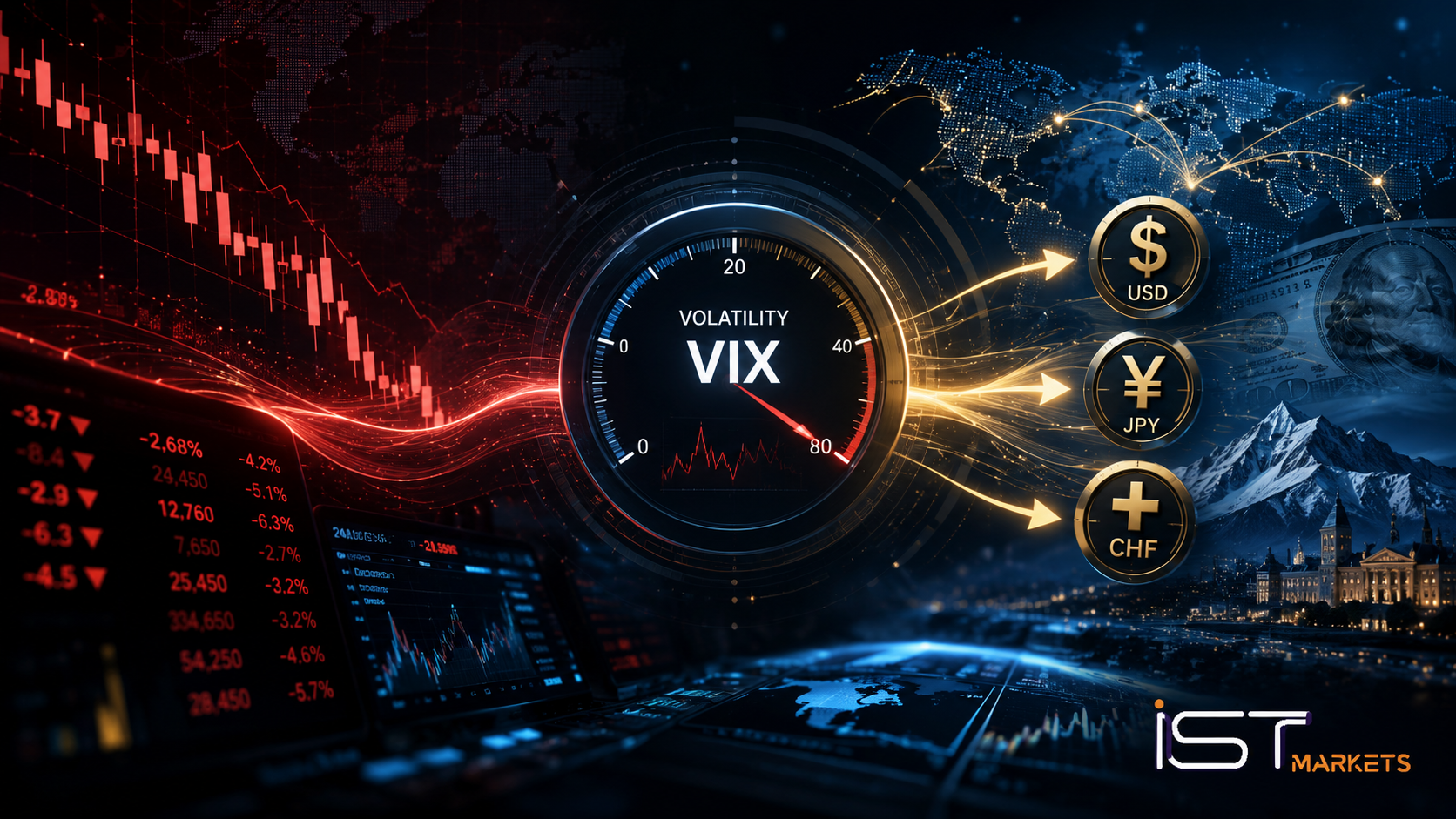
A stock-market sell-off rarely stays inside the stock market. When volatility rises, the forex market often starts sending its own signals through the US dollar, Japanese yen, Swiss franc, and risk-sensitive currency pairs. For traders, the important question is not only whether stocks are falling. The better question is whether capital is actually moving into safe haven currencies.
That distinction matters. A falling S&P 500 does not automatically create a forex trade. A sharp Nasdaq pullback does not always mean the yen should strengthen. Sometimes the move is local, sector-specific, or quickly reversed. Other times, falling equities, rising volatility, stronger safe havens, weaker risk currencies, and clean pair structure all align into a genuine risk-off trading environment.
This guide explains how stock market volatility forex analysis works, how safe haven currencies respond, which pairs to monitor, and how traders can separate genuine risk-off setups from headline-driven noise. The goal is not to react to every red candle. The goal is to build a calmer decision process before the market narrative becomes obvious to everyone.
Stock Market Volatility Forex Decision Framework
The strongest volatility trades usually begin with a question, not a signal. Is this a local equity correction, or is the market entering a broader risk-off regime? A structured decision framework helps traders avoid chasing late moves and focus on confirmation.
Step 01
Identify the Volatility Driver
Is the move driven by inflation, Fed repricing, weak earnings, banking stress, liquidity pressure, geopolitical risk, or a sector-specific sell-off?
Step 02
Decide Whether It Is Local or Systemic
A tech-sector pullback may not create the same forex reaction as a broad equity sell-off with rising VIX, weaker credit sentiment, and safe-haven demand.
Step 03
Check Safe Haven Confirmation
Are USD, JPY, or CHF actually strengthening? Understanding each safe haven currency separately helps traders avoid assuming they all move for the same reason.
Step 04
Select the Cleaner Forex Pair
USD/JPY may be complex if both USD and JPY are in demand. In some conditions, AUD/JPY, NZD/JPY, EUR/CHF, or CHF/JPY may express the risk-off move more clearly.
Step 05
Apply a Risk Filter
Check whether the move is already extended, whether spreads have widened, whether a news event is still unfolding, and whether the pair has enough structure to define risk.
Step 06
Decide Whether to Act, Wait, or Monitor Live
If several signals are moving at once, a structured trading room can help traders monitor the sequence without reacting to every headline.
Market Volatility Drivers
Stock market volatility matters for forex when it changes capital flows. A small earnings correction may stay inside equities. A broad shock to rates, liquidity, credit, or global confidence can move currencies much more aggressively.
Interest-Rate Repricing
When markets suddenly reprice interest-rate expectations, equities can fall and currencies can move quickly. A hawkish repricing may support the US dollar and pressure risk-sensitive FX. A dovish repricing may weaken the dollar even if stocks are under pressure, which makes safe-haven interpretation more complicated.
Inflation Surprises
Inflation shocks can create mixed signals. Higher inflation may pressure equities because rate expectations rise, but it can also strengthen the dollar if markets believe policy must stay tighter for longer. Traders should watch yields and DXY before assuming the risk-off trade is clean.
Earnings and Growth Concerns
Weak earnings can trigger stock-market volatility, but the forex impact depends on whether the weakness is isolated or broad. A single-sector sell-off may not create strong safe haven flows. A growth scare across multiple sectors may have a larger currency-market impact.
Banking, Credit, or Liquidity Stress
Credit and liquidity stress are often more important for forex than ordinary equity volatility. When traders seek cash, reduce leverage, or unwind carry trades, safe haven currencies can move quickly. This is where a structured volatility trading process helps separate genuine risk-off conditions from short-term market noise.
Geopolitical Risk
Geopolitical risk can support safe havens, but the reaction depends on the region, expected economic impact, and whether energy, bonds, or the US dollar are also moving. Traders should avoid treating every geopolitical headline as the same type of forex setup.
Key takeaway: Volatility matters most for forex when it changes capital flows, not when it is only a stock-specific correction.
Safe Haven Currencies
Safe haven currencies are not all the same. The US dollar, Japanese yen, and Swiss franc can all attract demand during uncertainty, but the reason behind each move may be different. That is why traders should study the driver before choosing the pair.
US Dollar as a Liquidity Safe Haven
The US dollar often benefits when markets need liquidity. During global stress, investors may reduce risk, buy dollars, and protect cash positions. This can pressure EUR/USD, GBP/USD, AUD/USD, and emerging-market currencies.
The trade-off: USD is not always the cleanest safe haven. If the stock-market sell-off leads traders to price aggressive Fed cuts, the dollar may weaken even while equities are under pressure.
Japanese Yen and Carry Trade Unwind
The Japanese yen often strengthens when investors unwind carry trades and reduce leverage. This can make JPY crosses such as AUD/JPY and NZD/JPY useful risk-off indicators.
The trade-off: USD/JPY can be difficult because both USD and JPY may attract demand during stress. In some conditions, AUD/JPY or NZD/JPY gives a cleaner read than USD/JPY.
Swiss Franc as a Defensive Currency
The Swiss franc can act as a defensive currency during European uncertainty, geopolitical caution, or broad capital preservation. EUR/CHF is often watched when traders want to see whether defensive flows are affecting Europe-linked FX.
The trade-off: CHF pairs can be affected by Swiss National Bank policy, local factors, and liquidity conditions. The franc is useful, but not a guaranteed safe-haven signal.
Gold and Bonds as Confirmation Signals
Gold and government bonds are not currencies, but they can help confirm risk-off behavior. If equities fall, VIX rises, JPY strengthens, CHF strengthens, and bond yields fall, the risk-off story is usually stronger than if only one asset is moving.
Safe Haven Forex Setups Compared
| Setup | Best For | Main Signal | Main Benefit | Main Trade-Off | Best Fit |
|---|---|---|---|---|---|
| USD strength | Liquidity stress | DXY rising | Broad global signal | Can reverse on Fed cut expectations | Macro traders |
| JPY strength | Carry unwind | AUD/JPY falling | Strong risk-off expression | Yield differentials can interfere | Intermediate FX traders |
| CHF strength | European or geopolitical risk | EUR/CHF falling | Defensive FX exposure | SNB and local drivers | Conservative risk-off traders |
| Risk FX weakness | Broad market fear | AUD/JPY and NZD/JPY falling | Captures risk-off mood | Sharp rebounds possible | Active traders |
Comparison takeaway: The best safe haven setup is not always the currency that moves first. It is the pair that expresses the risk-off regime most clearly.
Trading Opportunities
Trading opportunities appear when volatility creates a pattern across markets, not when one chart moves alone. The goal is to identify whether equity stress is being confirmed by safe haven flows and clean forex structure.
Setup 01
Risk-Off Confirmation Setup
This setup is stronger when the S&P 500 or Nasdaq falls, VIX rises, AUD/JPY weakens, and JPY or CHF strength confirms the same defensive tone.
Setup 02
Carry Trade Unwind Setup
When investors cut leverage, JPY can strengthen and high-beta currency crosses such as AUD/JPY and NZD/JPY can come under pressure.
Setup 03
USD Liquidity Demand Setup
If DXY rises while equities fall and risk-sensitive currencies weaken, the market may be pricing demand for dollar liquidity. The trade-off is that Fed cut expectations can weaken USD even during stress.
Setup 04
False Risk-Off Trap
If stocks fall but VIX is calm, safe havens do not confirm, and risk-sensitive FX remains stable, the move may be a local correction rather than a tradeable risk-off regime.
Stock-to-Forex Volatility Playbook
The playbook is not a signal service. It is a filter that helps traders decide whether volatility is tradeable or just noise.
| Stock Market Signal | Forex Confirmation | Possible Setup | Avoid If |
|---|---|---|---|
| S&P 500 falls + VIX rises | JPY strengthens | AUD/JPY downside | Move already extended |
| Nasdaq selloff | USD rises | EUR/USD pressure | Fed cut pricing weakens USD |
| European equity stress | CHF strengthens | EUR/CHF downside | SNB headlines distort move |
| Global panic | USD + JPY bid | Risk-off FX basket | Spreads are too wide |
| Stocks fall but VIX calm | No safe haven flow | Wait | Move may be local correction |
Playbook takeaway: The cleanest setups usually appear before the wider market narrative becomes obvious. The challenge is watching the sequence without reacting to every headline.
Risk Management
Risk-off trading can feel urgent, but urgency is exactly what makes it dangerous. The safest approach is not to react first. It is to confirm first, size carefully, and define the point where the trade idea is wrong.
- Do not enter only because stocks fell. Wait for confirmation from safe havens, VIX, yields, and pair structure.
- Avoid chasing spikes. The best risk-reward may disappear after the first volatility shock.
- Watch spreads. Volatile conditions can widen execution costs, especially around news.
- Reduce position size around major events. High volatility can make normal stop distances less reliable.
- Separate signal from emotion. Fear in the market does not automatically mean a high-quality setup.
- Use the trading room as decision support. It can help monitor confirmation, but it does not replace personal risk limits.
Scenario Example: Equity Sell-Off and Safe Haven Flows
Imagine US inflation data comes in stronger than expected. Equity indices fall, VIX rises, and bond yields move sharply. At the same time, AUD/JPY breaks below support, EUR/CHF turns lower, and USD/JPY becomes choppy because both the dollar and yen are attracting demand.
A less experienced trader may immediately chase USD/JPY. A more structured trader asks: which pair expresses the risk-off move most clearly? If both USD and JPY are strong, USD/JPY may be noisy. AUD/JPY or EUR/CHF may offer cleaner expressions, provided the move is not already extended and spreads remain reasonable.
The key is not to predict panic. It is to recognize whether the market has moved from isolated equity weakness into a broader cross-market risk-off regime.
Recommended For
| Best Suited For | Not Ideal For |
|---|---|
| Intermediate forex traders | Traders looking for guaranteed signals |
| Traders who monitor live markets | Traders who use excessive leverage |
| Traders watching USD/JPY, AUD/JPY, EUR/CHF | Traders who chase headlines without confirmation |
| Traders who want cross-market context | Traders who cannot manage volatile spreads |
If you often see stocks moving first and forex reacting later, a structured trading room can help you follow the cross-market sequence more clearly. The value is not simply receiving a market view. It is watching how volatility, safe haven flows, and currency-pair confirmation develop together.
Frequently Asked Questions
How does stock market volatility affect forex?
Stock market volatility can affect forex when investors reduce risk exposure and move toward safe haven currencies. The impact is strongest when equity weakness is confirmed by VIX, USD, JPY, CHF, yields, and risk-sensitive FX pairs.
What are safe haven currencies?
Safe haven currencies are currencies that may attract demand during uncertainty or risk aversion. The most commonly watched examples are the US dollar, Japanese yen, and Swiss franc.
Is USD always a safe haven?
No. The US dollar can benefit during liquidity stress, but it may weaken if markets start pricing aggressive US rate cuts or if the volatility driver is specific to the United States.
Why does the Japanese yen strengthen during risk-off markets?
The yen can strengthen when investors unwind carry trades, reduce leverage, and move away from risk-sensitive assets. This is why AUD/JPY and NZD/JPY are often watched during risk-off conditions.
Which forex pairs should traders watch during stock market volatility?
Common pairs include USD/JPY, AUD/JPY, NZD/JPY, EUR/CHF, CHF/JPY, and risk-sensitive USD pairs. The best pair depends on whether USD, JPY, or CHF is expressing the safe haven move most clearly.
What is risk-off trading?
Risk-off trading refers to market conditions where investors reduce exposure to higher-risk assets and seek defensive assets or currencies. In forex, this often involves watching USD, JPY, CHF, and risk-sensitive pairs.
Can safe haven trades fail?
Yes. Safe haven trades can fail if the market reverses quickly, central-bank expectations change, liquidity improves, or the currency pair does not confirm the broader risk-off signal.
Is a trading room useful during volatile markets?
A trading room can be useful if it helps traders follow cross-market confirmation in real time. It should be used as a decision-support tool, not as a replacement for personal risk management or independent judgment.
Risk Warning
Trading forex, CFDs, and leveraged products involves substantial risk and may not be suitable for all investors. Market volatility can increase spreads, slippage, and the speed of losses. You may lose some or all of your invested capital. This article is educational only and does not provide investment advice, trading signals, or a recommendation to trade any specific instrument.
Trade Volatility Opportunities with IST Markets
Market volatility can create fast-moving forex opportunities, but reacting to every red candle is not a strategy. The stronger decision is to follow volatility, safe haven flows, and currency-pair confirmation together.
Join the trading room to monitor structured market updates, risk-off setups, and safe haven currency moves before the wider market narrative becomes obvious.
No trading setup is guaranteed. Use the trading room as a decision-support tool, not a replacement for risk management.
Sources & Further Reading