At a Glance
| Question | Decision-Led Answer |
|---|---|
| Which oil benchmarks matter most? | WTI and Brent are the key references for most traders. |
| Which forex pairs react? | USD/CAD, CAD/JPY, NOK pairs, and sometimes commodity-sensitive AUD pairs. |
| Main oil drivers | Supply, demand, inventories, OPEC+, geopolitics, refining margins, and the US dollar. |
| Best use for traders | Use oil as a macro and correlation layer, not as a standalone forex signal. |
| Main risk | Oil–forex correlations can break when rates, USD flows, or local central-bank drivers dominate. |
Last reviewed: May 2026 ·
This guide is educational only and does not provide investment advice, price forecasts, or a recommendation to trade any specific instrument.
On This Page
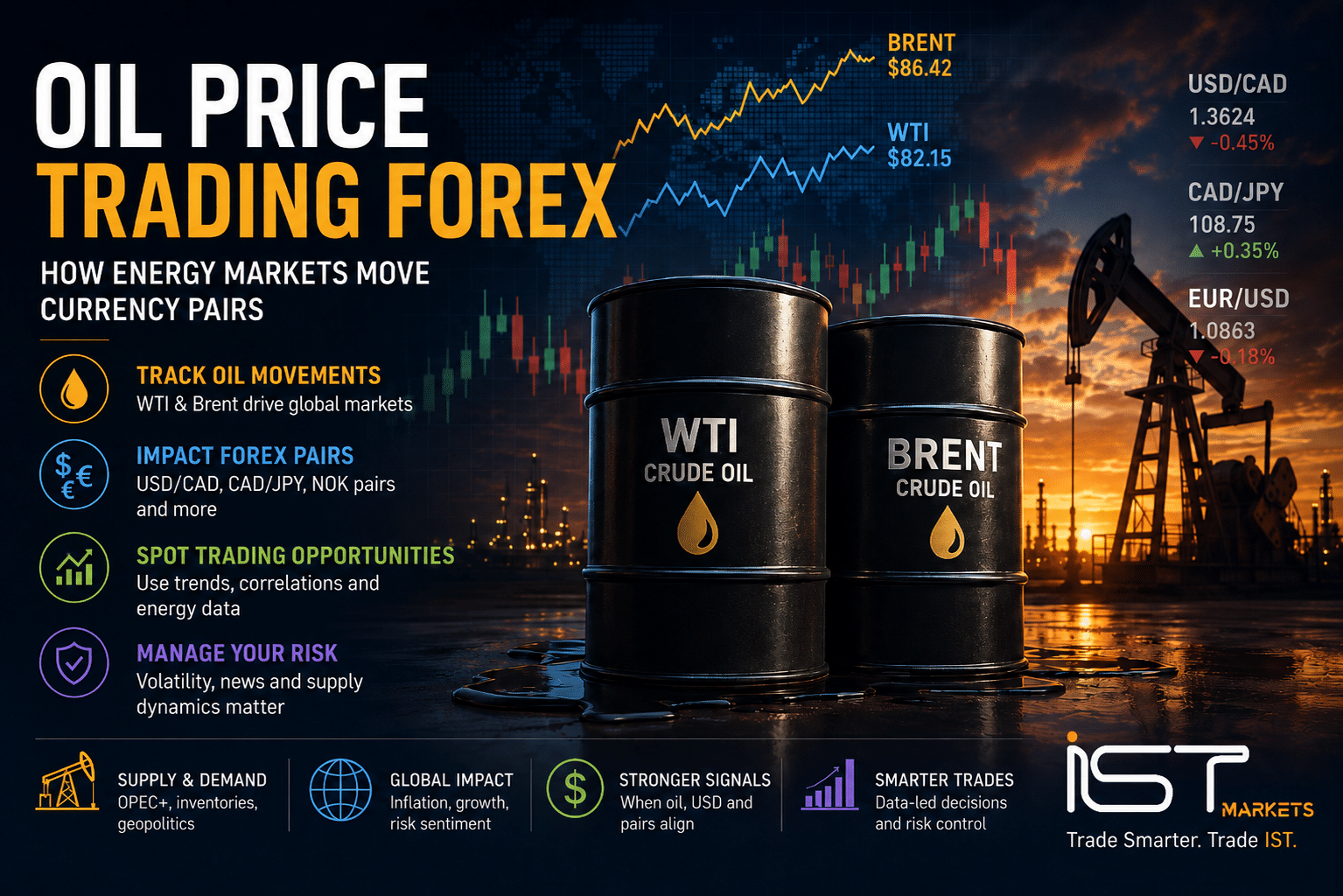
Oil rarely moves quietly. A supply headline in the Middle East, an unexpected inventory draw, a shift in OPEC+ guidance, or a stronger US dollar can change the tone of the energy market within hours. For forex traders, the question is not simply whether oil is rising or falling. The better question is: what kind of oil move is this — and which currency pair expresses it most clearly?
That is where oil price trading forex analysis becomes useful. Crude oil prices can influence inflation expectations, commodity-linked currencies, global risk sentiment, and central-bank expectations. But the relationship is not mechanical. Higher oil does not always mean a stronger Canadian dollar. Lower oil does not always mean a clean short-energy trade. The market driver matters.
This guide is written for intermediate traders who want to connect crude oil trading, energy market analysis, and forex pair selection into one practical decision framework. The goal is not to predict every move in WTI or Brent. The goal is to know when oil matters, which pairs to watch, what risks can break the signal, and how to decide whether an energy-linked trade fits your risk profile.
Oil-Forex Decision Framework
Before looking for a trade, traders should first classify the oil move. This keeps the analysis calm and practical. The strongest trades usually happen when the oil driver, the currency pair, the US dollar, and broader risk sentiment all point in the same direction.
Step 01
Identify the Driver
Is oil moving because of supply disruption, demand optimism, inventory data, OPEC+ policy, geopolitical risk, or USD weakness?
Step 02
Choose the Right Market Expression
Sometimes the cleanest expression is crude oil itself. Other times, a currency pair from your monitored trading pairs list may offer a more structured setup.
Step 03
Check the Correlation
Oil-sensitive currencies do not always move with crude. Use correlation trading as a filter, not as a guaranteed signal.
Step 04
Match the Trade to Your Risk Profile
Oil-linked setups can move fast. The right choice depends on your timing, stop size, leverage, market hours, and tolerance for headline risk.
Oil Market Drivers
Oil prices are shaped by more than one story at a time. A trader who only watches the price chart may see a breakout, but miss the reason behind it. For energy market traders, the reason matters because a supply-driven oil rally can affect forex differently from a demand-driven rally.
Supply Dynamics
Supply is the most visible oil driver. Production cuts, unplanned outages, sanctions, shipping disruption, or conflict near key transit routes can create a risk premium. This can support WTI and Brent, especially when inventories are already tight. The trade-off is that supply headlines can reverse quickly if tensions cool or production returns faster than expected.
Demand Expectations
Demand-driven oil rallies are different. If crude rises because global growth expectations improve, commodity currencies may benefit alongside equities and other risk assets. If oil rises because consumers and businesses face higher fuel costs, the same move may become a headwind for growth and risk sentiment.
Inventories and Refining Margins
Inventory reports can shift short-term direction. Large crude draws often suggest tighter supply or stronger demand, while builds may pressure prices. But traders should also watch refined products, such as gasoline and diesel, because crude prices do not always tell the full energy story. Refining margins can reveal whether the stress is in crude supply, product demand, or refinery capacity.
The US Dollar
Oil is globally priced in US dollars, which means dollar strength can pressure crude by making it more expensive for non-dollar buyers. But this relationship is not fixed. If the supply shock is strong enough, oil can rise even while the dollar is firm. This is why traders should separate the oil driver from the currency driver before choosing a setup.
Best suited for: Traders who follow macro data, inventory releases, geopolitics, OPEC+ updates, and USD direction together. If you only want a clean technical chart, oil-linked trades may feel noisy around news events.
Forex Pair Impact
Oil can influence forex through trade balances, inflation expectations, central-bank policy, and investor sentiment. The impact is usually clearest in currencies linked to major oil exporters or energy-sensitive economies.
USD/CAD: The Classic Oil-Forex Pair
Canada is a major oil exporter, so USD/CAD is one of the most watched oil-sensitive currency pairs. In many environments, stronger oil can support CAD and pressure USD/CAD lower. The trade-off is that USD/CAD is also driven by Bank of Canada policy, US data, yield spreads, and broad USD direction. Oil matters, but it is not the only driver.
NOK Pairs: Energy Exposure with Liquidity Trade-Offs
The Norwegian krone often attracts attention when oil prices move because Norway is an energy exporter. NOK pairs can respond to oil strength, but traders should be careful with liquidity, spreads, and local central-bank factors. This can make NOK attractive for experienced traders, but less suitable for those who need tighter execution.
JPY and EUR: Energy Importer Sensitivity
For energy importers, rising oil can create inflation pressure and affect trade balances. Japan is often watched in this context, though USD/JPY is still heavily influenced by yield differentials and central-bank policy. The euro can also react to energy prices, especially when energy costs affect growth or inflation expectations in Europe.
AUD and Risk Sentiment
AUD is not a pure oil currency, but it can react when oil moves as part of a broader commodity or risk sentiment theme. If oil rises alongside metals, equities, and global growth optimism, AUD/USD may participate. If oil rises due to geopolitical stress, the signal may be less supportive for risk currencies.
| Pair | Oil Link | Main Benefit | Main Trade-Off |
|---|---|---|---|
| USD/CAD | Strong | Clear energy-exporter angle | USD and rate spreads can dominate |
| NOK pairs | Strong | Energy-sensitive currency exposure | Liquidity and spreads require care |
| USD/JPY | Indirect | Useful when oil affects inflation and yields | Rates usually matter more |
| AUD/USD | Theme-based | Works when oil is part of broad commodity strength | Not a pure oil pair |
Trading Strategies
Oil-linked trading strategies work best when they start with the driver and then move to the instrument. A trader should not automatically buy CAD because crude rises. The stronger approach is to ask why crude is rising, whether CAD confirms the move, and whether the pair offers a clean technical structure.
Setup 01
Oil Breakout + CAD Confirmation
This setup works best when WTI or Brent breaks a major level and USD/CAD confirms by moving lower. The trade-off is that a broad USD rally can weaken the signal.
Setup 02
Inventory Surprise Reaction
Inventory data can trigger short-term volatility. This suits traders who can react quickly and manage spreads. It may not suit traders who prefer slower, lower-noise setups.
Setup 03
Geopolitical Risk Premium
Supply-risk rallies can be powerful, but they can also reverse sharply if tensions ease. This is better suited to traders with strict stops and clear event-risk rules.
Setup 04
Commodity Basket Confirmation
If oil, metals, commodity currencies, and risk sentiment all align, the signal is stronger. This approach overlaps naturally with broader commodity trading analysis.
Current Trends
Oil market analysis in the current environment is shaped by a mix of supply uncertainty, demand resilience, inventory sensitivity, and geopolitical risk. Traders should avoid treating one headline as the full story. A higher oil price can reflect genuine demand strength, limited supply, or temporary risk premium. Each has a different implication for forex.
Trend 1: Geopolitical Risk Premium
When markets price disruption risk around major producing regions or shipping routes, Brent and WTI can rise quickly. In that case, commodity-linked currencies may react, but safe-haven flows into USD or JPY can complicate the setup. Traders should check whether the oil rally is risk-on or risk-off.
Trend 2: OPEC+ and Supply Management
OPEC+ decisions can influence expectations for future supply. Production guidance, compliance signals, and policy changes often affect oil sentiment before physical balances fully adjust. For forex traders, the key is whether OPEC+ news changes the outlook enough to move energy-linked currencies.
Trend 3: Demand Divergence
Oil demand is not uniform across regions. Emerging-market demand, aviation fuel, freight, industrial activity, and consumer fuel use can move at different speeds. This makes it important to watch whether price strength is broad-based or concentrated in a specific product or region.
Trend 4: USD and Real Yields
A stronger dollar and higher yields can reduce risk appetite and pressure commodities, but supply shocks can override that pressure. This is why oil price trading forex analysis should always compare crude direction with DXY, rates, and the relevant currency pair.
Current-trends takeaway: Oil is not one signal. It is a cluster of supply, demand, policy, geopolitical, and currency signals. The stronger trade usually appears when several of those signals align.
Comparison Table: Energy Market Trading Choices
| Choice | Best For | Difficulty | Main Benefit | Main Trade-Off | Best Fit |
|---|---|---|---|---|---|
| WTI / Brent | Direct oil exposure | Medium to high | Pure energy price view | Headline volatility | Active commodity traders |
| USD/CAD | Oil-forex integration | Medium | Clear energy-linked FX pair | USD and BoC drivers | Forex traders watching oil |
| NOK pairs | Energy-sensitive currencies | High | Strong oil sensitivity | Liquidity and spread concerns | Experienced macro traders |
| AUD/USD | Broad commodity sentiment | Medium | Risk and commodity overlap | Not a direct oil proxy | Multi-asset traders |
Recommended For
- Best for direct oil views: WTI or Brent.
- Best for forex traders: USD/CAD when oil and CAD confirm each other.
- Best for advanced energy-FX exposure: NOK pairs, if spreads and liquidity are acceptable.
- Best for broader risk sentiment: AUD/USD when oil strength is part of a wider commodity rally.
Scenario Example
Imagine Brent and WTI rise after a larger-than-expected inventory draw. At the same time, USD/CAD begins to move lower, CAD crosses strengthen, and the US dollar is not broadly rallying. This setup may suggest that oil strength is being reflected in Canadian dollar performance.
A trader does not need to trade immediately. The decision is whether the move is clean enough. If the oil breakout is confirmed by CAD strength and the technical structure in USD/CAD is clear, the setup may be worth monitoring. If oil rises but USD/CAD ignores the move, the better decision may be to wait.
Frequently Asked Questions
How do oil prices affect forex trading?
Oil prices can affect forex through commodity currencies, inflation expectations, trade balances, and risk sentiment. The impact is usually strongest when oil moves are confirmed by currency-pair structure and broader macro conditions.
Which forex pair is most affected by crude oil?
USD/CAD is one of the most watched oil-sensitive forex pairs because Canada is a major oil exporter. However, USD direction, interest-rate expectations, and Bank of Canada policy can still dominate the pair.
What is the difference between WTI and Brent?
WTI is a US crude oil benchmark, while Brent is a global benchmark often used for international oil pricing. Traders watch both because spreads between WTI and Brent can reflect regional supply, demand, and logistics conditions.
Is oil price trading suitable for beginners?
Oil-linked trading is usually better suited to traders who understand volatility, news risk, spreads, and correlation. Beginners can study oil as a market driver, but should be cautious with leveraged exposure.
Can oil prices move forex pairs even if I do not trade crude oil?
Yes. Even if you do not trade crude oil directly, oil price movements can influence currencies linked to energy exports, inflation, and global risk sentiment. That is why many forex traders monitor WTI and Brent.
What is the biggest risk in oil-linked forex trading?
The biggest risk is assuming that oil and a currency pair will always move together. Correlations can weaken or reverse when the US dollar, central-bank expectations, or local economic data dominate.
Risk Warning
Trading forex, commodities, CFDs, and leveraged products involves substantial risk and may not be suitable for all investors. Oil-linked markets can be highly volatile around news, inventory data, OPEC+ decisions, and geopolitical developments. You may lose some or all of your invested capital. This article is for educational purposes only and does not constitute investment advice or a recommendation to trade.
Trade Energy Pairs with IST Markets
Not sure whether crude oil, USD/CAD, or another energy-linked setup fits your view? Compare available markets, monitor correlations, and trade with a clearer risk framework.
Prefer to compare first? Review available trading pairs and commodity exposure before you decide.
Sources & Further Reading