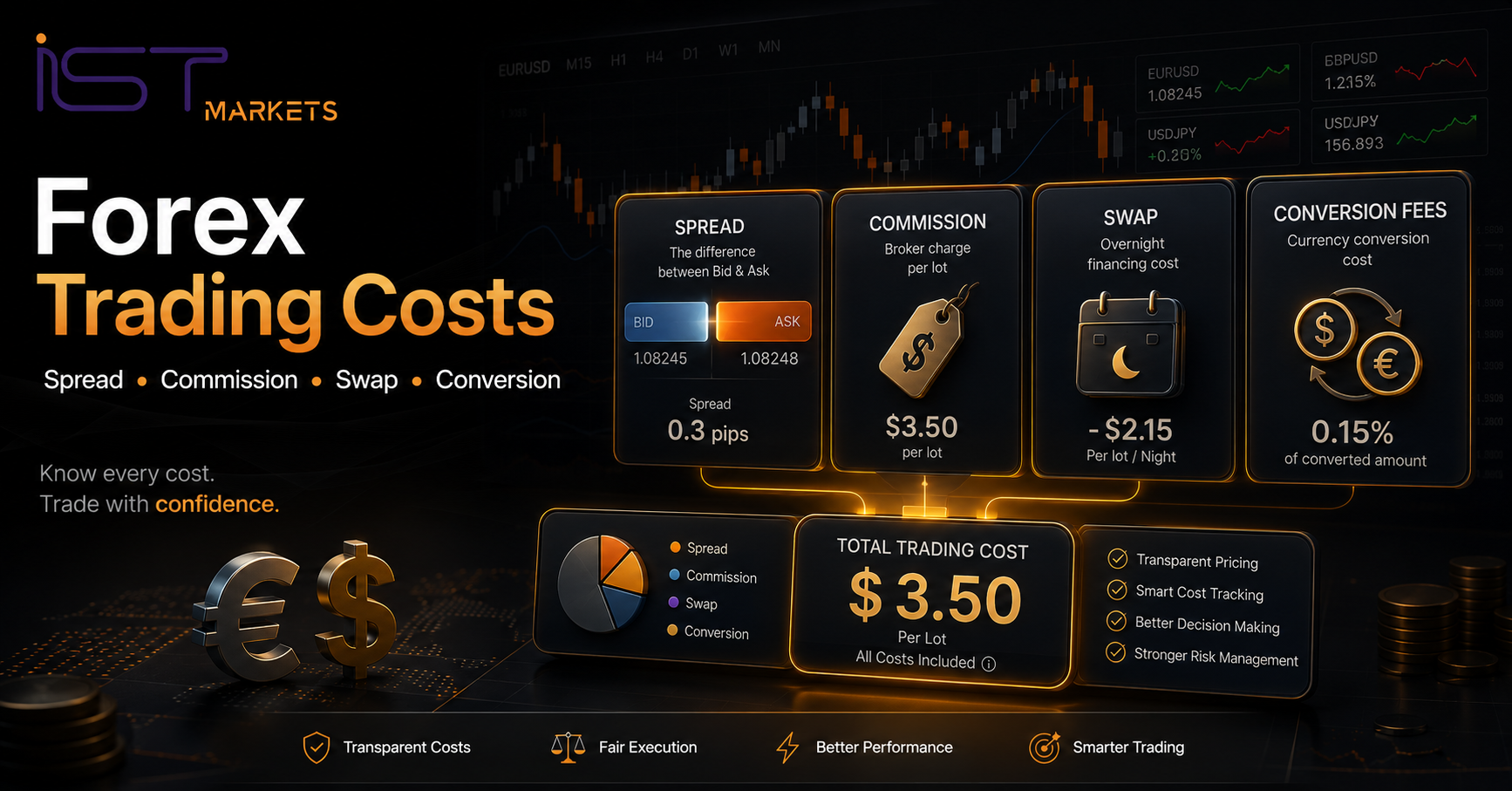
Trading Costs in Forex: Spread, Commission, Swap and Conversion Fees Explained
A practical total-cost guide for traders who want to compare accounts, funding routes and trading conditions without being distracted by one headline spread.
Quick Answer: What are forex trading costs?
Forex trading costs are the charges and pricing effects that can influence a trade before funding, at entry and exit, while the order is being executed, during overnight holding and when money is withdrawn. They may include the bid/ask spread, commission, swap, currency conversion and charges imposed by banks or payment providers. Spread is only the first visible layer. A fair account comparison should also consider lot size, trading frequency, holding period, account currency and changing execution conditions.
Important risk reminder
Lower costs do not make leveraged forex or CFD trading safe. Market losses, margin pressure, gaps, volatility, liquidity changes and execution differences can outweigh the fees discussed in this guide. This article explains how to assess costs; it does not recommend an account, position, strategy or funding decision.
Pricing and methodology note
This guide separates direct fees from execution variability and market risk. Product figures should always be checked against the current
IST Markets fee schedule,
account-type page,
platform contract specifications and the documents applying to your account.
Hypothetical examples below are educational and are not quoted IST pricing.
The five layers of forex trading cost
The spread is the cost most traders notice first. It is not necessarily the cost that matters most over the life of the trade. A useful cost review separates five different layers instead of placing every negative outcome under the word “fee.”
| Cost layer | What it includes | What it actually is |
|---|---|---|
| Transaction cost | Spread and commission. | The cost connected directly to opening and closing trades. |
| Holding cost | Swap or overnight funding. | An adjustment that may apply when positions remain open after rollover. |
| Money-movement cost | Currency conversion and third-party payment charges. | A cost connected to the currency or route used to fund and withdraw. |
| Execution variability | Spread widening, slippage, gaps and rejected or delayed orders. | Not a fixed fee; the outcome may differ as market conditions change. |
| Capital and market risk | Losses, margin pressure and liquidation risk. | Not a fee, but potentially much larger than the fee structure. |
Trader’s takeaway
Not every trading cost is a fee, and not every trading risk should be presented as a fee. Separating the categories makes account comparisons more accurate.
The IST Total Cost Audit: six checks before you fund
Before choosing an account, calculate the cost path that matches how you expect to use it. The following framework is designed to prevent a decision based on one promotional figure.
What spread and opening commission could apply at your usual lot size?
Will commission apply again, and could the closing spread be different?
Could the position remain open after rollover, and for how many nights?
Do the account, deposit and withdrawal currencies match?
Could a bank, card, wallet or intermediary apply its own charge?
Are you trading around news, thin liquidity, market openings or gaps?
Estimated all-in planned cost
When forex trading costs appear
| Stage | What to check | Why it matters |
|---|---|---|
| Before funding | Account currency and payment route. | Conversion or external-provider charges may alter the credited amount. |
| Before choosing an account | Spread model and commission basis. | The suitable cost structure depends on frequency and trade size. |
| Before placing the order | Current spread, volume and pip value. | A cost quoted per lot must be converted to your actual position size. |
| During execution | Liquidity, volatility, slippage and available price. | The final fill may differ from the screen price. |
| While holding | Swap, margin usage and rollover schedule. | A day trade can become a multi-day cost decision. |
| When withdrawing | Withdrawal currency and third-party deductions. | The received amount may differ from the requested amount. |
Spread and commission: calculate the complete trade
The spread is the difference between the bid and ask prices. Commission is a separate transaction charge that may be quoted per side or as a complete round-turn amount. A tight displayed spread is therefore incomplete information until you understand the commission basis.
Estimated spread cost ≈ spread in pips × pip value at the selected position size
Round-turn commission = opening commission + closing commission
Do not multiply a commission by two if the published amount is already described as “round turn.” Also avoid using the pip value for one standard lot when your real trade size is 0.10 or 0.01 lot.
Cost-to-breakeven
Cost-to-breakeven is the approximate favourable price movement required to cover transaction costs before a trade reaches a positive net result.
Hypothetical example
A trade has a 0.7-pip spread and commission equivalent to 0.6 pip at the selected size. Its approximate transaction cost-to-breakeven is 1.3 pips before swap or slippage.
This does not mean the market must move exactly 1.3 pips in every circumstance; bid/ask pricing and closing conditions can change. The figure is a planning tool, not a prediction.
Swap and cumulative holding cost
When a leveraged position remains open after rollover, an overnight adjustment may apply. It may be a debit or credit depending on the instrument, direction and current terms. A credit should not be treated as guaranteed income, and a small daily debit can become material when it repeats.
| Holding period | If the hypothetical daily debit is $1.25 | What to remember |
|---|---|---|
| 1 night | $1.25 | The first overnight adjustment. |
| 3 nights | $3.75 | Rates or multi-day adjustments may differ. |
| 7 nights | $8.75 | Cumulative cost matters more to longer holds. |
| 30 nights | $37.50 | Do not assume the daily rate stays unchanged. |
The figures above are hypothetical. Actual swap can change, and some instruments may apply larger adjustments on particular rollover days. Verify long and short rates inside the platform specifications.
For a position that may remain open longer, compare both the daily charge and its cumulative effect. A small daily figure can look less significant than the amount it produces over several weeks.
Conversion fees and the funding route
If your deposit or withdrawal currency differs from the account currency, conversion may apply. The exchange rate and any additional charge may come from the broker, bank, card network, wallet, payment processor or intermediary involved in the route.
IST Markets states that it charges zero broker fees on deposits and withdrawals, while third-party providers may still apply intermediary, beneficiary-bank or payment-provider charges. Review the current
funding and withdrawal terms
before initiating a payment.
The key distinction
“Zero broker funding fee” does not automatically mean “zero total payment cost.” The payment route may still change the amount that reaches the trading account or bank account.
Execution variability: slippage is not a fixed fee
Slippage is the difference between the expected price and the executed price. It can be positive or negative and may occur during news, low liquidity, market openings, gaps or connection delays. Spread widening may also change the cost visible on the deal ticket.
These outcomes should not be mixed with fixed commission. They are execution variables. Review the
order execution policy
to understand how market orders, stop orders, gaps, available liquidity and changing prices may affect a fill.
How to compare two forex accounts fairly
A fair account comparison changes the pricing model—not every assumption at the same time. Use the same instrument, trade size, market window, holding period and account currency for both accounts.
| Comparison field | Account A | Account B |
|---|---|---|
| Actual spread at the same time | ||
| Round-turn commission at your lot size | ||
| Expected nights held | ||
| Estimated overnight adjustment | ||
| Currency conversion | ||
| Estimated all-in cost |
Which costs matter most to different traders?
| Trading behaviour | Costs to study closely |
|---|---|
| Frequent intraday trading | Spread, commission and slippage repeated across many trades. |
| Swing or multi-day trading | Swap, cumulative holding cost, gaps and margin use. |
| Trading around news | Spread widening, liquidity and execution variability. |
| Funding in another currency | Conversion and third-party payment charges. |
| Hedged long and short positions | Commission and possible funding charges on both open legs. |
Practical scenario: the account with the lower spread
A beginner compares two hypothetical accounts for a 0.10-lot EUR/USD trade. At that size, assume the pip value is approximately $1 for this simplified example.
- Account A: 1.3-pip spread and no separate commission → estimated transaction cost: $1.30.
- Account B: 0.2-pip spread plus $0.80 round-turn commission → estimated transaction cost: $1.00.
Hypothetical figures only. They do not represent current IST Markets pricing.
Account B is cheaper in this isolated example. But the trader frequently holds positions overnight and deposits in a currency different from the account currency. Once swap and conversion are included, the final comparison may change.
Small differences across repeated trades
| Extra cost per complete trade | 10 trades | 50 trades | 100 trades |
|---|---|---|---|
| $0.50 | $5 | $25 | $50 |
| $1.00 | $10 | $50 | $100 |
| $2.00 | $20 | $100 | $200 |
A difference that looks insignificant on one ticket can become material when repeated across many trades.
Cost-to-risk ratio
This is a planning diagnostic, not an industry rule or a universal acceptable threshold. It simply shows how much of the amount you intended to risk is already being consumed by transaction cost.
Do matched long and short positions remove trading costs?
Not necessarily. Opening equal long and short positions may reduce net market exposure, but both contracts remain open. Depending on the provider’s terms, each leg may still attract commission, spread and overnight funding.
The FCA has highlighted that matched CFD positions can accumulate substantial ongoing charges when providers apply funding to gross open positions. Before hedging, compare the cost of keeping both legs open with the cost and consequences of closing the original position.
What “low cost” does not automatically mean
| Headline | What it does not prove |
|---|---|
| Low or zero spread | The lowest all-in cost after commission and changing conditions. |
| Commission-free | That the transaction has no cost; pricing may be built into the spread. |
| Zero broker funding fee | That banks or payment providers will not charge. |
| Swap-free | That no administrative fee, condition or eligibility rule applies. |
| Demo pricing | Identical future live fills, fees, psychology or execution. |
| A deposit promotion | A reduction in the underlying cost of executing or holding trades. |
Common mistakes beginners should avoid
| Mistake | Better routine |
|---|---|
| Comparing headline spreads from different times | Compare the same instrument at the same time and similar conditions. |
| Confusing per-side and round-turn commission | Confirm whether the published amount covers one side or the full trade. |
| Using a standard-lot pip value for a smaller trade | Calculate cost at the actual volume you expect to use. |
| Ignoring swap because the trade was meant to be intraday | Repeat the cost check whenever the holding plan changes. |
| Assuming zero broker fee means zero payment cost | Check the bank, card, wallet and intermediary route. |
| Treating slippage as a guaranteed fixed charge | Treat it as execution variability that can be positive or negative. |
| Using demo results as proof of live cost | Use demo for workflow, then verify live pricing and terms separately. |
Forex trading costs checklist before opening or funding
Cost planning cannot remove market risk. Leverage can magnify losses and costs relative to the funds supporting a position. Orders may also be affected by gaps, liquidity, changing prices, platform or communications interruptions and insufficient margin.
Compare the full cost path before you fund
Review the current
trading fees and costs,
compare the published
account types,
check
funding and withdrawal terms,
and read the
risk disclosure.
Practise the workflow on a
demo account,
but verify current live terms before using real funds.
The cheapest-looking account is not automatically the lowest-cost account for your behaviour. Calculate one complete trade at your real position size, then add the costs that appear only when you hold, convert currency, move money or trade in changing market conditions.
Frequently Asked Questions
What are the main forex trading costs?
They may include spread, commission, overnight swap, currency conversion and third-party funding charges. Spread widening and slippage can also affect the realised cost but are execution variables rather than fixed fees.
Is a zero-spread account always cheaper?
No. A zero or very low displayed spread may be combined with commission. Compare the actual spread and complete round-turn commission at your expected trade size.
What does round-turn commission mean?
Round-turn commission normally describes the combined commission for opening and closing a trade. Confirm the provider’s definition before calculating because some prices are instead quoted per side.
How can trading frequency affect costs?
Spread and commission repeat with each complete trade. A small difference per trade can become significant across dozens or hundreds of transactions.
Can hedged forex positions still incur costs?
Yes. Equal long and short positions remain separate open contracts. Depending on the applicable terms, commission, spread and overnight funding may affect both legs.
Does zero broker deposit fee mean funding is free?
Not necessarily. A bank, card network, wallet, intermediary or payment processor may apply conversion or transaction charges even when the broker charges zero.
Do demo accounts show the real cost of live trading?
Demo accounts can help traders learn the platform and find where costs appear, but they do not prove future live spreads, fills, swap rates, payment-provider charges or results.
References and Further Reading
IST Markets documents
- Trading Fees and Costs
- Trading Account Types
- Funding and Withdrawals
- Islamic and Swap-Free Account Terms
- Order Execution Policy
- Risk Disclosure
- Demo Account vs Live Account
Official external guidance
- FCA — CFD Providers’ Provision of Price and Value
- CFTC — Foreign Currency Trading
- eCFR — Retail Forex Risk Disclosure Statement
This article uses current fee, account, funding, execution and risk materials as primary sources. Hypothetical calculations are labelled clearly. Review the article whenever pricing, platform specifications, payment routes, risk documents or account terms materially change.