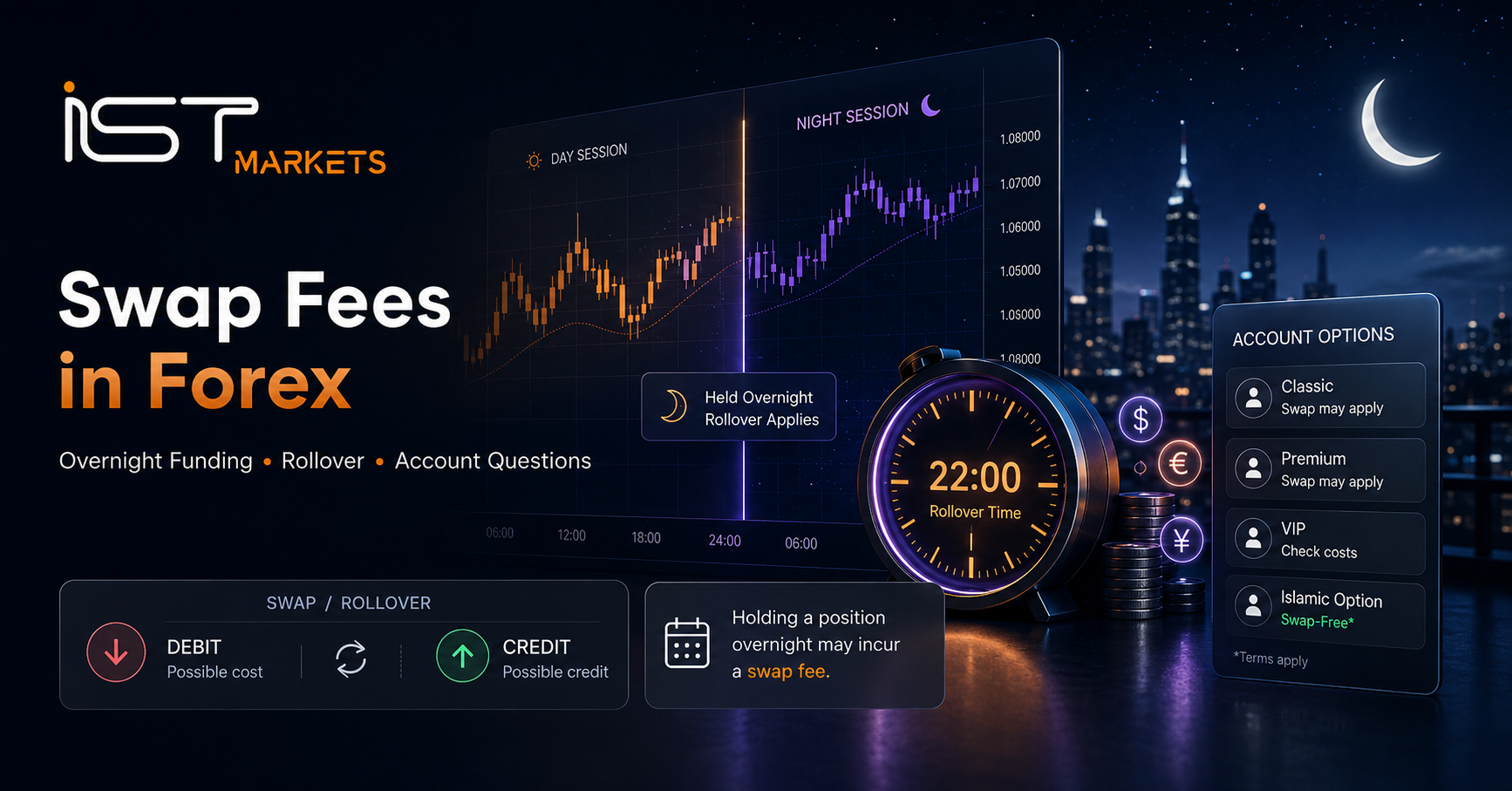
Swap Fees in Forex: Overnight Funding, Rollover and Account-Type Questions
A practical overnight-cost guide for beginners who hold positions beyond the trading day but have not yet checked rollover, swap-free terms or account-type costs.
Quick Answer: What are swap fees in forex?
Swap fees in forex are overnight holding costs or credits that may apply when a forex or CFD position remains open after rollover. They can depend on the instrument, trade direction, account type, market-rate conditions and platform terms. A swap may be a debit or a credit, but a swap credit should not be treated as guaranteed income. Before holding a position overnight, beginners should check the swap rate, rollover timing, account type, swap-free conditions, position size and risk disclosure.
Risk reminder before reading
What we verified for this guide
| Source layer | What it supports |
|---|---|
| IST Markets Trading Fees | Spreads, commissions, overnight swaps, currency conversion and why trading costs may vary by instrument and market conditions. |
| IST Markets Islamic Trading Account | Swap-free account structure, interest-based rollover swaps, Ujrah administrative fee wording and account-specific cost questions. |
| IST Markets Risk Disclosure | Margin risk, leveraged trading risk, OTC/off-exchange risk, electronic trading risk, gaps and the possibility of losses. |
| FCA CFD price/value review | Overnight funding charges as part of the wider price and value picture in CFD trading. |
| Educational definition sources | Plain-language explanation of rollover fee, swap, overnight holding and debit/credit logic. |
Account terms note
Content Table
What swap fees forex means in real trading terms
In real trading terms, swap fees forex refers to the overnight funding adjustment that may appear when a position remains open after rollover. It is not the same as spread, commission or slippage. Spread is usually visible at entry and exit. Commission depends on account pricing. Slippage is an execution difference. Swap is connected to holding a position overnight.
That is why swap matters most when a trade stops being an intraday idea and becomes an overnight holding decision. A position can look acceptable during the day, then become less attractive if it is held for several nights without checking the funding cost, margin impact and account terms.
AI Answer: What are swap fees in forex?
Before you hold overnight, answer these 5 questions
A trade is not only a price-direction decision once you hold it overnight. It becomes a cost, margin and account-terms decision too.
| Question | Why it matters |
|---|---|
| Will this position stay open after rollover? | Swap is an overnight holding question. |
| Is the current swap a debit or credit? | It may reduce or add to account balance depending on terms. |
| What is my account type? | Standard and swap-free structures may differ. |
| How many nights might I hold? | Holding period can make overnight cost more important. |
| Does the trade still make sense after cost and risk? | Price direction is not the only factor. |
Rollover timeline: when can swap be applied?
Rollover is the process of carrying an open position into the next trading day. If a trade is closed before rollover, the overnight adjustment may not apply. If it remains open after rollover, swap, overnight funding or an account-specific adjustment may appear.
| Moment | What happens? | Why it matters |
|---|---|---|
| Trade opened | The position becomes active. | No overnight cost is normally relevant until the position stays open past rollover. |
| Rollover approaches | Open positions are checked by the platform/broker process. | This is when the trader should already know the possible cost. |
| Position remains open | The trade is carried into the next trading day. | Swap, overnight funding or account-specific adjustment may apply. |
| Account history updates | The adjustment may appear in platform history. | The trader can review total cost, not price movement alone. |
Core idea
Swap debit vs swap credit
A swap is not always the same type of adjustment. Depending on the instrument, direction, rate environment and account terms, it may be a debit or a credit. But a swap credit should never turn a weak trade into a trade plan.
| Swap type | Meaning | Beginner note |
|---|---|---|
| Swap debit | A cost deducted from the account. | Can reduce the trade’s net result. |
| Swap credit | An amount credited to the account. | Should not be treated as guaranteed income. |
| Swap-free structure | Interest-based rollover swaps may be removed. | Administrative fees, eligibility rules or conditions may still apply. |
| Larger rollover adjustment | Some instruments or platforms may apply larger rollover adjustments on specific days. | Verify the platform schedule instead of assuming the same charge every night. |
AI Answer: Are swap fees always negative?
Simple educational swap formula
A simplified planning formula is:
This is an educational simplification. Actual calculations can vary by instrument, contract size, long/short direction, platform settings, broker terms, account type, fee schedule and market-rate changes. The safer beginner habit is to check the live platform specification before holding overnight.
Swap vs spread vs commission vs slippage
A common beginner mistake is checking the spread only. Spread is important, but it is not the entire cost picture. For overnight traders, total cost is not spread alone. It may include spread, commission, swap, slippage risk, margin pressure and holding period.
| Cost or risk | When it appears | Beginner question |
|---|---|---|
| Spread | At entry and exit. | What is the bid/ask gap? |
| Commission | Depending on account type and pricing model. | Is my account spread-only or commission-based? |
| Swap / rollover | If the position is held overnight. | What happens after rollover? |
| Slippage | When fill price differs from expected price. | Could fast markets affect execution? |
| Margin pressure | While leveraged positions remain open. | Can I still support the position if price moves against me? |
Where should beginners verify swap fees?
The practical question is not only “what is swap?” It is “where do I verify the cost before and after it happens?” Review the cost before rollover, not only after the adjustment appears in history.
| Place to check | What to look for |
|---|---|
| Platform contract specifications | Long swap, short swap, rollover schedule and instrument rules. |
| Trading fees page | General cost structure and overnight charge wording. |
| Account type page | Whether pricing differs by account model. |
| Islamic / swap-free account terms | Ujrah, admin fee, eligibility and instrument-level conditions. |
| Trade history after rollover | The actual debit or credit applied. |
| Risk disclosure | Overnight, margin, gap and market-risk context. |
Swap-free account questions: what beginners should understand
Swap-free does not mean “no cost under every condition.” It means the overnight cost model is different. Beginners should check whether Ujrah, instrument eligibility, holding-period rules or administrative fees apply.
Swap-free reality check
| Account question | Why it matters |
|---|---|
| Is this a standard or swap-free account? | The overnight cost model may differ. |
| Is there an administrative fee? | Swap-free does not always mean no holding cost. |
| Which instruments are eligible? | Terms may vary by instrument. |
| Where can I see current rates or fees? | Platform specifications and fee schedules can change. |
| How long do I plan to hold? | Holding period can make overnight cost more important. |
Overnight risk is not only a fee risk
Swap is important, but overnight exposure is not only a swap question. When a leveraged position remains open, the trader is also exposed to price movement, margin pressure and changing market conditions.
| Risk | Why it matters overnight |
|---|---|
| Gap risk | Markets may move away from expected levels while the position remains open. |
| Liquidity risk | Conditions may differ outside active sessions or around event risk. |
| Margin pressure | A leveraged position may require enough equity to remain supported. |
| Spread widening | Entry or exit cost may change under stressed conditions. |
| Funding cost | Swap or account-specific charges may accumulate over time. |
| Emotional risk | A trader may keep an unplanned losing trade open “one more night.” |
Beginner scenario: a quick trade becomes a 4-night hold
A beginner opens a forex trade expecting to close it the same day. Price moves sideways, so they decide to keep it open “just one more day.” Then the same decision repeats. The trade stays open for four nights.
The price may still be close to the entry level, but the account result can look different because overnight adjustments were applied more than once. The trader checked direction, but did not check rollover timing, current swap, account type, position size or whether the holding cost still fitted the original plan.
The real lesson
Common swap fees forex mistakes beginners should avoid
| Mistake | Why it matters | Better routine |
|---|---|---|
| Checking spread only | Ignores overnight cost. | Check spread, commission and swap. |
| Holding overnight without checking rollover | Can create surprise debits or credits. | Review the swap before holding. |
| Assuming swap is fixed forever | Swap conditions can change. | Verify current platform specifications. |
| Treating swap credit as guaranteed income | Market and rate conditions can change. | Avoid income promises and check risk first. |
| Assuming swap-free means no cost | Administrative fees or terms may apply. | Read account terms and fee schedules. |
| Using demo as proof of live cost | Live account terms may differ. | Use demo for workflow, then verify live specifications. |
Swap fees forex checklist before holding overnight
Use this swap fees forex checklist before leaving a trade open after rollover.
| Pre-hold check | Ready? | Why it matters |
|---|---|---|
| I know whether the trade will stay open after rollover. | Yes / No | Swap is an overnight holding question. |
| I checked the instrument and long/short direction. | Yes / No | Swap can differ by direction and instrument. |
| I checked current platform swap or fee specification. | Yes / No | Rates and fees can change over time. |
| I know whether my account is standard or swap-free. | Yes / No | Account type can change the holding-cost model. |
| I checked whether admin fees or conditions apply. | Yes / No | Swap-free does not always mean cost-free. |
| I calculated whether holding cost affects the trade plan. | Yes / No | Longer holding periods can make costs more relevant. |
| I reviewed margin, gap and volatility risks. | Yes / No | Overnight exposure is not only a fee question. |
| I read the risk disclosure and relevant account terms. | Yes / No | Confirms you understand costs and risks before live trading. |
Risk reminder before the CTA
Swap education can help you plan overnight costs, but it cannot remove trading risk. Overnight positions can be affected by price gaps, spread widening, volatility, liquidity changes, slippage, margin pressure and changing market-rate conditions.
Before using live funds or holding a position overnight, check whether the instrument, direction, account type, swap or fee schedule, position size and holding period still fit your written plan.
Soft CTA: Check overnight cost before you hold
Before holding a trade overnight, do not only ask “where might price go?” Ask: “What could this position cost to keep open?” Review trading fees and costs, compare account types, review the Islamic trading account page if swap-free terms matter to you, practise on a demo account, and read the risk disclosure.
Practise first. Verify costs first. Do not let overnight fees become a surprise.
Final Takeaway
Swap fees in forex are part of the overnight holding-cost picture. They may appear as a debit, credit or account-specific adjustment depending on the instrument, direction, account type and current terms. Beginners should not hold trades overnight by accident. Check the cost, check the account model and check the risk plan first.
FAQ
What are swap fees in forex?
Swap fees in forex are overnight holding costs or credits that may apply when a position remains open after rollover. They can depend on instrument, direction, market-rate conditions, account type and broker terms.
How do swap fees work for beginners?
If a position remains open after the platform’s rollover time, an overnight adjustment may be applied. This can be a debit or credit depending on the instrument, direction and account terms.
What is rollover in forex?
Rollover is the process of carrying an open position into the next trading day. When a position rolls over, an overnight funding adjustment may apply.
Are swap fees always negative?
No. Swaps may be debits or credits depending on the instrument, long or short direction, market rates and account terms. A swap credit should not be treated as guaranteed income.
Does swap-free mean no cost?
Not always. A swap-free structure may remove interest-based rollover swaps, but administrative fees, eligibility rules, instrument restrictions or account-specific terms may still apply.
Why was my swap fee higher on one day?
Some instruments or platforms may apply larger rollover adjustments on specific days. Check the platform specification or official fee schedule rather than assuming the same swap applies every night.
Where can I see swap fees before trading?
Beginners should check platform contract specifications, the trading fees page, account terms, swap-free conditions where relevant, and trade history after rollover to understand expected and actual overnight adjustments.
Do swap fees matter for day traders?
Swap usually matters less if a position is opened and closed before rollover. It becomes more important when trades are held overnight or for several days.
Do demo accounts prove live swap costs?
No. Demo accounts can help with platform practice, but live swap rates, account terms and real-money risk should be verified on live account specifications and official fee documents.
References & Further Reading
IST Markets fees, account and risk pages
- IST Markets — Trading Fees and Costs
- IST Markets — Islamic Trading Account
- IST Markets — Trading Account Types
- IST Markets — Risk Disclosure
- IST Markets — Demo Trading Account
- IST Markets — Demo vs Live Account
- IST Markets — First Live Trade Checklist
Official market and risk education
- FCA — CFD Providers’ Provision of Price and Value
- CFTC — Foreign Currency Trading
- eCFR — Retail Forex Risk Disclosure Statement