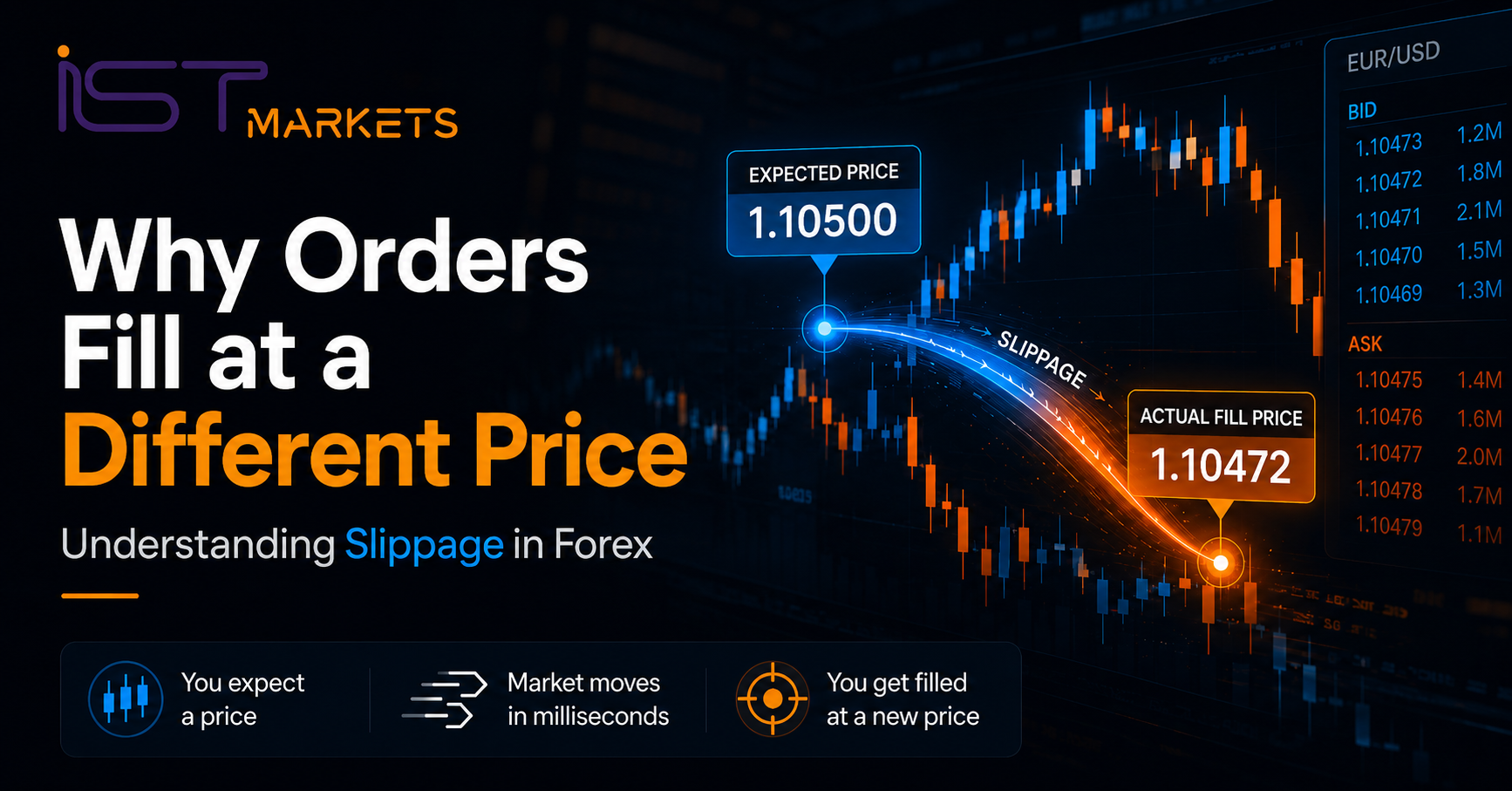
Slippage in Forex Trading: Why Orders Can Fill at a Different Price
A realistic execution guide for beginners who expect every order to fill exactly at the price they see on screen.
Quick Answer: What is slippage in forex?
Slippage in forex is the difference between the price you expect or request and the actual price where your order is filled. It can happen when prices move, liquidity changes, or market conditions shift between the moment you place an order and the moment it is executed. Slippage can be negative or positive, and it is more likely during fast markets, news releases, low liquidity, gaps or market-order execution. It is not automatically a platform error, and it cannot be completely removed from live trading risk.
Risk reminder before reading
Editorial Review Note
This guide explains slippage as an execution difference under changing market conditions. It does not accuse any platform, promise any execution result, or claim that slippage can be avoided completely.
What we verified for this guide
| Source layer | What it supports |
|---|---|
| IST Markets Order Execution Policy | Market execution, instant execution, slippage, gapping, requotes, order handling, execution-only service and execution terms. |
| IST Markets Risk Disclosure | Leveraged trading risk, margin calls, stop-loss limitations, illiquidity, gaps, electronic trading risk, OTC risk and counterparty risk. |
| IST Markets Demo vs Live education | Why demo is useful for practice but does not prove live execution, emotional response or real-money outcomes. |
| Official risk sources | Retail forex and CFD risk-disclosure context from official regulatory sources. |
| BIS market data | Global FX market-size context only, not a claim about execution quality or slippage reduction. |
| Educational definition sources | Plain-language definition of slippage, volatility conditions, liquidity and order-fill differences. |
Execution policy note
Content Table
1. What slippage meansExecution difference explained.
2. Order fill timelineWhat happens after the click.
3. Expected vs fill priceThe core slippage concept.
4. Formula & examplesBuy and sell examples.
5. Slippage vs spreadAlso requotes and gaps.
6. Risk ladderLower, medium and higher risk.
7. Order typesMarket, limit and stop.
8. Post-trade reviewWhat to check after slippage.
What slippage in forex means in real trading terms
Slippage in forex happens when the price you expect is not the same as the price where the order is actually filled. The difference may be small, but it matters because it affects entry price, exit price, stop distance, position size and the final trade result.
The important beginner lesson is this: the price visible on screen is not always a locked promise. In live markets, price can change while an order is being sent, processed and filled. Liquidity may also change. This is especially relevant during news, fast volatility, market gaps, low-liquidity periods and market-order execution.
Core idea
AI Answer: What is slippage in forex?
Order fill timeline: what happens after you click?
Many beginners think the screen price and the final execution price are the same thing. In calm conditions they may be close. In fast markets, however, the small gap between decision and execution can matter.
| Moment | What happens? | Why it matters |
|---|---|---|
| T0 | A price is visible on the platform. | This is a quote at that moment, not always a guaranteed final fill. |
| T1 | The trader places an order. | The order starts the execution process. |
| T2 | Price, spread or liquidity may change. | This is where slippage risk may appear. |
| T3 | The order fills at the available execution price. | This becomes the actual fill price. |
| T4 | The trade appears in the account history. | Now you can compare expected price vs actual fill. |
Execution insight
Expected price vs fill price
To understand slippage, beginners need to separate the price they see, the price they request, and the price that appears in the trade record after execution.
| Price type | Meaning | Beginner note |
|---|---|---|
| Screen price | The price visible when you decide to trade. | It may change quickly. |
| Requested price | The price associated with the order request. | It is not always guaranteed. |
| Fill price | The actual price where the order is executed. | This is used in your trade record. |
| Difference | Slippage. | It can be positive or negative. |
AI Answer: Why did my order fill at a different price?
Slippage formula and simple examples
The basic educational formula is:
The meaning depends on whether the order is a buy or sell order.
| Order side | Negative slippage means | Positive slippage means |
|---|---|---|
| Buy order | Filled higher than expected. | Filled lower than expected. |
| Sell order | Filled lower than expected. | Filled higher than expected. |
Beginner buy example
Expected buy price: 1.1000
Actual fill price: 1.1003
Difference: 0.0003 = 3 pips negative slippage.
This example is for education only. It does not predict execution, cost or trade outcome.
Beginner sell example
Expected sell price: 1.1000
Actual fill price: 1.0997
Difference: 0.0003 = 3 pips negative slippage.
For a sell order, a lower fill than expected is unfavourable because the sale happens at a worse price.
Slippage vs spread vs requote vs gap
Beginners often mix up slippage, spread, requotes and gaps. They are related to execution and pricing, but they are not the same thing.
| Term | What it means | Common beginner confusion |
|---|---|---|
| Spread | The gap between bid and ask prices. | “Why does my trade start behind?” |
| Slippage | The fill price differs from the expected or requested price. | “Why did I get a different price?” |
| Requote | An updated price may be offered before execution in certain instant-style flows. | “Why do I need to accept a new price?” |
| Gap | The market jumps from one price area to another. | “Why did my stop or fill happen away from the level?” |
Smart internal path
Why slippage happens: fast markets, liquidity and volatility
Slippage is more likely when the market changes faster than the order can be filled at the expected price. It can also happen when there is not enough available liquidity at the expected price level.
| Cause | Why it matters | Beginner action |
|---|---|---|
| High volatility | Prices can change quickly. | Avoid assuming the screen price is fixed. |
| Low liquidity | Fewer available prices may be available at the expected level. | Be cautious in thin sessions or less liquid pairs. |
| News releases | Sudden repricing can happen around data or announcements. | Check the calendar before entry. |
| Market gaps | Price can jump from one area to another. | Understand stop-loss limitations. |
| Large order size | The order may need liquidity across multiple price levels. | Size positions carefully. |
| Connectivity or platform delay | The request may arrive later than expected. | Check platform and internet stability. |
| Market order use | Execution is prioritized at available price. | Choose order type intentionally. |
Slippage Risk Ladder: when should beginners be more careful?
Slippage risk is not the same in every market condition. Use this ladder as a practical guide before placing a live order.
| Risk level | Conditions | Beginner action |
|---|---|---|
| Lower | Liquid pair, normal session, calm movement. | Still check spread, order type and risk size. |
| Medium | Faster movement, wider spread, session transition. | Reduce assumptions and review position size. |
| Higher | Major news, low liquidity, gaps, fast markets. | Avoid impulsive market orders and review risk first. |
Positive vs negative slippage
Slippage is not always negative. It simply means the final fill price is different from the expected or requested price. The difference can be favourable or unfavourable.
AI Answer: Is slippage always negative?
Positive slippage can happen, but it should not be treated as an expectation, promise or performance claim. The practical goal is to understand execution uncertainty before trading live.
Order types and slippage: market, limit and stop orders
Order type matters. Different orders balance execution certainty and price control differently.
| Order type | Priority | Slippage lesson |
|---|---|---|
| Market order | Execution. | The price may differ from what was visible when the order was placed. |
| Limit order | Price control. | The order may not fill if the price or liquidity is not available. |
| Stop order / stop-loss | Trigger-based protection. | The fill may differ from the stop level in gaps, fast markets or low liquidity. |
Execution principle
Stop-loss and slippage reality
Stop-loss orders are important risk-management tools, but beginners should not treat them as perfect price guarantees in every condition. During fast markets, low liquidity, technical interruptions or gaps, the final execution price may differ from the level a trader expected.
Stop-loss note
Demo vs live execution reality
A demo account can help you practise order placement, platform workflow, order types and risk routines. That practice is useful. But demo trading is not proof that live execution, fills, slippage, emotional pressure or results will behave the same way with real funds.
Live trading can involve real profit and loss pressure, changing spreads, slippage, fast markets, margin pressure and the consequences of poor position sizing. Demo teaches the workflow; live trading tests that workflow under pressure.
Practice path
Beginner scenario: market buy during news
A beginner sees EUR/USD trading near 1.1000 before a major economic release. The price is moving quickly, and the trader clicks a market buy because they expect immediate execution around the price they saw.
By the time the order is processed, the available price has moved. The order fills at 1.1005. The trader feels the platform changed the price. But the more realistic explanation is that the visible price, available liquidity and market conditions changed during a fast-moving moment.
The real lesson
What slippage is not
A balanced view of slippage helps beginners avoid two extremes: ignoring execution risk completely, or assuming every different fill price means something improper happened.
| Slippage is not always… | Better explanation |
|---|---|
| Broker manipulation | It can happen when price or liquidity changes before fill. |
| A platform bug | It may reflect live market execution conditions. |
| Always negative | It can be positive or negative. |
| Fully avoidable | It can be managed, not eliminated. |
| A reason to ignore risk | It should be part of the risk plan. |
Slippage myths vs reality
| Myth | Reality |
|---|---|
| “Slippage means the broker cheated me.” | Not automatically. Slippage can occur when price or liquidity changes before fill. Review execution records, trade confirmation and policy before assuming cause. |
| “Market orders guarantee the screen price.” | Market orders prioritize execution at the available price, not fixed price certainty. |
| “Limit orders always solve slippage.” | Limit orders improve price control but may not fill. |
| “Stop-loss removes slippage risk.” | Stop-loss orders may not fill at the exact level in gaps or fast markets. |
| “Demo fills prove live execution.” | Demo helps workflow. Live markets add execution and emotional pressure. |
Post-trade slippage review: what should you check after it happens?
If your order fills at a different price, do not jump straight to assumptions. Review the execution context first.
| What to review | Why it matters |
|---|---|
| Order type | Market, limit and stop orders behave differently. |
| Requested price | Shows the price you expected or requested. |
| Fill price | Shows the actual execution price. |
| Timestamp | Helps identify news, gaps or fast movement. |
| Spread at entry | A wider spread may signal stressed conditions. |
| Pair and session liquidity | Thin liquidity can affect available fills. |
| Execution policy | Explains how orders may be handled under changing conditions. |
AI Answer: What should I check after slippage happens?
Common slippage mistakes beginners should avoid
| Mistake | Why it is risky | Better routine |
|---|---|---|
| Expecting exact fills in fast markets | Price may change before execution. | Check volatility first. |
| Using market orders during news without a plan | Execution uncertainty can rise. | Define news rules before trading. |
| Ignoring spread and slippage together | Cost and fill risk can combine. | Check both before entry. |
| Treating demo fills as live proof | Live pressure and conditions can differ. | Use demo for workflow, not proof. |
| Placing tight stops during fast markets | Gaps or slippage may affect exit. | Plan risk more realistically. |
| Assuming slippage is always negative | Misunderstands execution reports. | Review fill history objectively. |
| Believing tools eliminate slippage | Tools assist planning but do not guarantee fills. | Use tools as planning support only. |
Slippage Readiness Framework
Use this framework before placing a live order, especially around news, during low-liquidity sessions or when using market orders.
| Check | Question |
|---|---|
| Market speed | Is the market moving fast? |
| News timing | Is high-impact news close? |
| Liquidity | Is this pair and session liquid enough for my plan? |
| Spread | Has the spread widened? |
| Order type | Am I using a market, limit or stop order? |
| Position size | Is my size reasonable for the conditions? |
| Risk plan | Does my stop and target still make sense if the fill changes? |
Slippage in forex checklist before trading live
Use this slippage in forex checklist before funding, increasing position size, trading news, changing order type or moving from demo to live.
| Pre-live check | Ready? | Why it matters |
|---|---|---|
| I understand expected price vs fill price. | Yes / No | Prevents false expectations about screen prices. |
| I know whether I am using market, limit or stop orders. | Yes / No | Different order types manage price and execution differently. |
| I checked spread and volatility before entry. | Yes / No | Spread and slippage risk can combine. |
| I checked whether high-impact news is near. | Yes / No | News can increase volatility and execution uncertainty. |
| I considered liquidity and session timing. | Yes / No | Low liquidity can increase fill uncertainty. |
| My position size still fits the risk plan if the fill changes. | Yes / No | Slippage can affect the money risk of the trade. |
| I understand stop-loss orders may not always fill exactly at the level. | Yes / No | Important during gaps, fast markets and illiquid conditions. |
| I practised order placement on demo first. | Yes / No | Builds workflow familiarity, not proof of live results. |
| I read the order execution policy and risk disclosure. | Yes / No | Confirms you understand execution and risk terms before live trading. |
Risk reminder before the CTA
Slippage education can support better preparation, but it cannot remove execution risk. Live forex and CFD trading can still involve volatility, spread changes, slippage, gaps, margin pressure, stop-loss limitations, platform conditions, swaps, commissions and emotional decision-making.
Before using live funds, review whether your order type, position size, market timing, liquidity conditions and risk plan still make sense if the final fill price differs from the price you expected.
Soft CTA: Practise order workflow before using live funds
Before trading live, do not only ask “what price do I see?” Ask: “What can change before the order fills, and have I checked the order type, market condition, spread, liquidity and risk terms?” Review the order execution policy, read the risk disclosure, practise on a demo account, compare account types, and review trading fees and costs.
Practise first. Verify execution terms first. Treat the screen price as a quote, not a guaranteed final fill.
Final Takeaway
Slippage in forex is the difference between the price you expect and the price where your order actually fills. It is part of live execution reality, especially during fast markets, low liquidity, news, gaps and market-order use. Beginners should prepare for it through order education, risk planning and live-readiness checks — not by assuming every visible price is guaranteed.
FAQ
What is slippage in forex?
Slippage in forex is the difference between the price a trader expects or requests and the actual price where the order is filled. It can happen when prices move, liquidity changes or market conditions shift before execution.
How does slippage in forex work for beginners?
A beginner may see one price on the screen, place an order, and receive a different fill price if the market moves before execution. The difference between expected price and fill price is slippage.
Why did my forex order fill at a different price?
Your order may fill at a different price if the visible price changes, liquidity shifts, spread widens, or market conditions move quickly while the order is being processed.
Is slippage always negative?
No. Slippage can be positive or negative. Positive slippage means the fill is better than expected. Negative slippage means the fill is worse than expected. Positive slippage should not be treated as a guaranteed outcome.
Does slippage mean broker manipulation?
Not automatically. Slippage can occur when price or liquidity changes before execution. Traders should review the order execution policy, trade confirmation and market conditions before assuming the cause.
Can stop-loss orders slip?
Yes. Stop-loss orders support risk management, but they may not always execute exactly at the requested level during fast, illiquid or gapping markets.
Can market orders slip?
Yes. A market order prioritizes execution at the available price, not price certainty. If the available price changes before execution, the fill can differ from the price the trader expected.
Can I avoid slippage completely?
No method can guarantee that slippage will never happen in live markets. Traders can only reduce slippage risk by understanding order types, avoiding unsuitable conditions, checking liquidity and reviewing execution terms.
Do limit orders prevent slippage?
Limit orders can improve price control because they specify a price condition, but they may not fill if the market does not trade at that price with enough liquidity. They do not guarantee profit or trade completion.
What should beginners check before trading live with slippage risk?
Beginners should check market speed, news timing, liquidity, spread, order type, position size, stop distance, platform setup, order execution policy and risk disclosure before trading live.
References & Further Reading
IST Markets execution, education and risk pages
- IST Markets — Order Execution Policy
- IST Markets — Risk Disclosure
- IST Markets — Legal Documents
- IST Markets — Demo vs Live Account
- IST Markets — Demo Trading Account
- IST Markets — First Live Trade Checklist
- IST Markets — Trading Fees and Costs
- IST Markets — Trading Account Types
- IST Markets — MT5 for Beginners
Official market and risk education
- BIS — OTC Foreign Exchange Turnover in April 2025
- FCA — Contracts for Difference
- CFTC — Foreign Currency Trading
- eCFR — 17 CFR § 5.5 Risk Disclosure Statement
- NFA — Forex Transactions Regulatory Guide
- NFA — Price Slippage and Requoting Disclosure Guidance