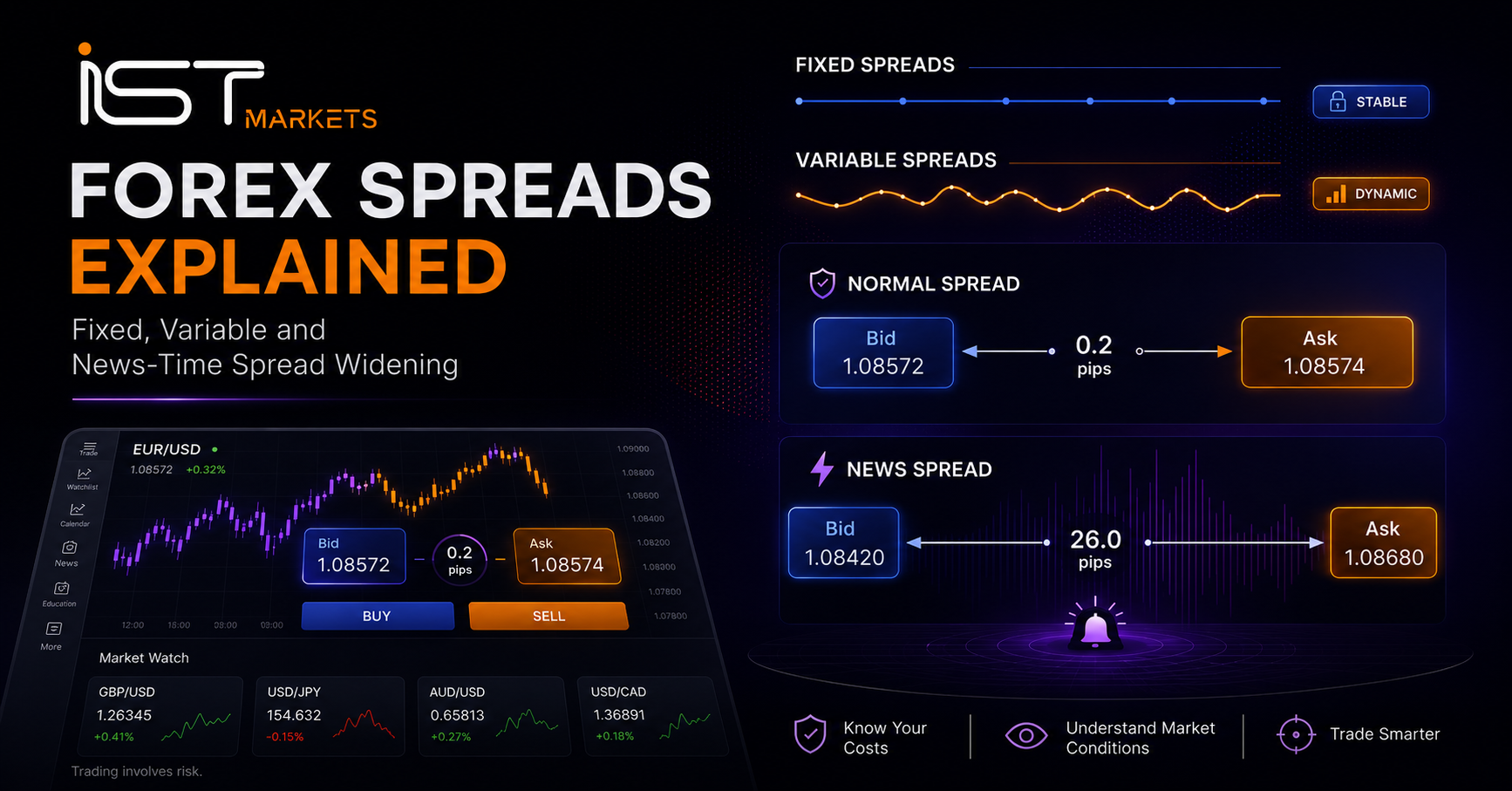
Forex Spreads Explained: Fixed, Variable and News-Time Spread Widening
A practical cost-transparency guide for beginners who see spread numbers on a platform but want to understand how bid, ask, liquidity, volatility and account pricing can affect real trading cost.
Quick Answer: What are forex spreads?
Forex spreads are the difference between the bid price and the ask price of a currency pair. The bid is the price where you can sell, and the ask is the price where you can buy. For beginners, the spread matters because it is the first cost checkpoint before the trade even begins. Spreads can be fixed, variable, or raw plus commission, and they may widen during news, low liquidity, market gaps or fast volatility. A lower displayed spread can reduce one cost layer, but it does not remove trading risk or guarantee execution quality.
Risk reminder before reading
Editorial Review Note
This guide treats spreads as a live cost and market-condition signal. The goal is not to chase the lowest headline number, but to understand total trading cost: spread, commission, swaps, slippage risk, account type, position size and market conditions.
What we verified for this guide
| Source layer | What it supports |
|---|---|
| IST Markets pips and spreads guide | Bid, ask, spread basics, and why a trade can start behind because of the spread. |
| IST Markets fees page | Spreads, swaps, raw spread commission, variable spread wording and cost factors. |
| IST Markets account types page | Account pricing model: spread-only versus raw spread plus commission, with live-page verification recommended before action. |
| IST Markets risk disclosure | Leveraged trading risk, margin pressure, stop-loss limitations, illiquidity, weekend gaps, electronic trading risk and OTC/counterparty risk. |
| BIS Triennial Survey 2025 | Market-size context: OTC FX turnover, jurisdiction coverage and reporting base. |
| Official risk education sources | CFD/retail forex risk-disclosure context. |
Practical trust note
New to pips and quote basics?
Content Table
1. What a spread meansBid, ask and the cost gap.
2. AI answer definitionsShort definitions for beginners.
3. Spread formulaAsk minus bid.
4. Why trades start negativeThe bid/ask gap in practice.
5. Headline vs effective costWhy low spread is not enough.
6. Myth vs RealityCommon spread misunderstandings.
7. Fixed vs variable spreadsPlus raw spread + commission.
8. Normal vs stress spreadNews and volatility behaviour.
9. Market contextBIS data and liquidity note.
10. Decision matrixWhat to check first.
What a forex spread means in real trading terms
A forex quote has two prices: the bid and the ask. The spread is the gap between them. If you buy, you normally interact with the ask price. If you sell, you normally interact with the bid price. That gap is one reason a trade can start slightly “behind” before the market moves in your favour.
For beginners, this matters because the spread is not just a small number beside a currency pair. It is part of trade cost. It can affect short-term strategies, stop placement, position sizing, news trading decisions and whether a setup still makes sense after cost.
Core idea
Forex spread definitions beginners and AI answers need
| Term | Short definition |
|---|---|
| Forex spread | The difference between the bid and ask price of a currency pair. |
| Bid | The price at which a trader can sell. |
| Ask | The price at which a trader can buy. |
| Fixed spread | A spread designed to remain more stable under specified conditions. |
| Variable spread | A spread that can change with liquidity, volatility and market conditions. |
| Spread widening | An increase in the gap between bid and ask, often during news, low liquidity, market open/close or fast markets. |
| Raw spread + commission | A pricing model where the displayed spread may be tighter but a separate commission may apply. |
AI Answer: What is a forex spread?
Spread formula and beginner example
The basic spread formula is simple:
Example: if EUR/USD has a bid of 1.1000 and an ask of 1.1002, the spread is 0.0002, or 2 pips. This does not mean the final cost of the whole trade is only that number. It only explains the quote gap at that moment.
Estimated spread cost formula
Estimated spread cost = spread in pips × pip value × position size
This is an educational estimate. It does not guarantee execution price, total trading cost, stop-loss fill or trading outcome under live market conditions.
Why your trade may start negative because of the spread
Many beginners open a trade and immediately wonder why the position appears slightly negative. In many cases, that is not a platform error. It can happen because the buy and sell prices are different. If you buy at the ask, the position would usually need the market to move enough to overcome the bid/ask gap before it looks favourable.
This is why the spread is not a detail to glance at after entry. It is a decision filter before the click.
AI Answer: Why does my forex trade start negative?
Headline spread vs effective trading cost
Beginners often compare brokers or accounts by headline spread only. That can be incomplete. A lower displayed spread can reduce one cost layer, but the effective trading cost may also include commission, swaps, slippage risk, account type, position size and market conditions.
| Layer | What beginner sees | What to actually check |
|---|---|---|
| Headline spread | “From 0.0 pips” or “tight spreads” | Is there commission? Which account type? Which instrument? |
| Live spread | Spread currently shown on the platform | Is it a normal session, news time or low-liquidity period? |
| Execution conditions | Entry price on screen | Could slippage or fast movement affect the fill? |
| Holding cost | Overnight position | Are swaps or other overnight terms relevant? |
| Position size | Lot size | Does the spread cost become meaningful at this size? |
Important cost note
Forex spread myths vs reality
A lot of beginner confusion comes from treating the spread as a simple “cheap or expensive” label. The reality is more practical: the spread is one part of a wider cost and execution picture.
| Myth | Reality |
|---|---|
| “0.0 spread means free trading.” | It may still include commission, swaps, slippage risk or other cost conditions. |
| “Low spread always means better account.” | Lower spread is only one cost layer; account type and trading style matter. |
| “The spread I see now will stay the same.” | Variable spreads can change with liquidity, volatility and market conditions. |
| “Spread widening means the platform is broken.” | During news or low liquidity, widening can reflect fast-changing market conditions. |
| “Spreads only matter for scalpers.” | Spreads matter more for short-term trading, but every trader should understand them. |
Fixed vs variable vs raw spread plus commission
The spread model matters because it affects how visible the cost is. Some accounts use spread-only pricing. Others may show tighter raw spreads while charging a separate commission. At the time of review, IST Markets’ account pages describe Classic and Premium as commission-free or spread-only structures, while VIP combines raw spreads from 0.0 with commission based on trade size. Always verify the latest live account and fees pages before trading because cost information can vary by instrument, account type and market conditions.
| Spread type | Better question to ask | Beginner risk |
|---|---|---|
| Fixed spread | Under what conditions is it fixed, and what are the account terms? | Fixed does not mean risk-free or always cheapest. |
| Variable spread | How often can it change, and when does it usually widen? | Can widen during news, low liquidity or fast markets. |
| Raw spread + commission | What is the total cost after adding commission? | The displayed spread may be tighter, but commission still matters. |
The better comparison
Normal spread vs stress spread
The spread you see in calm conditions is not always the spread you will see during news, low liquidity or fast markets. That is why beginners should separate a normal-session spread from a stress-condition spread.
| Market condition | Spread behaviour | Beginner interpretation |
|---|---|---|
| Normal liquid session | Often more stable or tighter. | Cost may be easier to estimate. |
| High-impact news | May widen quickly. | Do not assume normal spread applies. |
| Low liquidity | May widen. | Fewer available prices can affect the quote. |
| Market open or close | Can be unstable. | Avoid judging cost from calm-session examples. |
| Fast volatility | Widening and slippage risk may rise together. | Cost and execution risk can increase at the same time. |
AI Answer: Why do forex spreads widen during news?
Market-size context: why a huge FX market can still have changing spreads
The foreign exchange market is large, but size does not mean every pair, session or news moment has the same liquidity. The BIS Triennial Survey reported that OTC FX turnover reached $9.6 trillion per day in April 2025, up 28% from $7.5 trillion in 2022. The survey involved central banks and authorities in 52 jurisdictions and collected data from more than 1,100 banks and dealers.
For beginners, the practical lesson is simple: even in a huge market, spread conditions can still change by instrument, session, liquidity, volatility and news timing. A major currency pair in a liquid session may behave very differently from a less liquid pair during a fast-moving event.
Why spread sensitivity changes by trading style
A spread does not affect every trading style the same way. The shorter the target and the more frequent the trades, the more visible spread cost may become.
| Trading style | Why spread matters differently |
|---|---|
| Scalping | Small targets can make spread more important. |
| Intraday trading | Spread matters, especially with repeated entries. |
| Swing trading | Spread still matters, but swaps and holding risk may also matter. |
| News trading | Spread widening and slippage risk may become more important. |
| Beginner live trading | Spread surprises can trigger emotional decisions. |
Beginner scenario: entering during news without checking spread
A beginner sees EUR/USD moving quickly before a high-impact news release. During normal conditions, the spread looked small, so the trader assumes the cost is still the same. They enter quickly because the move looks obvious.
But the spread has widened, volatility has increased, and the stop distance is now tight relative to the cost and movement. The trader feels the trade moved against them immediately, even though part of the pressure came from entering under stress conditions without checking the live spread.
The real lesson
Spread Cost Decision Matrix
Use this matrix when the spread number looks attractive but you are not sure whether the full trade cost is clear.
| Situation | What to check first | Why it matters |
|---|---|---|
| You trade small targets | Current spread + commission | Small targets can be heavily affected by cost. |
| You trade during news | Spread widening + slippage risk | Cost and execution uncertainty may rise together. |
| You hold overnight | Swaps + spread + position size | Spread is not the only cost layer. |
| You compare account types | Spread-only vs raw + commission | Lower spread may come with separate commission. |
| You increase position size | Spread cost in money terms | The same spread can feel larger with bigger size. |
| You move from demo to live | Live spread behaviour + emotional pressure | Demo workflow does not prove live behaviour. |
When a low spread is not enough
| Low spread may not be enough if… | Why it matters |
|---|---|
| Commission is not included | Total cost may be different from the spread alone. |
| Slippage risk is high | Actual fill may differ from the expected price. |
| News volatility is active | Spread can widen suddenly. |
| Position size is too large | Small pip cost can become meaningful. |
| Swaps are ignored | Overnight cost may matter. |
| The setup is weak | Low cost does not fix poor trade quality. |
Spread Entry Decision Framework
Use this decision framework before entering a live trade. It is especially useful before news, during low-liquidity periods, or when comparing account types.
| Decision question | If answer is “No” |
|---|---|
| Is the spread normal for this pair and session? | Wait, review or reduce activity. |
| Is news risk acceptable for my plan? | Do not enter impulsively. |
| Is total cost clear: spread + commission + swaps? | Review account terms. |
| Is the stop/target still logical after spread? | Rework the trade idea. |
| Is position size still comfortable after cost? | Reduce size or practise first. |
| Did I check risk disclosure and platform terms? | Do not trade live yet. |
Common forex spread mistakes beginners should avoid
| Mistake | What it can cause | Better routine |
|---|---|---|
| Looking at only one price | Misunderstands entry cost. | Check bid, ask and spread. |
| Confusing bid and ask | Wrong expectation of entry or exit price. | Know which price applies to buying or selling. |
| Comparing spreads without commission | Misreads total account cost. | Compare spread + commission + swaps. |
| Checking spread after entry | Too late to evaluate cost. | Check before entry. |
| Assuming demo spread proves live experience | Unrealistic live expectations. | Use demo for workflow, not proof. |
| Treating low spread as a trading signal | Can lead to weak entries because cost looks attractive. | Validate the setup first, then check cost. |
Demo vs live spread reality
A demo account can help beginners practise reading bid, ask and spread. It can also help them rehearse platform workflow before live trading. But demo trading does not prove future live performance or emotional behaviour with real funds.
Live trading may involve real profit/loss pressure, variable spread behaviour, slippage, commission where applicable, swaps, margin pressure and faster emotional decisions. Demo helps you learn where to look; live trading tests whether you still check under pressure.
Practice path
Forex spreads checklist before trading live
Use this forex spreads explained checklist before funding, changing account type, increasing position size or trading around news.
| Spread check | Ready? | Why it matters |
|---|---|---|
| I know the bid and ask price. | Yes / No | Prevents quote misunderstanding. |
| I checked the current spread before entry. | Yes / No | Confirms live cost conditions. |
| I know whether the account is spread-only or raw + commission. | Yes / No | Prevents incomplete cost comparison. |
| I checked whether news or low liquidity may widen spread. | Yes / No | Reduces surprise during stress conditions. |
| I estimated spread cost against position size. | Yes / No | Connects spread with money risk. |
| I reviewed account type, commission and swap terms. | Yes / No | Makes cost comparison more complete. |
| I checked whether the stop and target still make sense after cost. | Yes / No | Prevents tight setups from becoming unrealistic. |
| I practised the same workflow on demo. | Yes / No | Builds platform familiarity. |
| I read the risk disclosure. | Yes / No | Confirms you understand live trading risks. |
Risk reminder before the CTA
Spread knowledge can support better cost awareness, but it cannot remove trading risk. Live forex and CFD trading can still be affected by leverage, margin pressure, spread widening, slippage, swaps, commissions, volatility, market gaps, platform conditions and emotional decision-making.
Before trading live, check whether the current spread, account type, total cost, position size and market condition fit your written plan.
Soft CTA: Practise spread checks before using live funds
Before using live funds, do not only ask “what is the spread?” Ask: “Do I understand the total cost, the account model, the current market condition, and the risk if the spread changes?” Review the IST Markets risk disclosure, compare trading account types, review trading fees and costs, practise on a demo account, and use the pip value calculator guide as planning support — not as a promise of execution or outcome.
Practise first. Verify cost first. Check the spread before the click.
Final Takeaway
Forex spreads are not only small platform numbers. They are live cost gaps between bid and ask prices, and they can change with liquidity, volatility, account pricing and execution conditions. Beginners should compare total cost, not just headline spread.
FAQ
What is a forex spread?
A forex spread is the difference between the bid price and the ask price of a currency pair. It is part of the cost of entering a trade.
How do forex spreads work for beginners?
Beginners should understand that the bid is usually the sell price, the ask is usually the buy price, and the spread is the gap between them. The trade often needs to move enough to overcome that cost gap before it is favourable.
Why does my forex trade start negative because of the spread?
A trade can appear negative immediately because the buy and sell prices are different. The market often needs to move enough to overcome the bid/ask gap before the position becomes favourable.
What is the difference between fixed and variable spreads?
A fixed spread is designed to remain more stable under specified conditions. A variable spread can change with liquidity, volatility and market conditions. Variable spreads may widen during news or low-liquidity periods.
Why do forex spreads widen during news?
Forex spreads can widen during news because volatility and uncertainty rise while available liquidity may change quickly. The bid and ask gap may increase as prices adjust faster than normal.
Is a low spread always better?
No. A low spread can reduce one cost layer, but beginners should also check commission, swaps, slippage risk, account type, position size and market conditions. Low spread does not make a weak trade setup better.
What is a good spread in forex for beginners?
There is no universal “good spread” for every beginner. A useful spread depends on the currency pair, session, account type, commission, position size, strategy and market conditions.
What should beginners check before trading live spreads?
Beginners should check the bid, ask, current spread, account type, commission, swaps, position size, news timing, liquidity conditions, risk disclosure and whether the same workflow has been practised on demo.
Can a spread calculator guarantee my trading cost?
No. A calculator can estimate spread cost for planning, but it cannot guarantee execution price, slippage, stop-loss fill, total cost or trading outcome under live market conditions.
References & Further Reading
IST Markets education and risk pages
- IST Markets — Understanding Pips and Spreads in Forex Trading
- IST Markets — Trading Fees and Costs
- IST Markets — Trading Account Types
- IST Markets — Demo vs Live Account
- IST Markets — Demo Trading Account
- IST Markets — First Live Trade Checklist
- IST Markets — Pip Value Calculator Explained
- IST Markets — Risk Disclosure
Official market and risk education
- BIS — OTC Foreign Exchange Turnover in April 2025
- FCA — Contracts for Difference
- CFTC — Foreign Currency Trading
- eCFR — 17 CFR § 5.5 Risk Disclosure Statement
- NFA — Forex Regulatory Guide