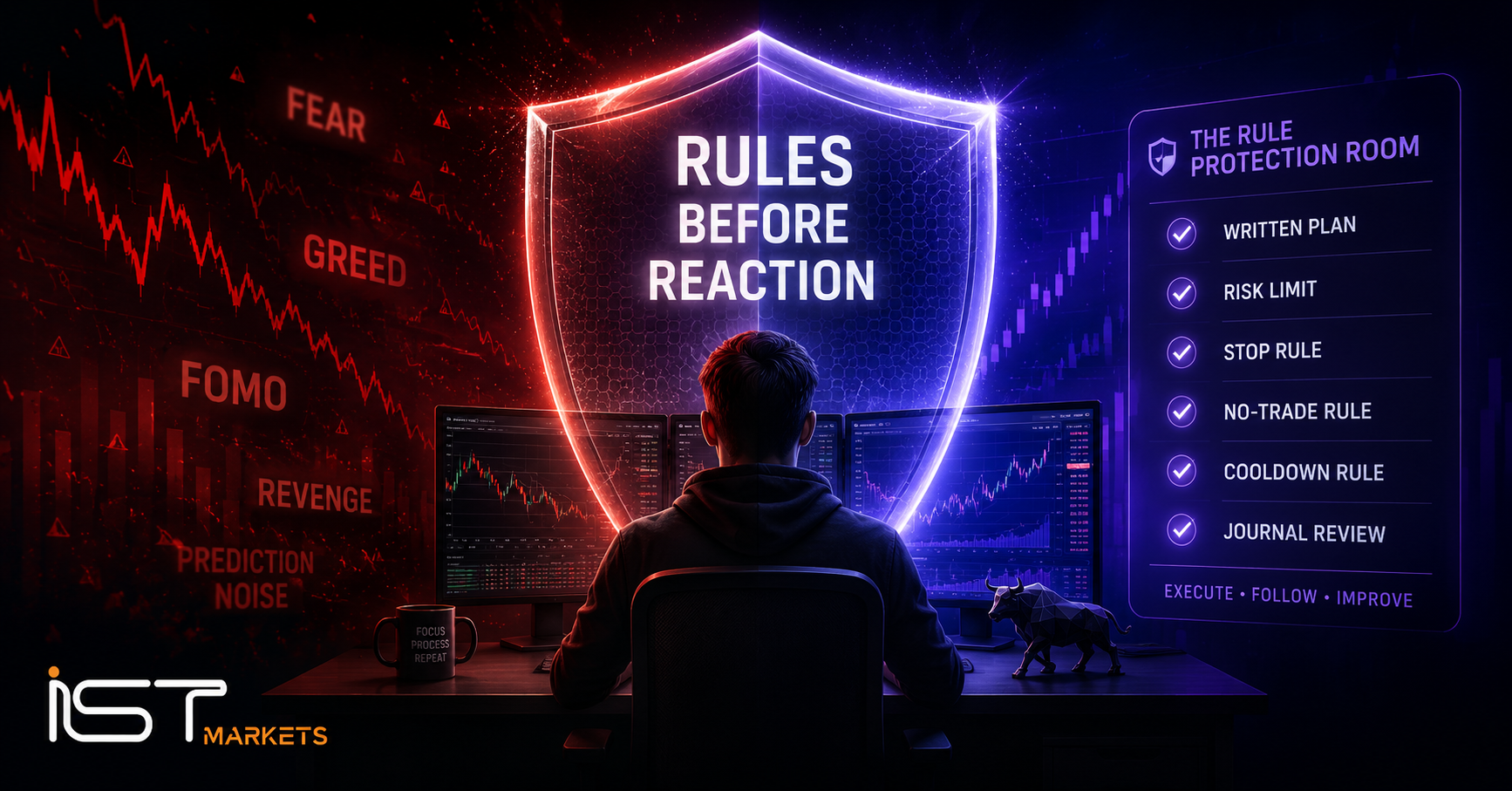
Trading Psychology for Beginners: Why Discipline Matters More Than Predictions
A practical beginner guide to protecting trading rules under pressure — when fear, greed, revenge trading, loss aversion and real-money decisions try to take control.
Quick Answer: What is trading psychology for beginners?
Trading psychology for beginners is the way emotions, pressure and behaviour affect trading decisions. It is not about removing fear or predicting the market perfectly. It is about protecting your rules when price moves fast, losses appear, or confidence becomes too high. Beginners should focus on written plans, risk limits, stop rules, no-trade rules, cooldown rules and post-trade review. Good psychology does not guarantee profit, but weak psychology can make fear, greed, revenge trading, loss aversion and rule-breaking more likely.
This guide treats trading psychology as a practical rule-protection system, not motivational advice. The focus is on discipline under pressure, risk routines and decision review — not on predicting the next market move.
This guide uses IST Markets Risk Disclosure, demo-vs-live education, fees and cost education, pip value education and first-live-trade readiness guidance. It also uses official retail-forex and CFD investor-risk sources for risk-disclosure context, plus educational trading psychology sources to explain fear, greed, revenge trading, loss aversion and rule-breaking in beginner-friendly language.
Content Table
1What psychology meansBehaviour under pressure.
2Discipline vs predictionWhy rules matter more.
3Bias vs planA better way than prediction.
4What beginners misdiagnoseThe real issue behind the feeling.
5Rule Protection SystemHow discipline survives pressure.
6Emotion-to-rule mapFear, greed and revenge trading.
7Readiness scoreAre your rules ready?
8Demo confidence trapWhy demo can feel easier.
What trading psychology means in real trading terms
Trading psychology is not a personality test. It is the way your behaviour changes when money, uncertainty and speed are involved. A beginner may understand support and resistance, trend direction, stop loss, take profit and lot size, yet still break the plan when the trade becomes emotional.
That is why trading psychology for beginners should not be taught as motivation. It should be taught as rule protection. The question is not “How do I remove fear?” The better question is: “What rule protects me when fear appears?”
For beginners, psychology appears in small moments: entering too early, moving a stop loss, closing a trade from fear, increasing size after wins, revenge trading after a loss, ignoring costs, or clicking before the checklist is complete because the market feels urgent.
Discipline vs prediction: why discipline matters more
Beginners often overvalue prediction. They want to know where price will go next. That is understandable, but even a reasonable market idea can fail if the trader cannot follow risk rules.
Discipline matters because the trader does not control price. The trader controls preparation, position size, risk limits, entry conditions, exit rules, no-trade conditions and review. These are the parts a beginner can actually manage.
| Prediction-focused thinking | Discipline-focused thinking |
|---|---|
| “I need to know what happens next.” | “I need a rule for what I do if I am wrong.” |
| “This trade feels obvious.” | “The checklist must be complete before entry.” |
| “I will recover the loss.” | “My cooldown rule and daily stop rule decide when I stop.” |
| “I will increase size because I am confident.” | “Size changes only after structured review.” |
Prediction vs bias vs plan: a better beginner mindset
A prediction says, “This will happen.” A trading bias says, “This may be the direction I am watching, if the market confirms it.” A plan says, “Here is what I will do, what will prove me wrong, how much I may risk, and when I will stay out.”
For beginners, this difference matters. A prediction can become emotional attachment. A bias can remain flexible. A plan gives the trader rules before pressure appears.
| Concept | Beginner risk | Better wording |
|---|---|---|
| Prediction | Can turn into emotional certainty. | “This is only a possible scenario.” |
| Bias | Can still become stubborn if not reviewed. | “This bias must be confirmed or invalidated.” |
| Plan | Only works if written and followed. | “My entry, exit, risk and no-trade rules are written first.” |
Willpower is not a trading plan
Many beginners believe the solution is to “be more disciplined.” That sounds right, but it is incomplete. Discipline cannot depend only on willpower in the middle of a fast market. The better approach is to reduce the number of decisions that must be made under pressure.
A written rule turns emotion into a process. Fear still appears. Greed still appears. Loss frustration still appears. But the trader has a routine to follow before those emotions become rule-breaking.
What beginners often misdiagnose
One reason trading psychology becomes confusing is that beginners often name the wrong problem. They may think they need a new strategy, when the real issue is that the position size makes every price movement feel too heavy. They may blame the market, when the trade had no invalidation rule.
| Beginner thinks the problem is… | Often the real issue is… |
|---|---|
| “My analysis is bad.” | The entry rule was not followed. |
| “The market tricked me.” | There was no clear invalidation rule. |
| “I need a better strategy.” | Position size was too stressful for the rule to survive. |
| “I am emotional.” | There was no cooldown rule, no-trade rule or review routine. |
| “Demo worked, live failed.” | Live pressure changed behaviour and execution felt different. |
| “I need more confidence.” | Confidence replaced structure. |
The Rule Protection System
The strongest beginner psychology routine is not a motivational quote. It is a system that protects rules when pressure appears. Use this five-layer framework before moving from demo to live or before increasing trade size.
| Layer | Question | Purpose |
|---|---|---|
| 1. Rule Clarity | What rule should I follow? | Discipline needs written rules, not vague intention. |
| 2. Pressure Trigger | What emotion may break it? | Identifies fear, greed, FOMO, revenge or loss aversion before they act. |
| 3. Protection Routine | What do I do when pressure appears? | Uses cooldown rules, no-trade rules, risk caps and written exits. |
| 4. Execution Reality | What live condition increases pressure? | Connects psychology with spread, slippage, margin and position size. |
| 5. Review Loop | What did I break or protect? | Turns the trade into a journal note and one rule for next time. |
Emotion-to-rule map: fear, greed, revenge and loss aversion
Trading psychology becomes practical when every emotion is connected to a rule at risk. Do not only write “I was emotional.” Write which rule the emotion tried to break.
| Emotion / pressure | Rule at risk | Behavioural risk | Protection routine |
|---|---|---|---|
| Fear | Exit rule | Closing early or moving the stop randomly. | Write stop, target and invalidation before entry. |
| Greed | Position-size rule | Increasing size after wins without review. | No size increase without structured review. |
| Revenge trading | Daily stop rule | Opening another trade quickly after a loss. | Cooldown rule after loss and journal before next trade. |
| FOMO | Entry checklist | Chasing late moves. | No entry if the setup was missed or incomplete. |
| Loss aversion | Stop-loss discipline | Refusing to accept the planned loss. | Accept invalidation before entry and avoid moving risk emotionally. |
| Overconfidence | Risk cap | Trading larger because recent trades went well. | Review process consistency before any size change. |
Psychology Readiness Score: are your rules ready for pressure?
Confidence is not the same as readiness. Use this simple score before increasing size or moving from demo to live. It does not predict results. It only checks whether your routine has enough structure to review.
| Readiness question | Score |
|---|---|
| Do I have a written plan before the trade? | 0 / 1 |
| Do I know where the trade idea is invalidated before entry? | 0 / 1 |
| Is my position size connected to a written risk rule? | 0 / 1 |
| Do I have a cooldown rule after losses? | 0 / 1 |
| Do I stop when the setup or conditions are incomplete? | 0 / 1 |
| Do I record fear, greed, revenge impulses or rule-breaking after trades? | 0 / 1 |
| Score | Educational meaning |
|---|---|
| 0–2 | Live trading pressure may be too high for your current routine. |
| 3–4 | You have partial structure, but several rules still depend on willpower. |
| 5–6 | Your routine is stronger, but it still does not guarantee trading results. |
The Demo Confidence Trap
The Demo Confidence Trap happens when a beginner treats calm demo decisions as proof that they will behave the same way with live money. Demo can train the routine, but live money tests the routine.
| Demo behaviour | Live pressure difference |
|---|---|
| Easy to follow stops. | Real loss may trigger fear or stop movement. |
| Calm after losses. | Real money may trigger revenge trading. |
| Larger experimental size. | Live size may create margin pressure. |
| Less concern about spread. | Live cost can create frustration or surprise. |
| No emotional account impact. | Live P/L can change behaviour quickly. |
The live pressure layer: why execution conditions affect psychology
Live conditions can introduce spread changes, slippage, liquidity differences, gaps, volatility and margin pressure. These factors can make a beginner feel more fear, urgency or frustration than they felt in demo.
Risk mechanics: what psychology cannot fix
Trading psychology cannot fix poor risk structure. If position size is too large, spread is ignored, margin pressure is uncomfortable, or the trader has no exit rule, emotional pressure becomes much harder to manage.
This is why psychology should be connected to mechanics: lot size, pip value, spread, slippage, swaps, commissions, leverage, margin and platform workflow. A calm trader can still lose money. A disciplined trader can still face volatility, gaps, execution differences and market risk.
| Risk factor | Psychology impact | Routine response |
|---|---|---|
| High position size | Increases fear and impulsive exits. | Estimate pip value and risk before entry. |
| Wide spread or slippage | Can trigger frustration or surprise. | Record execution notes and review costs. |
| Leverage and margin | Can increase pressure when price moves quickly. | Review margin impact before opening the trade. |
| No written exit rule | Encourages hope, fear or random exits. | Define stop, target and invalidation before entry. |
Psychological no-trade rules
Sometimes the most disciplined trade is no trade. A no-trade rule is not hesitation. It is a protection rule that prevents emotion from turning into execution.
| No-trade rule | Why it matters |
|---|---|
| No trade after a revenge impulse. | Prevents emotional recovery trades. |
| No trade if the entry reason cannot be written. | Blocks random entries and FOMO. |
| No trade after the daily stop rule is reached. | Protects against emotional escalation. |
| No trade when spread or cost is unsuitable for the plan. | Reduces frustration and poor execution decisions. |
| No trade when position size feels emotionally heavy. | Signals that risk size may be too large. |
| No trade after breaking a rule until the journal is updated. | Forces review before repetition. |
Beginner scenario: knowing the chart but breaking the rules
Imagine a beginner understands the setup. They know where entry might make sense. They know the stop level, the target and the risk rule. On demo, the process felt simple.
Then live pressure appears. Price moves quickly. The trader enters before the checklist is complete. Spread is wider than expected. The trade moves against them. They move the stop because they do not want to accept the planned loss. After closing, they immediately open another trade to recover. The problem was not lack of chart knowledge. The problem was rule-breaking under pressure.
Rule Failure Autopsy: review the rule that failed
Do not only review the trade result. Review the rule that failed under pressure. This makes the journal more useful than a simple profit-and-loss note.
| Review question | Example answer |
|---|---|
| What rule did I break? | I moved the stop wider. |
| What emotion appeared first? | Fear of taking the planned loss. |
| What live factor increased pressure? | Position size felt too large. |
| What should protect this next time? | Smaller size plus no stop movement rule. |
| What should I record in the journal? | Loss aversion / moved stop / rule break. |
Common trading psychology mistakes beginners should avoid
| Mistake | What it often looks like | Better routine |
|---|---|---|
| Chasing price | Entering late because the move already started. | No entry if the checklist was not ready before the move. |
| Revenge trading | Opening another trade quickly after a loss. | Use a cooldown rule and journal the loss first. |
| Moving stops emotionally | Widening the stop because accepting loss feels difficult. | Define invalidation before entry and review after exit. |
| Oversizing after wins | Increasing size because confidence is high. | Change size only after structured review. |
| Ignoring costs | Focusing only on the chart while spread or slippage affects execution. | Check spread, costs and account terms before trading. |
| Treating demo wins as proof | Moving live too fast after several positive demo trades. | Use demo to practise routine, not prove future performance. |
Trading psychology checklist before going live
Use this trading psychology for beginners checklist before funding, increasing size or moving from demo to live. If several answers are “No,” the psychological routine is not ready yet.
| Pre-live check | Ready? | Why it matters |
|---|---|---|
| My trading plan is written. | Yes / No | Discipline needs rules to follow. |
| My risk per trade is defined before entry. | Yes / No | Reduces emotional sizing. |
| My stop, target and invalidation are written. | Yes / No | Reduces emotional exits. |
| I have a cooldown rule after losses. | Yes / No | Helps reduce revenge trading. |
| I check costs, spread and margin before entry. | Yes / No | Connects psychology with live trading conditions. |
| I journal emotion notes after trades. | Yes / No | Makes repeated behaviour visible. |
| I understand demo is practice, not proof. | Yes / No | Keeps expectations realistic before live trading. |
What to do after reading this
Do not try to become emotionless. That is not realistic. Build rules that still work when emotion appears.
- Write your trading rules before the session starts.
- Define risk, stop, target and invalidation before entry.
- Use a no-trade rule when the setup is incomplete.
- Use a cooldown rule after losses or emotional mistakes.
- Record fear, greed, revenge trading and rule-breaking in your journal.
- Review costs, spread, slippage, swaps and margin impact.
- Practise the routine on demo before using live funds.
Risk reminder before the CTA
Trading psychology can support discipline, but it cannot guarantee profit or prevent losses. Live trading can still be affected by leverage, margin pressure, spread, slippage, swaps, commissions, volatility, market gaps, platform conditions and emotional decision-making.
Before funding, increasing size or going live, review whether your routine is repeatable under pressure — not whether you feel confident after a few positive outcomes.
Soft CTA: Practise the routine before using live funds
Before judging live readiness, review the IST Markets risk disclosure, check the legal documents, compare account types, review trading fees and costs, practise on a demo account, and understand the live transition through the demo vs live account guide.
Practise first. Verify risk first. Protect rules before increasing size.
Trading psychology does not make the market predictable. It makes your behaviour easier to review when the market becomes uncomfortable. For beginners, discipline matters more than predictions because discipline is what keeps risk rules alive under pressure.
FAQ
What is trading psychology for beginners in simple terms?
Trading psychology for beginners is the way emotions and behaviour affect trading decisions. It includes discipline, fear, greed, revenge trading, loss aversion and the ability to follow written rules under pressure.
Why does discipline matter more than predictions?
Predictions can be wrong, even when the analysis is reasonable. Discipline matters because it controls position size, risk limits, stop rules, exit rules and when to stay out. These are the parts a trader can manage.
How does fear affect beginner traders?
Fear can cause beginners to close trades too early, avoid valid setups, move stops randomly or make decisions based on discomfort instead of written rules. A checklist and journal can help make those patterns visible.
What is revenge trading?
Revenge trading happens when a trader opens another trade quickly after a loss to recover emotionally or financially. It can lead to larger risk, weaker setups and more rule-breaking.
What should I check before relying on trading psychology live?
Check whether your trading plan, risk rule, position size, stop rule, cooldown rule, no-trade rule, platform workflow, spread, fees, margin impact and risk disclosure are understood before using live funds.
Can good trading psychology guarantee profit?
No. Good trading psychology cannot guarantee profit or prevent losses. It can support discipline and reduce impulsive decisions, but market risk, leverage, spread, slippage, margin and volatility still remain.
What mistakes should beginners avoid with trading psychology?
Beginners should avoid chasing price, revenge trading, moving stops emotionally, increasing size after wins, ignoring costs, treating demo wins as proof and trading without a written plan.
References & Further Reading
- IST Markets Risk Disclosure
- IST Markets Legal Documents
- IST Markets Trading Fees and Costs
- IST Markets Demo Trading Account
- IST Markets Demo vs Live Account
- IST Markets Pip Value Calculator Explained
- IST Markets MT5 for Beginners
- IST Markets Trading Account Types
- IST Markets First Live Trade Checklist
- CFTC — Foreign Currency Trading
- eCFR — 17 CFR § 5.5 Risk Disclosure Statement
- NFA — Forex Regulatory Guide
- ESMA — CFD Product Intervention Obligations