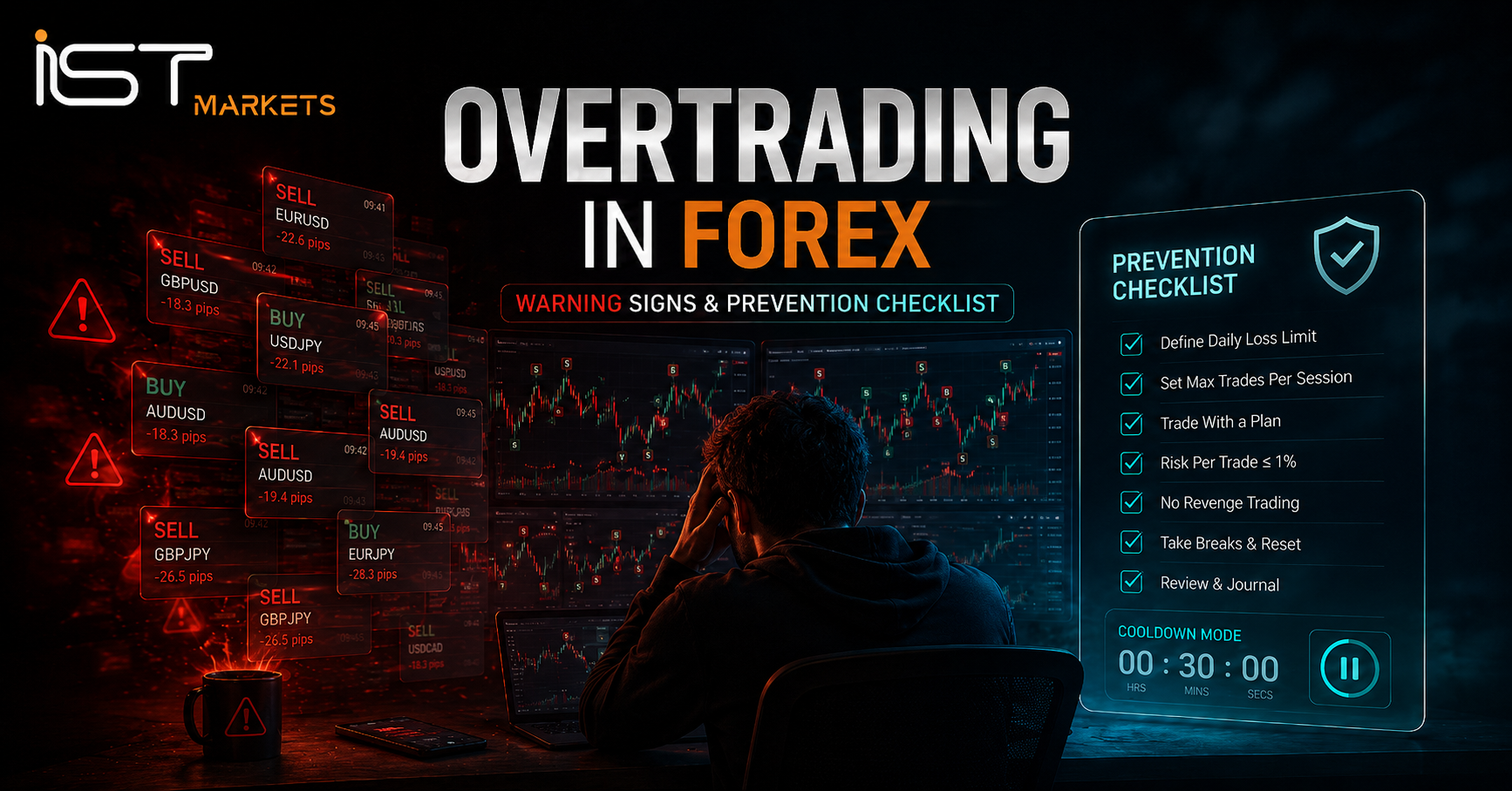
Overtrading in Forex: Warning Signs, Causes and Prevention Checklist
A practical beginner guide to spotting overtrading before trade frequency, emotional pressure, costs and broken rules damage account discipline.
Quick Answer: What is overtrading in forex?
Overtrading in forex is not simply taking many trades. It happens when trade frequency moves beyond your written plan, setup quality, session rules, daily limits, risk structure or emotional control. Beginners often overtrade after losses, wins, missed moves, volatile news or boredom. It can increase exposure to spread, slippage, commissions where applicable, margin pressure and emotional mistakes. A prevention checklist can support discipline, but it cannot guarantee profit or remove the risks of leveraged forex and CFD trading.
Risk reminder before reading
Editorial Review Note
This guide treats overtrading as a process problem: trade count, setup quality, emotional triggers, cost exposure, session rules, daily limits and review habits. The goal is not to trade less blindly. The goal is to stop unplanned trades from breaking risk discipline.
Source Snapshot
This guide uses IST Markets Risk Disclosure, trading-fee education, demo-vs-live education, pip value education and first-live-trade readiness guidance. It also uses official retail-forex and CFD investor-risk sources for risk-disclosure context, plus reputable educational sources to explain overtrading, revenge trading and excessive trading behaviour.
Practical trust note
What this guide will not do
Content Table
1What overtrading meansBeyond trade count.
2Active trading vs overtradingWhy frequency alone is not enough.
3Count vs qualityPlanned trades vs emotional trades.
4Overtrading loopHow one extra trade becomes a pattern.
5Early-warning systemTrade count, triggers and limits.
6Warning scoreCheck before the next trade.
7Hidden signsThe quiet signals beginners miss.
8Trigger mapLoss, win, news, boredom, FOMO.
9Excuse vs realityHow traders justify overtrading.
10Cost dragWhy frequent trades can get expensive.
What overtrading in forex means in real trading terms
Overtrading in forex is often misunderstood. It does not always mean “many trades.” A trader with a written intraday strategy may take several planned trades and still be disciplined. Another beginner may take only three trades, but if all three were emotional, unplanned and outside the session rules, that can still be overtrading.
A better definition is this: overtrading starts when trade frequency moves faster than the trader’s plan, risk limits, session rules, cost awareness or emotional control.
Core idea
For beginners, overtrading usually appears after a trigger: a loss that feels unfair, a win that creates overconfidence, a missed move, a news spike, boredom during a slow session, or the feeling that “one more trade” will fix the day.
Overtrading vs active trading vs scalping
A common beginner mistake is assuming that every high-frequency style is overtrading. That is not accurate. The difference is not only how many trades are taken. The difference is whether the activity is planned, controlled, cost-aware and reviewable.
| Concept | What it means | Is it automatically a problem? |
|---|---|---|
| Active trading | More frequent trading inside a written plan, session rule and risk structure. | No. Frequency alone is not the issue. |
| Scalping | A short-term style that may involve frequent entries and exits with strict rules. | No, if it is planned, cost-aware and suitable for the trader’s rules and account conditions. |
| Overtrading | Trading beyond the plan, setup quality, risk limits, session rules or emotional control. | Yes. The concern is rule drift and uncontrolled activity. |
| Revenge trading | Trading after a loss to recover quickly or emotionally fix the day. | Yes. It is one common form of emotional overtrading. |
Balanced definition
Trade count vs trade quality: is more trading always overtrading?
Trade count matters, but it is not the only test. The more important question is whether each trade was planned, reviewable and inside the trader’s written rules.
| Not automatically overtrading | More likely overtrading |
|---|---|
| Trades are planned before the session. | Trades are added after emotion. |
| Setup quality is consistent. | Setup quality drops after wins or losses. |
| Risk is fixed before entry. | Risk changes after a loss or missed move. |
| Session rules are respected. | Trading continues outside the planned session. |
| Costs are reviewed. | Costs are ignored because it is “only one more trade.” |
| Journal is updated before the next review. | Review is skipped before the next entry. |
No universal-number note
The Overtrading Loop: how one extra trade becomes a pattern
Overtrading usually starts before the extra trade. It starts when the trader gives emotion permission to override the plan.
| Stage | What happens |
|---|---|
| Trigger | Loss, win, missed move, news spike or boredom. |
| Impulse | “One more trade.” |
| Rule drift | Entry happens outside the plan, session or setup rules. |
| Cost drag | More spread, slippage, commission exposure where applicable, and execution decisions. |
| Emotional escalation | Frustration, urgency, revenge or overconfidence increases. |
| Repeat | Trade count rises while discipline falls. |
The Overtrading Early-Warning System
The strongest way to prevent overtrading is to catch it early. Use this system before the next click, not after the damage is done.
| Warning layer | What to check | Why it matters |
|---|---|---|
| Trade Count | Did I exceed planned trades? | Shows activity drift. |
| Trade Quality | Was each trade planned? | Separates plan from impulse. |
| Trigger | Was it after a win, loss, news move or boredom? | Identifies emotional cause. |
| Cost Drag | Did spread, slippage or commission exposure matter? | Frequent trading increases cost exposure. |
| Daily Limit | Did I break my max trade or max loss rule? | Prevents escalation. |
| Review | Did I log the reason before the next trade? | Stops repetition. |
Overtrading Warning Score
This score is educational only. It does not predict profit or loss, and it does not replace a written risk plan. Use it as a pause before the next trade.
| Question | Score |
|---|---|
| Did I take a trade that was not in my plan? | 0 / 1 |
| Did I trade immediately after a loss? | 0 / 1 |
| Did I increase size after a win or loss? | 0 / 1 |
| Did I trade outside my planned session? | 0 / 1 |
| Did I ignore spread, slippage or news conditions? | 0 / 1 |
| Did I skip journal review before the next trade? | 0 / 1 |
| Score | Educational meaning |
|---|---|
| 0–1 | Trade frequency may still be inside the plan. |
| 2–3 | Warning zone: review before the next trade. |
| 4–6 | High-risk overtrading pattern: stop, review and reduce pressure. |
Hidden overtrading signs beginners often miss
Overtrading is not always obvious. Sometimes it looks like “research,” “confidence,” or “being active.” These hidden signs are often more useful than counting trades alone.
| Hidden sign | What it may mean |
|---|---|
| You keep changing timeframes to find a setup. | You may be searching for permission to trade. |
| You reopen the platform after deciding to stop. | Your stop rule may not be strong enough. |
| You call every move “an opportunity.” | Volatility may be replacing selectivity. |
| You stop checking spread after the first few trades. | Cost awareness is dropping. |
| You stop journaling losing trades. | Review discipline is breaking. |
| You lower your setup standards late in the session. | Fatigue may be controlling the next entry. |
Overtrading Trigger Map: loss, win, news, boredom and FOMO
Different triggers can create the same outcome: another trade outside the plan. Naming the trigger makes prevention easier.
| Trigger | What it looks like | Protection rule |
|---|---|---|
| Loss | “I need to win it back.” | Cooldown rule after loss. |
| Win | “I am reading the market well today.” | No size or frequency increase without review. |
| News | “Big move means big opportunity.” | Event filter before trading volatile periods. |
| Boredom | “Nothing is happening, I will try a small trade.” | No setup, no trade. |
| FOMO | “I missed it, but I can still enter.” | No late entry rule. |
Overtrading excuse vs reality check
Overtrading often comes with a reasonable-sounding excuse. A strong routine challenges the excuse before it becomes another click.
| Excuse | Reality check |
|---|---|
| “The market is active today.” | Are you following your session rule or chasing volatility? |
| “I need to recover the loss.” | That is revenge pressure, not a setup. |
| “I am only taking a small trade.” | Small unplanned trades can still train poor habits. |
| “I already won today.” | Confidence is not a reason to break frequency limits. |
| “This is the last one.” | If it breaks your daily rule, it is already a problem. |
Cost Drag: why frequent trades can become expensive
Every extra trade is not just another chance. It is another interaction with spread, execution conditions, account exposure and decision pressure. Frequent unplanned trading can make costs and mistakes appear more often.
Simple cost-drag example
| Cost / risk factor | Why overtrading makes it worse |
|---|---|
| Spread | More trades mean more repeated spread exposure. |
| Commission where applicable | Trade frequency can increase commission impact on applicable account types. |
| Slippage | More entries during fast conditions increase exposure to execution differences. |
| Swaps | Impulsive trades held overnight may add overnight cost where applicable. |
| Margin pressure | More or larger trades can raise account stress. |
| Mistake rate | Fatigue and emotion can reduce checklist discipline. |
Smart cost-review path
The Demo-to-Live Overtrading Trap
Demo practice can help beginners learn workflow, order placement and platform navigation. But it can also create a habit of clicking often without the same emotional impact as live funds. Demo can build the routine; live trading tests whether the routine survives pressure.
| Demo habit | Live risk |
|---|---|
| Clicking often without emotional cost. | Live profit and loss may create pressure. |
| Testing many setups casually. | Live setups need stricter filtering. |
| Ignoring small spread changes. | Live costs affect review. |
| Recovering quickly after a demo loss. | Live loss may trigger revenge trading. |
| Holding many positions lightly. | Live margin pressure can feel different. |
Practice path
Beginner scenario: “one more trade” after a loss
A beginner takes one planned forex trade during the London session. The setup is clear, the stop is defined, and the risk looks acceptable. The trade loses. The trader feels frustrated because the market reverses shortly after the stop.
Instead of recording the trade, the trader opens another position quickly. The second trade has weaker setup quality. The spread is wider than earlier. The trader increases size slightly to recover faster. After the second loss, a third trade appears because “the day cannot end like this.”
The real lesson
The Overtrading Prevention System
Prevention works best when it is written before the session starts. Do not wait until emotion is already active. A prevention rule is useful only if it stops the next emotional click.
| Prevention rule | What it controls |
|---|---|
| Max trades per session | Trade count and click frequency. |
| Daily stop rule | Escalation after losses. |
| Cooldown rule | Revenge trading and emotional re-entry. |
| Setup quality filter | Low-quality trades after fatigue or FOMO. |
| News/event filter | Volatility chasing and surprise conditions. |
| Cost check | Spread, slippage and fee awareness. |
| Journal-before-next-trade rule | Repeated emotional mistakes. |
The 4-Step Overtrading Stop Protocol
When you notice overtrading pressure, do not debate the market first. Interrupt the behaviour first. A cooldown rule is a circuit breaker, not a punishment.
| Step | Action |
|---|---|
| 1. Stop | Do not open another trade immediately. |
| 2. Tag | Name the trigger: loss, win, FOMO, boredom or news. |
| 3. Check | Review spread, size, margin, session rule and daily limit. |
| 4. Reset | Return only when the next trade matches the written plan. |
Common overtrading mistakes beginners should avoid
| Mistake | Why it is risky | Better routine |
|---|---|---|
| Using a fixed number without context | A limit that ignores strategy and session rules may be misleading. | Build the limit into the trading plan. |
| Trading again immediately after a loss | Revenge pressure can reduce setup quality. | Use a cooldown rule and journal first. |
| Increasing size after wins | Confidence can replace structure. | Change size only after structured review. |
| Trading every news move | Fast conditions can increase slippage, spread changes and emotional reaction. | Use an event filter and planned session rule. |
| Ignoring costs | Frequent trades can increase repeated cost exposure. | Review spread, swaps, commissions where applicable and execution notes. |
| Skipping review | The same trigger can repeat without being noticed. | Journal the trigger before the next trade. |
Overtrading prevention checklist before live trading
Use this overtrading in forex checklist before funding, increasing size or moving from demo to live. If several answers are “No,” the trading routine needs more structure before activity increases.
| Pre-live check | Ready? | Why it matters |
|---|---|---|
| My max trades per session are written. | Yes / No | Controls trade count. |
| My daily stop rule is written. | Yes / No | Reduces emotional escalation. |
| I have a cooldown rule after losses. | Yes / No | Helps reduce revenge trading. |
| I check news and session conditions. | Yes / No | Reduces volatility chasing. |
| I check spread, costs and margin before entry. | Yes / No | Connects activity with real trading conditions. |
| I review position size before increasing trade frequency. | Yes / No | Reduces pressure from larger or repeated exposure. |
| I journal the trigger before the next trade. | Yes / No | Stops repetition without review. |
| I understand demo is practice, not proof. | Yes / No | Keeps expectations realistic before live trading. |
What to do after reading this
Do not try to solve overtrading by promising yourself to “be more careful.” Build friction before the next click.
- Write your max trades per session.
- Write your daily stop rule.
- Use a cooldown rule after losses.
- Avoid entries that do not have a written setup reason.
- Check spread, slippage risk, swaps, commissions where applicable and margin pressure.
- Record the trigger before taking another trade.
- Practise the routine on demo before increasing live activity.
Risk reminder before the CTA
Overtrading prevention rules can support discipline, but they cannot guarantee profit or prevent losses. Live trading can still be affected by leverage, margin pressure, spread, slippage, swaps, commissions, volatility, market gaps, platform conditions and emotional decision-making.
Before funding, increasing size or trading more frequently, review whether your routine is repeatable under pressure — not whether you feel ready after a few positive outcomes.
Soft CTA: Practise limits before increasing activity
Before judging live readiness, review the IST Markets risk disclosure, check the legal documents, compare account types, review trading fees and costs, practise on a demo account, and understand the live transition through the demo vs live account guide.
Practise first. Verify risk first. Use limits and review routines before increasing trade frequency.
Final Takeaway
Overtrading in forex is not only about taking many trades. It is about taking trades that your plan, risk limits, session rules, costs or emotional discipline cannot support. The prevention goal is simple: stop the unplanned trade before it becomes the next pattern.
FAQ
What is overtrading in forex?
Overtrading in forex is trading beyond your plan, setup quality, session rules, daily limits, risk structure or emotional control. It is not only about the number of trades; it is about whether the trades are planned and reviewable.
Is taking many forex trades always overtrading?
No. Some strategies involve more frequent trading. It becomes more concerning when trades are added after emotion, setup quality drops, costs are ignored, risk changes, or the trader breaks session and daily limits.
Is scalping the same as overtrading?
No. Scalping is a short-term trading style that may involve frequent trades, while overtrading is trading beyond the plan, risk limits, setup quality or emotional control. A scalper can be disciplined, and a swing trader can still overtrade if the trades are unplanned.
Why do beginners overtrade after losses?
Beginners may overtrade after losses because they want to recover quickly, avoid ending the day negative, or prove the original idea was right. This can become revenge trading if the next trade is emotional rather than planned.
Why do beginners overtrade after wins?
Wins can create overconfidence. A trader may feel they are reading the market well and increase size or frequency without review. That can weaken discipline if the next trades are not part of the written plan.
How does overtrading increase trading costs?
More frequent trades can increase repeated exposure to spreads, commissions where applicable, slippage, swaps if trades are held overnight, and margin pressure. Costs should be reviewed as part of the trading journal.
How can I stop overtrading in forex?
Use written session rules, max trades per session, a daily stop rule, a cooldown rule after losses, a setup-quality filter, a news filter, cost checks, and a journal-before-next-trade rule. These routines can support discipline, but they do not guarantee results.
What should beginners check before trading live?
Beginners should check their trading plan, max trades per session, daily stop rule, cooldown rule, position size, platform workflow, spread, fees, margin impact, demo practice, legal documents and risk disclosure before using live funds.
References & Further Reading
- IST Markets Risk Disclosure
- IST Markets Legal Documents
- IST Markets Trading Fees and Costs
- IST Markets Demo Trading Account
- IST Markets Demo vs Live Account
- IST Markets Pip Value Calculator Explained
- IST Markets MT5 for Beginners
- IST Markets Trading Account Types
- IST Markets First Live Trade Checklist
- Investopedia — Overtrading Explained
- BabyPips — Avoiding Overtrading
- CFTC — Foreign Currency Trading
- eCFR — 17 CFR § 5.5 Risk Disclosure Statement
- NFA — Forex Regulatory Guide
- ESMA — CFD Product Intervention Obligations