Current VIX Data & Source Snapshot
| Source | What It Confirms | Why It Matters for Forex Traders |
|---|---|---|
| Cboe VIX Methodology | VIX estimates expected 30-day volatility using S&P 500 index options. | It is an equity-volatility measure, not a direct forex signal. |
| S&P Dow Jones Indices | VIX is widely used as a barometer of expected S&P 500 volatility. | It helps traders interpret broad market fear and uncertainty. |
| FRED / St. Louis Fed | Daily VIX historical data is available from 1990 onward. | Historical data helps traders compare today’s volatility regime with past market stress. |
| IMF GFSR 2026 | Global financial stability risks and portfolio-flow sensitivity remain important for emerging markets. | VIX spikes can matter for EM FX because risk-off flows often affect funding and portfolio flows. |
Content Table
- VIX Measures Equity Fear, But Forex Reacts Through Risk Sentiment
- Quick Answer: How Does the VIX Affect Forex Trading?
- What Intermediate Forex Traders Will Learn from the VIX
- Understanding VIX: What the Fear Gauge Measures and What It Does Not
- VIX Levels: Calm, Alert, Stress and Panic Market Regimes
- VIX-Forex Correlation: How Market Fear Reaches Currency Markets
- Safe-Haven vs High-Beta Currencies During VIX Spikes
- VIX, DXY and U.S. Yields: Why the Dollar Reaction Changes
- Trading Strategies: How Forex Traders Use VIX Without Treating It as a Signal
- VIX Forex Trading Checklist
- Current Levels: How to Read VIX Without Overreacting
- When VIX-Forex Correlation Breaks
- Risk Management During VIX Spikes and Forex Volatility
- Common Mistakes Traders Make with VIX Forex Trading
- How IST Markets Helps Traders Track VIX-Based Forex Setups
- FAQs About VIX and Forex Trading
VIX Measures Equity Fear, But Forex Reacts Through Risk Sentiment
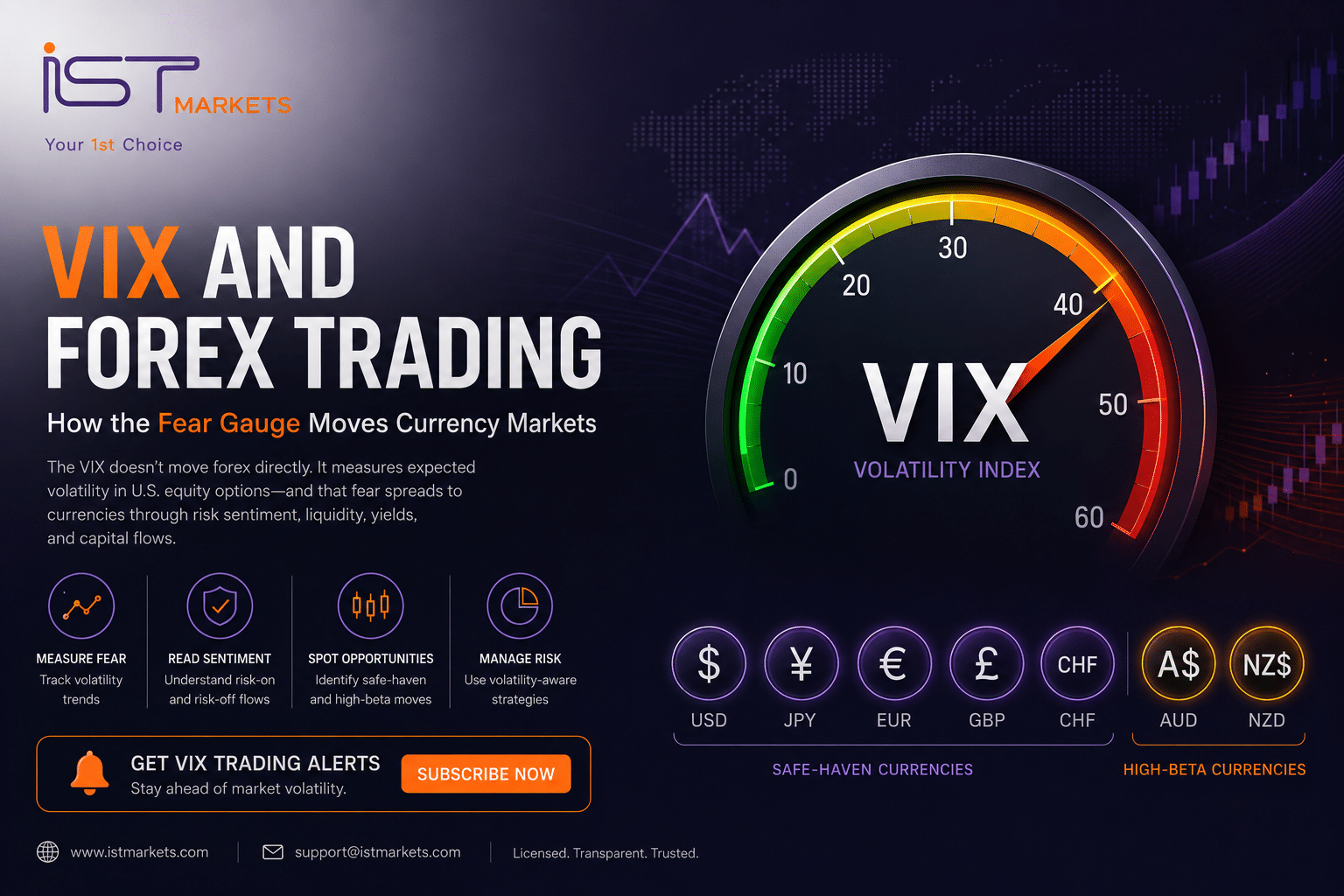
The VIX does not move forex markets directly. It measures expected volatility in U.S. equity options, but the fear it captures can quickly spread into currency markets through risk sentiment, dollar liquidity, safe-haven demand, and high-beta currency flows.
When VIX rises sharply, traders often reduce exposure to risk assets. In forex, that can pressure risk-sensitive currencies such as AUD, NZD, and some emerging-market currencies. It can also support defensive currencies such as JPY, CHF, or USD depending on whether the shock is driven by liquidity demand, growth fear, or interest-rate stress.
The key question is not whether VIX is “bullish or bearish” for forex. The better question is whether the VIX move is changing risk sentiment, DXY, U.S. yields, liquidity conditions, and the behaviour of safe-haven versus high-beta currencies.
Quick Answer: How Does the VIX Affect Forex Trading?
VIX affects forex trading by acting as a risk-sentiment input. A rising VIX often signals higher market fear, which can reduce demand for high-beta currencies and increase demand for safe-haven currencies. A falling VIX may suggest improving risk appetite, which can support carry trades and growth-sensitive currencies if other markets confirm the move.
However, VIX is not a standalone forex signal. A VIX spike can support USD if markets want liquidity, but JPY or CHF may outperform if falling yields and carry-unwind flows dominate. That is why traders should always confirm VIX with DXY, Treasury yields, equity breadth, market session timing, and actual currency-pair price action.
What Intermediate Forex Traders Will Learn from the VIX
| You Will Learn How To… | Why It Matters |
|---|---|
| Read VIX as risk sentiment, not a trade signal | It prevents simple “VIX up, buy USD” thinking. |
| Compare VIX with DXY and U.S. yields | The dollar reaction changes depending on liquidity and rates. |
| Separate safe-haven from high-beta FX behaviour | JPY, CHF, USD, AUD, NZD, and EM FX do not react the same way. |
| Use a VIX trading checklist | Confirmation reduces false correlation signals. |
| Manage risk during volatility spikes | Execution risk, spread widening, and slippage can become more important than direction. |
Understanding VIX: What the Fear Gauge Measures and What It Does Not
The VIX is commonly called the “fear gauge,” but that nickname can mislead traders if it is used too loosely. The VIX measures expected volatility, not direction. It is derived from S&P 500 index option prices and reflects the market’s expectation for volatility over the next 30 days.
This matters because VIX is not a direct measure of forex volatility. It does not tell traders which currency pair to buy or sell. Instead, it gives a cross-asset clue about whether investors are becoming more defensive or more comfortable holding risk.
A high VIX does not always mean stocks will keep falling. A low VIX does not mean markets are safe. For forex traders, VIX becomes useful when it is combined with stock-market volatility signals, DXY, U.S. yields, currency-pair behaviour, and liquidity conditions.
Traders who understand that distinction can use VIX as a volatility-context tool rather than a mechanical entry trigger.
VIX Levels: Calm, Alert, Stress and Panic Market Regimes
VIX levels are best read as regimes, not fixed trading rules. A VIX level below 15 may suggest a calm market, but it can also reflect complacency. A VIX above 30 may show stress, but the best forex reaction still depends on why volatility is rising.
| VIX Level | Market Regime | FX Interpretation |
|---|---|---|
| Below 15 | Calm / low fear | Risk appetite may be stable, but complacency risk can build. |
| 15–20 | Normal / alert | Watch DXY, yields, equities, and risk-sensitive currencies. |
| 20–30 | Stress building | Safe-haven demand may rise; high-beta FX may weaken. |
| Above 30 | Panic / market stress | Liquidity risk increases; spreads may widen; defensive FX may outperform. |
| Falling from high levels | Relief phase | Risk-sensitive FX may recover if liquidity and sentiment improve. |
VIX-Forex Correlation: How Market Fear Reaches Currency Markets
The VIX-forex correlation is not mechanical. VIX does not push a currency button. Instead, VIX reflects the market’s stress level, and currency markets respond through capital flows, liquidity demand, risk-on and risk-off sentiment, and carry-trade positioning.
During risk-off phases, traders may reduce exposure to currencies linked to global growth or carry trades. At the same time, defensive demand can support currencies associated with safety, liquidity, or funding unwinds. This is why VIX often matters for AUD/JPY, NZD/JPY, USD/JPY, USD/CHF, and emerging-market currencies.
Still, VIX must be confirmed. If VIX rises but DXY is flat, JPY is not strengthening, and high-beta FX is not weakening, the move may be equity-specific rather than a broad forex risk-off event.
Safe-Haven vs High-Beta Currencies During VIX Spikes
VIX spikes matter because currencies do not all respond to fear in the same way. Some currencies can benefit from defensive flows. Others may weaken when traders reduce exposure to growth, carry, or emerging-market risk.
| Currency Type | Examples | Typical Reaction During VIX Spikes |
|---|---|---|
| Safe-haven currencies | JPY, CHF, sometimes USD | May strengthen during stress, especially when risk reduction is broad. |
| High-beta currencies | AUD, NZD, EM FX | May weaken during risk-off conditions. |
| Dollar-sensitive majors | EUR/USD, GBP/USD | Depend on DXY, U.S. yields, and liquidity demand. |
| Carry-sensitive pairs | AUD/JPY, NZD/JPY | Vulnerable to carry unwind when volatility rises quickly. |
This is where risk-on and risk-off sentiment becomes important. VIX helps identify whether the market is becoming more defensive, but traders should check whether that defensiveness is actually appearing in currency pairs. For emerging-market currencies, VIX spikes can be especially important when combined with emerging-market currency stress, weaker portfolio flows, or dollar funding pressure.
VIX, DXY and U.S. Yields: Why the Dollar Reaction Changes
A common mistake is assuming that a rising VIX always means a stronger U.S. dollar. Sometimes it does. But sometimes the yen or Swiss franc can outperform, especially when U.S. yields fall and the stress is driven by growth fear rather than dollar liquidity demand.
That is why traders should combine VIX with DXY and Fed rate expectations. The same VIX spike can produce different FX outcomes depending on whether yields rise, fall, or stay mixed.
| Scenario | VIX | U.S. Yields | Possible USD Reaction |
|---|---|---|---|
| Equity fear + liquidity demand | Up | Mixed | USD may strengthen as traders seek liquidity. |
| Growth scare | Up | Down | JPY/CHF may outperform USD if yields fall sharply. |
| Inflation or rate shock | Up | Up | USD may strengthen strongly, especially versus low-yielders. |
| Volatility relief | Down | Stable/down | High-beta FX may recover if broader risk appetite improves. |
Trading Strategies: How Forex Traders Use VIX Without Treating It as a Signal
VIX can support volatility trading decisions, but only when it is used as context. The strongest setups are not based on VIX alone; they appear when VIX, DXY, yields, equities, and currency pairs confirm the same market story.
Setup 1: VIX Spike + DXY Strength
This may suggest dollar liquidity demand. Traders may watch whether EUR/USD, GBP/USD, AUD/USD, and EM FX are weakening together. The trap is entering late after the first move when spreads are already wider.
Setup 2: VIX Spike + JPY or CHF Strength
This can indicate safe-haven demand or carry unwind. Pairs such as AUD/JPY and NZD/JPY may be more sensitive if risk reduction is broad and U.S. yields are falling.
Setup 3: VIX Falling + AUD or NZD Recovery
A falling VIX after a spike may signal relief. Traders may watch whether high-beta currencies recover, equities stabilise, and DXY stops rising. This is a recovery setup, not a guarantee that risk appetite has fully returned.
Setup 4: VIX High but FX Not Confirming
If VIX is elevated but JPY, CHF, DXY, AUD, and NZD are not confirming, the volatility may be equity-specific. In that case, waiting can be more professional than forcing a forex trade.
VIX Forex Trading Checklist: What to Confirm Before Acting
This checklist is designed to keep VIX analysis practical and risk-aware. It helps traders avoid treating one volatility number as a complete trading plan.
| Question | Why It Matters |
|---|---|
| Is VIX rising slowly or spiking? | A spike suggests stress; a slow rise suggests caution. |
| Is DXY confirming? | Confirms whether the dollar is reacting to fear or liquidity demand. |
| Are U.S. yields rising or falling? | Separates USD strength from JPY/CHF strength. |
| Are equities falling broadly? | Broad equity weakness is more relevant than a single-sector shock. |
| Are AUD, NZD, or EM FX weakening? | Confirms high-beta pressure. |
| Are JPY or CHF strengthening? | Confirms defensive flows or carry unwind. |
| Are spreads widening? | Execution risk can damage even a correct directional view. |
| Is there a macro catalyst? | Prevents false signals when VIX moves for equity-specific reasons. |
Current Levels: How to Read VIX Without Overreacting
Traders often ask, “What is VIX today?” That number is useful, but it is not enough. The current VIX level should be compared with the recent trend, the speed of change, equity breadth, dollar behaviour, and bond yields.
For example, a move from 12 to 18 may matter more than a flat reading near 18 because the market is repricing volatility. A move from 35 down to 25 may still be high historically, but it can signal relief if liquidity is improving and risk currencies begin to recover.
This is also where broader product knowledge matters. Traders monitoring VIX index and global indices trading should understand that index volatility, equity direction, and currency reactions are connected but not identical.
The best use of current VIX levels is to ask: is the market calm, alert, stressed, panicked, or recovering? Then confirm that answer with FX behaviour.
When VIX-Forex Correlation Breaks
Correlation is useful until the market regime changes. VIX can rise without triggering a clean forex reaction if another driver is more important for currencies.
- A central-bank decision dominates currency pricing.
- A domestic shock affects one currency more than global risk sentiment.
- A commodity shock moves AUD, CAD, or NZD independently.
- Dollar liquidity dominates all other signals.
- VIX is low, but FX volatility is high because of local policy risk.
- VIX is high due to equity-specific stress that does not spread into currency markets.
- Government intervention, geopolitical events, or liquidity gaps override normal correlation.
Risk Management During VIX Spikes and Forex Volatility
Risk management becomes more important when VIX rises because volatility can expand faster than normal. During stress, spreads may widen, stop orders may slip, and the first price move may reverse quickly.
- Reduce leverage during volatility spikes.
- Avoid chasing the first candle after a VIX shock.
- Watch spreads and execution quality.
- Avoid tight stops in fast markets.
- Use VIX as confirmation, not a standalone trigger.
- Check market hours and event timing before trading volatility-sensitive setups.
- Read the platform’s risk disclosure before using leverage in volatile conditions.
A calm professional approach is usually better than reacting emotionally to a fear gauge. The goal is not to trade every VIX move. The goal is to know when volatility changes the quality of the forex setup.
Common Mistakes Traders Make with VIX Forex Trading
- Thinking VIX predicts forex direction.
- Buying USD automatically whenever VIX rises.
- Ignoring U.S. yields and Fed expectations.
- Ignoring JPY and CHF safe-haven behaviour.
- Using VIX level without checking the rate of change.
- Trading AUD, NZD, or EM FX during stress without checking spreads.
- Ignoring central-bank decisions and economic data.
- Treating alerts or analysis as guaranteed outcomes.
How IST Markets Helps Traders Track VIX-Based Forex Setups
VIX-based forex analysis works best when traders combine volatility trends, risk sentiment, DXY, U.S. yields, and currency-pair behaviour. It is not about reacting to fear. It is about reading whether fear is actually changing the forex setup.
IST Markets premium alerts help traders follow volatility-driven market conditions with stronger context. Traders can also use market analysis tools to monitor market conditions more consistently.
Get VIX Trading Alerts
Follow volatility trends, risk sentiment, DXY, U.S. yields, and currency-pair behaviour with stronger market context.
Alerts and market analysis are educational and do not guarantee trading outcomes. Forex and CFD trading involves risk.
FAQs About VIX and Forex Trading
How does the VIX affect forex trading?
The VIX affects forex trading indirectly through risk sentiment. A rising VIX can support safe-haven currencies and pressure high-beta currencies, while a falling VIX can support risk appetite if other markets confirm the move.
Is VIX a direct forex signal?
No. VIX is not a direct forex signal. It is a volatility and risk-sentiment indicator that should be confirmed with DXY, U.S. yields, equities, liquidity, and currency-pair behaviour.
What happens to USD when VIX rises?
USD may strengthen when VIX rises if markets seek dollar liquidity. However, if yields fall sharply and carry trades unwind, JPY or CHF may outperform USD.
Which currencies benefit when VIX spikes?
JPY, CHF, and sometimes USD may benefit during VIX spikes, depending on the type of stress. The reaction depends on yields, liquidity, and whether the market is reducing risk exposure broadly.
Which currencies weaken when VIX rises?
High-beta currencies such as AUD, NZD, and some emerging-market currencies may weaken when VIX rises sharply and risk sentiment deteriorates.
How do traders use VIX with DXY?
Traders compare VIX with DXY to see whether equity fear is creating dollar demand. If VIX and DXY rise together, markets may be seeking dollar liquidity. If VIX rises while DXY falls, the stress may be more growth- or yield-driven.
What VIX level signals market fear?
Many traders view VIX above 20 as a stress warning and VIX above 30 as a higher-fear regime. These are reference zones, not fixed trading rules.
Can VIX help trade AUD/JPY or NZD/JPY?
VIX can help traders monitor risk sentiment in carry-sensitive pairs such as AUD/JPY and NZD/JPY. A sharp VIX rise can pressure these pairs if risk-off flows and carry unwinds are confirmed.
Why does VIX-forex correlation break?
The correlation can break when central banks, domestic data, commodity shocks, interventions, or dollar liquidity dominate currency pricing more than equity volatility.
What are the risks of VIX-based forex trading?
Risks include false signals, changing correlations, spread widening, slippage, overleveraging, and treating VIX as a standalone trade trigger.
Risk Warning
Trading forex, CFDs, and leveraged products involves substantial risk and may not be suitable for all investors. VIX spikes, volatility events, liquidity shocks, safe-haven flows, and risk-off moves can create sharp price swings, widened spreads, slippage, and sudden reversals. You may lose some or all of your invested capital. This article is educational only and does not provide investment advice, trading signals, or a recommendation to trade any specific instrument.
Sources & Further Reading