At a Glance
| Question | Decision-Led Answer |
|---|---|
| Main topic | Geopolitical risk forex trading. |
| Main market lens | Risk-on vs risk-off sentiment. |
| Safe-haven currencies to watch | USD, JPY, CHF. |
| Risk-sensitive currencies to watch | AUD, NZD, CAD, EM FX. |
| Key confirmations | DXY, gold, oil, yields, equities, volatility, and spreads. |
| Strongest reaction happens when | The event is new, surprising, and economically material. |
| Main risk | Headline chaos, spread widening, gaps, and false safe-haven moves. |
| Best trading approach | Confirm cross-asset signals before choosing a pair. |
Last reviewed: May 2026 ·
This guide is educational only and does not provide investment advice, trading signals, or guaranteed outcomes.
Content Table
- What This Guide Helps You Decide
- What Is Geopolitical Risk in Forex Trading?
- Why Geopolitical Events Do Not Move Forex the Same Way Every Time
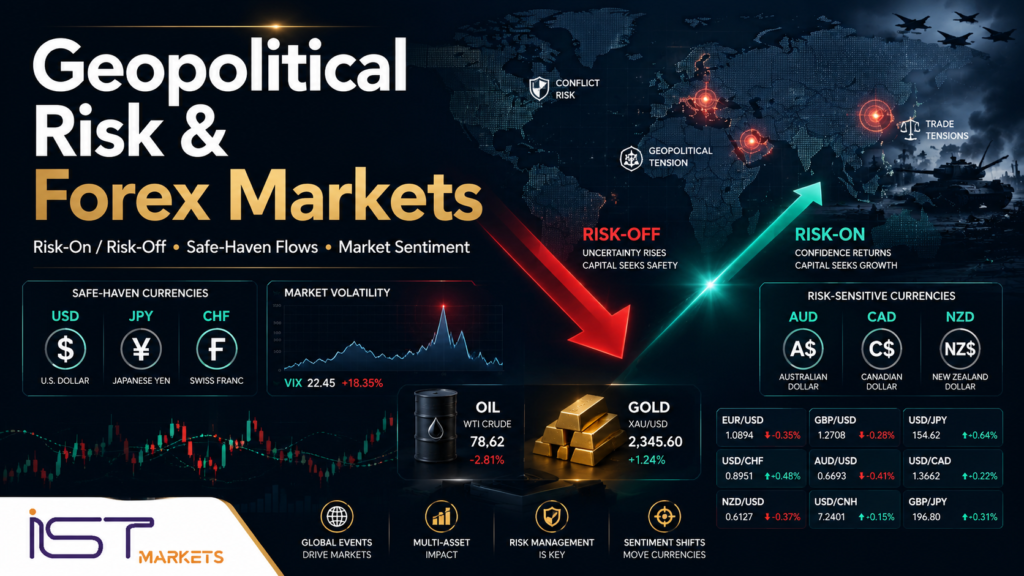
- Risk-On vs Risk-Off in Forex Markets
- Geopolitical Risk Severity Score
- Geopolitical Shock Type Matrix
- Safe-Haven Currencies During Geopolitical Events
- Risk-On Currencies and Vulnerable FX
- Cross-Asset Confirmation Before Trading Geopolitical News
- Geopolitical Risk Forex Decision Framework
- Trading Strategies for Risk-On/Risk-Off Forex Markets
- Best Forex Pairs to Watch During Geopolitical Risk
- Current Situation: How to Read Geopolitical Risk Without Overreacting
- Why Geopolitical Risk Trades Can Reverse
- When Not to Trade Geopolitical News
- Risk Factors in Geopolitical Forex Trading
- Recommended For / Not Ideal For
- Scenario Example
- Frequently Asked Questions
A geopolitical headline can hit the market in seconds. Oil jumps, gold spikes, equities sell off, the dollar strengthens, and risk-sensitive currencies start to weaken. But a few hours later, the move may fade completely if the event was already priced in or if the economic impact looks limited.
That is why geopolitical risk forex trading is not about reacting to every headline. It is about reading whether the event changes risk sentiment, safe-haven demand, commodity prices, bond yields, liquidity, and central-bank expectations.
For traders, the edge is not guessing the news. The edge is building a calm, structured process for deciding whether to trade, wait, or avoid.
What This Guide Helps You Decide
| If You Are Searching For… | This Guide Helps You Understand… |
|---|---|
| geopolitical risk forex | How geopolitical events affect forex through sentiment, liquidity, commodities, and safe-haven flows. |
| risk-on risk-off | How traders read market appetite and risk aversion before choosing a pair. |
| geopolitical events forex trading | When a political headline becomes a tradable macro or liquidity event. |
| safe haven currencies | Why USD, JPY, and CHF may strengthen during risk-off conditions — and why they do not always move together. |
| market sentiment forex | How sentiment shifts can change currency direction even without a central-bank decision. |
| premium forex alerts | Why structured real-time risk analysis matters when headlines move faster than normal market conditions. |
What Is Geopolitical Risk in Forex Trading?
Geopolitical Risk Meaning in Forex Markets
Geopolitical risk in forex refers to the effect of political conflict, military tension, sanctions, elections, trade restrictions, cyberattacks, or diplomatic shocks on currency markets. Traders care about geopolitical risk because it can change capital flows, risk appetite, commodity prices, inflation expectations, and liquidity.
Why Forex Traders Watch Wars, Sanctions, Elections and Trade Routes
Forex markets react when a geopolitical event changes the expected flow of money between economies. A conflict near an energy corridor may affect oil-linked currencies. A sanctions shock may affect capital flows. An election surprise may change policy expectations. A trade-route disruption may raise shipping and inflation risks.
Headline Risk vs Market-Priced Risk
A headline is not always a trade. Some events are already expected, widely priced, or economically limited. The more important question is whether the event changes the market’s view of growth, inflation, liquidity, safety, or policy.
Why Geopolitical Risk Can Affect USD, JPY, CHF, AUD, CAD and EM FX
In risk-off markets, traders may move toward perceived safety and liquidity, often supporting USD, JPY, or CHF. In risk-on markets, higher-beta and growth-sensitive currencies such as AUD, NZD, CAD, and some emerging-market currencies may recover. But the reaction depends on the type of shock, not just the headline.
Why Geopolitical Events Do Not Move Forex the Same Way Every Time
The Same Event Can Create Different Currency Reactions
A military escalation, election shock, oil disruption, or sanctions decision can all be described as geopolitical risk. But they do not all affect forex through the same channel. One may create a safe-haven bid. Another may raise inflation expectations. Another may hurt only a specific regional currency.
Why USD Can Rise Even When U.S. Risk Is Involved
The U.S. dollar can rise during uncertainty because of liquidity demand, reserve-currency demand, and defensive positioning. That does not mean every risk event is automatically bullish for the dollar, but it explains why USD strength can appear even when the event is globally negative.
Why JPY and CHF Do Not Always Behave the Same Way
JPY and CHF are often treated as safe-haven currencies, but their behavior can change with yield differentials, central-bank expectations, carry trades, and regional exposure. A risk-off move may support them, but that support can weaken when rate differentials or domestic policy expectations dominate.
Why Oil Shocks Can Help CAD but Hurt Oil Importers
When geopolitical risk affects oil supply, commodity-linked currencies may react differently from oil-importing currencies. CAD may receive support from higher oil prices in some conditions, while JPY or EUR may face pressure if higher energy costs worsen growth or inflation risks.
Why Markets Sometimes Fade Geopolitical Headlines
Some geopolitical headlines create a sharp first move and then fade. This can happen when the event is contained, already priced in, contradicted by cross-asset signals, or not large enough to change macro expectations.
Risk-On vs Risk-Off in Forex Markets
What Risk-On Means in Forex Trading
Risk-on describes a market environment where traders are more willing to hold growth-sensitive assets. In forex, this can support higher-beta or commodity-linked currencies such as AUD, NZD, CAD, and some emerging-market currencies.
What Risk-Off Means in Forex Trading
Risk-off describes a defensive market environment where traders reduce exposure to risk-sensitive assets and often seek liquidity or perceived safety. USD, JPY, and CHF may attract demand, depending on the source of the shock and the rate environment.
Risk-On Currencies: AUD, NZD, CAD and EM FX
AUD and NZD often reflect global growth appetite. CAD can respond to both risk sentiment and oil. Emerging-market FX can be more vulnerable when global investors reduce risk exposure or when dollar liquidity tightens.
Risk-Off Currencies: USD, JPY and CHF
USD can benefit from liquidity demand. JPY can benefit from carry unwind. CHF can benefit from defensive capital flows. But traders should still confirm with yields, DXY, gold, and equity reaction before assuming a clean safe-haven move.
How Risk Sentiment Affects Forex Pair Selection
Pair selection matters. A trader who sees risk-off sentiment may choose AUD/JPY, NZD/JPY, EUR/CHF, or USD/CHF depending on what is driving the move. To track broader risk sentiment, traders should compare currencies with equities, yields, gold, and volatility.
Geopolitical Risk Severity Score
Not every geopolitical headline deserves the same trading response. A severity score helps traders separate short-lived noise from events that can affect currencies through energy, trade, inflation, growth, or liquidity.
| Factor | Low Impact | High Impact | Trading Check |
|---|---|---|---|
| Location | Localized event | Major trade route or energy corridor | Does it affect oil, shipping, or capital flows? |
| Duration | Short headline | Prolonged conflict | Is the market repricing more than one session? |
| Economic link | Limited trade exposure | Oil, gas, food, chips, or shipping exposure | Does it change inflation or growth expectations? |
| Market surprise | Expected event | Sudden shock | Was the event already priced in? |
| Central-bank impact | No policy effect | Inflation or growth repricing | Does it change rate expectations? |
| Liquidity impact | Normal spreads | Wider spreads or gaps | Can the trade be executed safely? |
| Currency exposure | Limited FX impact | Direct impact on USD, JPY, CHF, CAD, AUD, or EM FX | Which pair expresses the risk cleanly? |
Geopolitical Shock Type Matrix
Different geopolitical shocks affect forex through different channels. Treating every headline as simple risk-off is usually too shallow. The market may be pricing safety, oil, inflation, trade, sanctions, or liquidity stress.
| Shock Type | Main Market Channel | FX Reaction to Watch | Example Pairs |
|---|---|---|---|
| Military conflict | Risk-off / safe haven | USD, JPY, CHF strength | USD/JPY, EUR/CHF, AUD/JPY |
| Oil supply shock | Inflation / commodity FX | CAD support, JPY/EUR pressure | USD/CAD, CAD/JPY, EUR/USD |
| Sanctions | Trade / capital flows | Affected currency weakness | EUR crosses, EM FX |
| Election shock | Policy uncertainty | Local currency volatility | GBP/USD, EUR/USD, USD/MXN |
| Cyberattack | Liquidity / risk aversion | USD and safe-haven demand | USD/CHF, AUD/USD |
| Trade-route disruption | Shipping / inflation | Oil, gold, commodity FX | CAD/JPY, AUD/JPY |
Safe-Haven Currencies During Geopolitical Events
Why the U.S. Dollar Often Acts as a Safe Haven
The U.S. dollar can attract demand during geopolitical uncertainty because traders may seek liquidity, defensive positioning, and exposure to the world’s main reserve currency. But USD strength can also come from rising U.S. yields, so traders should separate safe-haven demand from rate-driven demand.
Japanese Yen Safe-Haven Behavior and Carry Unwind Risk
JPY can strengthen when traders unwind carry trades during risk-off conditions. However, if yield differentials remain wide or Bank of Japan expectations dominate, yen behavior may be less straightforward.
Swiss Franc Safe-Haven Flows and CHF Risk
CHF is often watched as a defensive currency, especially during European risk. But Swiss National Bank expectations, regional exposure, and relative yields can affect whether CHF strengthens cleanly.
Gold as Confirmation, Not a Forex Pair
Gold can help confirm defensive demand, but gold does not always rise during geopolitical events. Real yields, dollar strength, inflation expectations, and positioning can affect the reaction.
When Safe-Haven Trades Fail
Safe-haven trades can fail when the event is contained, the first move is crowded, central-bank expectations dominate, or risk sentiment recovers quickly. Traders should use safe haven analysis as a framework, not as an automatic signal.
Risk-On Currencies and Vulnerable FX
AUD and NZD During Risk-On/Risk-Off Shifts
AUD and NZD often reflect global growth appetite and China-linked sentiment. They can weaken during risk-off periods and recover when markets return to growth-sensitive assets.
CAD and Oil-Linked Geopolitical Risk
CAD can react to oil shocks, but not always in a simple way. Higher oil may support CAD, while broad USD demand may pressure CAD at the same time. USD/CAD can therefore become choppy during energy-linked geopolitical events.
Emerging Market FX During Political Risk
Emerging-market FX can be vulnerable when global investors reduce risk exposure, when dollar funding conditions tighten, or when the event directly affects a country’s trade, energy imports, or political stability.
High-Beta FX and Equity Market Sentiment
High-beta currencies often move with global equity sentiment. If equities are selling off and volatility is rising, risk-sensitive FX may remain under pressure even if the original headline looks contained.
When Risk-On Currencies Recover After a Shock
Risk-on currencies may recover when the event is contained, oil stabilizes, equities rebound, volatility falls, and safe-haven demand fades. The recovery is stronger when cross-asset signals agree.
Cross-Asset Confirmation Before Trading Geopolitical News
A forex move becomes more credible when other markets confirm the same story. If currencies suggest risk-off but gold, oil, yields, equities, and volatility do not confirm, the move may be fragile.
| Asset / Signal | Risk-Off Confirmation | Risk-On Confirmation |
|---|---|---|
| DXY | Rises strongly | Softens or stabilizes |
| Gold | Rises with safe-haven demand | Fades or stabilizes |
| Oil | Rises on supply shock | Stabilizes after fear fades |
| Equities | Sell off | Recover |
| Bond yields | Fall on growth fear or rise on inflation shock | Stabilize |
| Volatility | Rises | Falls |
| AUD/JPY | Falls | Recovers |
Geopolitical Risk Forex Decision Framework
Step 01
Identify the Geopolitical Event Type
Start by classifying the event: military conflict, sanctions, election shock, cyberattack, energy disruption, trade-route risk, or diplomatic escalation.
Step 02
Decide Whether the Event Is New or Already Priced In
If the event was expected, the first move may fade quickly. New information usually matters more than repeated headlines.
Step 03
Define the Transmission Channel
Ask whether the market is pricing oil, sanctions, trade routes, election uncertainty, cyber risk, inflation, growth fear, or liquidity stress.
Step 04
Read Risk-On/Risk-Off Sentiment
Check whether traders are moving into risk-sensitive assets or reducing exposure and seeking safety.
Step 05
Confirm With DXY, Gold, Oil, Yields and Equities
A forex move is stronger when DXY, gold, oil, yields, equities, and volatility confirm the same risk message.
Step 06
Select the Right Forex Pair
Choose the pair that expresses the risk most cleanly. For risk sentiment, AUD/JPY may be clearer than EUR/USD. For oil shocks, USD/CAD or CAD/JPY may be more relevant.
Step 07
Reduce Position Size if Spreads Widen
Geopolitical headlines can widen spreads and increase slippage. Smaller size can be more appropriate during unstable conditions.
Step 08
Decide: Trade, Wait or Avoid
Trade only when the event, sentiment, cross-asset confirmation, liquidity, and pair structure align. Wait or avoid when signals are mixed.
Trading Strategies for Risk-On/Risk-Off Forex Markets
Safe-Haven Forex Setup
This setup can make sense when geopolitical risk is new, equities are under pressure, volatility rises, gold or the dollar confirms defensive demand, and risk-sensitive FX weakens.
Risk-On Rebound Setup
A risk-on rebound can appear when the event is contained, equities recover, volatility falls, and safe-haven demand fades. AUD, NZD, and some commodity-linked currencies may recover if the macro impact looks limited.
Oil Shock Forex Setup
Oil shocks can affect CAD, JPY, EUR, and some emerging-market currencies. A cleaner oil setup needs confirmation from crude prices, inflation expectations, yields, and the dollar.
Carry Unwind Setup
During deeper risk-off periods, traders may unwind carry trades. This can support JPY against high-beta currencies, making AUD/JPY or NZD/JPY useful sentiment gauges.
False Risk-Off Setup
A false risk-off setup happens when the market reacts sharply to a headline but cross-asset confirmation is weak. If equities recover and gold fades, the first safe-haven move may reverse.
Headline Fade Setup
A headline fade may appear when the event is already priced in or does not change macro expectations. Traders should be careful, because fading a headline without confirmation can be risky. A structured news trading approach helps filter the noise.
Best Forex Pairs to Watch During Geopolitical Risk
| Pair | Why It Matters | Best Fit |
|---|---|---|
| USD/JPY | USD liquidity vs JPY safe-haven and carry unwind | Risk-off confirmation |
| USD/CHF | Dollar vs Swiss franc safe-haven behavior | Safe-haven comparison |
| EUR/CHF | European risk vs CHF demand | Regional Europe risk |
| AUD/JPY | High-beta risk currency vs safe-haven yen | Risk sentiment gauge |
| NZD/JPY | Similar to AUD/JPY but often sensitive to risk appetite | Risk-on/risk-off shifts |
| USD/CAD | Oil, USD safety, and CAD interaction | Energy shock |
| EUR/USD | Dollar safety vs euro exposure | Broad risk-off / Europe risk |
| EM FX pairs | Capital outflows, dollar liquidity, and local political risk | High-risk environments |
Current Situation: How to Read Geopolitical Risk Without Overreacting
Not Every Headline Becomes a Forex Trade
Some headlines create attention without changing currency direction. Traders should focus on whether the event changes growth, inflation, energy costs, shipping, capital flows, or central-bank expectations.
Focus on Macro Impact, Not News Emotion
The market does not reward reacting first. It rewards understanding whether the headline has become a macro, commodity, or liquidity event.
Watch Whether the Event Changes Oil, Inflation or Growth
Energy-linked events can affect oil prices, inflation expectations, and central-bank pricing. Growth-linked events can create risk-off demand and support defensive currencies.
Follow Risk Sentiment Before Picking a Pair
A trader should first identify whether the market is risk-on, risk-off, or mixed. Only then should pair selection come into focus.
Use Live Risk Analysis When Headlines Move Fast
During fast-moving events, a trading room or live analysis environment can help traders track sentiment, cross-asset confirmation, and changing risk conditions without relying on a single headline.
Why Geopolitical Risk Trades Can Reverse
- The event was already priced in: The headline may confirm what the market already expected.
- Safe-haven demand was temporary: Traders may reduce defensive positioning once uncertainty fades.
- Oil or gold did not confirm the move: Weak confirmation can make the FX reaction fragile.
- Yields sent a different message: Bond markets may price inflation rather than growth fear, or the opposite.
- Risk sentiment recovered quickly: Equities and high-beta FX can rebound if the event looks contained.
- Central-bank expectations overpowered the headline: Rate expectations can dominate geopolitical fear.
- Traders took profit after the first shock: Crowded safe-haven positions can unwind quickly.
When Not to Trade Geopolitical News
- Do not trade if the headline is unverified.
- Do not trade if the event is already priced in.
- Do not chase if price moved aggressively before confirmation.
- Do not trade if there is no cross-asset confirmation.
- Do not trade if gold, USD, oil, yields, and equities give mixed signals.
- Do not trade if spreads are unusually wide.
- Do not trade if liquidity is weak or the market is in headline chaos.
- Do not trade without a clear exit plan.
- Do not trade with position size that ignores volatility.
Risk Factors in Geopolitical Forex Trading
Geopolitical events can create opportunity, but they can also damage execution quality. The risk is not only being wrong on direction. The risk is entering during poor liquidity, wide spreads, false confirmation, or a fast reversal.
- Spread widening during geopolitical headlines: Costs can rise sharply during unstable news flow.
- Slippage and price gaps: Fast markets may fill at worse prices than expected.
- False safe-haven signals: The first defensive move may fade if the event is contained.
- Oil shock and inflation repricing risk: Energy shocks can affect currencies through inflation, not only sentiment.
- Weekend gap risk: Geopolitical developments outside market hours can create opening gaps.
- Leverage risk during fast news: Larger size can magnify losses quickly.
- Liquidity risk in emerging-market FX: EM pairs can move sharply when global risk appetite deteriorates.
Recommended For / Not Ideal For
| Recommended For | Not Ideal For |
|---|---|
| Intermediate forex traders | Traders reacting to every headline |
| Traders following risk sentiment | Traders expecting guaranteed safe-haven moves |
| Traders using cross-asset confirmation | Traders ignoring oil, gold, yields and DXY |
| Traders tracking safe-haven flows | Traders using excessive leverage |
| Traders using premium alerts or live analysis | Traders without exit rules |
| Traders focused on macro context | Traders trading unverified news |
Scenario Example: Oil Shock Triggers Risk-Off but USD/CAD Fails to Follow
Imagine a geopolitical headline hits a major energy corridor. Oil jumps sharply, gold rises, equities fall, and DXY strengthens. At first, CAD receives support because oil is moving higher. USD/CAD falls for a short period.
Then broader dollar demand becomes stronger than CAD oil support. U.S. yields and DXY hold firm, equities remain weak, and USD/CAD reverses higher. The obvious headline link was “higher oil supports CAD,” but the cleaner market driver became “risk-off supports USD.”
- Is the event a real supply shock or only a headline?
- Is oil confirming the move?
- Is DXY stronger than CAD oil support?
- Are equities and yields showing risk-off?
- Is USD/CAD respecting key levels?
- Are spreads normal?
- Is the move already extended?
Frequently Asked Questions
How does geopolitical risk affect forex markets?
Geopolitical risk affects forex markets when wars, sanctions, elections, trade-route disruptions, or diplomatic shocks change risk sentiment, safe-haven demand, commodity prices, liquidity, or central-bank expectations.
What is risk-on risk-off trading in forex?
Risk-on risk-off trading is a way of reading whether markets are seeking growth-sensitive assets or defensive assets. In forex, this often affects AUD, NZD, CAD, EM FX, USD, JPY, and CHF.
Which currencies are safe havens during geopolitical events?
USD, JPY, and CHF are commonly watched as safe-haven currencies, but their behavior depends on the event type, yield environment, liquidity conditions, and central-bank expectations.
Does the U.S. dollar always rise during geopolitical risk?
No. The U.S. dollar often benefits from liquidity and safe-haven demand, but it can fail to rise if the event is priced in, U.S. yields fall sharply, or other currencies receive stronger support.
Why does the Japanese yen sometimes strengthen in risk-off markets?
The yen can strengthen when traders unwind carry trades or reduce risk exposure. However, wide yield differentials and Bank of Japan expectations can change how strongly JPY reacts.
How does an oil shock affect forex pairs?
An oil shock can support oil-linked currencies such as CAD in some conditions, but it can also pressure oil importers and strengthen the U.S. dollar if the shock creates broader risk-off sentiment.
Which forex pairs move most during geopolitical events?
Pairs such as USD/JPY, USD/CHF, EUR/CHF, AUD/JPY, NZD/JPY, USD/CAD, EUR/USD, and EM FX pairs can move strongly depending on the risk channel.
What is the best way to trade risk-off sentiment?
The better approach is to confirm risk-off sentiment through currencies, DXY, gold, oil, equities, yields, volatility, and spreads before selecting a forex pair.
Why can geopolitical forex trades reverse quickly?
They can reverse when the event was already priced in, safe-haven demand fades, cross-asset confirmation fails, or central-bank expectations overpower the headline.
Should traders trade immediately after geopolitical news?
Trading immediately after geopolitical news can be risky because spreads may widen and the first move may be emotional. Many traders wait for confirmation before entering.
How can traders confirm a real risk-off move?
A real risk-off move is stronger when safe-haven currencies strengthen, equities fall, volatility rises, gold or DXY confirms, and high-beta currencies weaken.
How can premium alerts help during geopolitical events?
Premium alerts can help traders follow risk-on/risk-off shifts, safe-haven flows, oil shocks, volatility, and cross-asset confirmation in a structured way before making decisions.
Risk Warning
Trading forex, CFDs, and leveraged products involves substantial risk and may not be suitable for all investors. Geopolitical events can increase volatility, spreads, slippage, price gaps, and the speed of losses. You may lose some or all of your invested capital. This article is educational only and does not provide investment advice, trading signals, or a recommendation to trade any specific instrument.
Stay Ahead of Risk Sentiment Shifts
Geopolitical events can change forex sentiment quickly, but the cleaner decision often comes from reading safe-haven flows, oil shocks, bond yields, gold, equities, volatility and currency confirmation together.
IST Markets premium alerts help traders follow risk-on/risk-off conditions with a structured view before making decisions.
Alerts support decision-making. They do not guarantee direction or trading outcomes.
Sources & Further Reading