At a Glance
| Question | Decision-Led Answer |
|---|---|
| Main event to watch | ECB rate decision, statement, projections, and press conference. |
| Main EUR/USD driver | ECB expectations versus Fed expectations. |
| Key ECB objective | Price stability through a 2% medium-term inflation target. |
| Inflation measure | HICP inflation in the euro area. |
| Main data inputs | HICP, wages, GDP, PMI, credit conditions, labour market, and U.S. rate expectations. |
| Strongest EUR/USD reaction happens when | ECB surprises expectations and yields confirm the move. |
| Main risk | EUR/USD can reverse if the Fed side or U.S. yields dominate. |
| Best pre-event tool | Economic calendar. |
Last reviewed: May 2026 ·
This guide is educational only and does not provide investment advice, trading signals, or guaranteed outcomes.
Content Table
- What This Guide Helps You Decide
- What Is ECB Policy in EUR/USD Trading?
- Why EUR/USD Is Not Only an ECB Trade
- ECB Policy Framework
- ECB vs Fed: The Real EUR/USD Driver
- ECB Policy EUR/USD Decision Framework
- ECB Decision Trading Playbook
- Trading Opportunities After ECB Decisions
- Current Outlook
- Best EUR Pairs to Watch Around ECB Decisions
- Why EUR/USD Can Reverse After ECB Announcements
- When Not to Trade ECB Decisions
- Risk Factors
- Recommended For / Not Ideal For
- Scenario Example
- Frequently Asked Questions
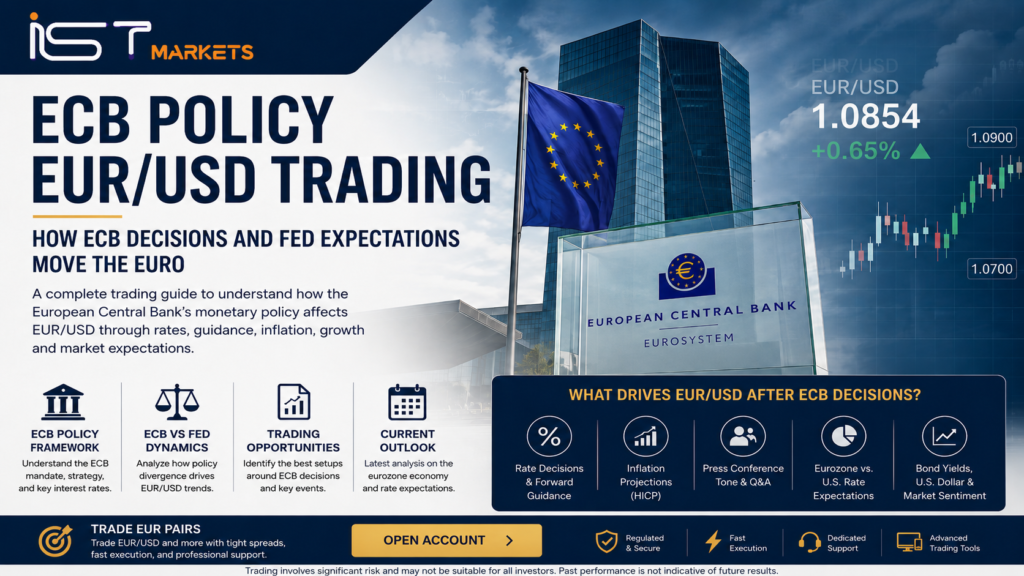
EUR/USD may look calm before an ECB meeting. Then the rate decision is released, one sentence in the statement changes, the press conference tone shifts, eurozone yields move, and EUR/USD breaks a level. But the real trade is rarely the headline decision alone.
The real trade is the market’s repricing of ECB policy versus Fed expectations. A hawkish ECB does not always mean a stronger euro. A dovish ECB does not always mean EUR/USD must fall. The pair reacts to relative expectations: eurozone rates versus U.S. rates, eurozone growth versus U.S. growth, and euro strength versus dollar strength.
This guide explains ECB policy EUR/USD trading from a practical decision-making perspective: what to watch, how to read the ECB statement, why the Fed side matters, when EUR/USD setups make sense, and when a trader should wait instead of chasing volatility.
What This Guide Helps You Decide
| If You Are Searching For… | This Guide Helps You Understand… |
|---|---|
| ECB policy EUR/USD | How ECB decisions affect EUR/USD through rate expectations and yield spreads. |
| ECB decision EUR/USD | Why EUR/USD may rise, fall, or reverse after the decision. |
| European Central Bank | What the ECB does and why traders watch its rate decisions, projections, and press conferences. |
| euro trading | Which EUR pairs may react to ECB policy and how to think about them. |
| ECB vs Fed EUR/USD | Why relative policy expectations matter more than the ECB decision alone. |
| ECB press conference trading | What to watch after the statement and why the Q&A can reverse the first move. |
| trade EUR/USD after ECB | How to decide whether to trade, wait, or avoid the setup. |
What Is ECB Policy in EUR/USD Trading?
ECB policy refers to the monetary policy decisions made by the European Central Bank for the euro area. For traders, the main focus is how these decisions affect eurozone interest-rate expectations, bond yields, inflation expectations, and euro demand.
In EUR/USD trading, ECB policy matters because it affects the euro side of the pair. But EUR/USD also includes the U.S. dollar side. That means traders need to compare ECB expectations with Federal Reserve expectations, not read the ECB decision in isolation.
A rate hike, rate cut, or unchanged decision can all move EUR/USD differently depending on what the market expected before the announcement and what the ECB signals about the next policy steps.
Key takeaway: ECB policy matters for EUR/USD when it changes expectations for eurozone interest rates relative to U.S. rates.
Why EUR/USD Is Not Only an ECB Trade
EUR/USD is a two-sided trade: the euro side and the dollar side. That is why a correct ECB view can still produce the wrong EUR/USD trade if the dollar side is stronger.
For example, EUR/USD can fall even after a hawkish ECB decision if U.S. yields rise faster, the Fed narrative becomes more hawkish, or risk-off flows support the dollar. In the same way, EUR/USD may not fall after a dovish ECB message if the market was already positioned for it or if the dollar weakens at the same time.
ECB Policy Framework
Inflation Target and HICP
The ECB’s monetary policy strategy is built around price stability. The Governing Council aims for 2% inflation over the medium term, and inflation is measured using the Harmonised Index of Consumer Prices, or HICP. For traders, this means eurozone inflation data can shape ECB expectations before and after policy meetings.
ECB Key Interest Rates
The ECB sets three key interest rates for the euro area: the main refinancing operations rate, the deposit facility rate, and the marginal lending facility rate. Traders often focus closely on the deposit facility rate because it is central to how the ECB steers monetary conditions.
Forward Guidance and Data Dependence
The market does not only watch whether the ECB cuts, holds, or raises rates. It also watches whether the ECB sounds data-dependent, cautious, restrictive, or open to future policy changes. A small wording change can matter when traders are already positioned for a particular policy path.
Press Conference and Q&A
The ECB press conference can be as important as the decision itself. The statement may move EUR/USD first, but the Q&A can change the tone. If the President sounds less confident about growth or more cautious about inflation, EUR/USD may reverse the initial move.
Staff Projections
ECB staff projections give traders a structured view of inflation, growth, wages, and risk assumptions. A change in projections can affect the market’s view of future rate cuts or future policy restraint, especially when the rate decision itself was expected.
ECB vs Fed: The Real EUR/USD Driver
EUR/USD usually becomes clearer when traders compare the ECB policy path with the Fed policy path. If the ECB becomes more hawkish while the Fed is neutral, EUR/USD may receive support. If the Fed is more hawkish than the ECB, the dollar side may dominate.
| Scenario | ECB Side | Fed Side | EUR/USD Bias |
|---|---|---|---|
| ECB hawkish, Fed neutral | Euro supported | USD stable | EUR/USD may rise |
| ECB dovish, Fed hawkish | Euro pressured | USD supported | EUR/USD may fall |
| Both hawkish | Rates supported | Rates supported | Relative yield move matters |
| ECB hawkish, Fed more hawkish | Euro supported | USD stronger | EUR/USD may still fall |
| Both dovish | Euro rates lower | U.S. rates lower | Wait for relative repricing |
ECB Policy EUR/USD Decision Framework
A structured process helps traders avoid reacting to the first headline. The goal is to understand whether the ECB decision changes the relative policy story between the euro and the U.S. dollar.
Step 01
Check the Economic Calendar
Before trading any ECB decision, start with the economic calendar to confirm the meeting time, statement release, press conference timing, and related eurozone data.
Step 02
Compare the ECB Decision With Market Expectations
A rate move only matters if it differs from what traders expected. If the decision was fully priced in, EUR/USD may react more to the statement and press conference than to the rate itself.
Step 03
Read the Statement Language
Watch for wording around inflation, growth risks, wage pressure, restrictive policy, and data dependence. Small language changes can shift rate expectations.
Step 04
Watch Staff Projections
Inflation and growth projections can change the market’s view of the future rate path. Higher inflation projections may support eurozone yields; weaker growth projections can limit euro strength.
Step 05
Listen to the Press Conference
The press conference can confirm or weaken the first move. A cautious tone may soften a hawkish decision, while firm language on inflation can support the euro after an unchanged rate decision.
Step 06
Compare ECB Pricing With Fed Pricing
Do not treat EUR/USD as a euro-only trade. If U.S. yields or Fed expectations move more strongly than eurozone yields, the dollar side can dominate.
Step 07
Confirm With Yields and EUR/USD Structure
Watch eurozone bond yields, U.S. Treasury yields, DXY, and EUR/USD support or resistance. A cleaner setup usually needs confirmation beyond the ECB headline.
Step 08
Decide: Trade, Wait, or Avoid
If the message is mixed, wait. If EUR/USD is already extended, avoid chasing. If ECB repricing, Fed comparison, yields, and price structure align, the setup may be worth monitoring.
ECB Decision Trading Playbook
| ECB Signal | Market Interpretation | Possible EUR/USD Reaction | Better Decision | Avoid If |
|---|---|---|---|---|
| Hawkish surprise | Eurozone rates repriced higher | EUR/USD may rise | Wait for yield confirmation | Fed also turns hawkish |
| Dovish surprise | Eurozone rates repriced lower | EUR/USD may fall | Watch continuation | Move already priced in |
| Unchanged rate + hawkish language | Policy support for euro | EUR/USD may recover | Check press conference | Growth outlook weakens |
| Rate cut + hawkish guidance | Mixed message | Choppy EUR/USD | Wait | First spike lacks confirmation |
| ECB hawkish but U.S. yields rise faster | USD side dominates | EUR/USD may fall | Avoid euro-only view | Fed narrative stronger |
Trading Opportunities After ECB Decisions
ECB events can create opportunities, but they also create noise. A policy-driven setup is stronger when the decision, statement, press conference, yields, and EUR/USD structure all support the same direction. This is where a structured policy trading approach can help traders avoid emotional entries.
Hawkish ECB Setup
This can make sense when the ECB is more hawkish than expected, eurozone yields rise, EUR/USD breaks resistance, and the Fed side does not overpower the move. The trade-off is that a hawkish ECB message may already be priced in.
Dovish ECB Setup
A dovish setup may appear when the ECB signals weaker growth, future easing, or reduced inflation pressure. EUR/USD downside becomes cleaner when eurozone yields fall and the dollar remains stable or supported.
Policy Divergence Setup
Policy divergence happens when the expected path of ECB rates and Fed rates moves in different directions. This is often more important than the ECB decision itself because EUR/USD reflects the gap between the two policy stories.
False Breakout Setup
The first EUR/USD move after ECB can fail if the press conference changes the tone, the Fed side dominates, or the move was already crowded. A failed breakout can sometimes be more informative than the first spike.
Current Outlook
The current outlook for EUR/USD should be read through a relative-policy lens. ECB policy remains tied to inflation and medium-term price stability, but the euro’s reaction also depends on U.S. inflation, Fed expectations, dollar positioning, and global risk sentiment.
Inflation Is Still the Anchor
The ECB’s policy framework remains anchored around price stability. If inflation looks persistent, the market may price a more restrictive ECB stance. If inflation cools and growth weakens, traders may focus more on the timing and depth of future easing.
Growth Matters More When Inflation Is Near Target
When inflation is closer to target, the market may become more sensitive to growth, credit conditions, and business activity. A weak eurozone growth outlook can limit euro strength even if inflation remains a concern.
EUR/USD Depends on Both Sides of the Pair
Even a clear ECB message can be overwhelmed by U.S. data or Fed repricing. Traders should avoid reading EUR/USD as a pure euro story.
Why the Economic Calendar Matters
ECB meetings, HICP releases, PMI data, U.S. CPI, Fed meetings, and U.S. labour data can all influence EUR/USD. A trader who only watches the ECB decision may miss the next driver of the pair.
Best EUR Pairs to Watch Around ECB Decisions
EUR/USD
EUR/USD is the main pair for ECB versus Fed repricing. It is often the cleanest expression when eurozone and U.S. rate expectations diverge.
EUR/GBP
EUR/GBP can be useful when the ECB story is clearer against the Bank of England outlook than against the Fed.
EUR/JPY
EUR/JPY can react when ECB expectations and Bank of Japan expectations move in different directions, especially when yield spreads are central to the market story.
EUR/CHF
EUR/CHF may become relevant during European risk events or defensive market conditions, though liquidity and safe-haven flows should be considered carefully.
Why EUR/USD Can Reverse After ECB Announcements
The first EUR/USD move is often the headline reaction. The second move is the market pricing the full ECB-versus-Fed story. Reversals are common when the first interpretation turns out to be incomplete.
- The decision was already priced in.
- The statement does not support the rate move.
- The press conference softens the initial message.
- Staff projections weaken the growth outlook.
- Fed expectations move faster than ECB expectations.
- U.S. yields overpower eurozone yields.
- The first move was algorithmic or liquidity-driven.
- The market was positioned heavily in one direction before the decision.
When Not to Trade ECB Decisions
- Do not trade if you do not know what the market expected before the ECB decision.
- Do not trade if the decision was expected and the statement adds nothing new.
- Do not chase EUR/USD before the press conference if the first move is already extended.
- Do not trade if the Fed narrative or U.S. data is clearly dominating the pair.
- Do not trade if spreads are too wide for your risk plan.
- Do not trade if eurozone yields and EUR/USD structure do not confirm each other.
- Do not trade without a clear exit plan.
Risk Factors
ECB decisions can create fast EUR/USD movement, but volatility is not the same as opportunity. A correct policy view can still lead to a poor trade if spreads widen, slippage increases, or the Fed side overrides the euro story.
- Spread widening: Central-bank events can reduce execution quality.
- Slippage: Fast moves may fill at worse prices than expected.
- Press conference reversal: The Q&A can change the initial direction.
- Headline traps: The rate decision may not tell the full policy story.
- Policy divergence: Fed expectations can dominate the ECB message.
- U.S. data dominance: U.S. inflation, jobs, or Fed commentary can quickly change EUR/USD direction.
- Overleveraging: Larger size around ECB events can magnify losses quickly.
Recommended For / Not Ideal For
| Recommended For | Not Ideal For |
|---|---|
| Intermediate EUR/USD traders | Traders chasing the first spike |
| Traders following central banks | Traders looking for guaranteed signals |
| Traders using an economic calendar | Traders ignoring the Fed side of EUR/USD |
| Traders comparing ECB vs Fed expectations | Traders using excessive leverage |
| Traders seeking EUR pair setups | Traders without risk limits |
Scenario Example: Hawkish ECB but EUR/USD Fails to Rally
Imagine the ECB statement sounds hawkish. Eurozone yields rise slightly, and EUR/USD spikes higher. At first glance, the euro looks supported. But then U.S. yields rise faster, DXY strengthens, and EUR/USD fails to hold above resistance.
A trader who only reads the ECB side may think the euro should continue higher. A trader who reads the full pair understands the problem: the dollar side is stronger. The ECB message may support the euro, but not enough to overcome Fed repricing or U.S. yield strength.
Frequently Asked Questions
How does ECB policy affect EUR/USD?
ECB policy affects EUR/USD when interest-rate decisions, inflation projections, growth outlook, and press conference language change expectations for eurozone rates compared with U.S. rates.
What is the European Central Bank?
The European Central Bank is the central bank for the euro area. It sets monetary policy for the eurozone, including key interest rates and policy guidance aimed at maintaining price stability.
Does an ECB rate hike always strengthen the euro?
No. An ECB rate hike may support the euro if it surprises the market or raises future rate expectations. But EUR/USD can still fall if the hike was already priced in or if Fed expectations support the dollar more strongly.
Why can EUR/USD fall after a hawkish ECB decision?
EUR/USD can fall after a hawkish ECB decision if U.S. yields rise faster, the dollar strengthens, the ECB message was already priced in, or the press conference weakens the initial interpretation.
What matters more for EUR/USD: ECB or Fed policy?
Neither side matters alone. EUR/USD is driven by the relative difference between ECB expectations and Fed expectations, along with bond yields, dollar strength, eurozone data, and market sentiment.
How should traders read an ECB press conference?
Traders should listen for language around inflation, growth risks, wage pressure, data dependence, and the future policy path. The press conference can confirm or reverse the first EUR/USD move.
Which EUR pairs move most after ECB decisions?
EUR/USD is usually the main pair to watch, but EUR/GBP, EUR/JPY, and EUR/CHF can also react depending on whether the ECB story is stronger against the Fed, BoE, BoJ, or Swiss franc safe-haven flows.
Should traders enter before or after an ECB decision?
Many traders prefer to wait until after the decision and press conference because spreads can widen and the first move may reverse. Entering before an ECB decision is higher risk unless the trader has a clear plan.
Why does EUR/USD reverse after ECB announcements?
EUR/USD can reverse if the rate decision was priced in, the press conference changes the tone, staff projections weaken the outlook, U.S. yields dominate, or the first move was driven by short-term liquidity.
How can traders manage risk around ECB events?
Traders can manage risk by reducing position size, checking spreads, waiting for confirmation, comparing ECB and Fed expectations, and avoiding trades when the message is mixed or EUR/USD is already extended.
Risk Warning
Trading forex, CFDs, and leveraged products involves substantial risk and may not be suitable for all investors. ECB decisions can increase volatility, spreads, slippage, and the speed of losses. You may lose some or all of your invested capital. This article is educational only and does not provide investment advice, trading signals, or a recommendation to trade any specific instrument.
Trade EUR Pairs with a Policy-Aware Approach
ECB decisions can move EUR/USD quickly, but the cleaner opportunity often appears when traders compare the ECB message with Fed expectations, bond yields, and EUR/USD confirmation.
With IST Markets, traders can access EUR pairs, follow market-moving events, and build a more structured approach to policy-driven trading.
Trading involves risk. Use policy analysis as decision support, not as a guarantee of direction.
Sources & Further Reading
- European Central Bank — Monetary policy strategy
- ECB Data Portal — Key ECB interest rates
- European Central Bank — Press conferences
- European Central Bank — Macroeconomic projections
- Eurostat — Harmonised Index of Consumer Prices
- Federal Reserve — Monetary policy goals and transmission
- BIS — Global exchange rate adjustments
- IMF — Euro area policy and macroeconomic reports