At a Glance
| Question | Decision-Led Answer |
|---|---|
| Main data to watch | CPI, core CPI, PCE, inflation expectations, and revisions. |
| Main forex channel | Interest-rate expectations and central-bank repricing. |
| Strongest reaction happens when | Actual inflation differs clearly from forecast and changes rate pricing. |
| Main pairs affected | EUR/USD, USD/JPY, GBP/USD, USD/CHF, AUD/USD, and gold-sensitive FX themes. |
| Main confirmation tools | DXY, Treasury yields, Fed pricing, gold, and equity reaction. |
| Main risk | The first CPI move can reverse after traders digest the details. |
| Best next step | Track alerts and post-release repricing, not the headline alone. |
Last reviewed: May 2026 ·
This guide is educational only and does not provide investment advice, trading signals, or guaranteed outcomes.
On This Page
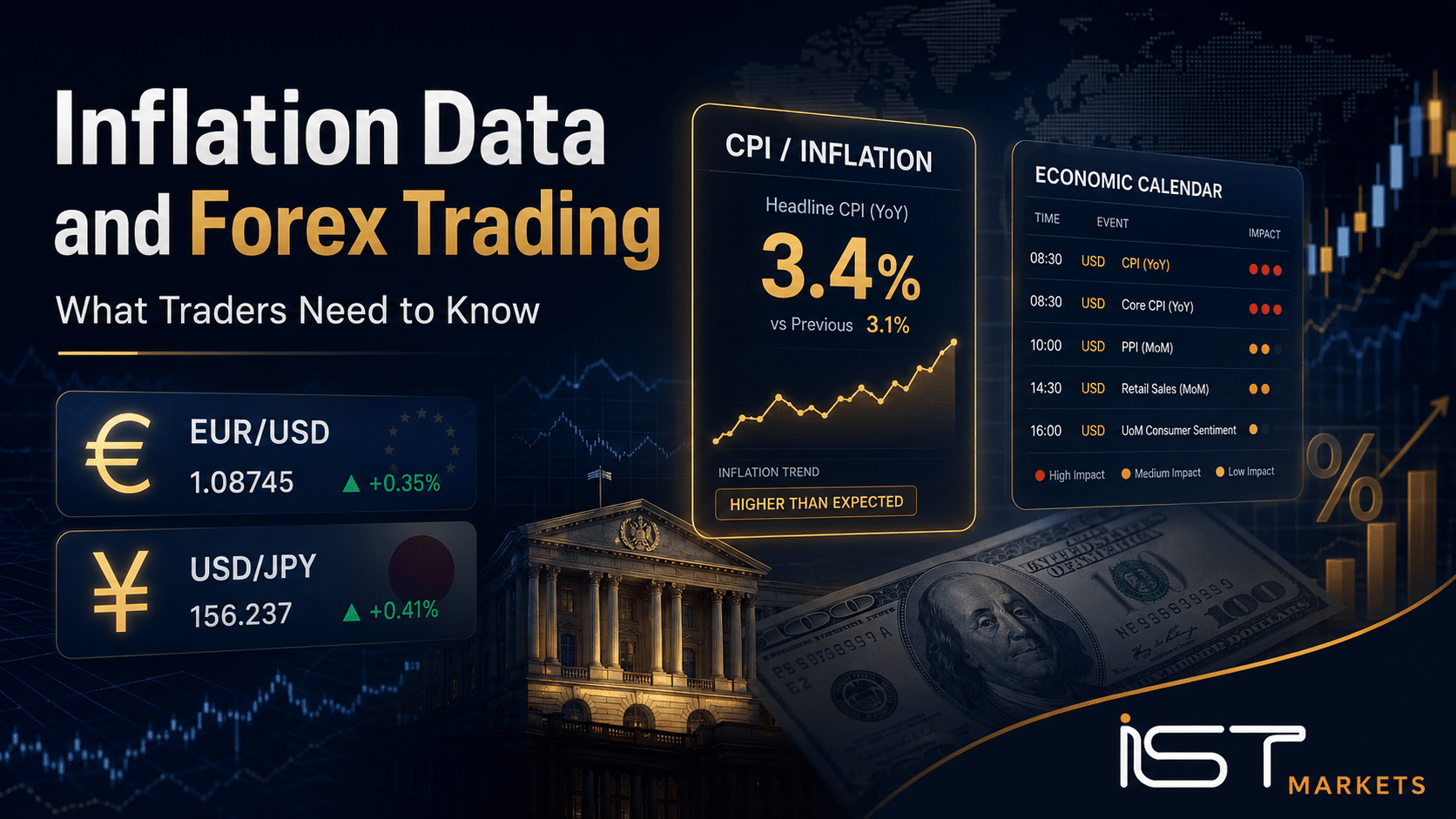
A CPI release can make the forex market look simple for a few seconds. The number comes out, the dollar jumps, EUR/USD breaks a level, USD/JPY spikes, and gold reacts. But experienced traders know that the first move is not always the real move.
The question is not only whether inflation is high or low. The better question is whether inflation data changes rate expectations enough to reprice currencies. A hot CPI number that the market already expected may produce a weaker reaction than a smaller surprise that changes the central-bank path. A soft headline CPI may weaken the dollar at first, then reverse if core inflation remains sticky.
That is why inflation data forex trading needs a decision framework, not just a headline reaction. This guide explains how traders can read CPI, core CPI, price index releases, rate expectations, and currency-pair confirmation before deciding whether to trade, wait, or follow premium alerts for the next phase of market repricing.
Understanding Inflation Data
Inflation data measures how price levels change over time. For forex traders, the number matters because it can influence interest-rate expectations, central-bank policy, bond yields, and currency valuations. But the market rarely reacts to the number in isolation. It reacts to whether the number changes what traders thought they already knew.
What Is CPI in Forex Trading?
The Consumer Price Index, or CPI, is one of the most watched inflation indicators. In forex trading, CPI matters because it can change expectations for how central banks may set interest rates. If inflation is stronger than expected, traders may price a more hawkish policy path. If inflation is weaker than expected, they may price faster easing.
Decision point: CPI is not a buy or sell signal by itself. The tradable information is the surprise: actual data versus forecast, previous reading, and market positioning before the release.
Headline CPI vs Core CPI
Headline CPI includes broad consumer prices, including food and energy. Core CPI usually excludes food and energy because those categories can be more volatile. Traders often watch both because they can tell different stories. A hot headline number with softer core inflation may create a mixed reaction. Sticky core inflation can keep a currency supported even if headline inflation cools.
CPI vs PCE Price Index
CPI often creates immediate market volatility because it is widely watched and released on a fixed schedule. PCE inflation, however, can matter more for broader Federal Reserve policy interpretation. Traders who focus only on CPI may miss part of the policy story, especially when central banks emphasize a different inflation measure.
Month-over-Month vs Year-over-Year Inflation
Month-over-month inflation often drives the fastest market reaction because it shows the latest pace of price changes. Year-over-year inflation gives the broader direction. A trader should compare both. A lower annual rate may look positive, but if monthly core inflation is still strong, the market may treat the report as less dovish than it first appears.
Forecast vs Actual vs Previous
The most important CPI trading question is not “what was the number?” It is “what did the market expect?” A report can look strong in absolute terms but still disappoint if traders expected an even hotter reading. Revisions also matter because they change the base from which the market interprets the latest data.
Key takeaway: The trade is not the inflation number. The trade is the surprise versus what the market had already priced in.
Inflation Data Forex Trading Decision Framework
A strong inflation-trading process starts before the data release. The goal is not to guess the number. It is to know what the market expects, which pairs may react, and what confirmation would make the move more reliable.
Step 01
Check the Economic Calendar
Before trading any CPI release, start with the economic calendar to confirm release time, forecast, previous reading, and expected market importance.
Step 02
Identify the Inflation Surprise
Compare actual CPI with forecast, previous readings, revisions, and core details. A clean surprise is usually more important than the absolute level of inflation.
Step 03
Read the Rate-Expectation Channel
If inflation is hotter than expected, traders may price higher-for-longer policy. If inflation is softer, traders may price earlier cuts. The forex reaction becomes stronger when yields and rate expectations confirm the move.
Step 04
Confirm With Currency Reaction
Watch DXY, EUR/USD, USD/JPY, GBP/USD, gold, Treasury yields, and equity sentiment. If the currency reaction does not confirm the data, the first move may be noise.
Step 05
Decide: Trade, Wait, or Track Alerts
When inflation data, rate expectations, and currency reactions move at the same time, premium analysis can help traders follow the sequence faster instead of reacting only after the move becomes obvious.
Historical Impact of Inflation Data on Forex
Inflation has not always affected currencies in the same way. The historical impact depends on the economic regime, the central bank’s credibility, the growth backdrop, and whether traders believe policy will respond strongly enough.
When Inflation Strengthens a Currency
Inflation can strengthen a currency when traders believe the central bank will keep policy tighter for longer. In that environment, bond yields may rise, the currency may gain rate support, and pairs such as EUR/USD or USD/JPY may move sharply if the dollar is involved.
When High Inflation Weakens a Currency
High inflation does not always strengthen a currency. If inflation damages growth, reduces purchasing power, or creates stagflation concerns, investors may become less confident. A currency can weaken if the market believes the central bank is behind the curve or the economy cannot absorb tighter policy.
When the First CPI Reaction Reverses
First reactions can reverse when the headline looks strong but core details are softer, when the data was already priced in, or when yields do not confirm. Liquidity around major releases can also create sharp algorithmic moves that fade once traders read the full report.
Why USD/JPY Often Reacts Sharply
USD/JPY is highly sensitive to US yields and rate expectations. That can make it one of the most active pairs around US CPI releases. The trade-off is that yen safe-haven behavior can complicate the move when inflation data also affects risk sentiment.
Historical-impact takeaway: Inflation data moves forex through policy expectations. The same inflation number can produce different currency reactions in different market regimes.
Trading the Release
CPI trading is a form of news trading, which means timing, spreads, slippage, and confirmation matter as much as the direction of the data. The question is not whether the release is important. The question is whether the market reaction is clean enough to trade.
Before the CPI Release
- Check the economic calendar for release time, forecast, and previous reading.
- Mark key levels on EUR/USD, USD/JPY, GBP/USD, and DXY.
- Check pre-release positioning in yields and the dollar.
- Decide whether you will trade, wait, or only monitor alerts.
- Avoid oversized positions before the release.
During the Release
The first seconds after CPI can be noisy. Spreads may widen, market orders may fill at worse levels than expected, and the first candle may reflect algorithmic reaction rather than durable direction. Traders should be careful with headline-only decisions.
After the Release
After the first reaction, the market usually starts asking the more important question: what does this mean for the next central-bank decision? This is where yields, DXY, and pair structure become more useful than the headline number alone.
CPI Trading Setups
- Hot CPI + stronger USD: Watch EUR/USD downside and USD/JPY upside if yields confirm.
- Soft CPI + weaker USD: Watch EUR/USD, GBP/USD, and gold-sensitive reactions if risk sentiment supports.
- Mixed CPI: Wait for confirmation instead of trading the first spike.
- Hot headline / soft core: Expect a choppy reaction if details do not confirm the headline.
- Weak CPI but USD holds: Check whether risk-off sentiment or positioning is supporting the dollar.
CPI Trading Playbook
| CPI Signal | Rate Expectation Impact | Possible FX Reaction | Better Pair to Watch | Avoid If |
|---|---|---|---|---|
| CPI hotter than forecast | Higher-for-longer pricing | USD strength | EUR/USD, USD/JPY | Already priced in |
| CPI softer than forecast | Cut expectations rise | USD weakness | EUR/USD, GBP/USD | Risk-off dominates |
| Headline hot, core soft | Mixed signal | Choppy USD | Wait | First move lacks confirmation |
| Core inflation sticky | Hawkish policy concern | USD supported | USD/JPY, EUR/USD | Yields do not confirm |
| CPI matches forecast | Limited repricing | Range or fade | Major pairs | No volatility expansion |
Current Inflation Trends
Inflation trends now matter less as a simple “high or low” story and more as a policy-timing story. Traders want to know whether inflation is cooling fast enough for central banks to ease, or whether sticky price pressures will delay policy shifts.
Inflation Is a Policy-Timing Question
A CPI report can move forex if it changes expectations for the next central-bank meeting. A small miss may matter if the market is positioned aggressively. A large miss may matter less if policymakers have already signaled patience.
Why Core Inflation Still Matters
Core inflation helps traders judge whether price pressure is persistent. If headline inflation cools but core remains sticky, the currency reaction may be more hawkish than a simple headline view suggests.
Central Bank Divergence
Inflation does not affect every currency the same way. Strong US CPI may support the dollar if it changes Fed pricing. Weak eurozone inflation may pressure the euro if it increases easing expectations. Sticky UK inflation may create GBP volatility. Japan inflation shifts can influence JPY repricing in a different way.
Why Premium Alerts Matter Around CPI
Inflation releases move fast because traders are not only reacting to the number. They are reacting to what the number means for the next central-bank decision. Structured premium analysis can help traders follow CPI alerts, rate-expectation shifts, and currency-pair reactions in one sequence.
Current-trends takeaway: The strongest CPI trades usually come from policy repricing, not from the headline number alone.
Currency Reaction Matrix
| Data Outcome | USD Reaction | EUR/USD | USD/JPY | Gold | Best Decision |
|---|---|---|---|---|---|
| Hot CPI + yields up | Stronger | Lower | Higher | Lower | Wait for confirmation |
| Soft CPI + yields down | Weaker | Higher | Lower | Higher | Watch continuation |
| Mixed CPI | Choppy | Range | Whipsaw | Mixed | Avoid first spike |
| Hot CPI + stocks fall | May rise | Lower | Mixed | Mixed | Check risk sentiment |
| Soft CPI + risk-on | Weaker | Higher | Lower or mixed | Higher | Monitor second wave |
Risk Management for CPI Trading
Inflation releases can create sharp volatility, spread widening, and fast reversals. That makes risk management more important than the direction of the headline. A clear number can still produce a poor trade if the entry is late or the spread is too wide.
- Do not enter only because the number was released. Wait for confirmation from yields, DXY, and pair structure.
- Avoid careless market orders in the first seconds. Spreads can widen around major data releases.
- Do not place stops too close during the first volatility burst. CPI can create whipsaw movement.
- Do not increase size because the headline looks obvious. The details may change the market interpretation.
- Watch revisions. Previous data revisions can change how traders read the new report.
- Use alerts as support, not a guarantee. Alerts help monitor the sequence, but the trading decision remains yours.
Recommended For / Not Ideal For
| Recommended For | Not Ideal For |
|---|---|
| Intermediate forex traders | Traders looking for guaranteed signals |
| Traders who follow economic indicators | Traders using oversized leverage |
| Traders who trade USD pairs | Traders entering before data without a plan |
| Traders who want CPI alerts | Beginners who do not understand spread widening |
| Traders who need structured post-release analysis | Traders who cannot tolerate volatility |
If CPI releases often move faster than you can interpret them, structured alerts and premium analysis can help you follow the inflation-to-rate-to-FX sequence more clearly. The goal is not to react faster to every headline. The goal is to understand which move matters.
Scenario Example: Hot CPI and USD Reaction
Imagine CPI comes in higher than forecast and core CPI remains sticky. Treasury yields rise, DXY moves higher, EUR/USD breaks below support, and USD/JPY jumps. At first glance, the trade looks simple: buy USD. But a stronger trader asks whether the repricing is confirmed and whether the move is already extended.
If yields continue higher, DXY holds the breakout, and EUR/USD remains below support after the first spike, the reaction may be more durable. If USD/JPY jumps but then stalls because risk sentiment turns defensive, the cleaner expression may be EUR/USD rather than USD/JPY. If headline CPI is hot but core details are mixed, the better decision may be to wait.
This is where alerts and premium scenario analysis can help: not by guaranteeing a trade, but by keeping the release, rate-pricing shift, and pair reaction in one structured view.
Frequently Asked Questions
How does inflation data affect forex trading?
Inflation data affects forex trading by changing expectations for interest rates, central-bank policy, bond yields, and currency valuations. The strongest moves usually happen when CPI or core CPI surprises the market and is confirmed by yields and major currency pairs.
What is CPI trading in forex?
CPI trading in forex means analyzing Consumer Price Index releases to understand how inflation data may affect currencies. It is a form of news trading and requires attention to forecasts, core inflation, yields, spreads, and market reaction.
Does higher inflation always strengthen a currency?
No. Higher inflation can strengthen a currency if traders expect tighter central-bank policy, but it can weaken a currency if inflation damages growth, reduces confidence, or creates stagflation concerns.
Why does CPI move the US dollar?
CPI can move the US dollar because it may change expectations for Federal Reserve policy. If CPI is hotter than expected and yields rise, the dollar may strengthen. If CPI is softer and rate-cut expectations increase, the dollar may weaken.
Which forex pairs react most to inflation data?
EUR/USD, USD/JPY, GBP/USD, USD/CHF, and AUD/USD often react to major inflation releases, especially US CPI. The best pair depends on whether the move is driven by dollar strength, yields, or broader risk sentiment.
Should traders enter before or after CPI data?
Many traders prefer to wait until after the release because spreads can widen and the first reaction can reverse. Entering before CPI is higher risk unless the trader has a defined plan and understands volatility conditions.
What is the difference between CPI and core CPI?
Headline CPI tracks broad consumer price changes, while core CPI usually excludes food and energy. Core CPI can matter more when traders are trying to judge whether inflation pressure is persistent.
Why can the first CPI reaction reverse?
The first CPI reaction can reverse if headline and core data conflict, if the move was already priced in, if yields do not confirm, or if traders reinterpret the report after the initial volatility spike.
How can alerts help during inflation releases?
Alerts can help traders track the release, rate-expectation shifts, and currency-pair reactions quickly. They should support decision-making, not replace risk management or independent judgment.
Risk Warning
Trading forex, CFDs, and leveraged products involves substantial risk and may not be suitable for all investors. Inflation releases can increase volatility, spreads, slippage, and the speed of losses. You may lose some or all of your invested capital. This article is educational only and does not provide investment advice, trading signals, or a recommendation to trade any specific instrument.
Access Premium Inflation Analysis Before the Market Fully Reprices
Inflation releases can move currencies in seconds, but the cleaner opportunity often appears when the market starts repricing interest-rate expectations after the first reaction.
With IST Markets premium analysis, traders can follow CPI alerts, rate-expectation shifts, currency-pair reactions, and post-release scenarios in one structured view.
Alerts support decision-making; they do not guarantee outcomes. Always manage your own risk.
Sources & Further Reading