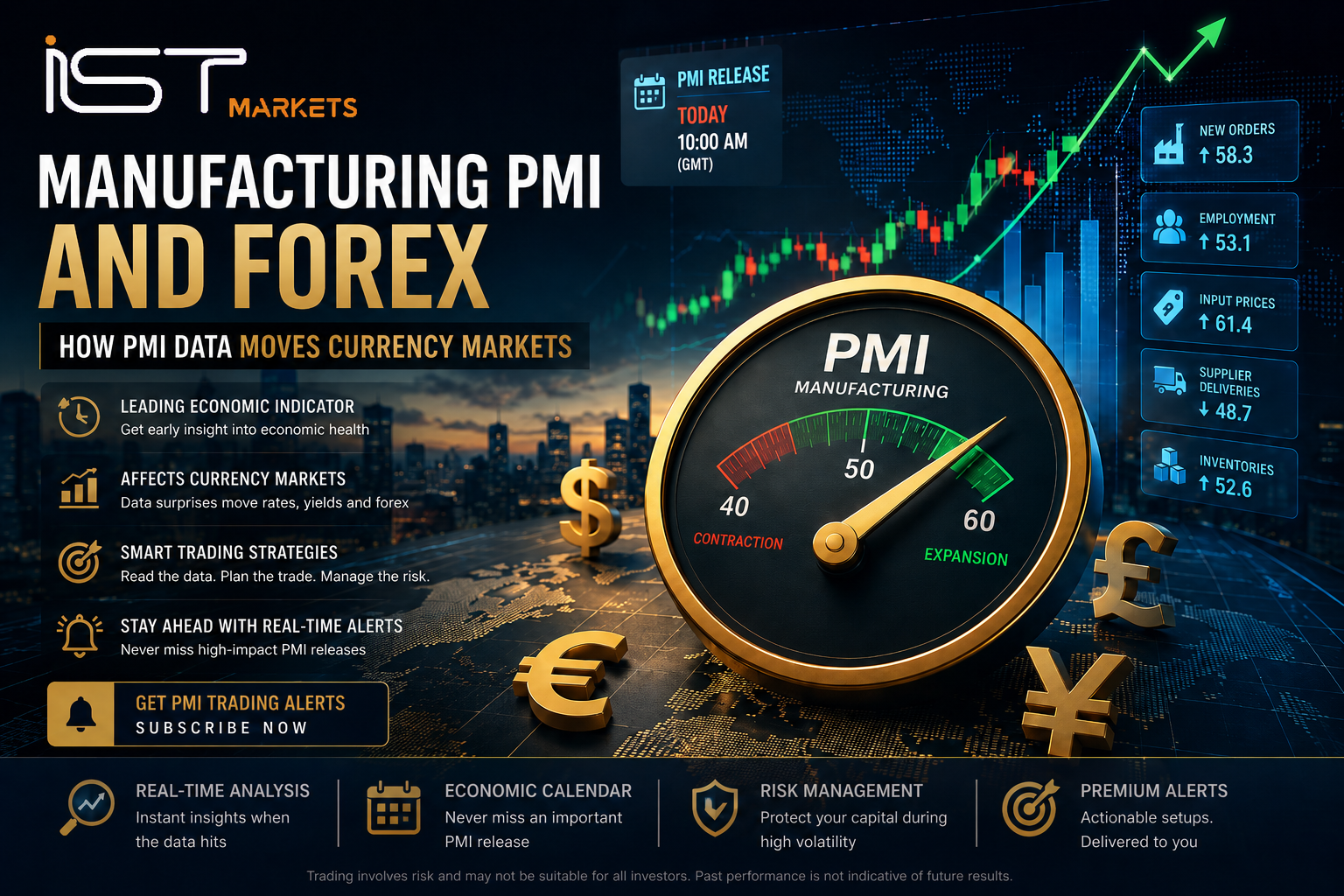
PMI Trading Insight
PMI looks simple until the market reacts the opposite way.
A reading above 50 does not automatically make a currency stronger, and a weak PMI does not always mean immediate selling. In forex, the real question is whether the PMI release changes expectations for growth, inflation, interest rates, or risk sentiment.
This guide shows how traders read Manufacturing PMI beyond the headline number: actual versus forecast, the 50 level, new orders, input prices, yields, central-bank context, and the currency pairs most likely to react.
At a Glance
| Question | Decision-Led Answer |
|---|---|
| Main topic | How Manufacturing PMI data affects forex markets. |
| Main market focus | PMI surprises, new orders, input prices, yields, and currency reactions. |
| Expansion threshold | Above 50 usually signals expansion; below 50 usually signals contraction. |
| Biggest reaction driver | Actual data versus forecast, not the headline number alone. |
| Important sub-components | New orders, production, employment, input prices, supplier deliveries, and export orders. |
| Better approach | Use PMI as part of a wider news, rates, and risk-management framework. |
Content Table
- What This Guide Helps Traders Do
- Why Manufacturing PMI Matters in Forex Trading
- Understanding PMI: What Is the Purchasing Managers’ Index?
- Why PMI Is a Leading Economic Indicator
- How Manufacturing PMI Data Moves Currency Markets
- Historical Impact: When PMI Data Creates Strong Forex Moves
- Actual vs Forecast: The Real Driver of PMI Reactions
- Why a Strong PMI Can Still Weaken a Currency
- Currency Pairs Most Sensitive to PMI Releases
- Trading Strategy: How Traders Read PMI Releases
- The PMI Forex Reaction Framework
- Current Data: How Traders Monitor PMI in Real Time
- Common Mistakes Traders Make with PMI Data
- Risk Management During PMI News Trading
- How IST Markets Helps Traders Track PMI Data
- Frequently Asked Questions
Manufacturing PMI is one of the first major economic signals traders receive each month. It can show whether factory activity is expanding, slowing, or contracting before many official data releases arrive.
That early timing is why PMI matters in forex. Currencies often move when traders believe new data changes expectations for growth, inflation, interest rates, or risk appetite.
The mistake is thinking PMI is only about the 50 level. In live markets, the surprise versus forecast, the direction of the trend, and the details inside the report can matter more than the headline.
What This Guide Helps Traders Do
| After Reading This Guide, You Will Know How To… | Why It Matters |
|---|---|
| Read PMI beyond the 50 level | Above or below 50 is useful, but not enough for trading decisions. |
| Compare actual data with forecasts | Surprises often create the strongest forex reactions. |
| Use sub-components intelligently | New orders and input prices can change the message of the headline PMI. |
| Link PMI to rates and currency strength | Currencies often react through interest-rate expectations. |
| Avoid common PMI trading mistakes | Fast data releases can create false first reactions and poor entries. |
Why Manufacturing PMI Matters in Forex Trading
PMI matters because it gives traders an early look at economic momentum. If manufacturing activity is improving, traders may see stronger growth, better demand, and possibly tighter policy expectations. If it is weakening, traders may start pricing slower growth or more cautious central-bank policy.
Manufacturing is especially important for export-heavy economies and currencies connected to global trade, commodities, industrial demand, and supply chains.
For traders, PMI is not just a data point. It is a signal about whether the economy is accelerating, losing momentum, or creating inflation pressure.
Understanding PMI: What Is the Purchasing Managers’ Index?
What PMI Measures
The Purchasing Managers’ Index is a survey-based indicator that asks purchasing managers whether business conditions are improving, unchanged, or worsening. In manufacturing, it can reflect production, new orders, employment, supplier deliveries, inventories, prices, and export demand.
PMI Above 50 vs Below 50
A reading above 50 usually signals expansion compared with the previous month. A reading below 50 usually signals contraction. A reading near 50 suggests little change.
Manufacturing PMI vs Services PMI vs Composite PMI
Manufacturing PMI focuses on factory activity. Services PMI tracks service-sector conditions. Composite PMI combines manufacturing and services to give a broader view of private-sector activity. For forex, the most important release depends on the country and what markets are focused on at the time.
| PMI Type | What It Tracks | Forex Relevance |
|---|---|---|
| Manufacturing PMI | Factory activity and goods production. | Important for industrial and export-linked currencies. |
| Services PMI | Services-sector activity. | Important for service-led economies. |
| Composite PMI | Manufacturing and services together. | Useful for the broader growth picture. |
Why PMI Is a Leading Economic Indicator
PMI is valuable because it is released early and reflects current business conditions. Traders often receive PMI readings before slower official data such as GDP, industrial production, or detailed employment reports.
That early timing can help markets adjust expectations. If PMI weakens for several months, traders may start pricing slower growth before official economic data fully confirms it.
| PMI Component | What It Signals | Forex Relevance |
|---|---|---|
| New orders | Future demand. | Growth expectations. |
| Output | Current production. | Economic activity. |
| Employment | Labour demand. | Central-bank context. |
| Input prices | Cost pressure. | Inflation expectations. |
| Export orders | External demand. | Trade and currency sensitivity. |
How Manufacturing PMI Data Moves Currency Markets
Growth Expectations
A strong PMI can suggest that manufacturing demand is improving. If traders believe this supports growth, the local currency may receive support.
Inflation and Input Prices
Input prices matter because they can reveal cost pressure. If price pressures rise while activity remains firm, markets may rethink inflation and rate expectations.
Interest-Rate Expectations
Currencies often react through rates. Stronger PMI data can reduce expectations for rate cuts or support tighter policy expectations. Weaker PMI data can do the opposite.
Export Demand and Manufacturing Currencies
Manufacturing PMI can matter more for economies with large industrial or export sectors. Export orders can be especially important for trade-linked currencies.
Risk Sentiment
Weak global PMI readings can hurt risk appetite. That may pressure risk-sensitive currencies while supporting defensive currencies in some conditions.
Historical Impact: When PMI Data Creates Strong Forex Moves
The historical impact of PMI is best understood through market patterns rather than fixed rules. PMI can move currencies strongly when it changes expectations, but the same reading can create different outcomes in different cycles.
| Pattern | Possible Market Reaction | Trader Interpretation |
|---|---|---|
| PMI beats forecast strongly | Currency may strengthen. | Growth or rate expectations improve. |
| PMI misses forecast sharply | Currency may weaken. | Slower growth or lower rates may be priced. |
| PMI above 50 but falling | Mixed reaction. | Expansion continues, but momentum is weaker. |
| PMI below 50 but improving | Possible recovery signal. | Contraction remains, but the downturn may be easing. |
| Input prices rise | Yields may move higher. | Inflation pressure may matter more than growth. |
Actual vs Forecast: The Real Driver of PMI Reactions
A PMI reading is not judged in isolation. Traders compare the actual number with the forecast, the previous reading, and the recent trend.
A PMI of 51 may look positive because it is above 50. But if the forecast was 53 and new orders are weakening, the currency reaction may still be negative. A PMI of 48 may look weak, but if the market expected 46 and new orders improved, the currency could recover.
That is why the most useful question is not simply whether PMI is above or below 50. The better question is whether the release changes what traders expected.
Why a Strong PMI Can Still Weaken a Currency
This is where many traders get caught. A strong-looking PMI does not always create a bullish currency reaction.
- The PMI may be above 50 but below forecast.
- New orders may be weakening beneath the headline.
- Input prices may rise enough to create inflation concerns.
- The market may have already priced in a strong release.
- A bigger data release or central-bank comment may dominate the move.
- Risk sentiment may move against the currency despite good domestic data.
Currency Pairs Most Sensitive to PMI Releases
PMI sensitivity depends on the economy, the currency pair, and what the market is currently focused on. Manufacturing PMI can be especially important for currencies tied to industrial activity, exports, commodities, or central-bank repricing.
| Currency / Pair | PMI Sensitivity | What Traders Watch |
|---|---|---|
| USD pairs | US ISM or S&P Global PMI can affect Fed expectations. | Yields, prices paid, new orders. |
| EUR/USD | Eurozone and German PMI can influence EUR sentiment. | German manufacturing, ECB expectations. |
| GBP/USD | UK PMI can affect BoE and growth expectations. | Services versus manufacturing mix. |
| USD/JPY | Reaction often comes through US yields and risk sentiment. | Treasury yields, risk-on/risk-off tone. |
| AUD/USD | China and global PMI can affect commodities and risk sentiment. | China PMI, iron ore, risk appetite. |
| USD/CAD | Manufacturing and US demand can affect CAD context. | US demand, oil, Canadian data. |
| USD/CNH | China manufacturing PMI can affect yuan and global risk sentiment. | China demand, exports, policy signals. |
Trading Strategy: How Traders Read PMI Releases
Before the Release
Before PMI is released, traders check the economic calendar, the forecast, the previous reading, related data releases, and the central-bank backdrop.
During the Release
During the release, traders compare actual versus forecast, check the 50 level, read the sub-components, and avoid assuming the first price reaction is reliable.
After the Release
After the release, traders look for confirmation from bond yields, equities, commodities, and related currency pairs. A structured news trading approach can help avoid reacting emotionally to PMI surprises.
The PMI Forex Reaction Framework
| Step | Question to Ask | Why It Matters |
|---|---|---|
| 1 | Was PMI above or below forecast? | Surprises move markets. |
| 2 | Is PMI above or below 50? | It shows expansion or contraction. |
| 3 | Is the trend improving or weakening? | Momentum can matter more than one release. |
| 4 | What do new orders show? | They can signal future demand. |
| 5 | What do input prices show? | They can shift inflation expectations. |
| 6 | Do yields confirm the currency move? | Rates often drive FX reactions. |
| 7 | Is liquidity normal enough to trade? | Spreads and slippage can distort entries. |
Current Data: How Traders Monitor PMI in Real Time
Because PMI updates monthly, traders should monitor the release calendar rather than rely on static numbers inside an article. The most useful approach is to track the data source, forecast, previous reading, and market reaction.
- ISM Manufacturing PMI
- S&P Global Manufacturing PMI
- Eurozone Manufacturing PMI
- German Manufacturing PMI
- UK Manufacturing PMI
- China NBS Manufacturing PMI
- Caixin China Manufacturing PMI
- Global Manufacturing PMI
- Sub-components: new orders, employment, input prices, export orders, supplier deliveries
The goal is not just to know the latest PMI number. The goal is to understand whether the latest number changes the currency story.
Common Mistakes Traders Make with PMI Data
- Trading only the headline PMI.
- Ignoring the forecast.
- Ignoring the previous trend.
- Forgetting the 50 threshold context.
- Ignoring new orders and input prices.
- Treating PMI as a guaranteed signal.
- Ignoring central-bank context.
- Entering during widened spreads.
- Following alerts without risk rules.
Risk Management During PMI News Trading
PMI releases can create quick movement, especially when the number surprises expectations. But quick movement is not the same as a clean opportunity.
- Spreads may widen around the release.
- The first reaction may reverse after sub-components are digested.
- One PMI release is not a complete macro trend.
- Other data released on the same day may dominate the move.
- Central-bank guidance may matter more than PMI in some cycles.
- Overleverage can turn a small release reaction into a large loss.
- Alerts can support awareness, but they do not remove trading risk.
How IST Markets Helps Traders Track PMI Data
PMI can move currency markets quickly, especially when the release surprises expectations or changes the rate outlook. But traders need more than the number. They need timing, context, reaction, and risk awareness.
IST Markets premium alerts help traders follow key economic releases, market reactions, and risk context with a more structured approach.
Get PMI Trading Alerts
Track PMI releases, forecast surprises, currency reactions, and risk context with premium market alerts.
Premium alerts are educational and market-focused. They do not guarantee trading results or remove the risks of forex and CFD trading.
Frequently Asked Questions
What is Manufacturing PMI in forex?
Manufacturing PMI is a survey-based economic indicator that tracks manufacturing activity. Forex traders use it to assess growth momentum, inflation pressure, interest-rate expectations, and potential currency reactions.
How does PMI affect currency markets?
PMI affects currency markets when it changes expectations for growth, inflation, central-bank policy, or risk sentiment. The biggest reactions often happen when actual PMI differs from forecasts.
Is PMI a leading economic indicator?
Yes. PMI is considered a leading or timely indicator because it is released early and reflects current business conditions before many official economic reports.
What does PMI above 50 mean?
A PMI reading above 50 usually signals expansion in the sector compared with the previous month. Traders still compare it with the forecast and trend before judging the currency impact.
What does PMI below 50 mean?
A PMI reading below 50 usually signals contraction. A currency may weaken if the reading increases growth or rate-cut concerns, but the reaction depends on expectations and broader market context.
Which PMI data matters most for forex traders?
Forex traders often watch headline PMI, new orders, input prices, employment, supplier deliveries, export orders, forecast surprises, and the recent trend.
How do traders use PMI in forex trading?
Traders use PMI by comparing actual data with forecasts, checking the 50 threshold, reading sub-components, watching yields, and confirming whether the currency move fits the wider macro story.
Why can PMI data affect interest-rate expectations?
PMI can influence rate expectations because it reflects growth and price pressure. Strong activity and rising input prices may support tighter policy expectations, while weak activity may support a more cautious central-bank outlook.
Which currency pairs react to PMI data?
Pairs such as EUR/USD, GBP/USD, USD/JPY, AUD/USD, USD/CAD, USD/CNH, and major USD crosses may react to PMI data depending on the release and market focus.
What are the risks of trading PMI releases?
Risks include wider spreads, slippage, false first reactions, conflicting sub-components, other data releases, and overreliance on a single indicator.
Risk Warning
Trading forex, CFDs, and leveraged products involves substantial risk and may not be suitable for all investors. Manufacturing PMI data, premium alerts, market analysis, and economic releases can be interpreted incorrectly and may not produce predictable currency reactions. You may lose some or all of your invested capital. This article is educational only and does not provide investment advice, trading signals, or a recommendation to trade any specific instrument.
Stay Ready for PMI Market Reactions
PMI releases can shift currency expectations quickly. Follow the data, forecast surprise, and risk context with structured premium alerts.
Alerts support awareness. They do not guarantee trading outcomes.
Sources & Further Reading