
A structural guide to how Strait of Hormuz supply risk moves through oil, currencies, gold, freight costs, inflation expectations, and institutional liquidity behavior in 2026.
Key Takeaways
-
The current oil move is best understood as a risk-premium repricing event, not automatic proof of a lasting physical shortage.
-
The Strait of Hormuz remains one of the world’s most critical energy chokepoints, so even partial disruption can reprice multiple asset classes quickly.
-
Imported-energy currencies such as the euro and sterling tend to absorb pressure early when higher oil prices lift inflation and cloud growth expectations.
-
Gold can lose momentum even during geopolitical stress if a stronger dollar and firmer rate expectations raise the opportunity cost of holding non-yielding assets.
Why This Market Regime Matters
Not every oil rally means the same thing.
Sometimes crude rises because barrels are physically missing from the market.
At other times, prices move because traders reprice the probability of disruption before hard supply losses fully appear in the data.
That distinction matters now. The International Energy Agency says the conflict that began on 28 February pushed export volumes of crude oil and refined products through the Strait of Hormuz to less than 10% of pre-conflict levels, while the U.S. Energy Information Administration says Brent rose from $71 per barrel on 27 February to $94 on 9 March as oil flows fell and shut-ins spread across the region.
This is why the current setup should be treated as a framework article, not a short-lived market recap. For readers who follow the broader macro backdrop, IST Markets’ Market Insights and Macro & Fundamental Analysis sections are the most natural internal companion pages to this piece.
1) Why Hormuz Moves Markets So Fast
The Strait of Hormuz is not simply a regional shipping lane.
It is one of the most important energy transit chokepoints in the global system.
The IEA says an average of 20 million barrels per day of crude oil and oil products moved through the Strait in 2025, equal to around 25% of world seaborne oil trade. The same factsheet notes that the navigable channel is extremely narrow and that most of the world’s spare production capacity sits close to the Gulf, which is why even the threat of sustained disruption can move global prices quickly.
That is why Hormuz is not just an oil story.
It is a market-transmission story.
When the market starts to doubt shipping continuity through a chokepoint of that scale, the first move appears in crude. The second-order effects then spread into freight costs, inflation expectations, currencies, sovereign yields, and broader risk positioning.
Bottom line: Hormuz matters because it can reprice global assets even before a full physical shortage is confirmed.
2) The Second Layer: Shipping, Insurance, and Freight
The cleanest way to add information value beyond a standard market recap is to look at what happened after the first oil move.
That layer is shipping.
Reuters-reported freight data showed that the benchmark TD3 route for very large crude carriers from the Middle East to China jumped to Worldscale 419, equivalent to about $423,736 per day, while shipowners suspended operations and LNG freight rates also surged sharply. In practice, that means the market was not just repricing crude supply risk. It was repricing the cost of moving crude itself.
This matters because freight inflation can extend the shock even if policymakers try to offset some of the physical disruption.
A barrel that can be produced is not the same as a barrel that can be moved cheaply, insured efficiently, and delivered on time.
That is one reason oil shocks that begin in Hormuz can spread more broadly than a simple production headline would suggest.
Bottom line: higher oil prices were only part of the repricing; transport risk became part of the price signal too.
3) What Can Bypass Hormuz — and What Cannot
One of the first questions sophisticated readers ask is whether alternative infrastructure can absorb the shock.
The answer is: partly, but not fully.
The IEA says only Saudi Arabia and the UAE have operational crude pipelines that can potentially reroute exports around the Strait, with an estimated 3.5 to 5.5 million barrels per day of available bypass capacity. The EIA similarly notes that rerouting options exist through Saudi Arabia’s East-West system and the UAE’s pipeline to Fujairah, but available capacity is limited and not all flows can be shifted quickly.
That limitation is crucial.
If average flows through Hormuz are around 20 million barrels per day, a bypass system measured in the low single-digit millions reduces stress but does not eliminate it. The logistics required to redirect large Gulf export streams at scale have also not been robustly tested under a prolonged disruption scenario.
The same logic is even tighter for LNG.
The IEA notes that around one-fifth of global LNG trade also moved through the Strait in 2025, and there are no comparable alternative transit routes for most of those cargoes.
Bottom line: bypass capacity exists, but it is a shock absorber, not a full replacement system.
4) Oil Market Resilience Is Not the Same as Calm
A resilient oil market can still trade with elevated volatility.
That is the mistake many readers make in energy shocks.
The EIA’s March outlook still argues that, once flows normalize, global production should outpace consumption over the forecast period, with inventories rising again. At the same time, it says near-term disruptions and a persistent risk premium are likely to keep Brent elevated in the second quarter. The IEA’s emergency-response framework reinforces that distinction by noting that coordinated stock releases are designed to address severe supply disruptions, not to serve as a permanent price-control tool.
That creates a two-layer market.
Structural layer: the global market is not necessarily locked into a permanent shortage regime.
Tactical layer: crude can still trade sharply higher because the probability of disruption has risen and moving the barrel has become harder.
The IEA also says its member countries agreed on 11 March to make 400 million barrels of emergency oil stocks available — the largest coordinated release in the Agency’s history — which creates a policy backstop but does not remove the logistics risk premium already embedded in the market.
Bottom line: resilience reduces disorder, not repricing.
5) Why GBP and EUR Feel Pressure Early
When oil volatility rises, currencies do not respond evenly.
Imported-energy economies tend to feel the pressure first because higher fuel costs can weaken growth and lift inflation at the same time.
That framework helps explain why sterling and the euro move quickly into focus during oil-led repricing. The March 12 review captured that tension well: traders were weighing whether higher energy costs would hurt import-heavy economies, even as possible supply interventions offered some hope of stabilization.
The wider regional importance is clear. The IEA says the Middle East is home to five of the world’s top 10 oil producers and accounted for more than four in ten barrels of global oil exports in 2022, which is why energy stress there quickly feeds into currency markets well beyond the Gulf itself.
This is the practical logic behind GBP/USD energy sensitivity.
Sterling does not just reflect rate differentials in this regime. It also reflects how much imported inflation the market believes the U.K. economy can absorb before growth expectations soften. The euro faces a similar challenge across a broader regional base, where industrial activity, energy costs, and policy flexibility interact in more complex ways.
Bottom line: in an oil shock, imported-energy currencies are often the first macro transmission channel.
6) Gold, the Dollar, and Real-Yield Pressure
Gold does not always behave like a one-direction geopolitical hedge.
That is especially true when the dollar is firm and rate expectations are moving higher.
CME’s early-March market commentary said gold futures stayed near all-time highs as traders reacted to rising Middle East tensions, confirming that the metal still attracts defensive demand during geopolitical stress. But CME’s broader 2026 precious-metals outlook also argues that the year is being shaped by changing asset correlations, not by a single macro driver.
That is the cleaner explanation for why gold can soften even when headlines remain tense.
A useful causal chain looks like this:
Higher Hormuz risk → higher energy prices → firmer inflation expectations → less room for rapid policy easing → stronger support for the dollar and interest-bearing assets → weaker short-term momentum in gold.
That does not mean the safe-haven bid disappears. It means it has to compete with the opportunity cost of holding a non-yielding asset.
For readers looking at longer-horizon hedging structures, IST Markets’ Islamic Trading Account is the most natural internal link here because it is designed for clients seeking swap-free positioning rather than interest-based overnight exposure.
Bottom line: gold can remain strategically relevant while still losing short-term momentum to the dollar and rates.
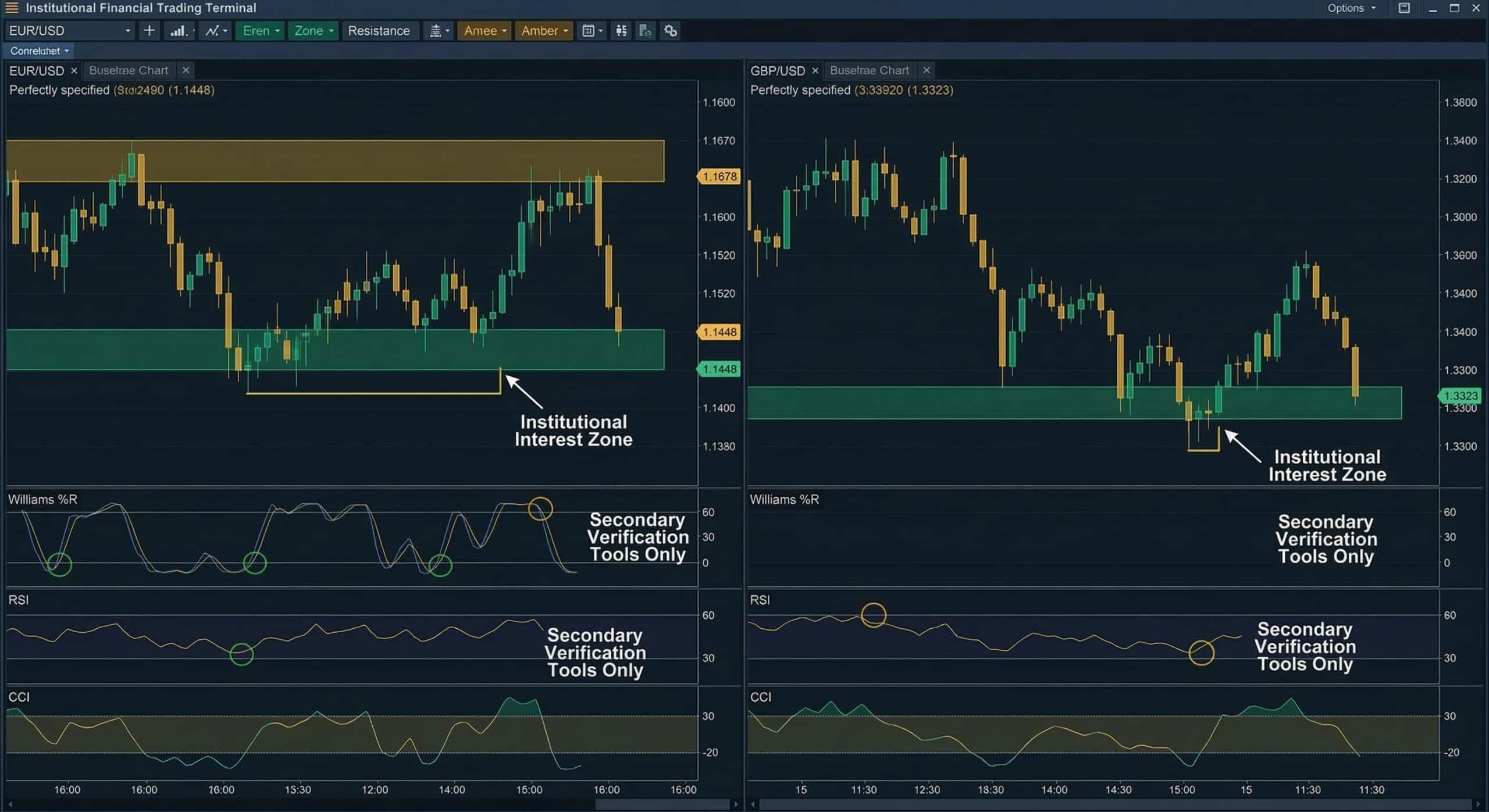
7) Institutional Liquidity Zones
The March 12 technical levels become more useful when treated as institutional liquidity zones rather than simple retail trigger lines.
EUR/USD Zone
Support: 1.1454
Resistance: 1.1678
This corridor matters because it captures where macro funds and hedgers are likely to reassess whether the dollar move is becoming overextended or simply normalizing after a fresh energy shock.
The negative CCI reading in the review supports the idea that bearish momentum remains intact unless a stronger macro catalyst changes the flow picture.
GBP/USD Zone
Support: 1.3323
Resistance: 1.3487
This is the cleaner expression of imported-energy sensitivity.
If sterling trades closer to the lower end of the range while oil remains supported, institutions may interpret the move as acceptance of an energy-driven macro repricing rather than noise.
The MACD signal in the review suggests the pair has not fully surrendered bullish structure, but that structure becomes harder to defend if energy costs remain elevated.
BTC/USD Zone
Support: 66,870
Resistance: 72,615
Bitcoin plays a different role in this framework.
It functions less as an energy asset and more as a stress test for broader risk appetite.
The review’s ROC signal warns that even when price rises, underlying momentum can still weaken.
AUD/USD Zone
Support: 0.7040
Resistance: 0.7220
AUD/USD remains the more resilient major-pair expression of commodity-linked support in the review.
But even here, strength is conditional. If the broader market shifts harder into defensive positioning, dollar liquidity can still overpower commodity support.
Bottom line: these levels matter because institutional hedging, profit-taking, and repricing often cluster around known liquidity corridors.
8) Advanced Market Signal: Why Brent–Dubai Matters
For more advanced readers, one useful cross-check is the Brent–Dubai relationship.
S&P Global says the Dubai benchmark is the primary physical pricing reference for crude loading from the Middle East Gulf toward Asian refiners, while CME lists the Brent–Dubai swap as a dedicated spread product. During the current crisis, Bloomberg reported that the Brent premium to Dubai widened to its largest level since 2022, a sign that geopolitical and freight dislocation were distorting the relationship between Atlantic-linked and Gulf-linked pricing.
That is not a retail detail.
It is a professional signal.
When that spread widens sharply, it can indicate that the market is pricing more than outright oil scarcity. It is also pricing route risk, benchmark distortion, and basis risk across different crude systems.
Bottom line: if Brent–Dubai widens sharply, the market is usually telling you that the disruption is no longer just local.
9) Why the First Move Feels Faster in 2026
Market structure now amplifies headline risk more quickly than it once did.
The IMF says AI-driven trading can improve market efficiency and deepen liquidity, but it can also increase volumes and volatility during periods of stress. Its Global Financial Stability Report adds that broader AI adoption could increase turnover, asset correlations, and the speed with which prices absorb new information.
In an energy shock, that matters.
Shipping headlines, policy rumors, inflation-sensitive data, and cross-asset flows can now be processed almost instantly by multiple systems at the same time. That helps explain why modern energy-driven moves can feel compressed into hours rather than sessions.
Bottom line: the first price move is often faster because the interpretation layer is now partially automated.
10) Execution and Infrastructure Under Stress
Volatile energy markets are not only a pricing story.
They are also an execution story.
When geopolitical headlines hit a thin or rapidly repricing market, spreads can widen, slippage risk can rise, and the quality of routing matters more than usual. IST Markets’ Execution Model says the firm uses direct access to deep liquidity sources with low-latency execution, while its Order Execution Policy explains how slippage, gapping, and fast markets can affect orders.
That is the practical bridge between macro analysis and trading infrastructure.
It is also why this topic should not be treated as a headline-only story. In volatile regimes, execution quality, pricing transparency, and capital efficiency become more important than usual. For clients focused on margin resilience under published rules, IST Markets’ Bonuses page is the most relevant internal reference.
Bottom line: in an energy shock, how you access the market can matter almost as much as the direction you expect.
11) Three Conditional Scenarios
Base Stabilization
If physical disruption stops deepening and policy measures restore confidence in shipping continuity, markets may move from acute fear to managed risk. Oil can remain elevated without accelerating, the dollar can keep part of its defensive bid, and imported-energy currencies may stabilize within existing liquidity corridors.
Persistent Risk Premium
If attacks on shipping continue, freight costs remain distorted, and bypass capacity proves insufficient, crude can hold a larger geopolitical premium than full-year fundamentals alone would justify. In that regime, sterling and the euro remain vulnerable, and gold may stay mixed rather than trending cleanly higher.
Renewed Physical Disruption
If shut-ins deepen or energy infrastructure damage broadens, the market may shift from “probability pricing” to a more explicit physical-supply shock. That would make inflation transmission, rate repricing, and execution quality even more central to asset allocation decisions.
FAQ
Why does the Strait of Hormuz matter so much for oil prices?
Because it handles around 20 million barrels per day of oil and products and a large share of LNG trade, while alternative routes can only bypass a fraction of that volume.
Why can gold weaken even when geopolitical tensions are rising?
Because the same energy shock that lifts safe-haven demand can also support the dollar and reduce expectations for near-term policy easing, which raises the opportunity cost of holding gold.
Why are GBP and EUR sensitive during an oil shock?
Because imported-energy economies can face a weaker growth outlook and higher inflation at the same time, which complicates rate expectations and currency valuation.
What do institutional liquidity zones actually tell traders?
They mark areas where hedging, stop activity, profit-taking, and macro reassessment are more likely to cluster — especially when a major cross-asset shock is still being priced.
Closing
Hormuz is not just an oil headline.
It is a pricing mechanism.
When freight costs, route risk, imported inflation, benchmark dislocation, and execution quality all start moving together, the market is no longer reacting to one asset. It is repricing a broader macro regime.
Navigating these dynamics requires institutional-grade infrastructure. IST Markets provides the liquidity aggregation and transparency required for professional asset allocation.
